Omokgyo Dermatology Clinic (Department: Dermatology),
If numerous blemishes make your skin tone look dull?
Omokgyo Dermatology Clinic (Department: Dermatology)
Hello.
This is U&I Clinic Mokdong Branch.
"My blemishes kept increasing,
and now my entire face looks dull."
"Could laser toning
make this pigmentation lighter as well?"
Even when pigmentation is small, if it is spread across several areas of the face, the skin tone itself can appear uneven.
In particular, if pigmentation is concentrated in areas that receive a lot of sunlight, such as the cheekbones, cheeks, and around the nose, it can remain bothersome even when covered with makeup.
Laser toning is one of the methods many people look into in situations like this.
However, it is important not to assume that simply applying a laser indiscriminately is the answer.
Even pigmentation that looks similar on the surface and appears brown may differ in location, depth, and skin condition.
So today, I will explain in detail how laser toning is performed, what can be observed in actual clinical photographs,
and what should be considered before and after treatment. ^^
Table of Contents
-
Is laser toning a treatment that strongly removes pigmentation?
-
What should be examined in actual clinical photographs?
Omokgyo Dermatology Clinic (Department: Dermatology)
- Is laser toning a treatment that strongly
removes pigmentation?
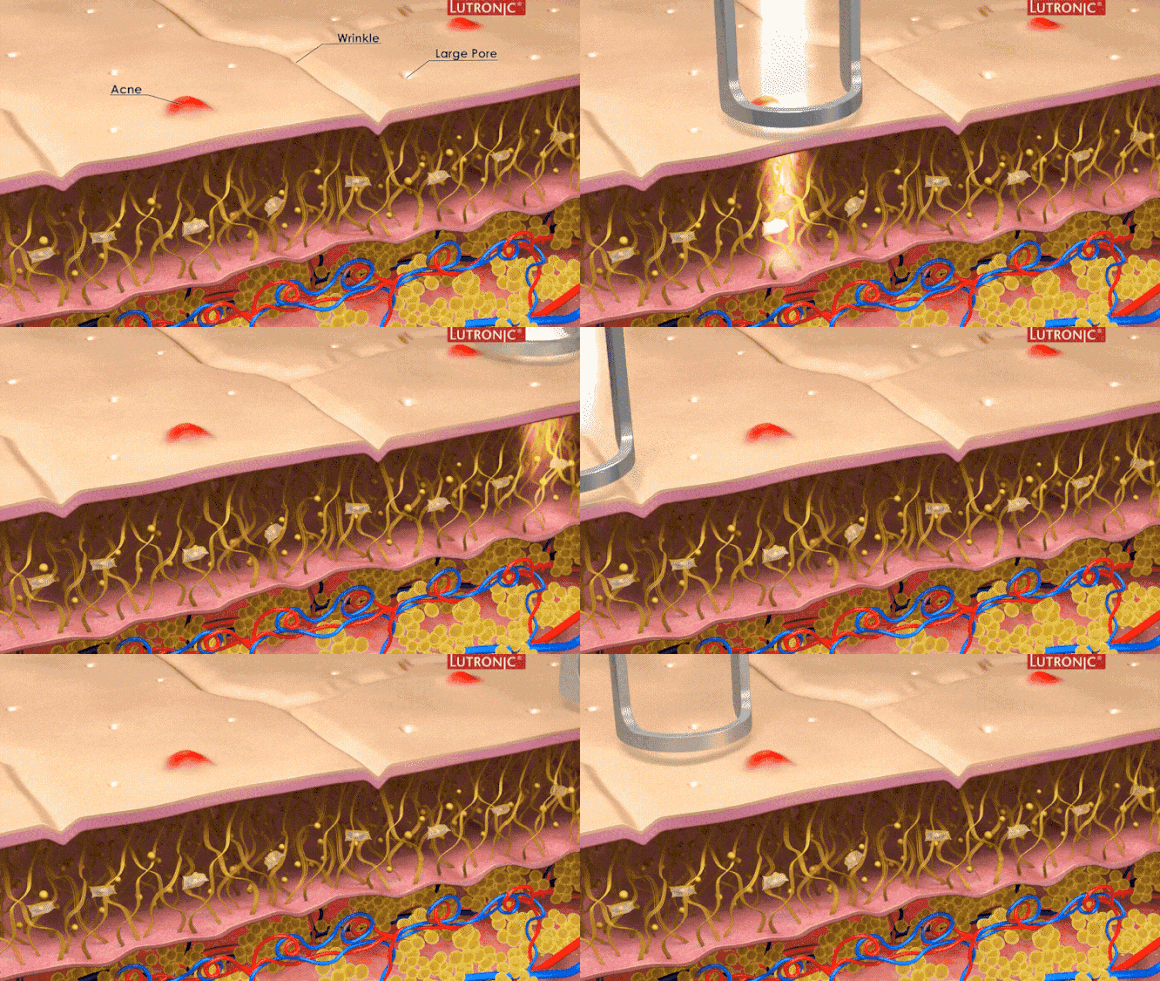
The basic purpose of laser toning is to deliver energy to melanin pigment in the skin and promote improvement in pigmentation.
However, what is important is not how strongly the laser is applied, but which type of pigmentation receives the energy and how it is delivered.
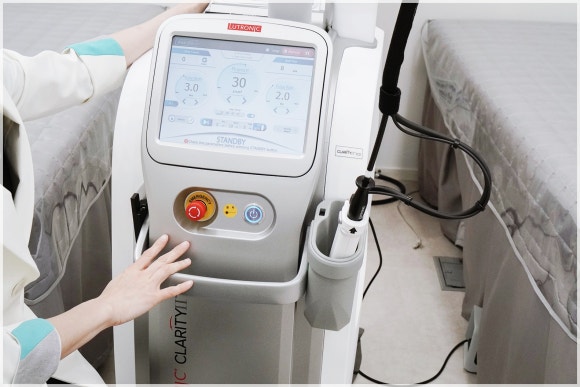
In this post, I will explain the treatment based on the Clarity II device.
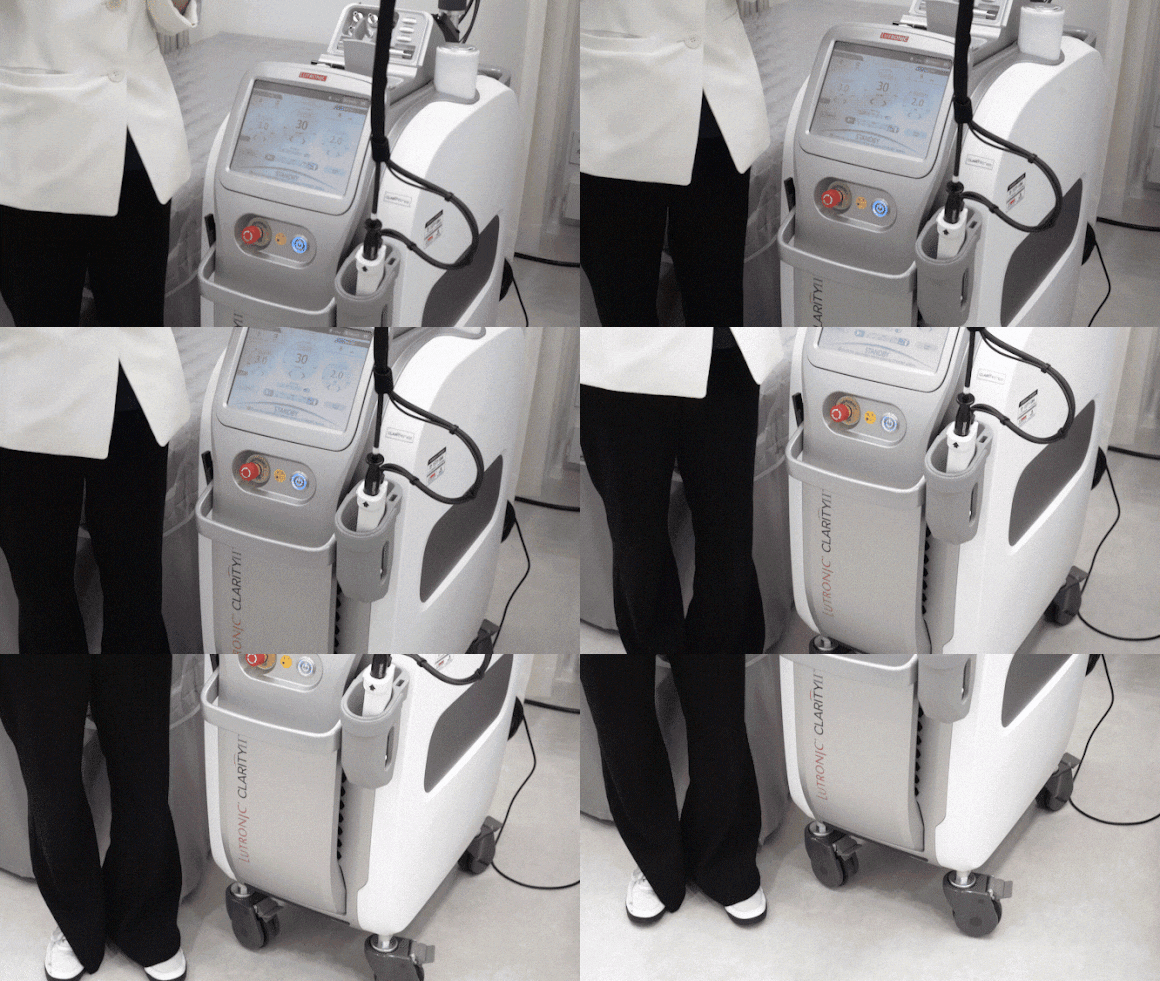
Clarity II is a device that uses two wavelengths: 755 nm and 1064 nm.
The two wavelengths can be used selectively after examining the characteristics and depth of the pigmentation in the skin, as well as whether redness is present.
-
The 755 nm wavelength can utilize its response to melanin,
-
The 1064 nm wavelength can deliver energy to relatively deeper areas, allowing the approach to be adjusted according to the skin condition.
The device is also equipped with a sensor that monitors skin temperature in real time, allowing the skin’s response to be observed during the procedure.
That said, using both wavelengths does not necessarily mean that the result will always be better.
For example, even if brown pigmentation is clearly visible, the intensity and treatment method must be adjusted depending on whether the skin is sensitive or redness is also present.
In particular, rather than excessively increasing the energy in an attempt to remove multiple blemishes all at once, it is important to treat them at intervals while observing the skin’s response.
Omokgyo Dermatology Clinic (Department: Dermatology)
- What should be examined in
actual clinical photographs?
Let us now take a look at the clinical photographs together.
The photographs show the skin condition from the front and side, as well as through different imaging modes.
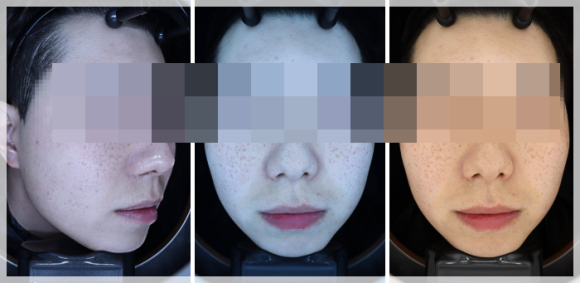
Before treatment
Looking at the photographs taken before treatment, small brown areas of pigmentation can be seen widely distributed, mainly across both cheeks and around the nose.
Several areas of pigmentation are concentrated from the cheekbones toward the center of the cheeks and around the bridge of the nose.
Rather than one large lesion, you can think of this as a pattern in which small areas of pigmentation make the overall facial skin tone look uneven.
In such cases, it is important to examine the distribution of pigmentation across the entire face instead of focusing only on a few conspicuous blemishes.
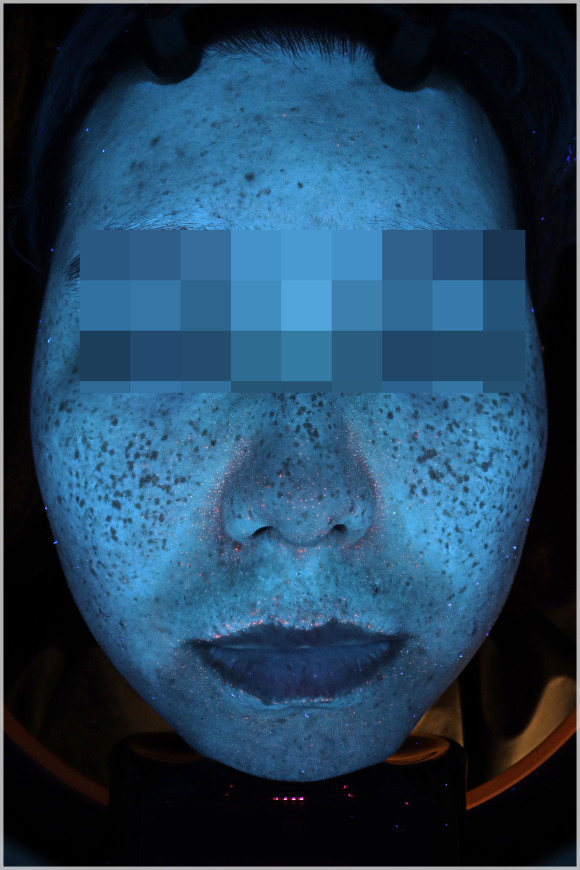
Before treatment, UV imaging
Pigmentation that is relatively less noticeable under ordinary light can be observed more extensively in this image.
Rather than examining only the pigmentation visible on the surface, this can help provide a reference for the extent to which pigmentation is currently distributed in the skin.
Now, let us look at the photographs taken after treatment. ^^
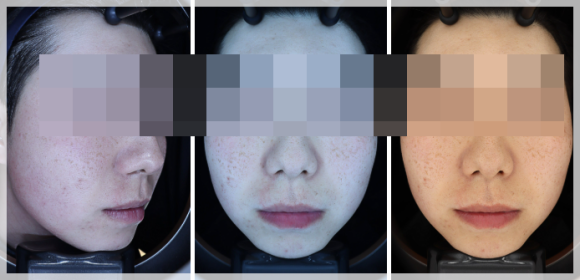
After treatment
In the photographs taken afterward, some of the brown pigmentation appears lighter than before when the same areas are compared,
and the overall contrast between areas of pigmentation also appears somewhat reduced.
However, the photographs do not show that all pigmentation has disappeared. Although the contrast of some pigmentation around the cheeks and nose appears reduced compared with before treatment, some pigmentation remains visible.
In particular, even if the pigmentation appears lighter under ordinary light, several areas of pigmentation can still be observed in the UV images.
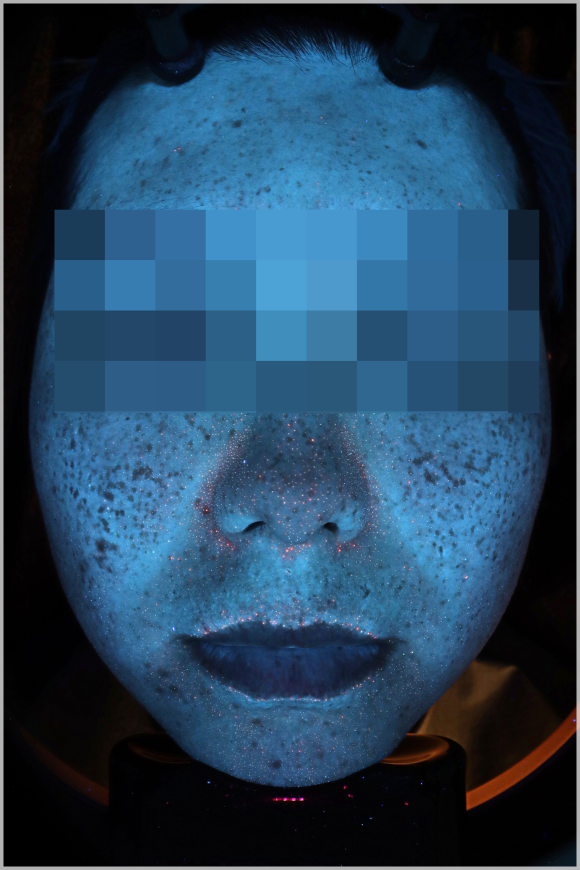
This is precisely what is important in pigmentation treatment.
A slight improvement visible to the naked eye does not necessarily mean that all pigmentation within the skin has been cleared.
Conversely, it is also difficult to conclude that treatment was completely ineffective simply because pigmentation appears dark in a single photograph.
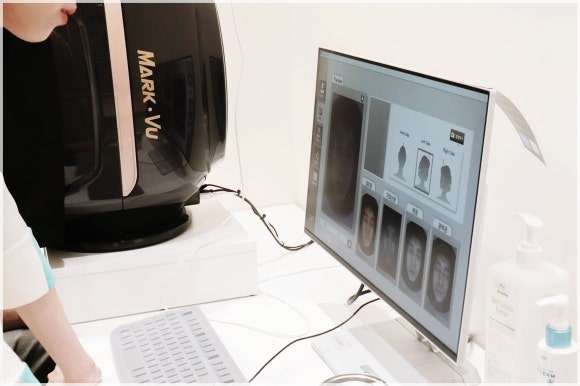
The appearance and contrast of pigmentation can vary depending on the lighting and imaging mode, so whenever possible, it is best to compare progress under similar photographic conditions.
Therefore, rather than approaching laser toning as though treatment is finished after a certain number of sessions, it is important to adjust the treatment plan while checking the skin condition periodically.
Today, I discussed the principles of laser toning, the features of Clarity II, and what can be observed in actual clinical photographs.
The before-and-after photographs showed a wide distribution of brown pigmentation in various sizes, mainly around the cheeks and nose before treatment,
as well as a reduction in the contrast of some areas of pigmentation in the later photographs. What did you think?
In pigmentation treatment, it is more important to gradually create a clearer, more even skin tone while minimizing the burden on the skin than to remove blemishes all at once.
Therefore, first carefully check what form the pigmentation on your face currently takes,
and make sure to see whether the treatment plan is adjusted by comparing photographs or the skin condition during treatment. With that, I will conclude today’s post. ^^
This was Kim Jin-hyun, Medical Director of U&I Clinic Mokdong Branch.
Thank you.
< Recommended Related Reading >
<U&I Clinic Mokdong Branch Hours>
Weekdays:
am 10:00 ~ pm 08:30 [Evening appointments]
Weekends (Saturday/Sunday) · Public holidays:
am 10:00 ~ pm 04:00
*No lunch break
*Open on Saturdays, Sundays, and public holidays
< Directions >