Hello,
I am Seo Ho-yeon, the chief dentist at Yonsei Dagam Dental Clinic, located in Garak-dong, Songpa-gu.
Do you happen to have wisdom teeth?
The third molars, commonly called wisdom teeth, are the third large molars.
Usually, there are four of them, one in each of the upper left, upper right, lower left, and lower right positions.
Depending on the person, there may be none at all, or there may be more than four.
Including wisdom teeth, the normal number of teeth is 32.
If there are more teeth than that, they are called supernumerary teeth.
Today, I’d like to introduce an interesting case that we often encounter in clinical practice.
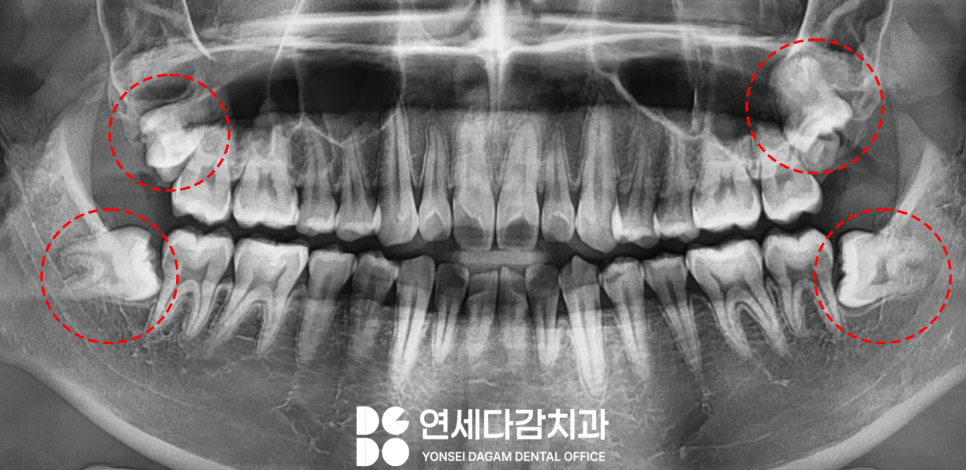
In this case, wisdom teeth were present in both the upper and lower jaws.
Near the wisdom tooth in the upper jaw, something that appeared to be overlapping was noticeable.
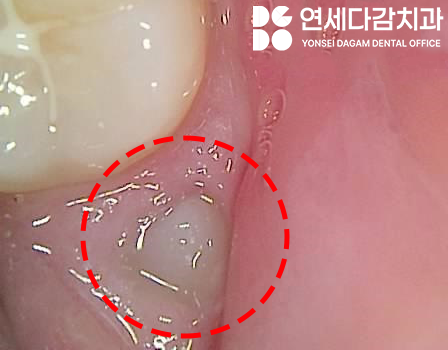
When we actually examined the oral cavity,
we could confirm that on both sides, the teeth had partially erupted through the gums.
At the Garak-dong dental clinic, we suspected that the overlapping structure might be a supernumerary tooth.
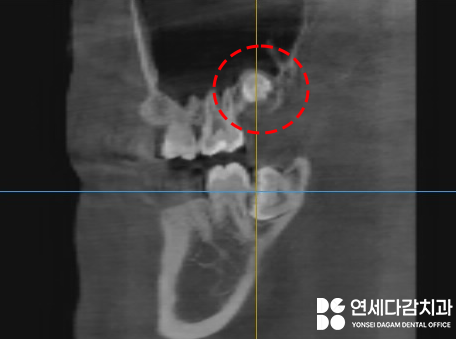
So we analyzed the three-dimensional structure through CT imaging.
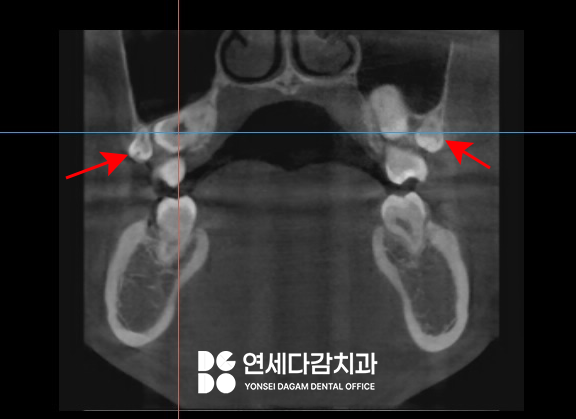
As a result of the CT analysis,
what had erupted outside the gums was a supernumerary tooth near the third molar, meaning one extra tooth beyond the normal number,
and it was a peg-shaped tooth smaller than the normal size.
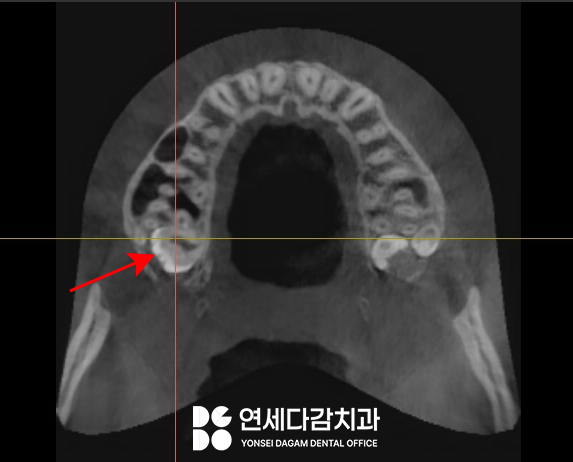
The actual third molars of normal size were impacted deeper below the supernumerary teeth on both sides.
As such, the area around the third molars is one where abnormal teeth can occur,
and in these cases, a variety of clinical symptoms may appear.
They may be hidden inside the jawbone,
or, as in this Garak-dong dental clinic case, they may erupt through the gums near the third molar.
If a supernumerary tooth interferes with the eruption path of a wisdom tooth,
there is a high possibility that the tooth will not erupt properly and become impacted.
If it is impacted within the jawbone,
there may also be a risk of an odontogenic cyst developing,
and it may also have a negative effect by resorbing the roots of adjacent teeth.
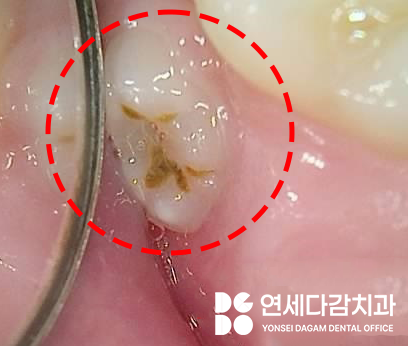
Especially in cases like this, where it is located all the way at the back,
if decay has developed,
food debris can easily get stuck, and hygiene management may be difficult.
Therefore, there is a concern that the surrounding tissues may swell and pain may occur, so treatment is recommended in such cases.
We planned to remove the supernumerary teeth and also extract the impacted third molars.
After giving a thorough explanation, we decided to extract all six teeth in the upper and lower jaws combined.
The area that required special caution was the upper jaw.
An upper wisdom tooth is anatomically located close to a structure like an air-filled sac called the maxillary sinus.
The maxillary sinus is surrounded by a thin membrane,
and if it overlaps with the third molar, there is a possibility that it may be perforated during extraction.
If such a problem occurs, inflammation may develop there,
or complications such as air leakage may arise,
so careful attention is needed.
Therefore, we carefully analyzed the CT taken in advance
and proceeded only after accurately identifying the relationship with the surrounding structures.
We first approached and removed the partially erupted tooth,
then used the exposed space to access the deeply impacted third molar.
In the case of a very deeply impacted upper wisdom tooth, it is very difficult to avoid perforation during extraction, and in this case, a small perforation occurred.
However, if treated appropriately, it is not a problem.
We immediately inserted a collagen-based hemostatic agent into the perforation site to close the maxillary sinus.
As a result of appropriate treatment,
the typical symptoms that can appear with a perforation,
such as a feeling of air leaking through the nose, runny nose, or nosebleeds,
did not occur.
As a result, fortunately, healing proceeded stably.
During follow-up observation, after confirming that recovery had gone well without any special complications,
we concluded the treatment.
This case was not just a simple wisdom tooth extraction case;
it also provided information about abnormal teeth.
Abnormal teeth refer to teeth that form differently from the normal shape or number due to genetic factors,
abnormalities in the developmental process,
or environmental factors.
In general, the three main differences from normal are number, size, and shape.
There are many types,
but among them, we looked at supernumerary teeth and peg-shaped teeth.
Supernumerary teeth refer to teeth that appear in addition to the normal number,
and peg-shaped teeth refer to teeth that are smaller than the normal size.
These two can occur in various forms and locations.
If there is no special problem, treatment is not necessarily required,
but if, from an anatomical standpoint, it is judged that they may cause problems,
it is better to receive appropriate treatment.
Because each person shows different variations, an accurate diagnosis and treatment plan with a specialist are important.
Was today’s content helpful as well?
This was Seo Ho-yeon, chief dentist at Yonsei Dagam Dental Clinic in Garak-dong,
doing my best for your healthy smile.
Thank you.
2024.12.05~2024.12.19