Hello.
This is Yonsei Dagam Dental Clinic near Munjeong-dong.
Do you know that there is a problem in your oral cavity overall,
but have been putting it off for various reasons?
The longer a problem is left untreated,
the greater the extent of the damage becomes,
and pain, cost, and time may increase as well.
For example, if there is a periapical lesion,
as it progresses, the inflammation
may destroy the surrounding bone.
In particular, if a missing tooth is left untreated,
the jawbone is resorbed,
after which its height decreases or its thickness
becomes thinner.
If this happens, when you later try to place an implant
to restore the missing area,
a more complicated process may be required.
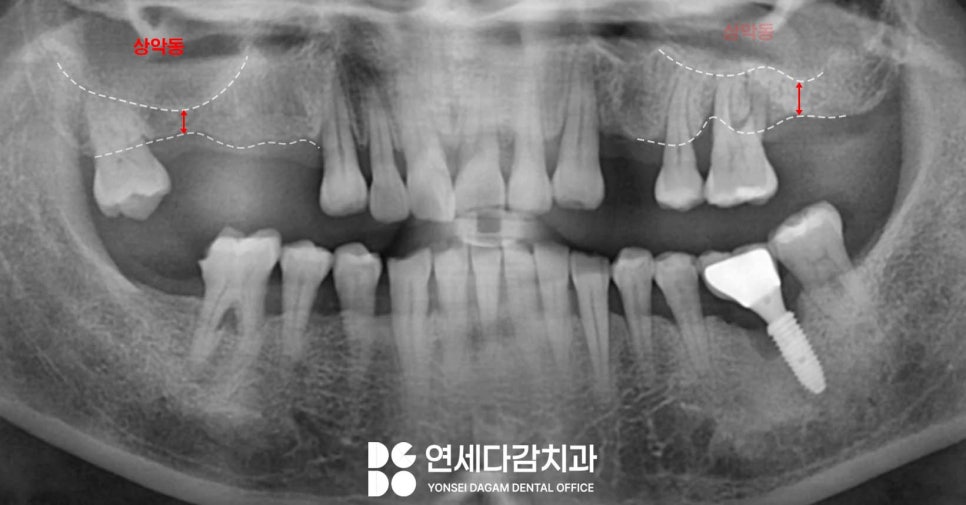
Looking at the case shown at the Munjeong-dong Dental Clinic,
you can see that a missing tooth exists in the molar area.
In the upper molar area,
there is a structure called the maxillary sinus,
so as mentioned earlier,
surgery must be performed with caution
regarding such anatomical structures.
Unlike simple placement,
this can become a more complicated process
by using a method that lifts the sinus.
The maxillary sinus is one of the four major
paranasal sinuses in the skull,
and refers to an air-filled cavity lined with mucosa
located beside the nose in the skull.
It filters and humidifies the air entering through the nose
and delivers it to the lungs.
Because it is close to the roots of the upper molars,
and is made of a thin membrane,
as the height of the alveolar bone decreases,
it can be easily damaged during the procedure.
In particular, if chronic inflammation continues or
the maxillary sinus expands with aging,
causing pneumatization that resorbs the alveolar bone,
a more cautious approach becomes necessary.
Therefore, at the Munjeong-dong Dental Clinic,
a process is performed in which the membrane is lifted upward
to expand the space,
and then bone graft material is placed into the formed space
to create an environment where placement can be performed safely.
Because the approach differs depending on the bone height,
those who are curious may find it helpful to refer to
a previous post I explained earlier.
First, through a CT scan that allows a three-dimensional understanding of the structure,
a surgical plan is established by analyzing the shape and proximity of the anatomical structures,
as well as the height and width of the remaining bone.
After extracting teeth that were severely loose or in poor condition,
we carefully approached as planned
and performed the process of lifting the sinus membrane.
At this time, the Munjeong-dong Dental Clinic proceeded while being careful to avoid perforation.
The implant placement was completed by filling the elevated space
with bone graft material.
After that, a sufficient healing period is needed.
To promote stable osseointegration,
you must manage and observe the area over a sufficient period of time.
Through regular radiographic examinations,
the osseointegration process is monitored,
and it is confirmed that proper stability has been achieved.
After confirming that osseointegration had been properly established,
the remaining procedures were carried out,
allowing the treatment to be completed stably.
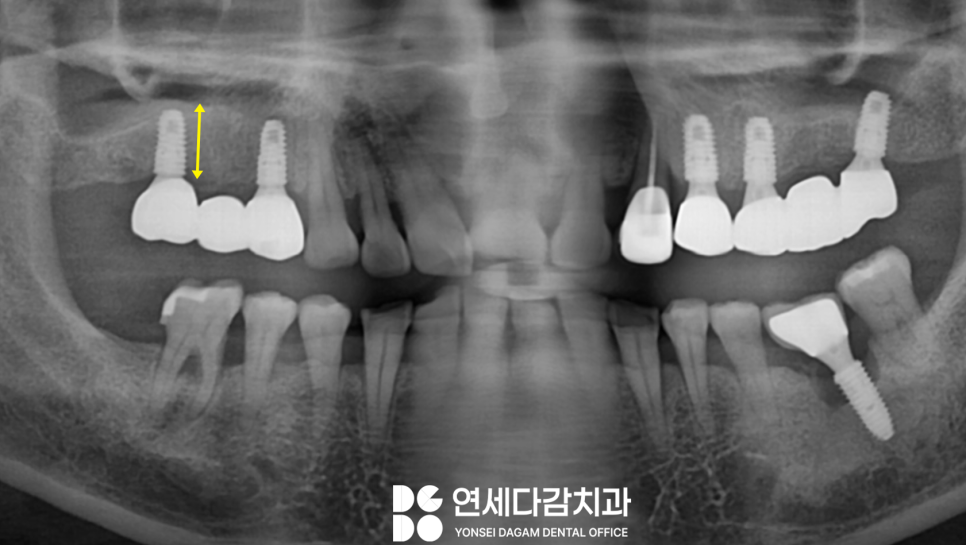
As a result, looking at the area marked at the Munjeong-dong Dental Clinic,
the vertical bone volume, which had been less than 4 mm,
increased to about 8 mm,
providing a stable amount of bone.
This made it possible to provide sufficient bone support
for the long-term stability of the implant.
Another point to note is that
fixed bodies (fixtures) were not placed in every area.
Applying them to every site can be quite a burden
for the patient in many ways.
Therefore, even though multiple teeth were missing,
we placed the minimum necessary number
so that all areas could be restored.
Although three teeth were missing,
it was planned and carried out as if only two were placed,
with a stable prosthetic structure in mind.
This approach can reduce the financial burden
while still providing adequate chewing function.
After that, we gradually treated the other teeth with problems
through prosthetic treatments such as root canal treatment or inlays,
resolving the overall oral issues.
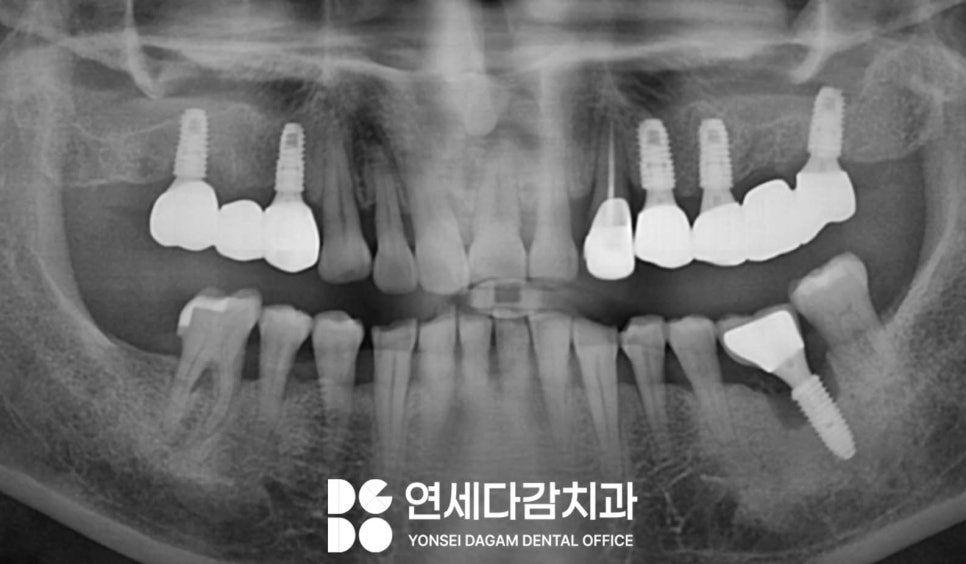
To this day, the treated areas at the Munjeong-dong Dental Clinic
are being maintained well without inflammation,
and the area that had peri-implantitis around the lower left implant
is being managed with periodic gum treatment.
When multiple problems exist together in this way,
you must set priorities and proceed step by step,
saving teeth that can be preserved whenever possible.
Even if your oral health has generally worsened,
it can be sufficiently restored through systematic diagnosis and planning,
so if you have been putting it off, please first receive an accurate examination.
This has been Yonsei Dagam Dental Clinic in Munjeong-dong.
Thank you.
2024.5.18 – 2025.5.10