Hello.
This is Yonsei Dagam Dental Clinic near Gaerong Station.
Are you worried because your wisdom teeth are not erupting normally?
The reason wisdom teeth rarely erupt normally is that, while the size of the modern human jaw has become smaller,
the size of the teeth has remained the same, so there is not enough space.
As the need for strong chewing force gradually decreased,
the jawbone gradually became smaller,
but the number and size of the teeth did not change, so it became common for late-erupting wisdom teeth to become impacted.
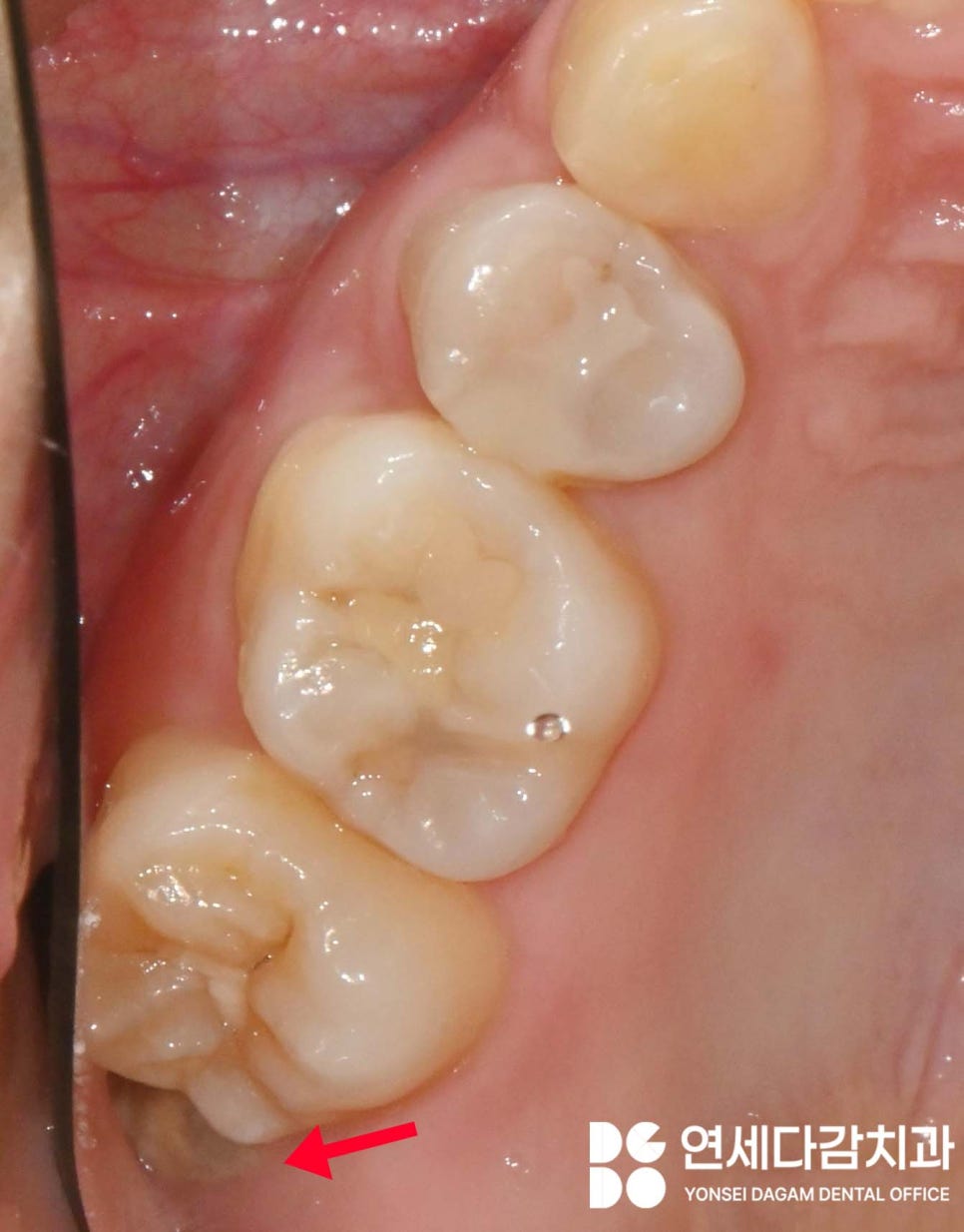
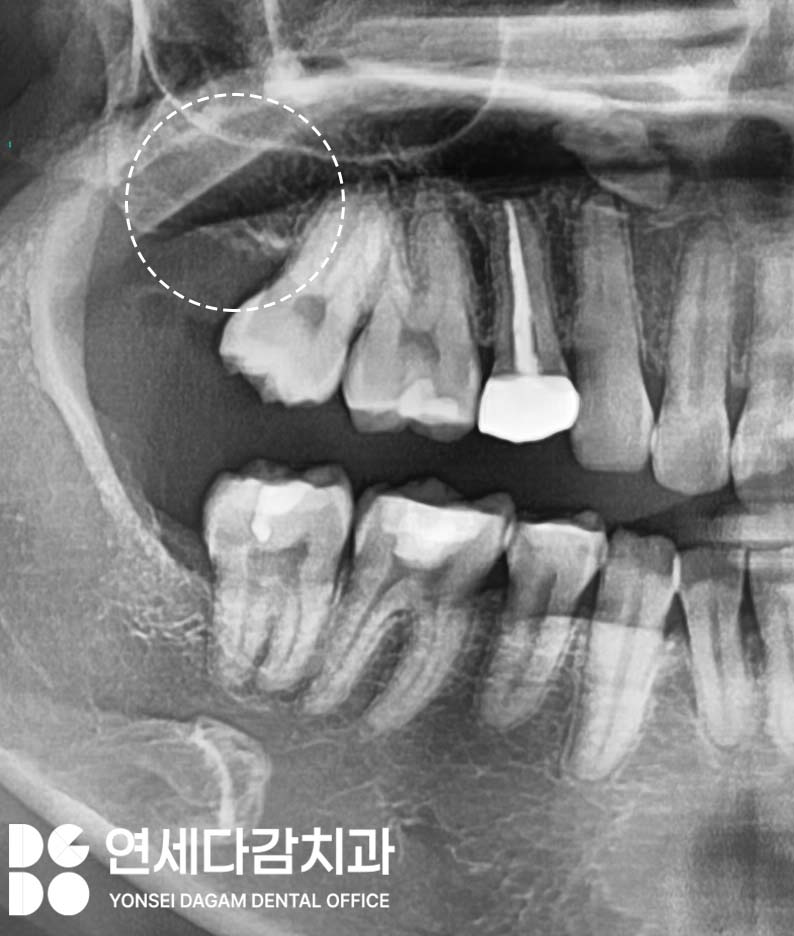
Especially among impacted upper wisdom teeth,
when they are tilted toward the adjacent tooth (mesially),
as shown in the photo from the Gaerong Station dental clinic,
a structure is created where food easily gets trapped, causing a lot of discomfort.
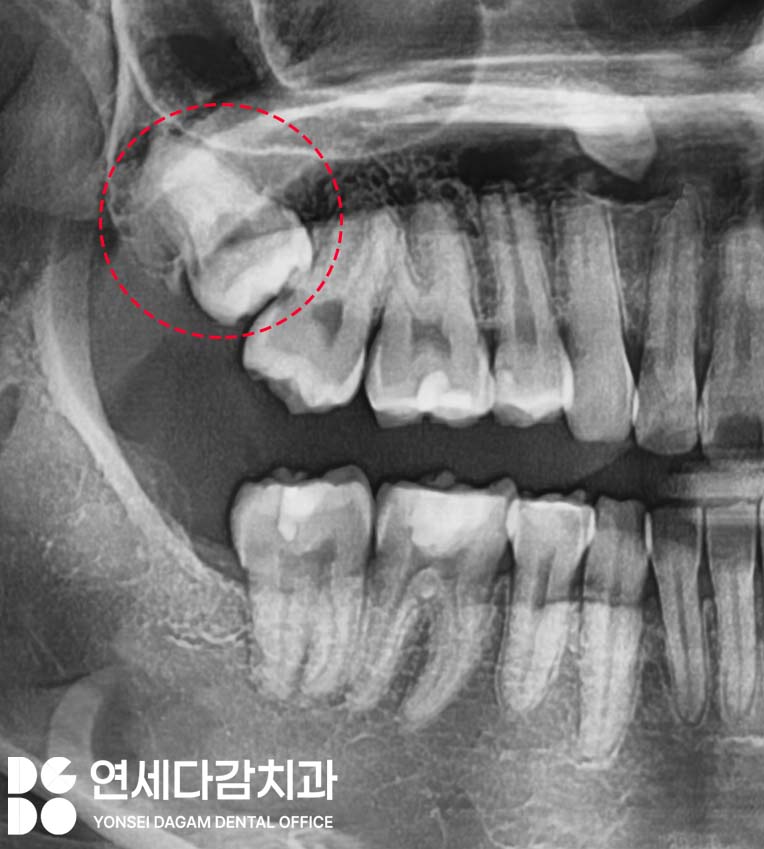
The crown part is pushing the front molar,
and it is difficult to remove all at once,
and if you try to extract it all at once by force,
damage to the adjacent tooth or excessive bone removal may be necessary.
Therefore, it is safer to separate it into pieces and remove it.
Unlike the lower jaw, the upper jaw has poor visibility,
so it is technically more difficult
and requires sufficient experience and skill.
There is a reason why we said visibility is poor at the Gaerong Station dental clinic.
First, because it is located in the upper jaw, the head must be tilted back sufficiently,
but from the patient’s perspective, it is not easy to keep the head tilted back and cooperate during treatment.
In addition, when the mouth is opened wide,
it can actually become narrower due to the coronoid process of the mandible,
making it even harder to see.
Because of these anatomical characteristics,
direct visibility of the upper wisdom tooth area is limited,
and in many cases, treatment relies on experience and tactile sense.
Above all, the root area of the upper molars is close to the floor of the maxillary sinus,
so if care is not taken, perforation can easily occur.
At the Gaerong Station dental clinic, in cases like this,
we aim for more delicate work.
Therefore, it is important to take a CT scan as a standard and analyze the three-dimensional structure.
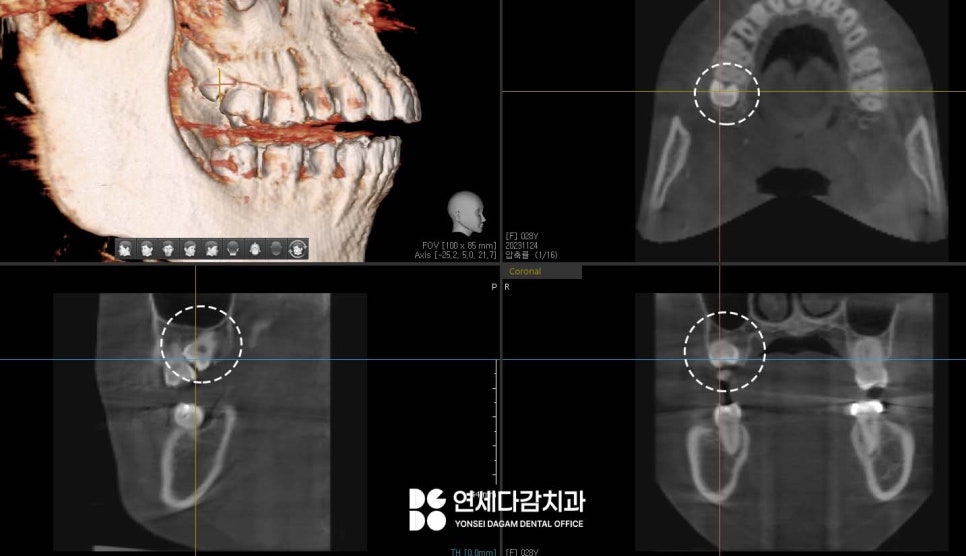
Before removing it, it is important to collect this kind of preliminary information,
understand the surrounding structures, and establish an extraction plan.
Through the CT images, we can determine the exact positional relationship between the wisdom tooth and the maxillary sinus,
as well as the relationship with the surrounding tissues, making this an essential examination for safe extraction.
After analyzing the CT,
the gum around the treatment area is incised and the bone is cleaned up.
Because wisdom teeth tilted mesially are difficult to remove as one piece,
they are separated into fragments.
After the tooth is removed, we check whether any fragments remain and then finish the procedure.
If a perforation occurs during the extraction process,
it can be managed by using a collagen membrane
to perform appropriate closure and suturing.
Small perforations may heal on their own,
but if a large perforation or a persistent
oral-sinus fistula occurs,
additional surgical treatment may be necessary.
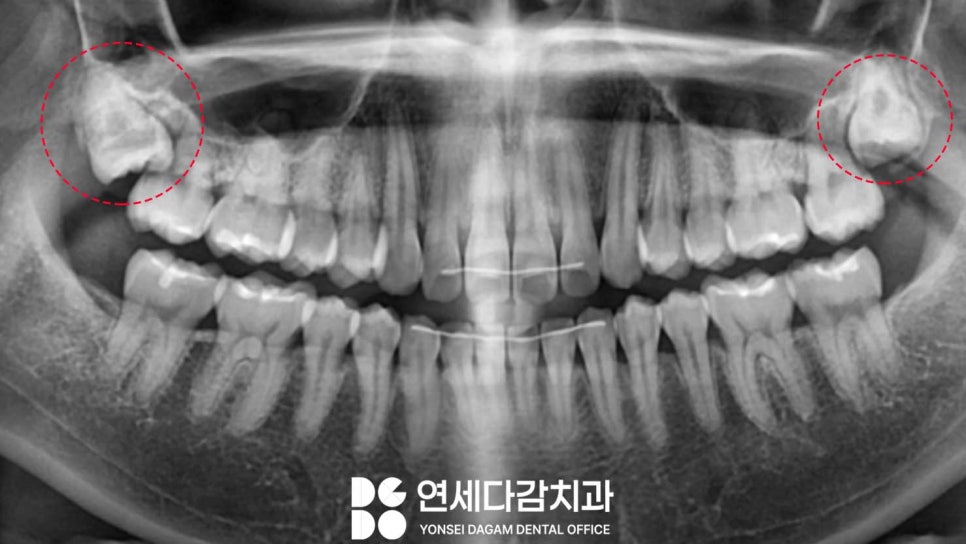
Looking at another case,
there are areas that are severely tilted mesially (on the left in the photo) and areas that are not.
The area tilted mesially is treated at the Gaerong Station dental clinic
according to the process mentioned above.
An upper impacted wisdom tooth with a mild tilt may involve a simpler process than the lower jaw.
The maxilla has lower bone density than the mandible
and a higher proportion of cancellous bone,
so extraction is relatively easier.
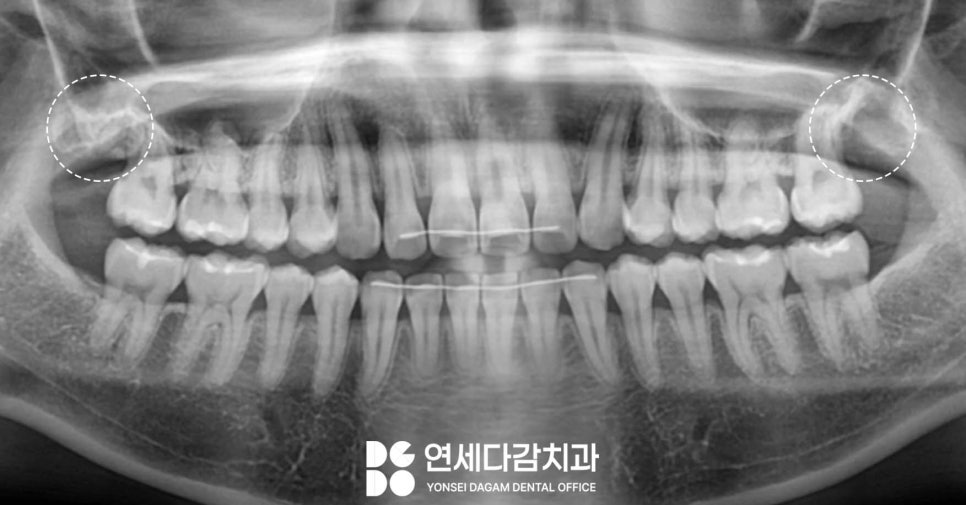
After the extracted area has gone through an appropriate healing period,
it becomes stabilized and attains normal bone density.
For this, proper care is essential,
and I will explain the things that need to be observed at the Gaerong Station dental clinic.
After a deep wisdom tooth extraction,
you should follow the precautions below.
✔ For hemostasis,
it is important to apply pressure to the gauze for about 2 hours.
✔ Do not blow your nose forcefully.
This is because pressure can be applied to the maxillary sinus when blowing your nose.
Therefore, when coughing or sneezing, it is better to keep your mouth open so that the pressure does not go through the nose.
In addition, you should avoid actions that increase intraoral pressure, such as using a straw,
gargling strongly, or playing wind instruments.
✔ It is better to avoid swimming, saunas, and strenuous exercise for more than a week.
✔ If you experience abnormal symptoms such as water going up into the nose,
a feeling of air leaking through the nose,
nosebleeds, facial pain, fever, or pus,
you should get examined immediately.
As such, impacted wisdom tooth extraction is a process that requires a cautious approach because of its relationship with special anatomical structures,
so I hope you can receive it safely through an accurate examination.
This was Yonsei Dagam Dental Clinic near Gaerong Station.
Thank you.
Treatment period: 2023.11.27 / 2023.07.14 ~ 2023.12.09