Hello.
Ogeum Station Yonsei Dagam Dental Clinic.
When performing implant treatment,
there are some areas that are relatively easier,
while others are more challenging.
Through today’s post,
let’s take a look at one of those
challenging areas.
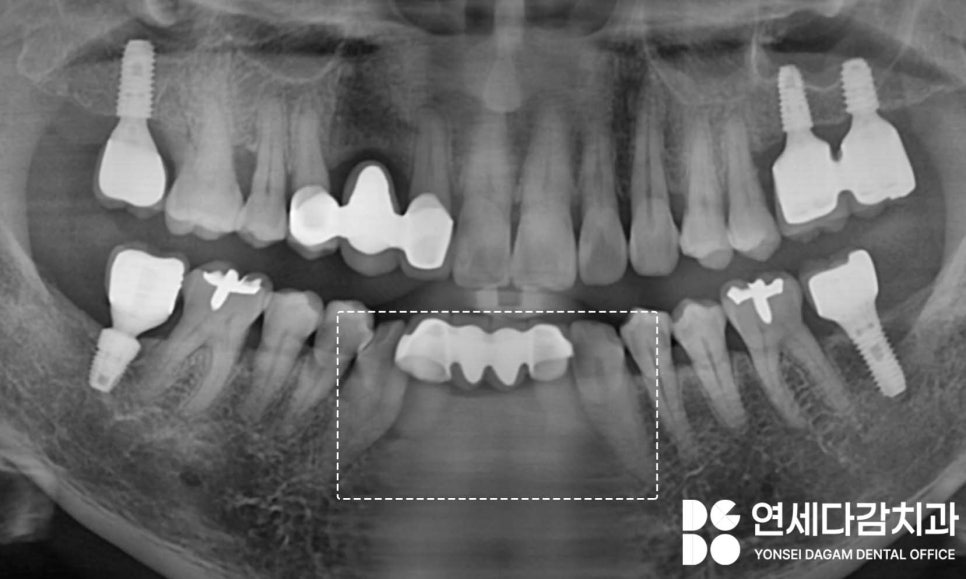
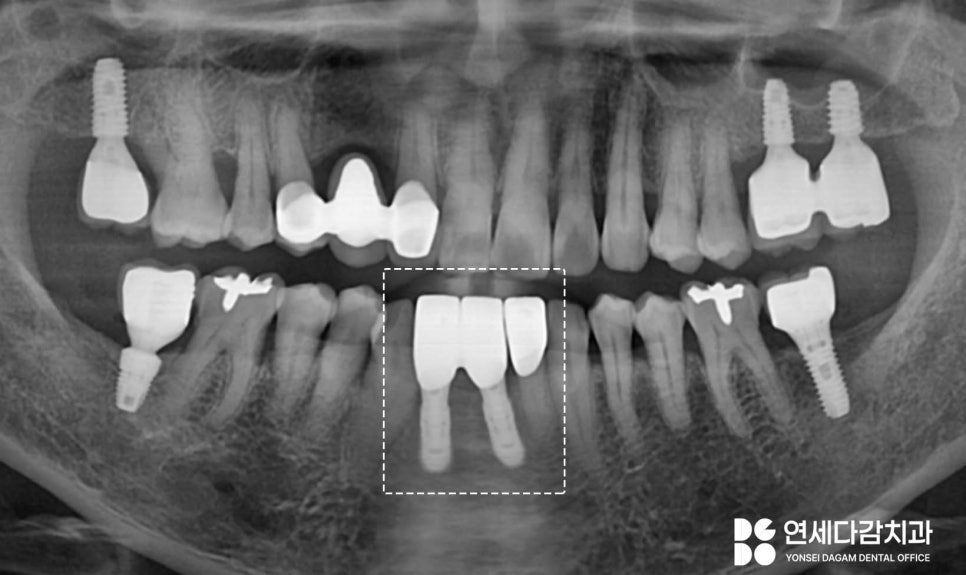
Looking at the X-ray image above,
on the lower front teeth,
it can be seen that a bridge-type
prosthesis is being worn.
The bone around the tooth roots
serving as abutments has been damaged.
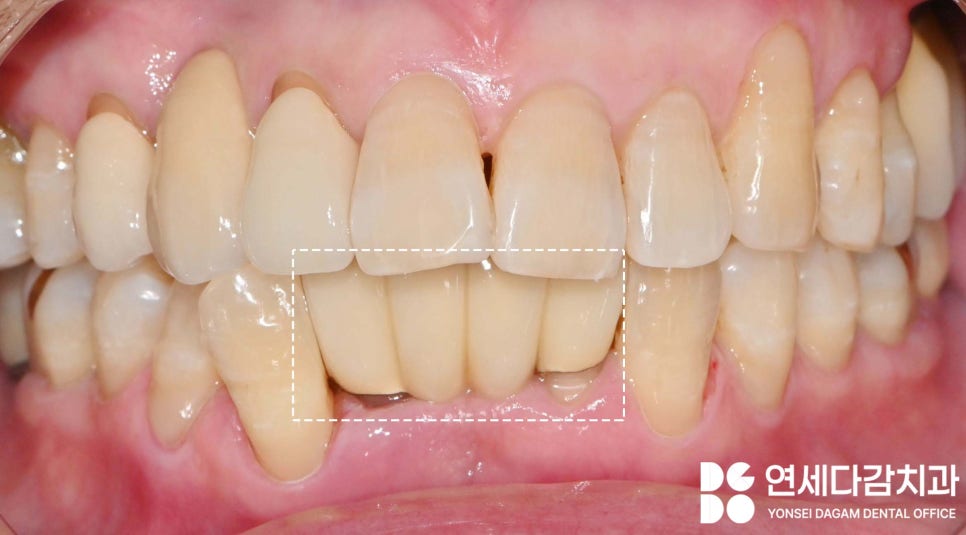
In the actual oral condition observed
at the dental clinic near Ogeum Station,
pus was also coming out from the gums,
and the inflammation had progressed severely,
causing continuous bone loss
and resulting in gingival recession.
A bridge is a method in which healthy teeth
on both sides of the missing area are prepared
and used as abutments,
then a connected prosthesis is
placed over both teeth to restore
the missing area with artificial teeth.
It has the advantage of being able to
restore the missing area quickly
without surgery,
but it also has drawbacks, such as
having to grind down healthy teeth and
the abutments being subjected to excessive load,
which can easily damage them.
In addition,
because of the connected structure,
cleaning is difficult,
so periodontitis can easily occur.
Food tends to get trapped underneath
the connected prosthesis,
and since it is difficult to clean thoroughly
with ordinary brushing alone,
periodontitis often develops.
Because it is a connected structure,
it is not possible to accurately judge
the condition of each individual tooth,
so at Ogeum Station Dental Clinic,
the prosthesis will be removed
and reevaluated.
Even if there does not appear to be
a major problem on the surface,
there is a possibility that severe damage
has actually progressed internally.
Upon inspection, one tooth was
severely loose,
and the other was in relatively good condition.
Therefore, the tooth in good condition
was planned to be covered again
with a single crown.
The loose tooth was in a condition
where preservation was impossible,
so extraction followed by an implant
was the better decision.
Together with the missing area next to it,
a plan was made for a total of two
implant placements.
Preoperative CT Scan
With CT imaging, a process is performed
to closely analyze the structure in 3D.
This area is originally one with thin bone,
and due to bone loss from inflammation,
an even more difficult environment
had been created.
The area being examined at the dental clinic
near Ogeum Station is the lower front tooth area,
which is the challenging implant site
mentioned earlier in the introduction.
Because the bone is thin and the area is
aesthetically important,
if the implant is not placed properly,
it is often difficult to achieve a satisfactory
aesthetic result.
In such a visible area,
the key is to create a natural appearance
along with functional restoration.
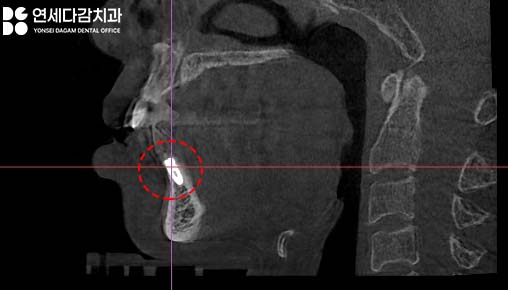
Based on the bone volume and bone quality
assessed through CT imaging,
the surgery is completed while considering
the planned placement position,
angle, and depth.
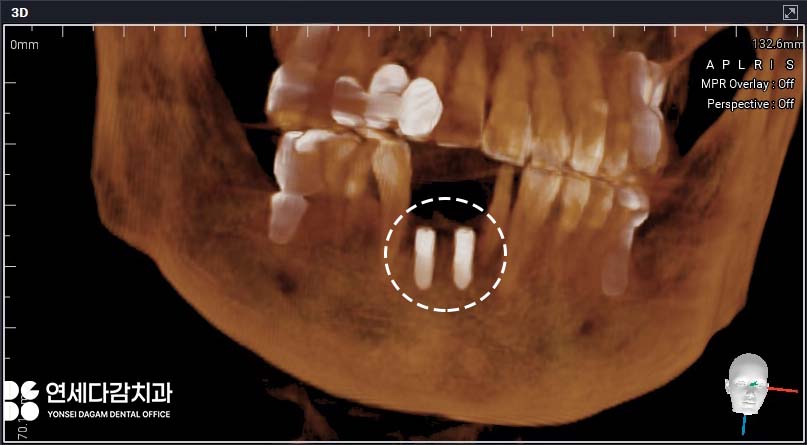
After confirming that the initial fixation
was also stable,
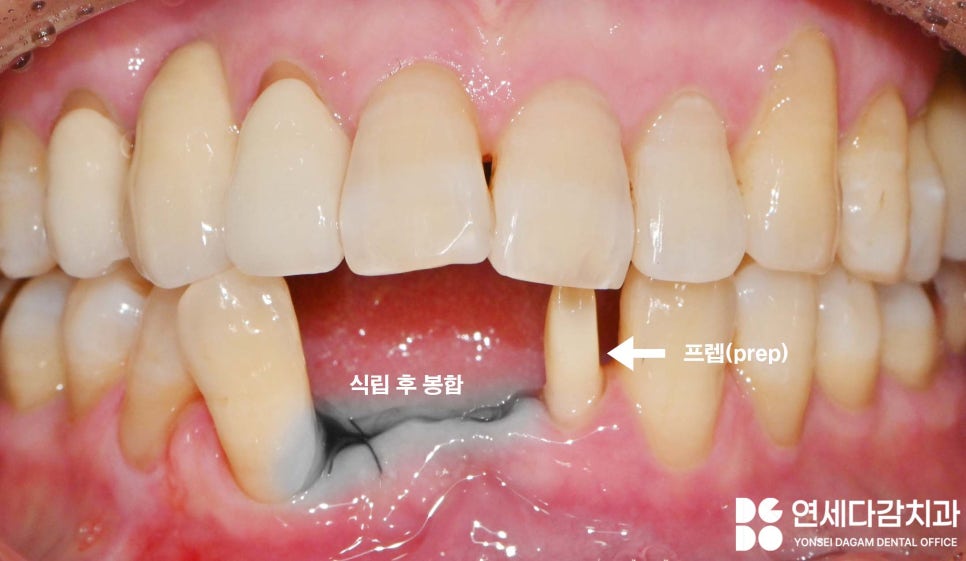
the tooth in the area that was in good condition
was also prepared in order to place a crown.
At Ogeum Station Dental Clinic,
this process is called prep,
and it is the work of shaping the tooth
so that the prosthesis can be stably seated.
A 3-month healing period was taken
for osseointegration.
During this period, the placed fixture
and the bone firmly bond together,
achieving stability similar to that of a natural tooth.
Once osseointegration is confirmed
and fixation is secured,
the process moves on to prosthesis fabrication,
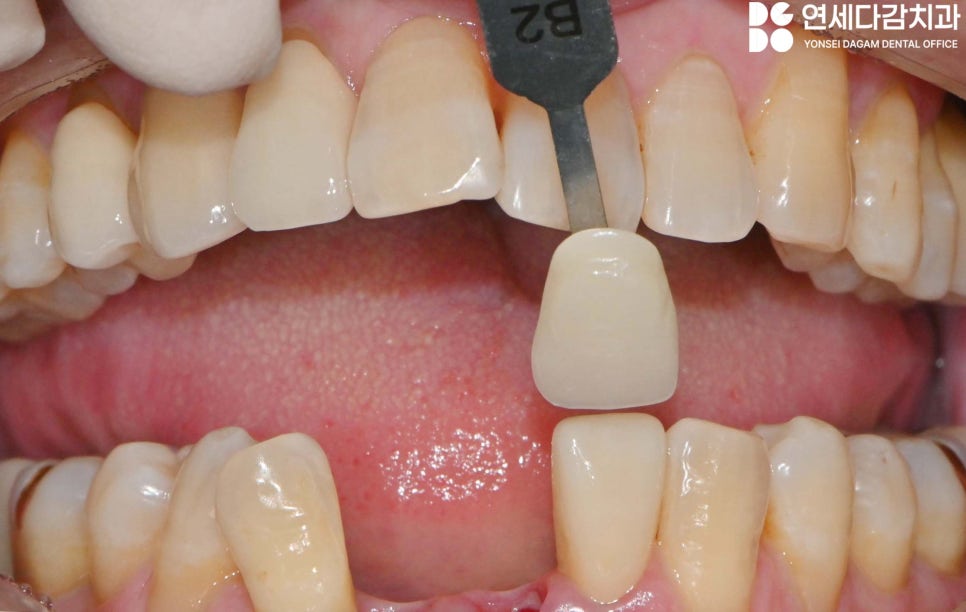
Under normal circumstances, four crown-shaped
restorations would be appropriate,
but because the space was limited,
a prosthesis matching the number of implants
rather than a bridge was fabricated
to close the ambiguous space.
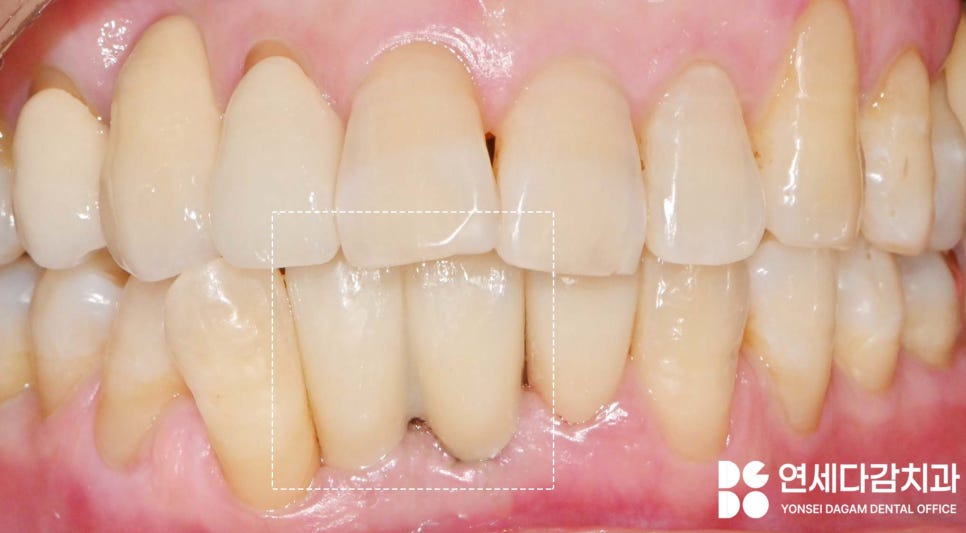
A prosthesis that was easier to maintain
and structurally more stable was made,
and the setting was completed.
Unlike the pre-treatment structure,
where force was distributed only to the abutment teeth,
it has now been improved into a stable
and sturdy structure, promoting long-term prognosis.
Even in such a difficult area,
if a careful 3D digital analysis process is
performed through CT,
accuracy and safety can be improved
during the actual surgery,
leading to good results.
Going forward, at Ogeum Station Dental Clinic,
we will continue to accurately understand
each individual’s oral condition,
and through customized care and systematic
treatment planning suited to each case,
we will take a more careful and precise approach
to contribute to better oral health.
Thank you for reading this long post today,
and at Ogeum Station Yonsei Dagam Dental Clinic,
we will visit you again next time
with useful oral health information!
Thank you~
2025.02.17~2025/06/15