Hello.
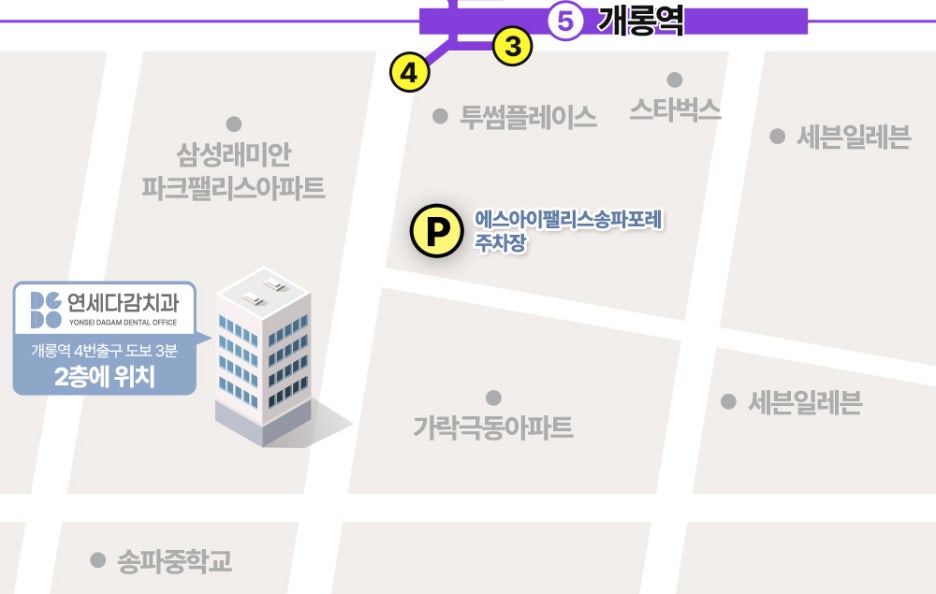
This is Yonsei Dagam Dental Clinic near Gae-long Station.
When a problem occurs with an implant that was previously treated elsewhere,
many people think that the existing one must be removed
and everything must be redone from the beginning.
At the dental clinic near Gae-long Station,
to start with the conclusion,
that is not always the case.
If there is no infection problem around the fixture
embedded in the bone,
and if the type of fixture can be identified,
compatible parts can be found
and the problem can be solved by making only the prosthetic part anew.
Because implants come in so many different types,
when a problem occurs,
a process of identifying the form is necessary.
For this to be done accurately,
you need to study the types and characteristics thoroughly
and understand them in detail.
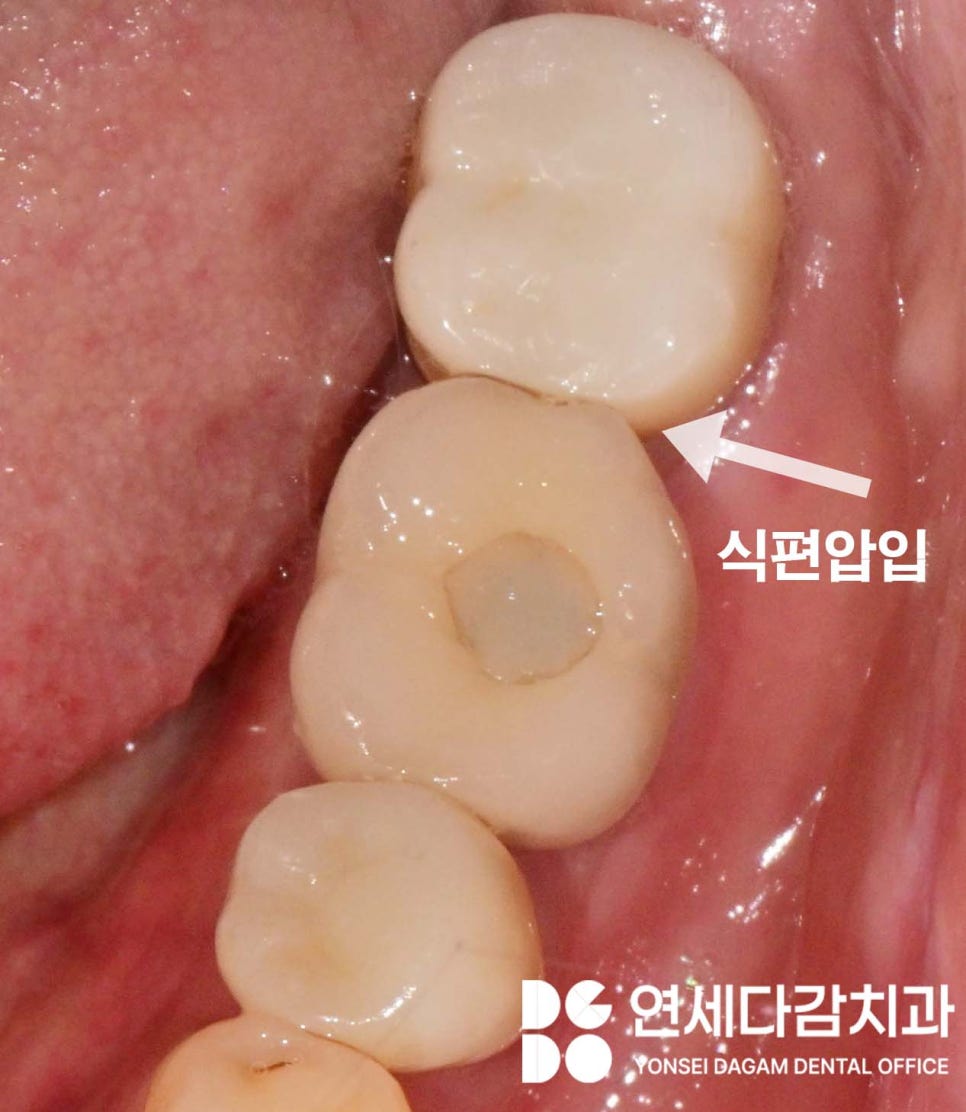
For example, at the dental clinic near Gae-long Station,
there are cases where the prosthesis between teeth has fractured
and the tight contact between them has loosened.
In such cases, food impaction
(when food gets trapped between teeth)
can occur.
You may think that, since a long time has passed since treatment,
a new implant must be placed again,
but it can be solved by remaking only the upper prosthesis,
which is the crown portion.
To do so, the shape of the fixture must be analyzed in detail.
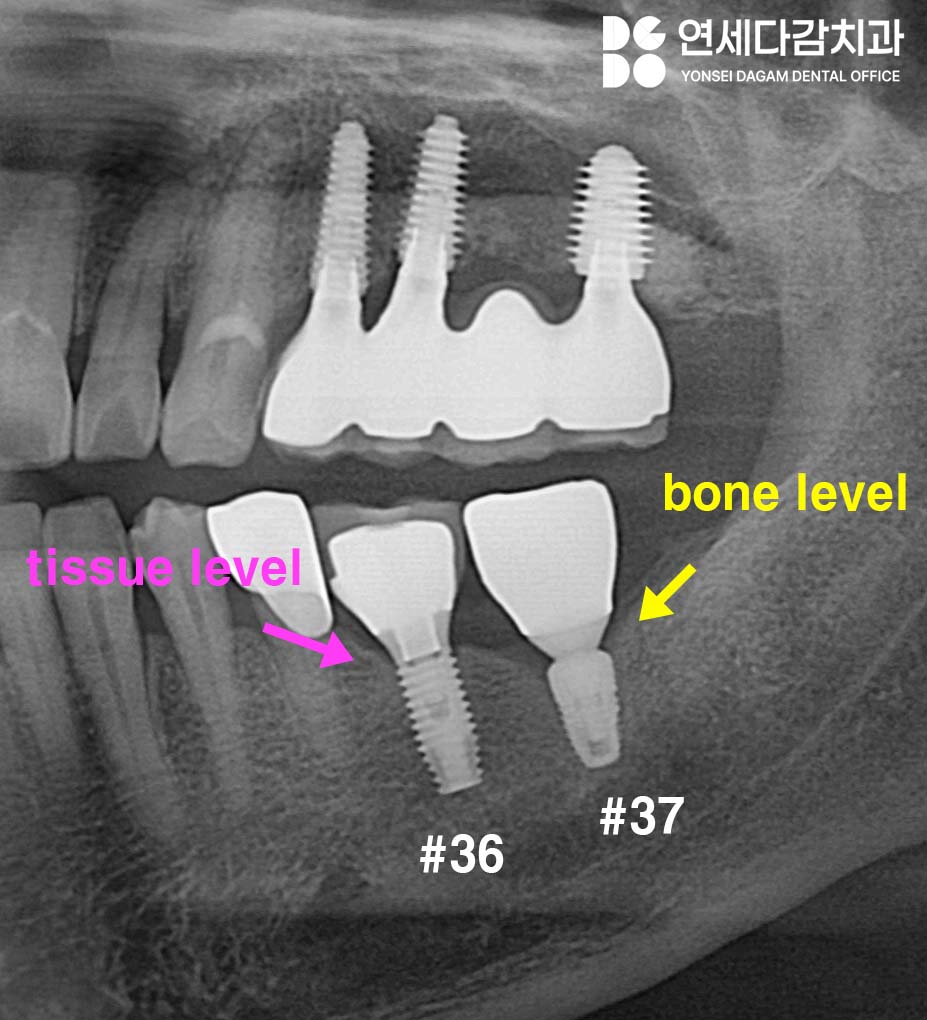
On the X-ray, you can see that the two are different types.
To explain in detail at the dental clinic near Gae-long Station,
for tooth 37, it is an internal hex type,
a Bone level type that is commonly used these days,
and for tooth 36, the implant is a tissue level type.
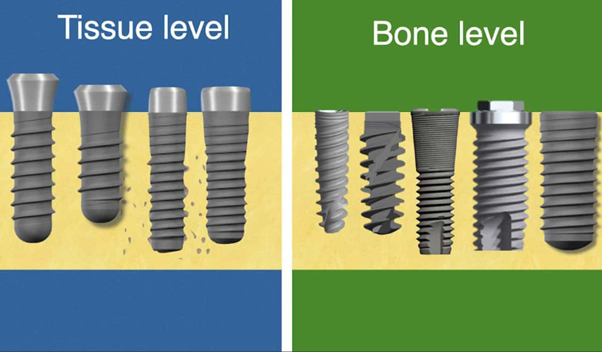
Broadly speaking, they can be divided into Bone Level
and Tissue Level.
Bone level is designed so that the fixture
is positioned at the bone level,
after which the prosthesis is fabricated from below the bone level,
making it easier to naturally reproduce the gum line.
Tissue level has the connection area located at the gingiva,
which makes hygiene management easier,
and the procedure is simpler and more predictable.
However, if the gingival line is thin
or uneven,
the metal part may be visible.
In the past, when a bone level fixture was used
in the molar region,
a fixture could tear or break,
so there was a time when tissue level was actively placed.
These days, bone level fixtures have also become thicker,
so tearing has become rare.
Internal VS External
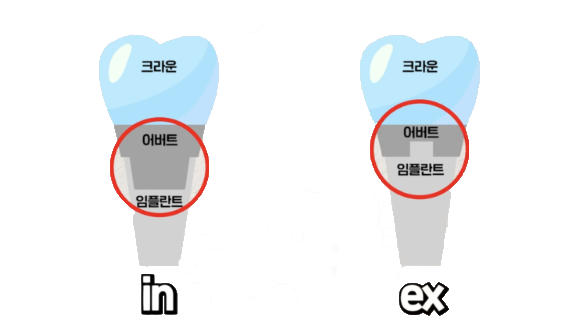
Another important point to look at in the external design
is the point where the abutment,
which acts as the post of the prosthesis,
meets the fixture (the micro gap).
Depending on the type, the location of this gap differs.
When it is recessed inward, it is the internal type.
When the fastening area protrudes outward,
it is the external type.
Our bone has a tendency to maintain the biological width,
so if the micro gap is located low,
the gingival bone will be resorbed by an amount equal to the biological width.
Because of this phenomenon,
no matter how ideally the implant is placed,
the gingival bone is said to resorb in order to maintain the biological width.
Of course, there are separate components
that compensate for this,
but the internal type,
which is a form that can prevent this phenomenon,
is increasingly used.
Classification by form
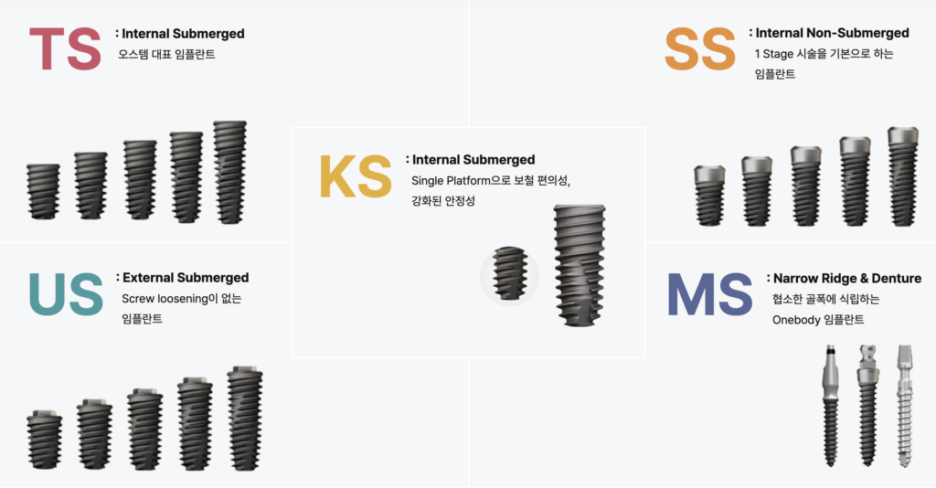
Among Osstem implants, which are widely placed in Korea,
there are five representative classifications:
( TS / KS / SS / US / MS )
The TS type is Osstem’s representative design,
which has been widely used historically and continues to be used today.
It uses an internal method in which the abutment
is fastened inside the fixture,
and it is a proven system with verified stability
and predictability.
The KS type is a more recently developed next-generation type
based on TS.
It has a single platform, which improves prosthetic convenience,
and an internal connection method with enhanced stability.
When fabricating the prosthesis,
there is no need to distinguish between mini and regular,
and it has the feature of simplifying the prosthetic process
by making everything in one standard size,
providing consistency.
The US type and SS type were used in the past
but are not used much now.
The MS type is an integrated form suitable
for narrow bone width areas or denture prostheses.
It was a type used when the bone was thin,
but as the TS type has continued to improve,
its frequency of use has decreased.
If you know these precise characteristics,
you gain the ability to distinguish the types,
and now, before making the prosthesis,
you need to connect the parts for taking impressions.
However, depending on the type or shape of the implant,
the parts needed for taking impressions
(a scan-type healing abutment)
are required.
They all look different, but at the dental clinic near Gae-long Station,
we keep all the parts in stock
so that impressions can be taken for all implant types.
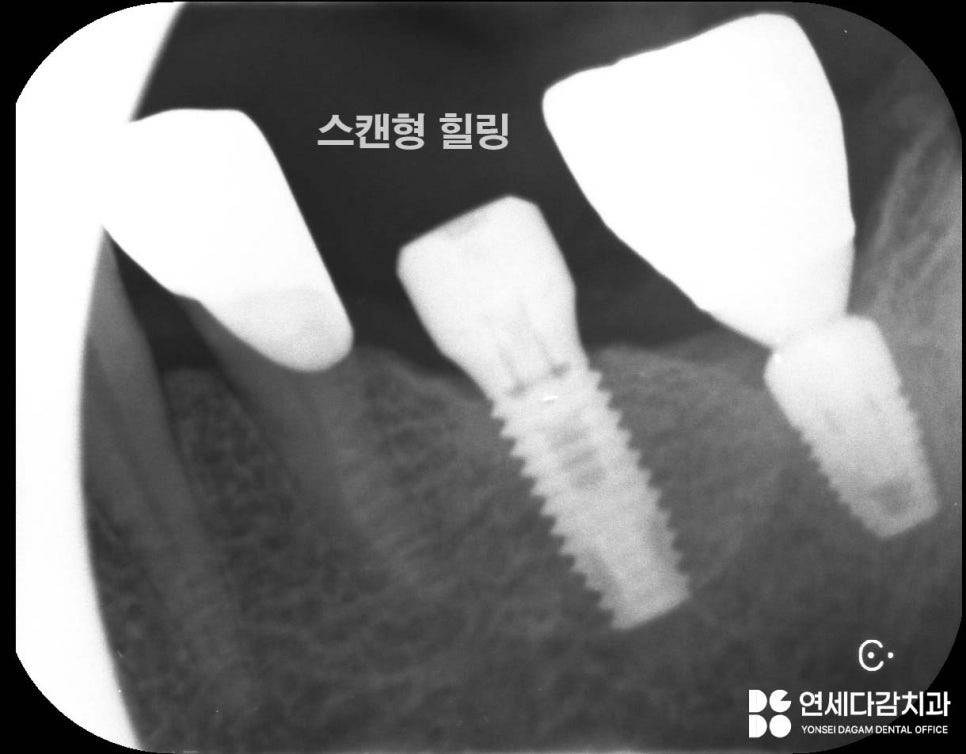
Once the correct healing abutment is fastened and scanned,
remaking the prosthesis is completed.
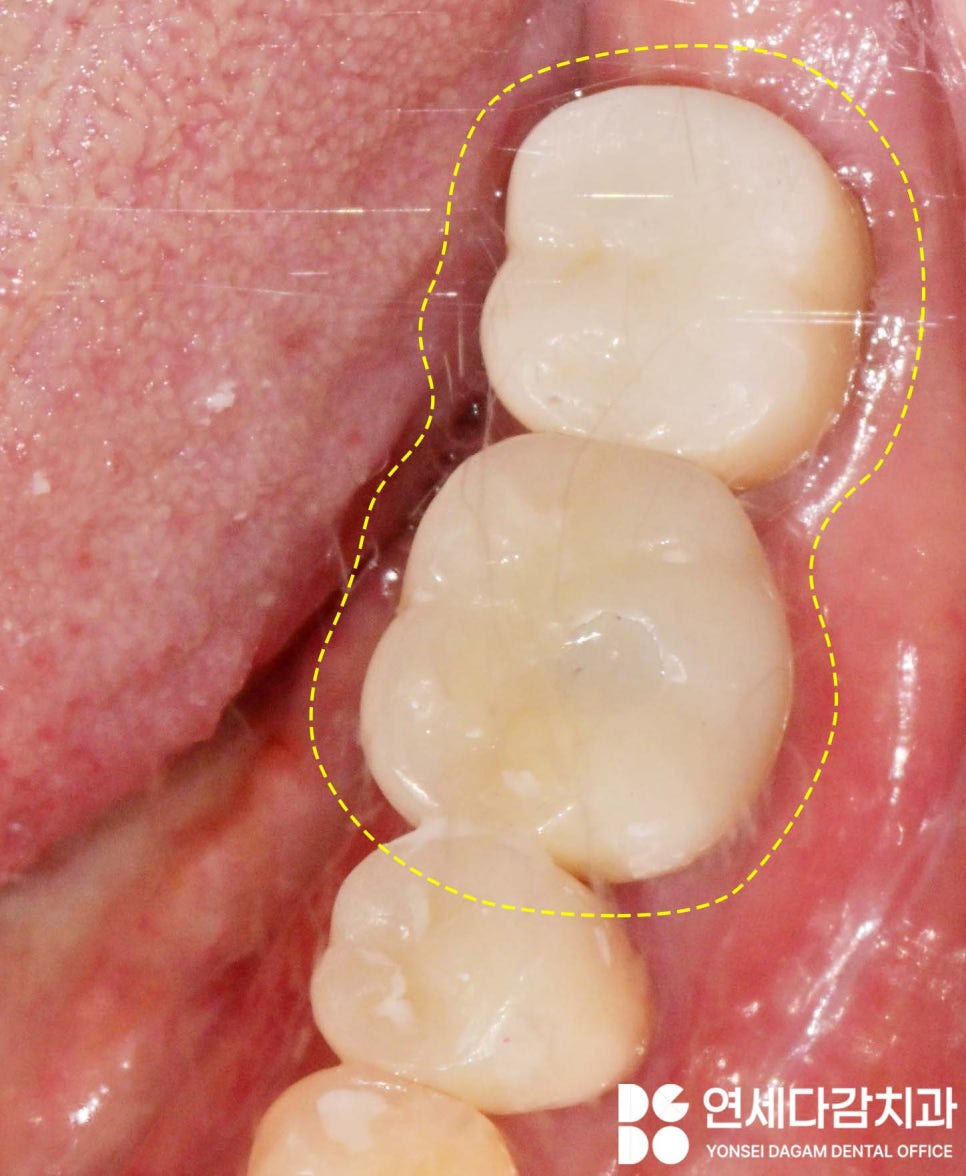
The prosthesis can also be replaced from the old PFM crown method
to a zirconia crown.
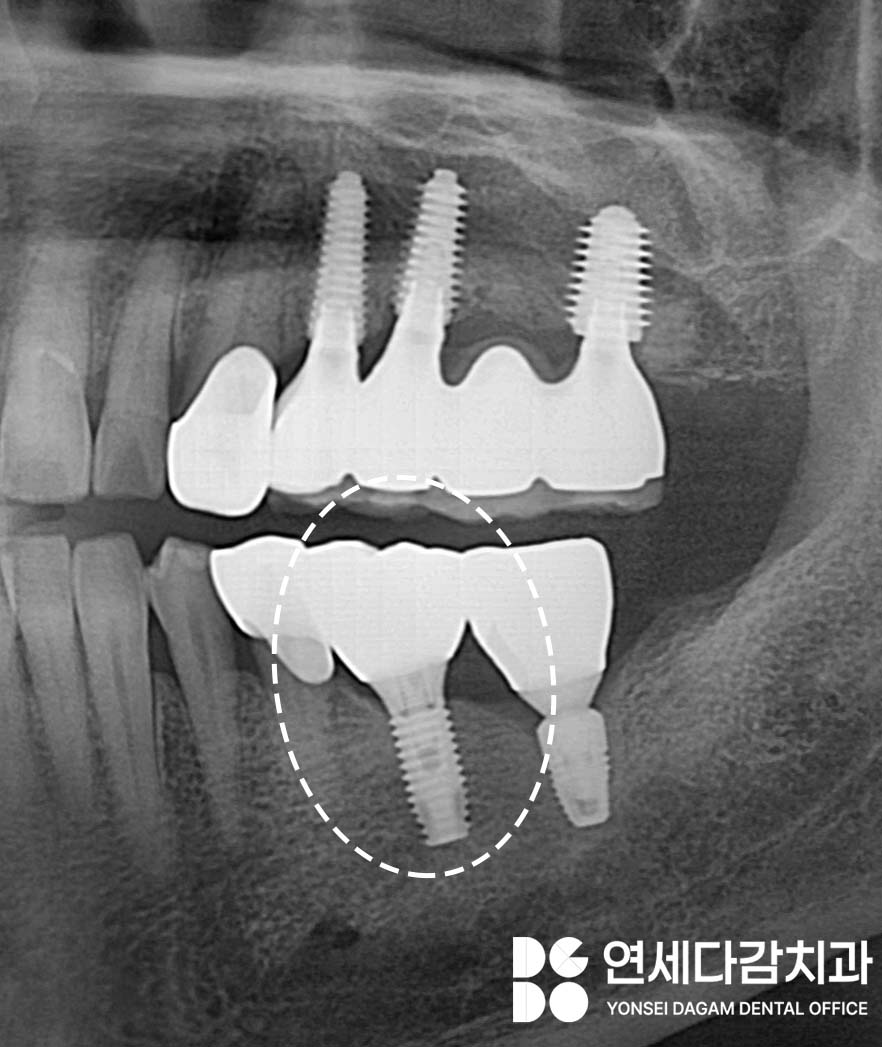
In this way, by having the precise ability
to distinguish forms through specialized knowledge,
the fixture can be left as is,
and the old prosthesis alone can be replaced to solve the problem.
Because implants are divided according to their form
and surface treatment,
there are that many more types and options available.
Therefore, I hope that the appropriate option
for each individual’s oral condition can be found and applied
so that good results can be achieved.
This was the dental clinic near Gae-long Station.
Thank you.
Treatment period: 2025/6/12 ~ 2025/6/25