Hello.
Garak-dong Yonsei Dagam Dental Clinic here.
Cavities are a complex disease that can appear in various forms depending on how far they have progressed and where they occur.
Much like the process of rusting, they often begin as a small black dot
and gradually spread deeper and wider.
Therefore, it is most important to accurately understand the current condition of the cavity
and receive the appropriate treatment at the right time.
Today at our Garak-dong dental clinic,
we will explain the characteristics of each stage of cavity progression
and the treatment methods suited to them.
Depending on the degree and location of a cavity, the treatment method changes
There is no fixed formula
for cavity treatment.
Even if cavities are the same size,
which tooth they occur in,
which area they are located in,
and the patient’s age and oral hygiene condition
all change the approach.
Cavities can generally be divided into early, middle, and late stages.
In the early stage, the lesion is limited to the enamel
and appears as a white spot, brown discoloration, or a black dot on the tooth surface.
At this stage, there is usually no pain yet,
and in many cases it is visible to the naked eye as a dot or line.
It is similar to a small scratch on an apple peel,
with the inner flesh still undamaged.
The biggest characteristic of early cavities is that they are reversible.
With proper fluoride application and oral hygiene care,
remineralization can occur,
preventing further progression and allowing the lesion to stop.
At our Garak-dong dental clinic, in the early stage,
we usually recommend observing it first,
and if treatment is desired,
it can often be completed with resin treatment.
This involves removing only the decayed area minimally
and filling it with composite resin material.
It is a simple procedure that takes only a few minutes
and causes almost no pain.
In the middle stage, the cavity has progressed into the dentin,
and from this point on, clear symptoms
begin to appear.
Sensitivity to cold foods or sweets may occur,
and it also begins to be noticeable to the naked eye.
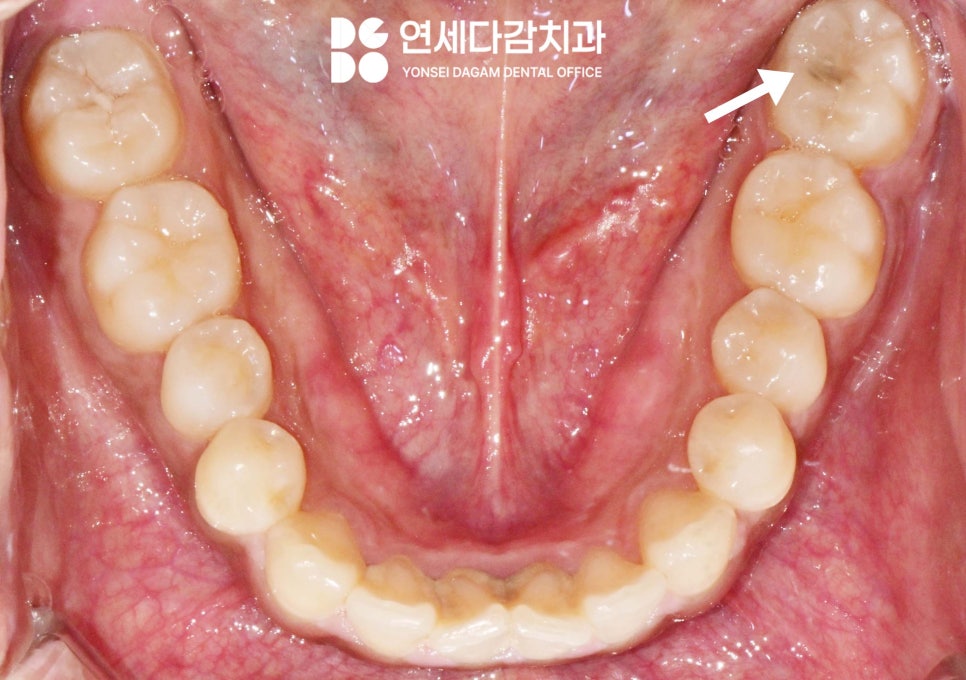 If it has progressed inside,
as shown at the Garak-dong dental clinic,
it often appears dark.
If it has progressed inside,
as shown at the Garak-dong dental clinic,
it often appears dark.
From this point on, active treatment is needed.
This is because dentin is structurally weaker than enamel,
so cavities tend to spread quickly.
Treatment is done with an inlay or a large composite resin filling.
For front teeth, resin is used with aesthetics in mind,
and for molars, which have strong biting force,
we recommend a durable inlay.
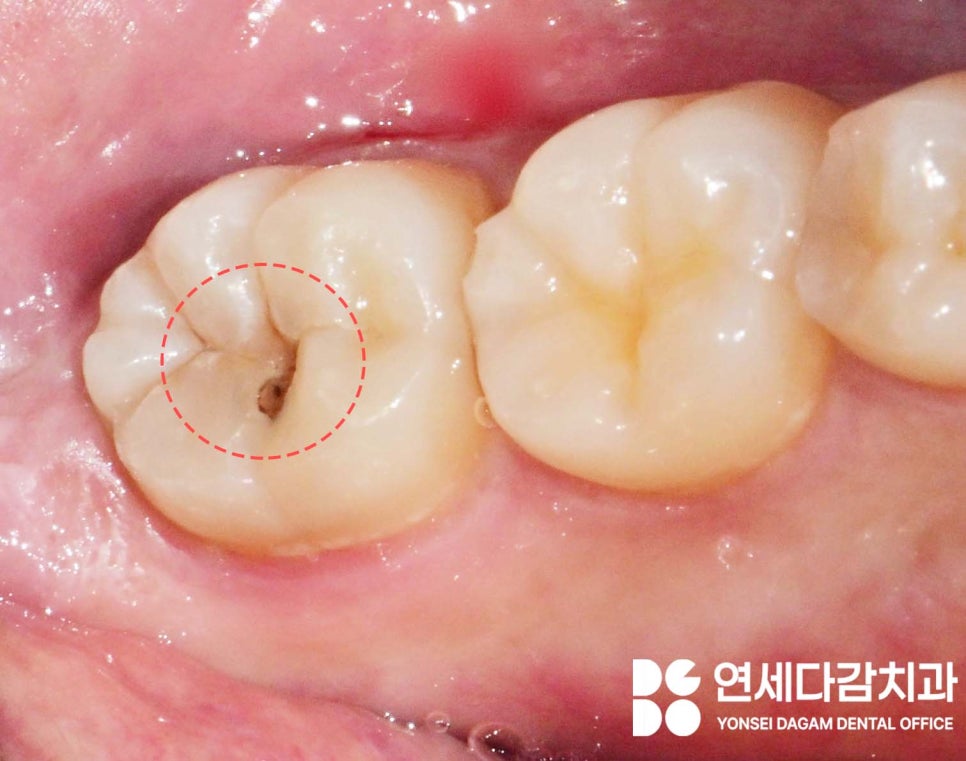 The middle stage is characterized by lesions that look as if a worm has hollowed out a fruit,
or dark areas that appear like bruised fruit.
At this point, an X-ray should be taken
to identify the location and extent of the decay.
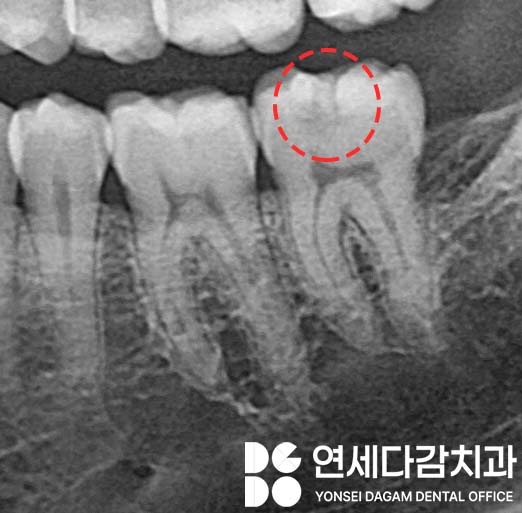 After confirming whether the infection has progressed to the pulp,
the scope for inlay treatment is determined.
After confirming whether the infection has progressed to the pulp,
the scope for inlay treatment is determined.
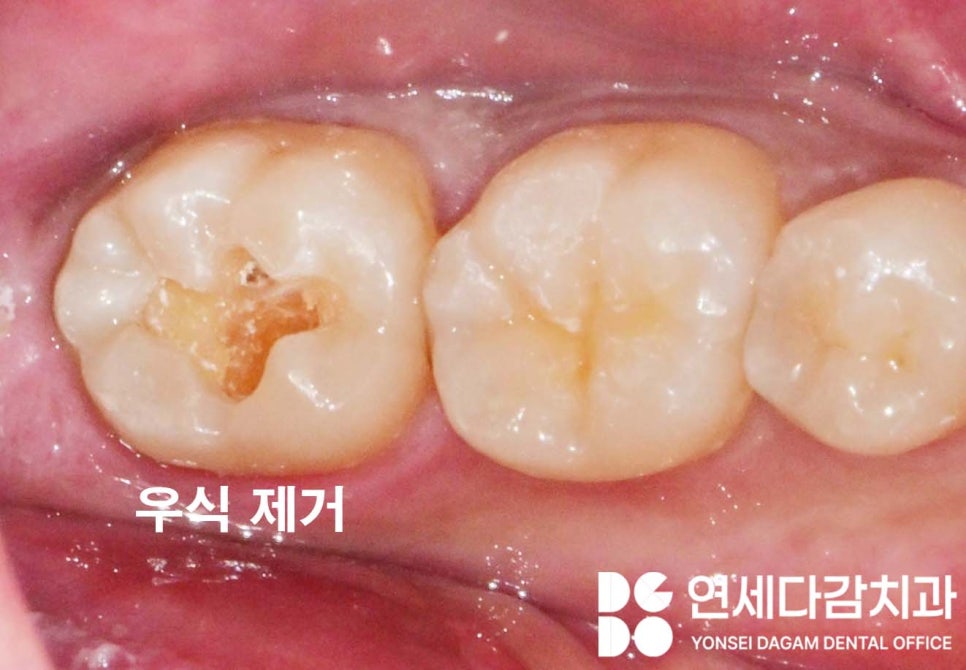 After carefully removing the infected area,
the cavity may turn out to be quite deep.
After carefully removing the infected area,
the cavity may turn out to be quite deep.
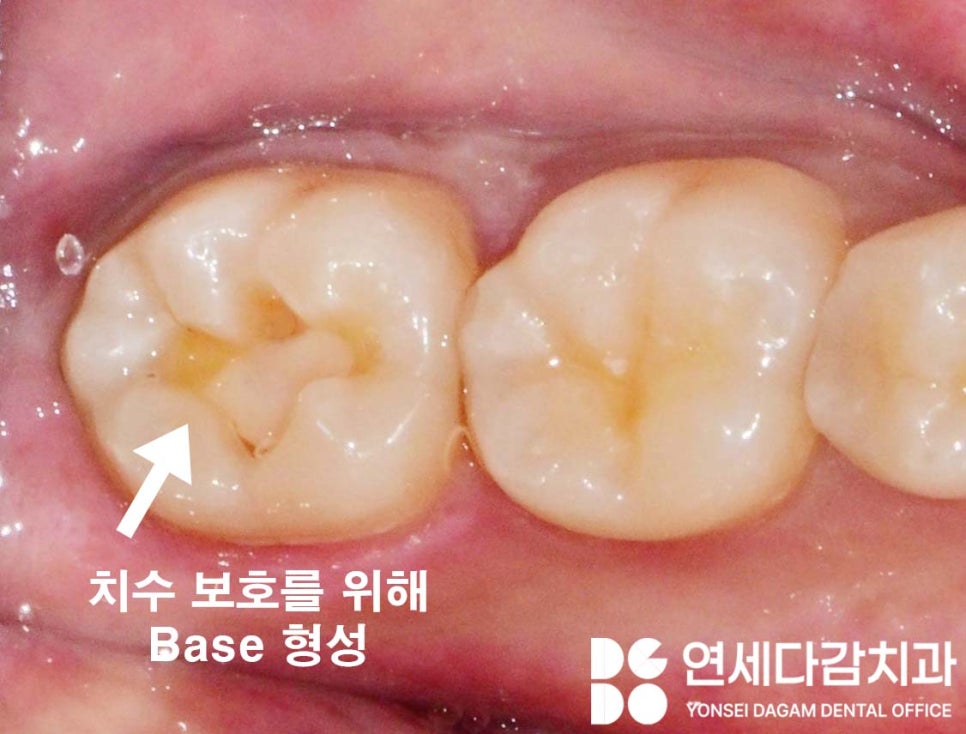 If it has been removed more deeply than expected,
it is better to place a thin base layer to protect the tooth structure and pulp.
If it has been removed more deeply than expected,
it is better to place a thin base layer to protect the tooth structure and pulp.
This helps secure a proper distance from the pulp
and distributes pressure,
protecting the deep area.
Once the shape suitable for stable prosthetic placement has been completed,
that shape is copied as it is
and used as the basis for the inlay prosthesis to be fabricated.
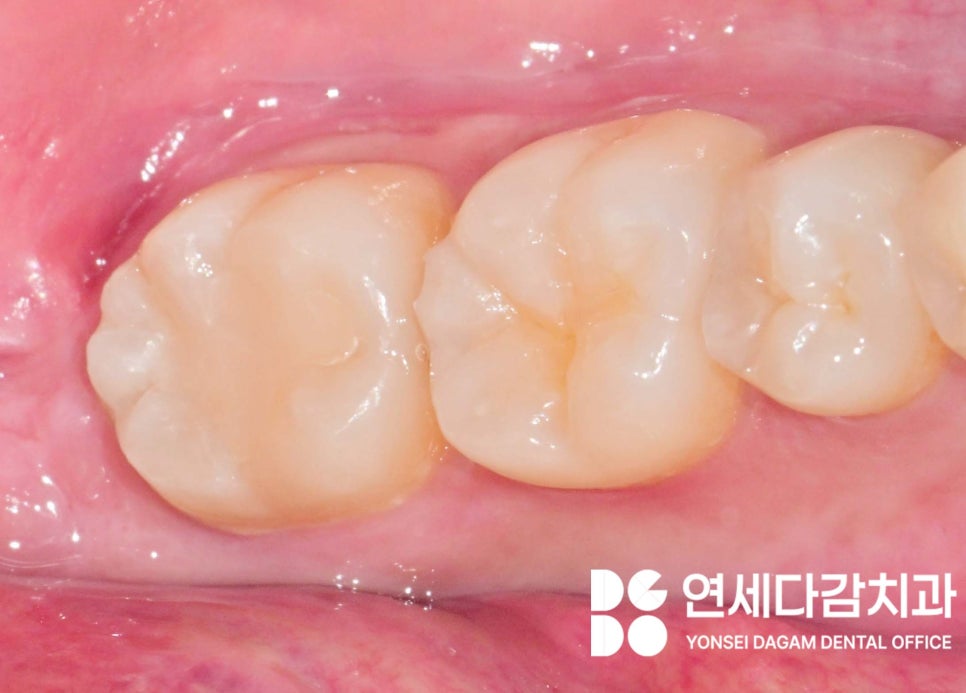 The inlay used at the Garak-dong dental clinic
is made of ceramic material,
The inlay used at the Garak-dong dental clinic
is made of ceramic material,
and compared with resin fillings,
its strength is about four times greater.
It also has a wider surface area,
which distributes pressure,
allowing it to be maintained safely for a long time.
The late stage is when the infection has progressed to the pulp,
and inflammation occurs along with pain.
Spontaneous pain continues,
and it may hurt even with hot food.
At this point, simple filling treatment is not enough.
The treatment direction is determined according to the extent of pulp infection.
If the infection is widespread, root canal treatment is necessary.
This is a process of removing the infected pulp,
cleaning the root canal, and sealing it,
which requires multiple visits.
This is an important process for the long-term survival of the natural tooth.
However, if severe decay has progressed in the root area rather than the crown,
preservation may not be possible.
As such, the location of the cavity
is a major factor in deciding the treatment method.
At our Garak-dong dental clinic,
we aim to achieve results that provide both function and aesthetics
through customized treatment that takes the characteristics of each area into account.
More importantly, it is even more important to prevent these problems from occurring in the first place, isn’t it?
I hope you can prevent cavities through proper brushing, the use of oral hygiene aids such as dental floss,
and regular fluoride application and checkups.
Since cavities do not heal naturally once they occur,
addressing them at the proper time is
a reliable way to protect oral health.
With that, Garak-dong Dental Clinic will end today’s post.
Thank you for reading today!
 25.07.24~25.07.31