Hello.
This is Yonsei Dagam Dental Clinic in Songpa-dong.
If you are preparing for cancer treatment,
just getting ready for treatment can already be very difficult..
When dental problems are added on top of that,
the burden can only increase.
In particular, head and neck radiation cancer treatment
can have a major impact on oral health,
so thorough examination and management before treatment are important.
Once head and neck radiation cancer treatment begins,
you are no longer in a condition
where surgical procedures can be performed,
so you will be informed that problematic teeth need to be extracted,
or surgical procedures such as implant surgery
should be done in advance.
Reasons for surgical procedures before radiation therapy
Head and neck radiation cancer treatment is a treatment method
that delivers high-dose radiation to the head and neck area.
When receiving this treatment, important changes occur
in oral tissues and the jawbone.
Radiation therapy affects not only cancer cells
but also healthy normal tissues nearby.
In particular, it damages the bones and blood vessels,
reducing blood supply
and significantly lowering healing ability.
What problems can this cause later?
During surgical procedures such as tooth extraction
or implant surgery,
bone can easily become necrotic.
For the reasons explained at the Songpa-dong dental clinic above,
because oral tissues are sensitive to radiation and can cause
various complications,
many hospitals recommend treating areas that need surgical procedures
before head and neck radiation therapy.
A practical approach suggested by the Songpa-dong dental clinic
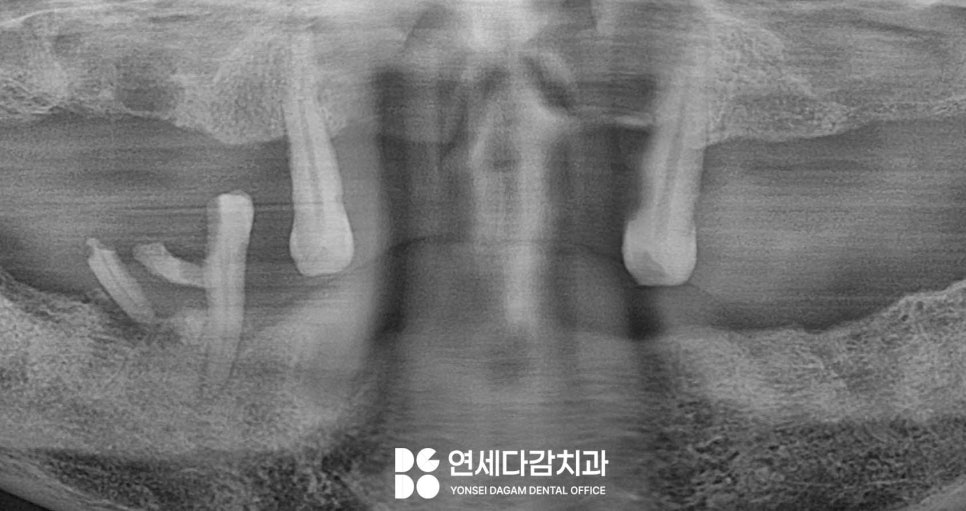
At the Songpa-dong dental clinic,
we first carefully examine the areas that require surgical procedures.
After examining, there were already not many teeth left,
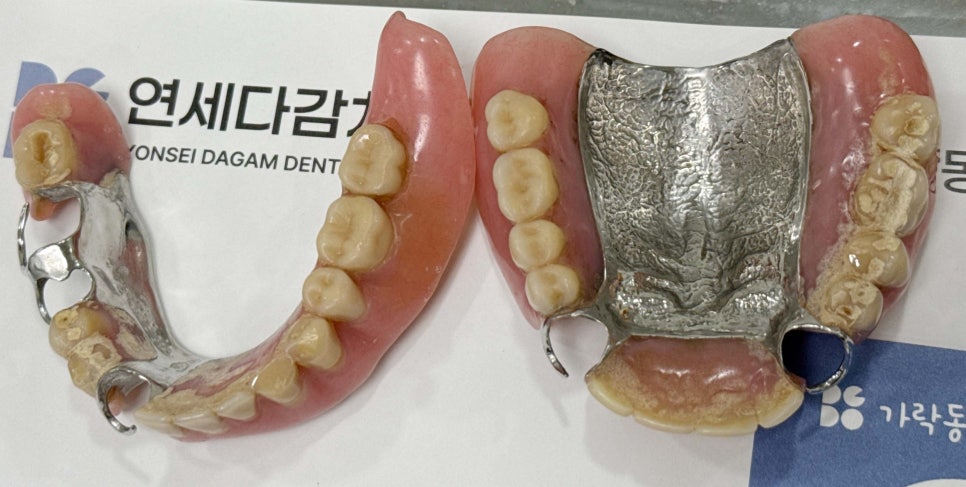
and the patient was already using a partial denture.
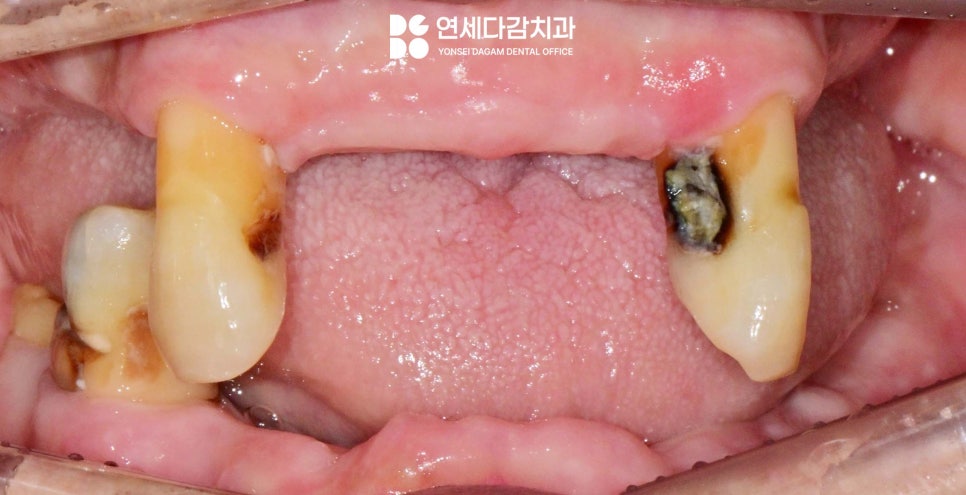
The only remaining teeth were a total of four abutment teeth,
which served as supports for attaching the partial denture,
and the examination showed that
the maxillary abutment teeth had root caries (decay on the tooth roots),
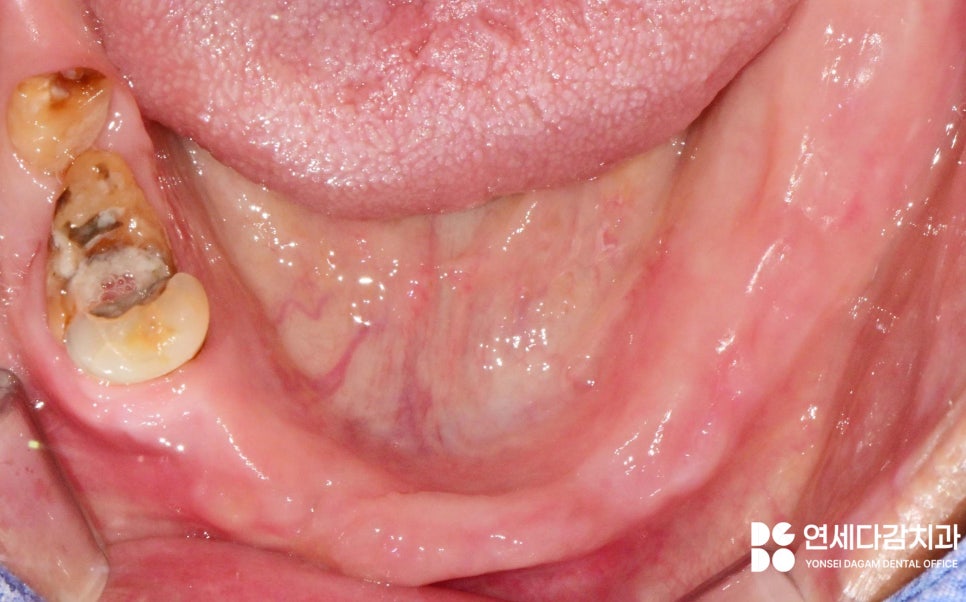
and the mandibular abutment teeth were badly decayed
and broken.
Leaving damaged teeth untreated can cause other problems,
so extraction was ultimately necessary.
However, after removing them, recovery would be needed with a denture
or implants,
but because surgical procedures cannot be done after treatment,
we had to move toward the option of restoring with a complete denture.
The problem, however, is that with head and neck radiation cancer treatment
imminent,
there is not enough time to make a completely new denture
after extraction.
But because one cannot remain toothless in daily life,
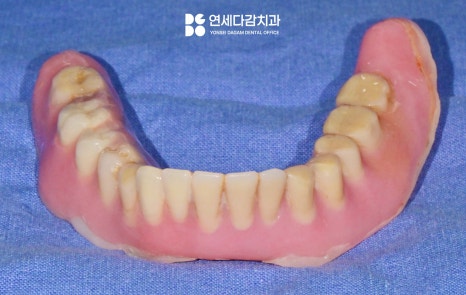
we decided to modify the existing partial denture
into a temporary complete denture.
To put it simply, at the Songpa-dong dental clinic,
it is similar to expanding an existing house without demolishing it
to create a larger space.
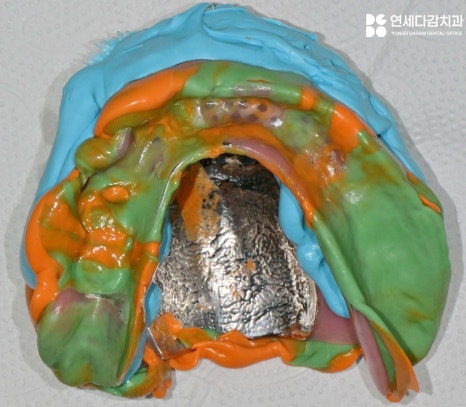
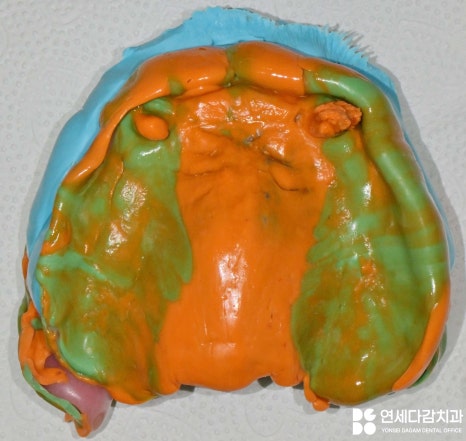
Artificial teeth were added to the existing denture,
and an accurate impression of the extracted gum area was taken,
so that it would cover even the gum areas that the existing partial denture
did not reach.
A partial denture is a structure supported by the remaining abutment teeth,
whereas a complete prosthesis must be worn with all inner surfaces
in contact with the gums.
Therefore, the more precisely it fits,
the more greatly comfort during later use will be affected.
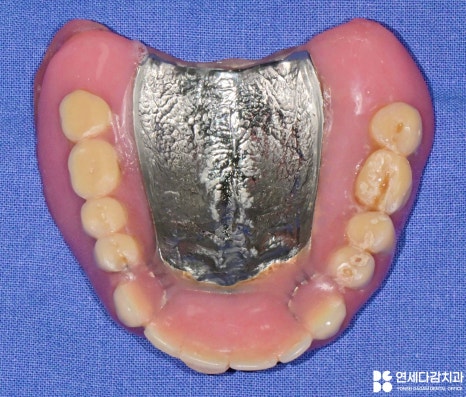
Even after the fabrication was completed,
we performed another precise impression
to improve the fit of the inner surface,
and carried out internal adjustments.
Through this process, even the fine contours of the gums
can be reflected on the inner surface to improve adaptation.
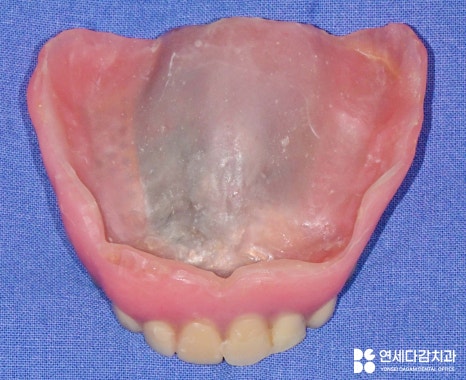
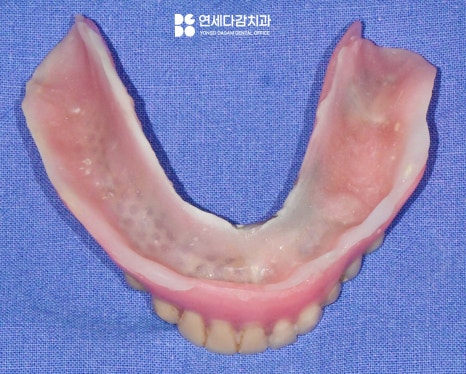
After that, we applied a material called tissue conditioner
inside the denture.
The tissue conditioner mentioned by the Songpa-dong dental clinic
is a soft material that
helps distribute pressure applied to the gums,
minimizes discomfort while wearing the denture,
and helps the gums adapt comfortably.
Once cancer treatment is completed,
the oral condition will be evaluated again,
and a new, more precise and comfortable final prosthesis
will be made.
In this way, by modifying an existing prosthesis
as if responding on the spot,
our role is to appropriately present practical alternatives
that can address the situation,
and this is an important issue.
Not all partial dentures can be modified into complete dentures,
so whether modification is possible may vary
depending on the oral condition and the prosthesis condition.
What is certain is that you should receive a diagnosis from a specialist,
and we hope you can receive the appropriate treatment
that fits your situation.
This was Yonsei Dagam Dental Clinic in Songpa-dong.
Thank you.
25.08.25~25.09.08