Hello.
This is Director Seo Hoyeon of
Songpa Station Yonsei Dagam Dental Clinic.
At some point, people may feel that
something is abnormally wrong with their oral condition
and come in for an examination.
It is not just mild cavities or pain,
but when bleeding, severe bad breath, and gums
that are excessively swollen with visible ulcers continue,
people may suddenly wonder,
Could this be oral cancer?
..
Looking at the characteristic symptoms of oral cancer,
there are persistent bad breath, bleeding of the oral mucosa,
and ulceration or mass formation.
However,
just because these features appear
does not necessarily mean it is oral cancer.
There is also the possibility of other inflammatory periodontal diseases,
so if you have any of the symptoms described above
at Songpa Station Dental Clinic,
an accurate examination is needed to differentiate them.
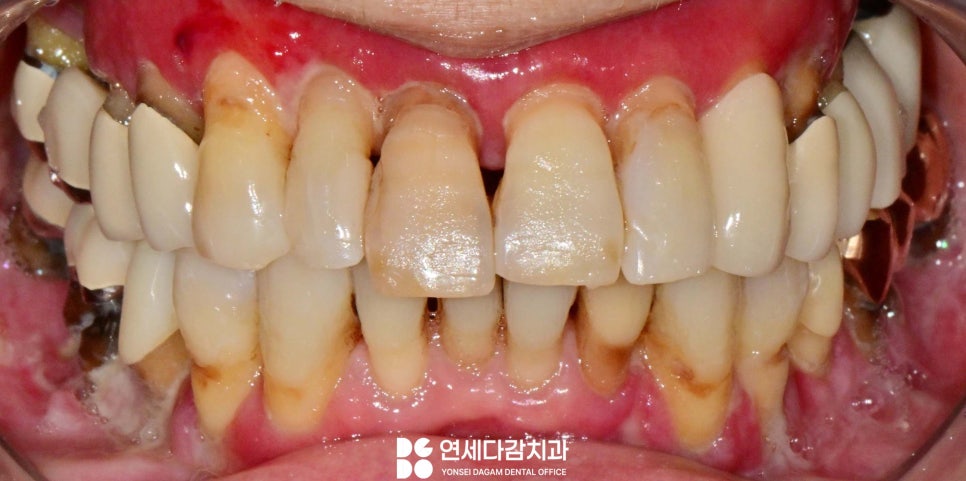
Looking at cases where the gums and periodontium are generally in poor condition,
redness, bad breath,
and bleeding may appear throughout the oral gums.
When you touch the gums with your hand or gauze,
the epithelium peels off easily and there is a lot of bleeding,
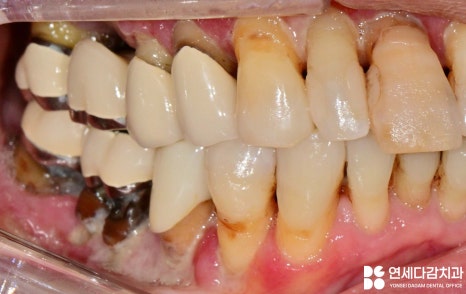
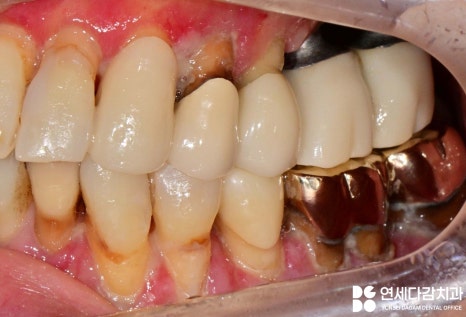
and yellow pus comes out of the gums.
It is a state in which the gum’s protective barrier has weakened,
as if the skin over a wounded area has become thin and peels off easily.
In such cases, a university hospital performs multiple tissue biopsies
to check for the presence of cancer
and whether there is a Candida infection.
However, the results may come back as neither cancer nor Candida.
Then what is the reason these features appear?
When it is neither cancer nor a fungal infection,
and the gums throughout the mouth become weakened,
with the epithelium peeling off easily and bleeding occurring,
you may suspect acute necrotizing ulcerative gingivitis.
💡
Acute Necrotizing Ulcerative Gingivitis
At Songpa Station Dental Clinic, it is also called ANUG as a professional term,
which is an abbreviation for Acute Necrotizing Ulcerative Gingivitis.
This is an acute inflammatory disease in which gum tissue necrotizes
and forms ulcers.
Major symptoms include severe gum pain,
spontaneous bleeding, severe bad breath,
and necrosis of gum tissue.
It is especially characterized by ulcer formation
in the interdental papilla area.
The causes are complex.
Stress, weakened immunity, poor nutrition,
poor oral hygiene, and smoking
work together to cause it.
It is a disease that develops as the oral environment worsens,
like plants withering as multiple bad conditions overlap.
It occurs especially often in young adults,
and is often seen during periods of high stress
or when immunity is low,
so getting enough rest is also important.
Still, because it is not a serious disease,
most cases can improve with early treatment.
Step-by-step gum treatment
However, if treatment is not provided or the condition recurs repeatedly,
it can lead to periodontal tissue damage,
alveolar bone resorption,
and even tooth loss.
Therefore, early treatment is important.
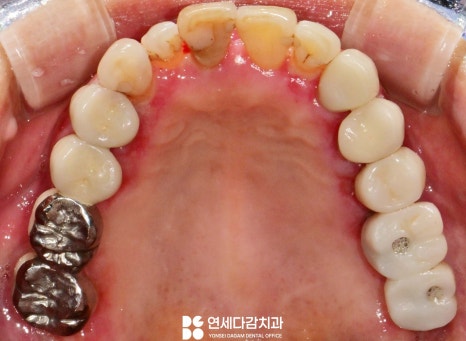
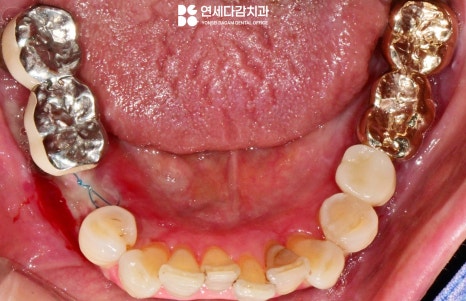
The treatment process is carried out in stages.
First, basic scaling and gum treatment are performed
to reduce inflammation throughout the gums.
During this process, tartar and plaque are cleaned away
to block the environment in which bacteria can multiply.
To use an analogy from Songpa Station Dental Clinic,
it is similar to purifying a contaminated environment.
When the gum epithelium is weakened, it becomes vulnerable to infection,
so prescribing antibiotics and giving exact instructions for how to take them
is important.
Therefore, patient cooperation is also important
in this process.
For areas where the gums are especially poor,
a tetracycline-class antibiotic,
minocycline ointment, is locally administered.
This is done twice, once a week,
and gum treatment once a week to manage oral hygiene
is helpful.
At Songpa Station Dental Clinic, this systematic
process is used to observe the healing process.
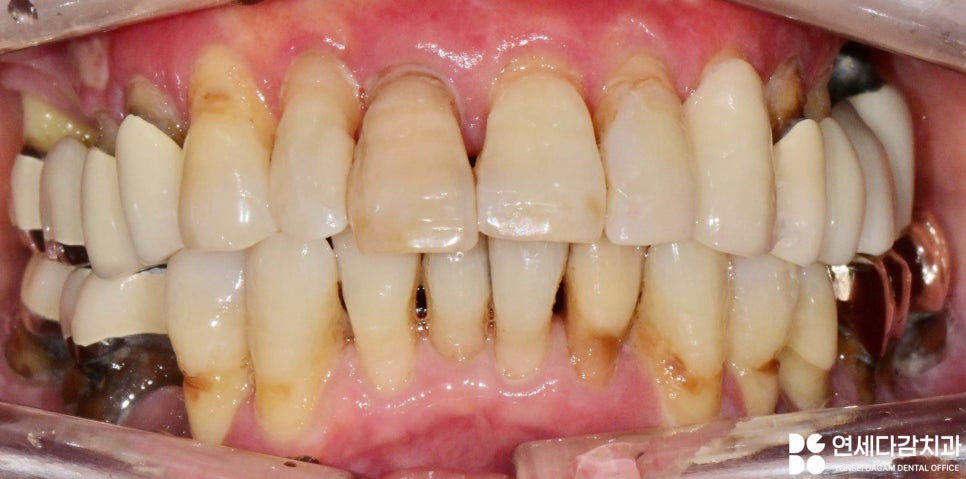
After the gum treatment program is finished
and checked one month later,
the gum epithelium is seen to be regaining its health.
Compared with the initial visit,
it is much improved
rather than red and swollen.
Previously, even eating something hot or spicy
was not possible,
but this discomfort can improve.
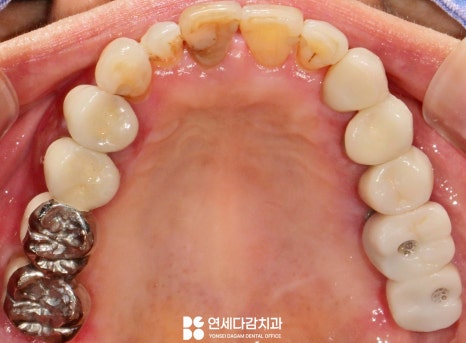
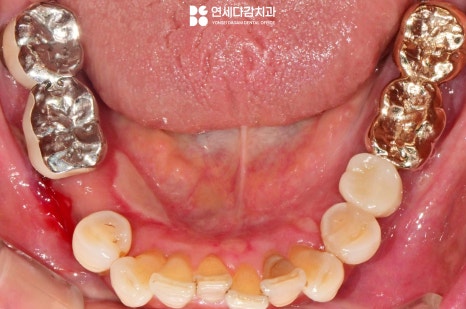
Because there are still areas where the gums
remain weak,
ongoing observation is needed,
and periodontal care should continue as necessary.
During the healing process,
stress management and sufficient nutrient intake,
smoking cessation, and proper daily oral hygiene
are also needed.
Through regular checkups, the condition is monitored,
and any additional treatment needed is provided continuously.
The acute necrotizing ulcerative gingivitis (ANUG)
introduced today at Songpa Station Dental Clinic is
a condition that is not commonly seen in clinical practice,
but it is sufficiently recoverable with appropriate treatment.
Even if it were oral cancer,
the probability of a cure is high when detected early,
so if you have any abnormal symptoms,
I strongly recommend getting an accurate examination promptly.
To strengthen immunity in daily life,
I hope you can improve and maintain your overall health
through sufficient sleep, appropriate exercise,
and vitamin supplementation,
and help prevent such conditions.
This has been Songpa Station Yonsei Dagam Dental Clinic.
Thank you.
25.08.15~25.09.25