Hello.
This is Yonsei Dagam Dental Clinic in Geoyodong.
After a wisdom tooth is removed, we are sometimes asked whether a root fragment left inside the bone could cause a problem.
Today, I’d like to answer that question in detail.
Wisdom Tooth Extraction, Where Structural Analysis Matters
The difficulty of wisdom tooth extraction varies depending on its position and shape.
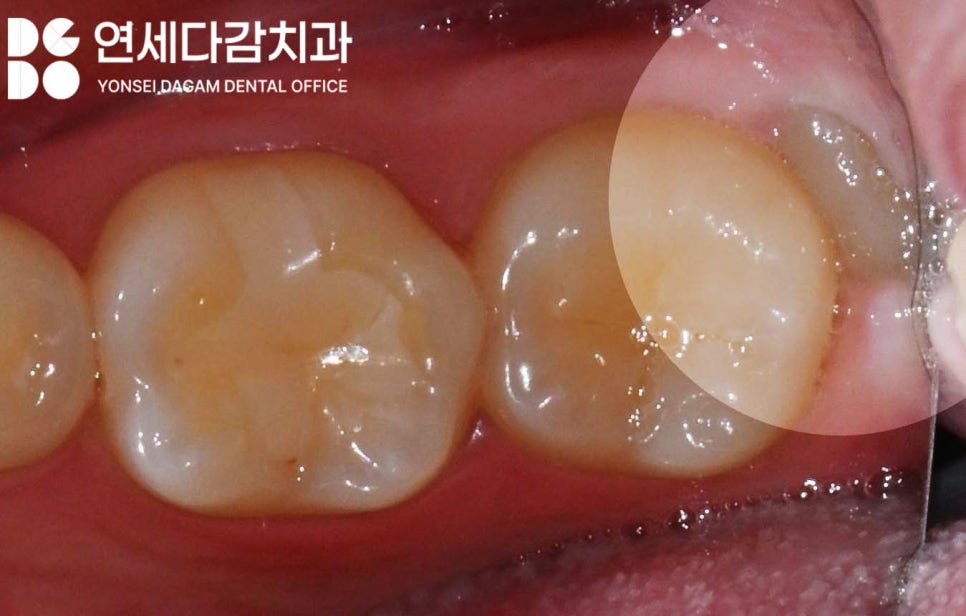
If a lower right wisdom tooth is partially erupted and causes food impaction or gum swelling,
we first check the surrounding structures through an X-ray.
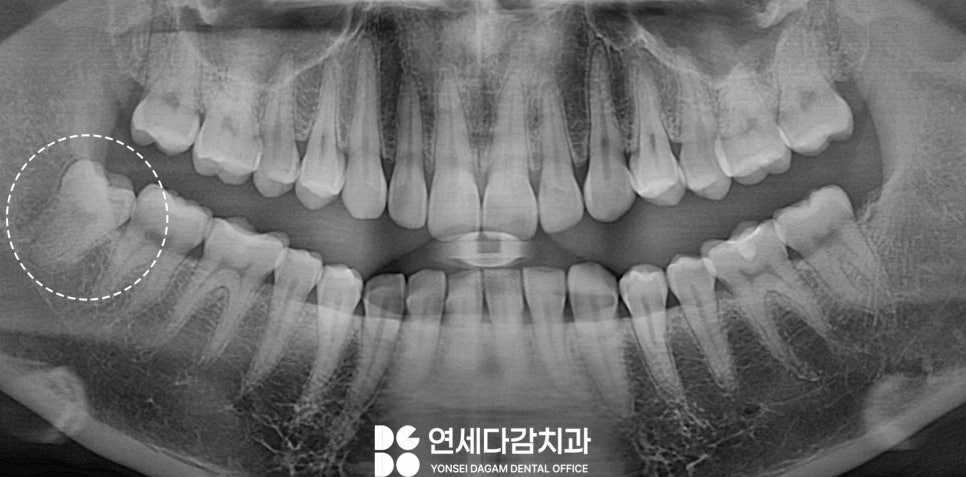
Because wisdom teeth are located at the very back,
they are often positioned close to anatomical structures such as the inferior alveolar nerve,
which is a major nerve that runs through the lower jaw.
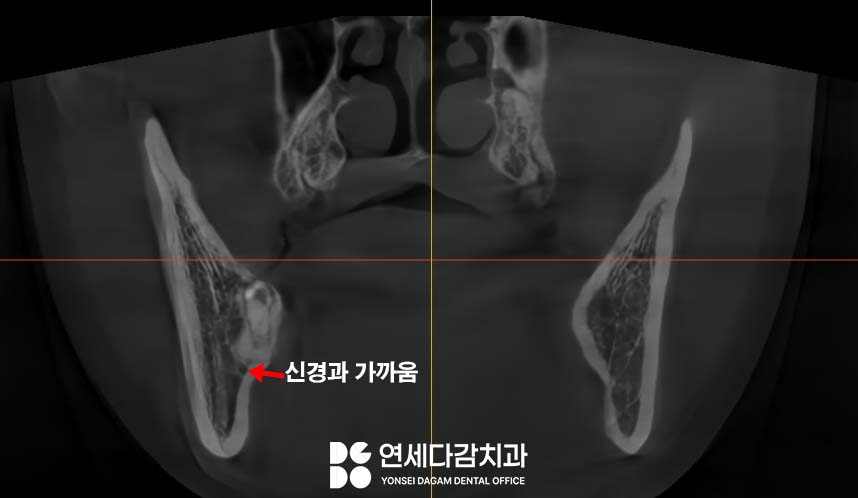
That is why, especially in the lower jaw, it is necessary to examine the distance to the nerve
with a CT scan in a three-dimensional structure.
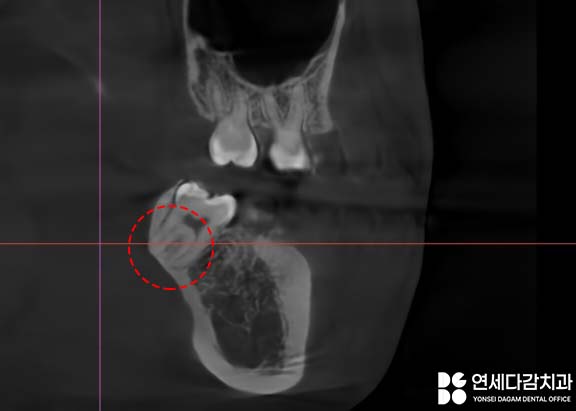
When confirmed by CT, the root of the wisdom tooth may appear to be slightly embedded
in the cortical bone, which is the dense outer layer of the lower jawbone.
Why the Position of the Root Matters
Our bones are broadly made up of two layers.
The outer layer is hard cortical bone, and the inner layer is cancellous bone,
which has many sponge-like spaces.
If we compare this to a building,
cortical bone is like a strong outer wall, while cancellous bone is like the internal structure.
When a wisdom tooth is located only within the cancellous bone,
the extraction is relatively straightforward.
However, as we often see in Geoyodong Dental Clinic,
there are cases where part of the root is embedded in the hard cortical bone.
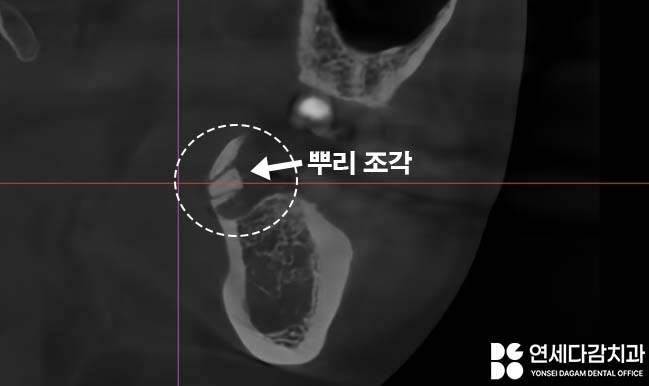
In such situations, the root may break during extraction.
This is something that can happen structurally,
and it is also fairly common.
It is a natural situation depending on the structural characteristics.
During extraction, the goal is to remove the entire root,
but when the root actually breaks,
leaving it in place may be the better choice depending on the situation.
Is It Okay for a Root Fragment to Remain in the Bone?
A broken root does not always mean that it must be removed completely.
At Geoyodong Dental Clinic as well,
we take a safe approach based on anatomical analysis
and a review of the patient’s medical history.
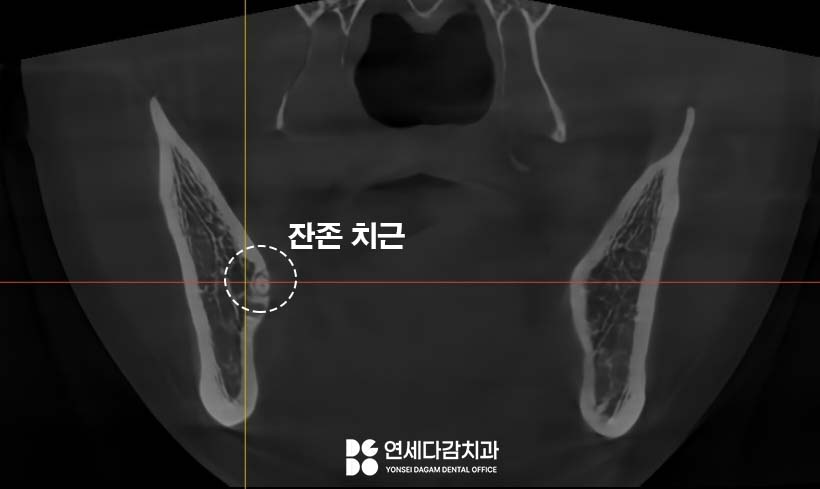
Small root fragments left in the bone usually do not cause problems.
A fragment of around 2–3 mm, if the tooth had no inflammation,
may be naturally resorbed as the surrounding bone gradually fills in,
or often remain without causing any noticeable symptoms.
There are, of course, exceptions
If the tooth already had inflammation around the root tip,
or if the remaining root fragment irritates the nerve,
or causes pain, then additional removal is necessary.
That is why, as shown in the images from Geoyodong Dental Clinic,
we make a judgment only after analyzing the images from multiple angles
and checking the medical history.
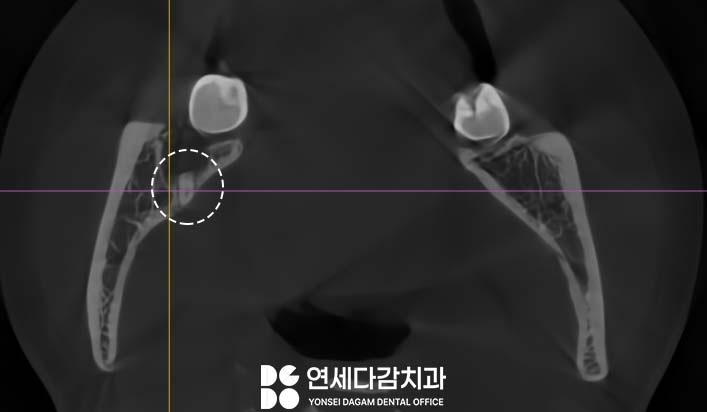
The problem is when the remaining root is close to the sublingual space.
The sublingual space is the area under the tongue and is made up of soft tissue,
so if the root slips into this area, its position may shift and removal becomes difficult.
In addition, important structures such as the lingual nerve and the submandibular duct pass through this area,
so various risks must be considered during the approach.
In such cases, forcing removal may place an even greater burden on the patient.
Therefore, leaving the remaining root fragment in place without further removal
may be the better choice.
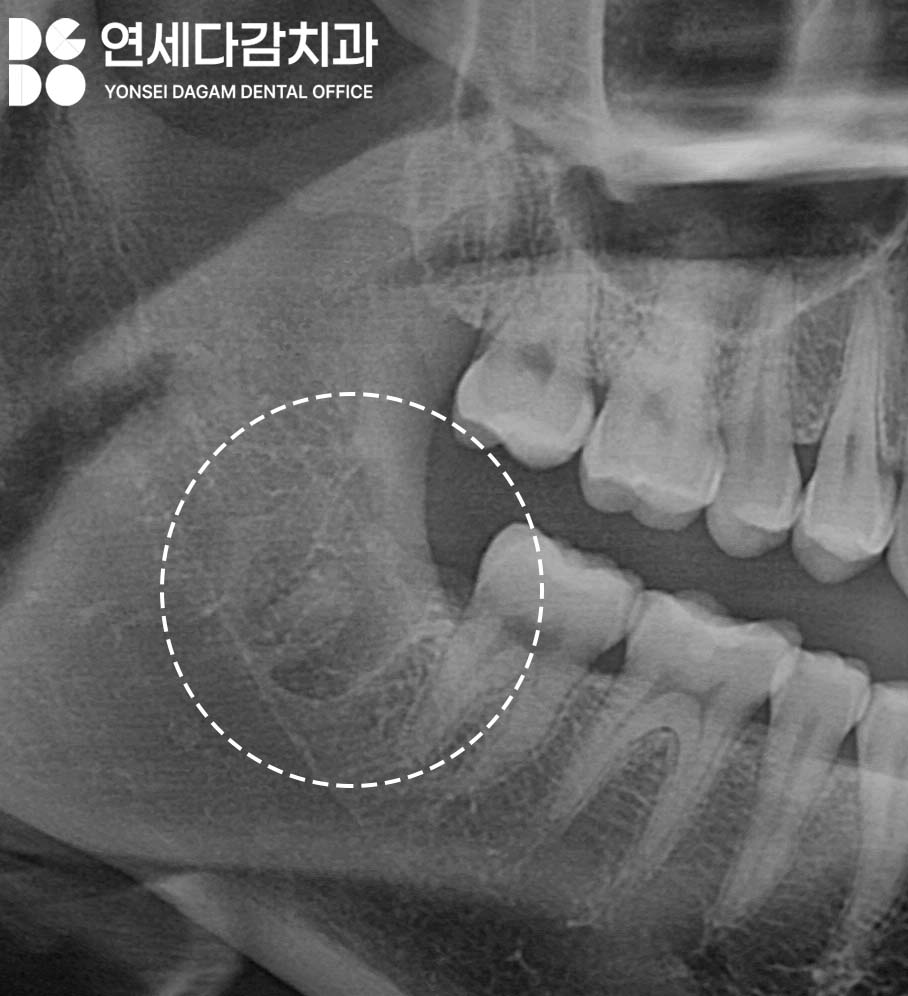
Even when a root fragment remains like this,
it is gradually resorbed,
so we confirm that it heals smoothly without causing major problems.
What We Would Like to Say at Geoyodong Dental Clinic
Because the position and shape of wisdom teeth differ from person to person,
not every case is treated in the same way, and there are several options depending on the anatomical shape and surrounding structures.
A tooth root breaking during wisdom tooth extraction is also common,
and having a remaining root fragment does not automatically mean there will be a risk.
Rather, carefully removing it only when necessary can be a stable approach.
One more thing we would like to mention is that it is better to have an extraction done at a younger age.
Wisdom Teeth
Why It Is Better to Remove Them When You Are Young
There is a difference in recovery ability, but as age increases,
the properties of the bone also change little by little.
To explain it as we do at Geoyodong Dental Clinic,
the cancellous bone becomes less dense and its structure becomes looser compared with younger ages.
On the other hand, the cortical bone becomes harder and stronger.
As age increases, the periodontal ligament between the tooth and the bone gradually becomes thinner,
and if the root adheres to the surrounding bone,
it can become firmly embedded in the bone, making root removal even more difficult.
Considering these age-related changes,
it is better to address problems early and maintain a healthy oral environment.
We hope this explanation from Geoyodong Dental Clinic today
has been helpful for those looking for related information.
Thank you.
Treatment period: 2025.11.10~2025.11.17