Hello.
Have you been keeping an eye on your child’s oral condition as well?
As children grow, baby teeth fall out and permanent teeth come in. This is a natural change in oral development.
Usually, this begins around age 6, and it is typical for all baby teeth to be replaced by permanent teeth by around ages 12 to 13.
However, some permanent teeth may be absent from birth.
Congenital absence of permanent teeth
This refers to a condition in which the tooth germ, the seed of the permanent tooth, has not formed from birth.
To use an analogy from the Munjeong Station Dental Clinic, just as a plant cannot grow without a seed, a permanent tooth cannot emerge if there is no tooth germ.
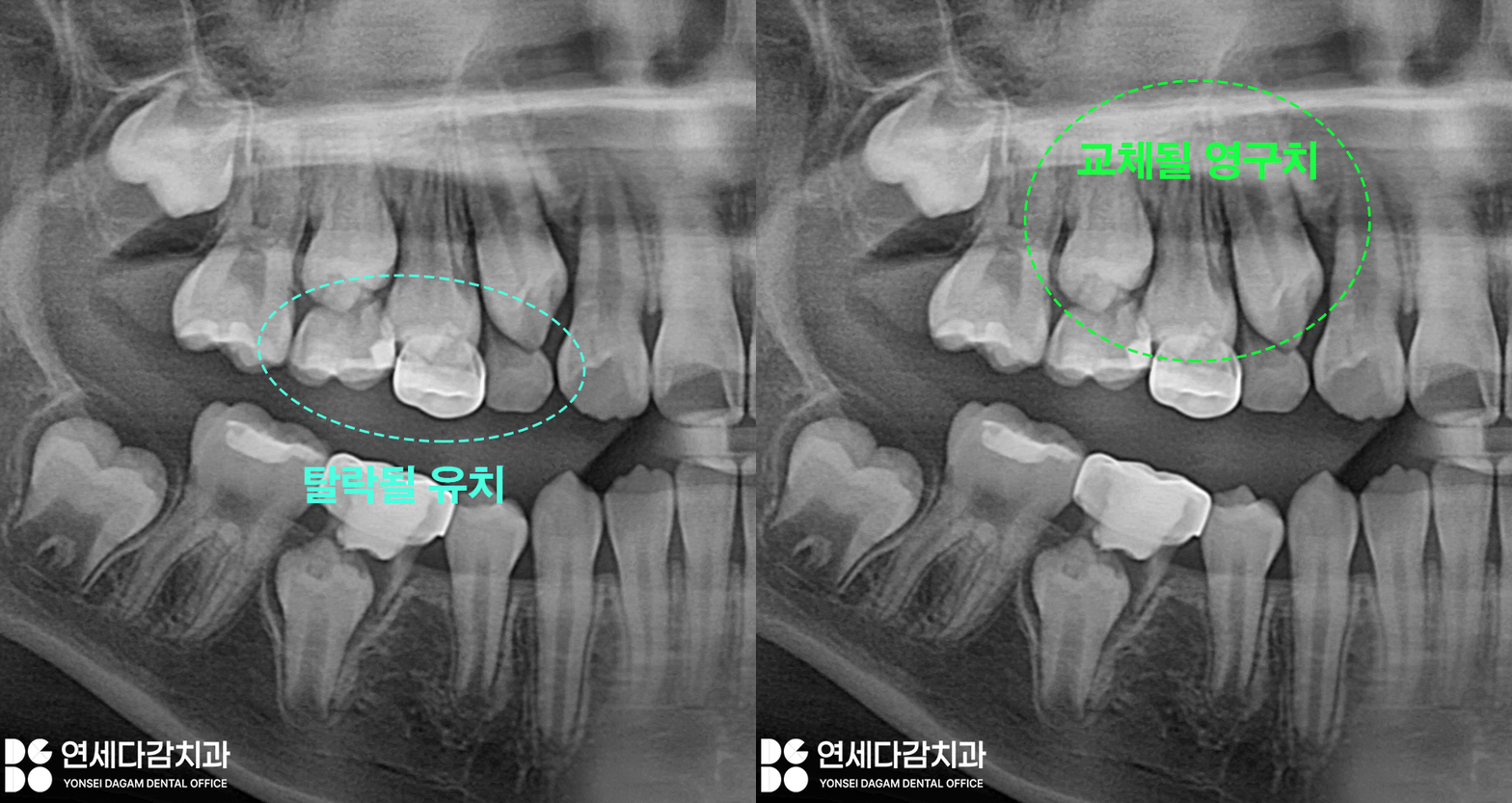
When an X-ray is taken,
it is normal to see the permanent tooth that will replace the baby tooth
coming up beneath the baby tooth that will fall out.
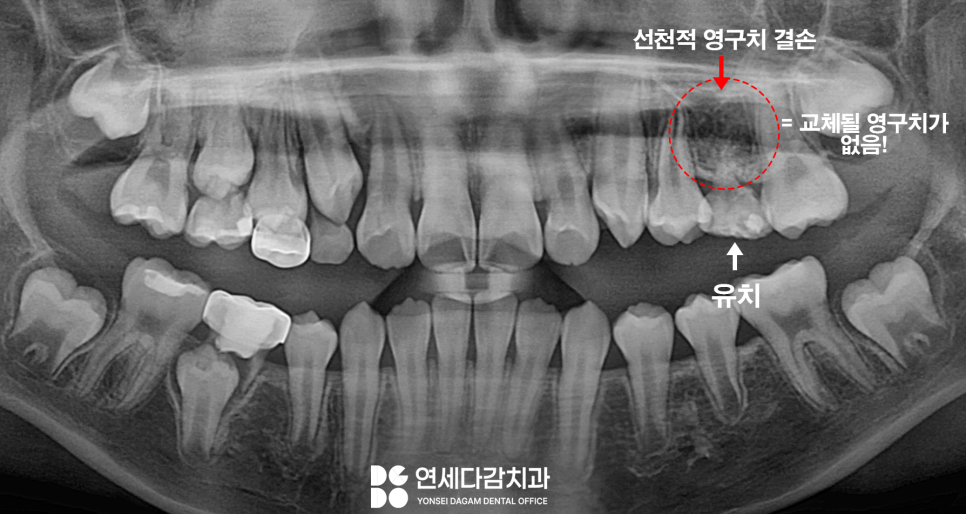
However, if the permanent tooth that should be inside the jawbone is not visible,
it is judged to be a congenital absence of a permanent tooth.
This is a more common phenomenon than you might think, and the results vary slightly depending on the study.
According to a paper we looked at at the Munjeong Station Dental Clinic,
about 10% to 12% of the population is said to have congenital absence of permanent teeth.
The most commonly missing teeth are the lateral incisors beside the front teeth and the second premolars, which are small molars.
Sometimes only one tooth is missing, and sometimes several are missing at the same time.
Because genetic factors play a major role, if a parent or sibling has missing permanent teeth,
it is characteristic that the child is also more likely to have the same issue.
Therefore, if a family history is suspected,
we recommend getting examined early.
Early detection makes it possible to establish an appropriate treatment plan,
which helps manage a child’s oral health.
Do baby teeth really need to be removed?
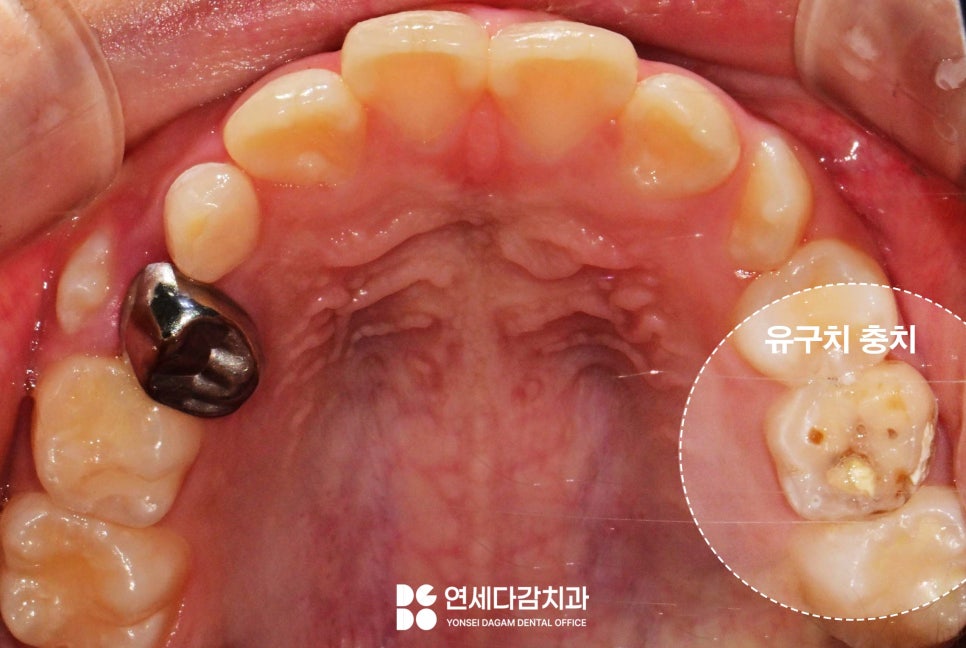
In general, if a baby tooth has severe cavities and there is not enough jawbone supporting the root, extraction is recommended.
However, as shown by the Munjeong Station Dental Clinic, the situation is different when there is no follow-up permanent tooth.
If the baby tooth is removed, the space will be left empty,
and pediatric patients cannot undergo implant surgery.
If it is lost, the empty space will remain for a long period until the child finishes growing.
Therefore, there is a method of wearing a space-maintaining device so that the surrounding teeth do not move,
but it must be worn for several years until the child’s growth is complete,
which can be inconvenient.
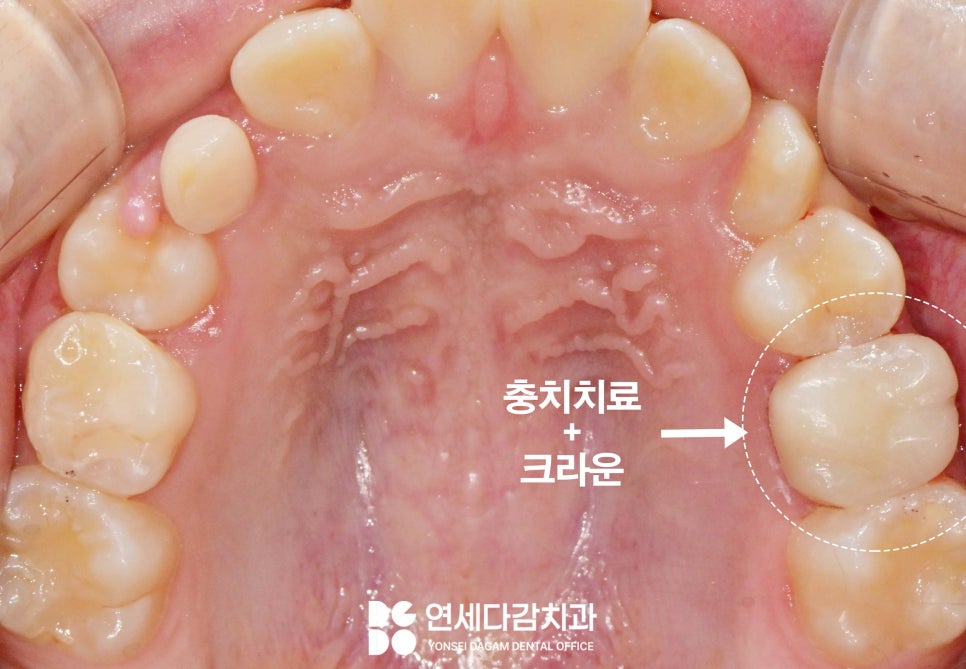
On the other hand, if the cavity is treated and a crown is placed,
the crown itself serves to maintain the space.
If the baby tooth remains in the place where a premolar should be,
it can be restored to function by being made into a molar-shaped crown.
This allows the space to be preserved naturally without a separate device,
which can greatly reduce discomfort.
Therefore, in such cases, the Munjeong Station Dental Clinic advises that, as long as the condition of the baby tooth allows,
it is best to preserve it whenever possible.
Of course, this does not mean keeping every baby tooth unconditionally;
it applies only when it can be restored with cavity treatment and the root is healthy to some extent.
What should be done if the baby tooth falls out?
In fact, even if a baby tooth is preserved this way, it is difficult to use it as long as a permanent tooth.
Because there are limits to preservation,
it is often extracted in the 30s to 40s.
This is because baby teeth and permanent teeth have fundamental anatomical differences.
To explain the main differences at the Munjeong Station Dental Clinic,
baby teeth have thinner enamel and dentin than permanent teeth.
Because they contain less mineral and more organic material and water,
there is a difference in strength.
Also, the roots of baby teeth are designed to be naturally resorbed when the permanent teeth come in,
so the roots are short and relatively weak.
Therefore, before treatment,
we fully explain these structural limitations to the guardian,
and we must inform them that extraction may be needed later or that the tooth may eventually fall out.
When there is congenital absence of permanent teeth,
regular checkups become even more important.
By visiting the dental clinic every 3 to 6 months to check the condition of the baby tooth,
and actively carrying out cavity-prevention treatments such as fluoride application or sealants,
we can help the baby tooth last longer.
The earlier it is detected,
the better the treatment plan can be established,
so please keep a close eye on your child’s oral condition!
This was Yonsei Dagam Dental Clinic at Munjeong Station.
Thank you.
2025.11.13~2025.11.20