Even if you brush very diligently,
if you have bad breath coming from the back of your molars,
it is worth suspecting your wisdom teeth.
In particular, if the wisdom tooth has not fully erupted
and only part of the crown has poked through the gum,
that gap may be the source of the problem.
At a Garak-dong dental clinic,
this condition is called partial eruption.
It is neither completely buried
nor fully erupted,
and being stuck somewhere in between
can actually be more troublesome.
Problems caused by partially erupted wisdom teeth
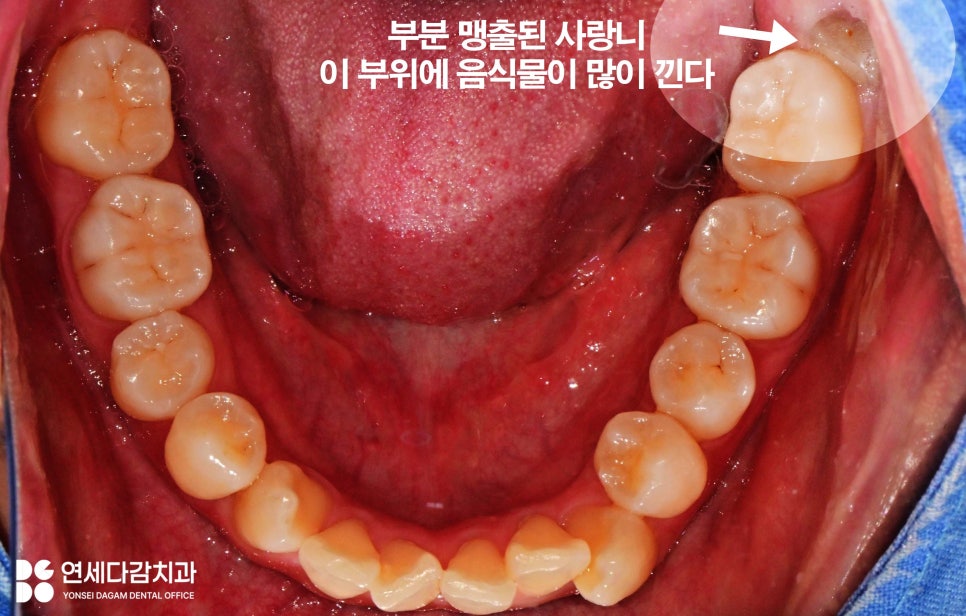
If only part of the wisdom tooth emerges,
a gap forms between the gum and the tooth.
This gap has a pocket-like deep structure,
so it is difficult for toothbrush bristles to reach.
When food gets in, it is hard to remove,
creating an environment where bacteria can thrive.
As a result, gum inflammation keeps recurring,
bad breath develops, and cavities can form,
and in severe cases,
the decay can even spread to the front molar.
Also, when the gum is swollen, if it is repeatedly irritated during chewing,
the swelling can become worse,
sometimes leading to trismus, where the mouth cannot open properly.
If these problems are present or are likely to occur,
the Garak-dong dental clinic
will recommend wisdom tooth extraction.
Why simple extraction is not possible
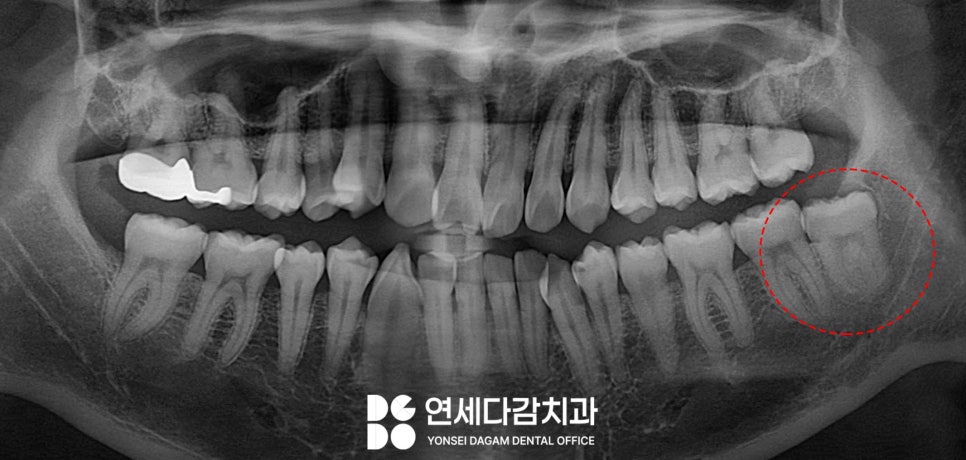
When checking the condition of a wisdom tooth,
a panoramic X-ray is generally taken.
A panoramic image allows you to see the entire jaw at once,
so it gives a rough idea of the wisdom tooth’s
position and direction.
However, because it is a two-dimensional image,
it has limitations.
In particular, if the root tip of the wisdom tooth
appears to be close to the inferior alveolar nerve,
it is difficult to know accurately
whether they are actually touching or separated.
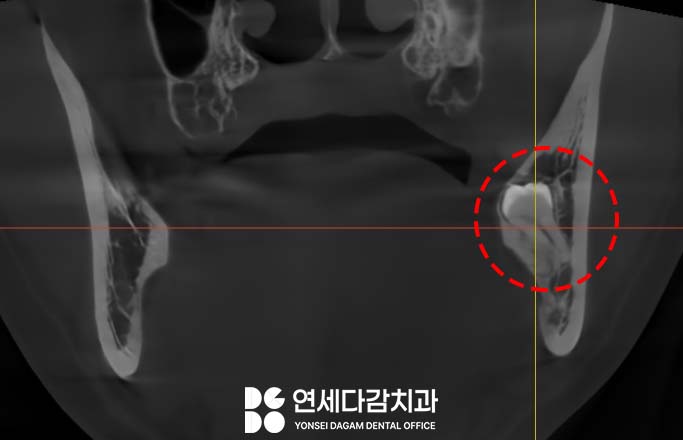
In such cases, CBCT imaging is necessary.
CT provides three-dimensional images,
showing the relationship between the nerve canal
and the tooth root in detail.
When diagnosing wisdom teeth,
the Garak-dong dental clinic takes CT scans as a standard
to plan a safe extraction.
When looking at the CT,
there are cases where part of the tooth
is buried in the bone.
In particular, if the back part of the tooth
is trapped in the alveolar bone,
it is impossible to pull it out upward.
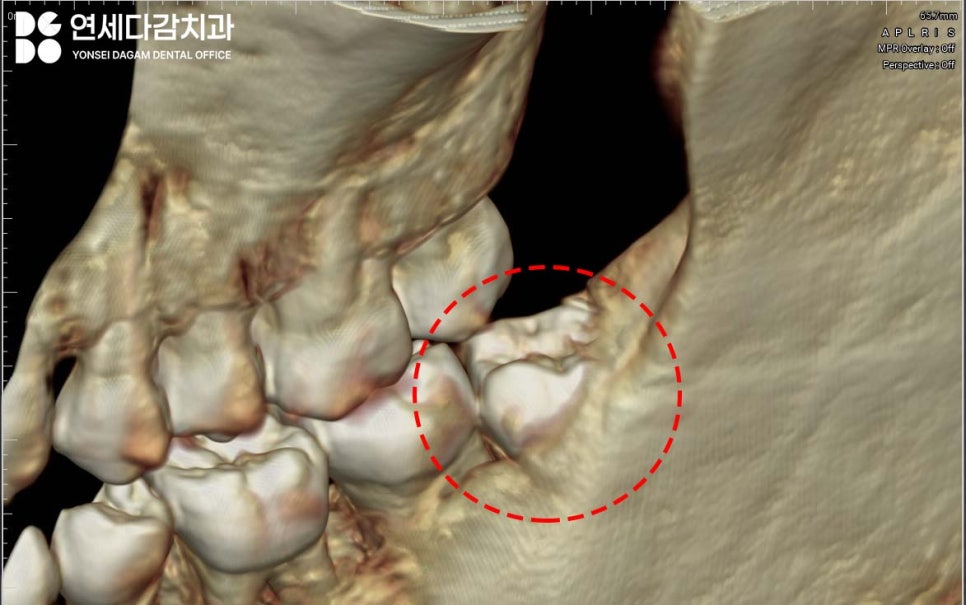
It is like not being able to simply lift out
a stone that is half-buried in the ground.
Just as you need to dig around the soil
to remove the stone,
you also need to remove part of the surrounding bone
to extract the wisdom tooth.
In such cases, the gum is incised,
the bone surrounding the tooth is removed,
and then the extraction is performed.
Cases where bleeding may be heavy
During impacted wisdom tooth extraction,
there are situations where bleeding can increase.
The first is when a large amount of alveolar bone
needs to be removed.
Because blood vessels are distributed within the bone,
a larger removal area can also increase bleeding.
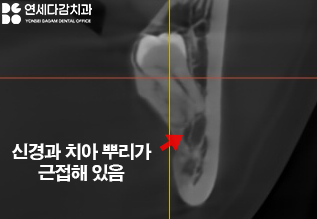
The second is when the tooth root
is in contact with the inferior alveolar canal.
Because of the name inferior alveolar canal,
it is easy to think that only the nerve passes through it,
but that is not actually the case.
Inside this canal,
the inferior alveolar artery runs together with
the inferior alveolar nerve.
So if the root is close to the nerve canal,
the blood vessels may be irritated during extraction,
which can increase bleeding.
This is also why the Garak-dong dental clinic
takes CBCT scans:
to understand these structures in advance.
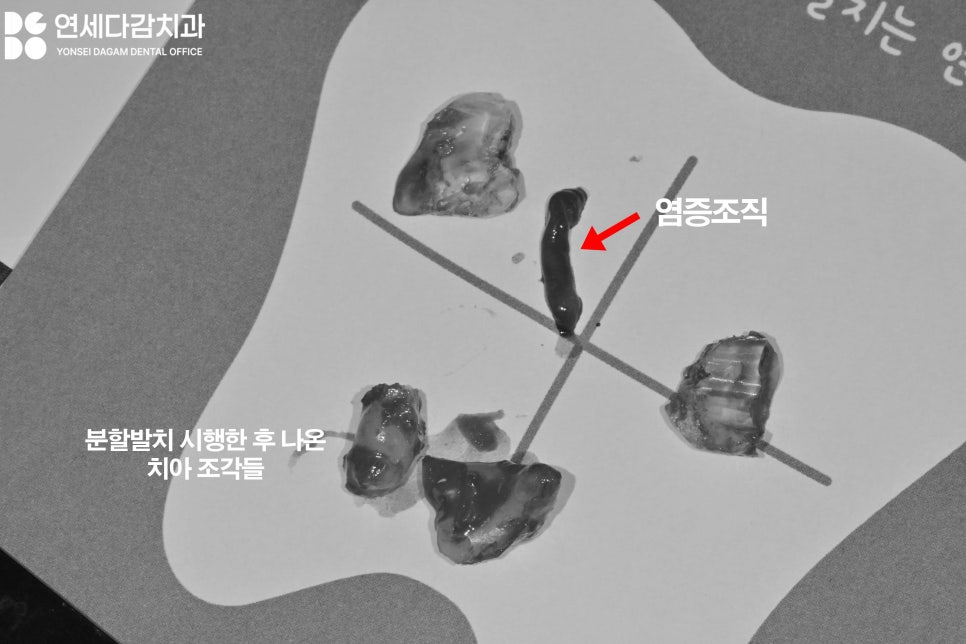
When impaction is severe
or the root is in contact with the nerve canal,
a sectioning extraction is performed.
Sectioning extraction is a method of removing the tooth
in several pieces rather than taking it out whole.
💡
Why is this done?
To remove the tooth whole,
force must be applied using the lever principle.
At this point, strong pressure is transmitted to the root tip,
which increases the risk of nerve damage.
However, if the tooth is cut into pieces,
the force needed to remove each piece is reduced,
and by working in the direction opposite the nerve,
the pressure applied to the root tip is also reduced.
At the Garak-dong dental clinic,
this method is often chosen
to reduce the risk of nerve injury.
Why a hemostatic agent is used
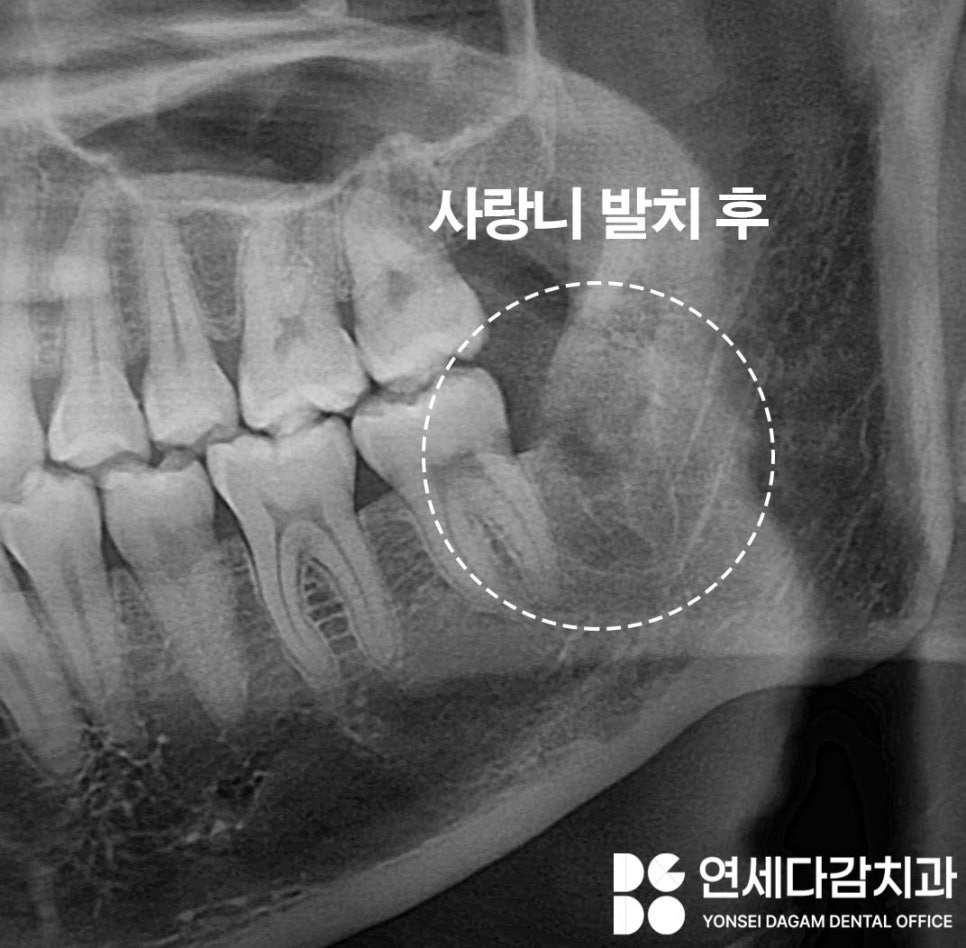
After the extraction is finished,
a space is left where the tooth used to be.
This space is called the extraction socket.
In most cases, bleeding can be stopped naturally
by biting on gauze and applying pressure.
However, if heavy bleeding is expected
or if a large area of bone was removed,
a hemostatic agent may also be placed in the extraction socket.
A hemostatic agent helps blood clot
and plays a role in controlling bleeding.
Over time, it is naturally absorbed
or comes out on its own,
so there is no need to remove it separately.
As explained today by the Garak-dong dental clinic,
if a wisdom tooth is partially erupted,
it creates an environment where problems can arise at any time.
Before inflammation keeps recurring
or affects the teeth in front,
it is a good idea to consult about whether extraction is needed,
and with treatment methods that support smoother healing,
such as sectioning extraction and a hemostatic agent,
we hope you can safely resolve wisdom tooth problems!
Thank you.
2025.12.19~2025.12.26