At some point, when eating cold food,
if your teeth start to feel sensitive,
people may say,
"Am I getting older now?"
Does sensitivity naturally become more common as we age?
It is not something that simply happens by default,
but it is closely related to tooth morphology.
At Yonsei Dagam Dental Clinic near Gareong Station,
let’s take a look at why.
Teeth do not regenerate
Unlike other body tissues,
tooth enamel does not have regenerative ability.
If the skin is cut, it heals again,
and even if a bone breaks, it can knit back together,
but once a tooth is damaged,
it does not grow back or recover.
Therefore, since we must use the same teeth for our entire lives,
as we age,
tooth problems are bound to increase.
Over a long period of use,
wearing down little by little
is, in a way, a natural phenomenon.
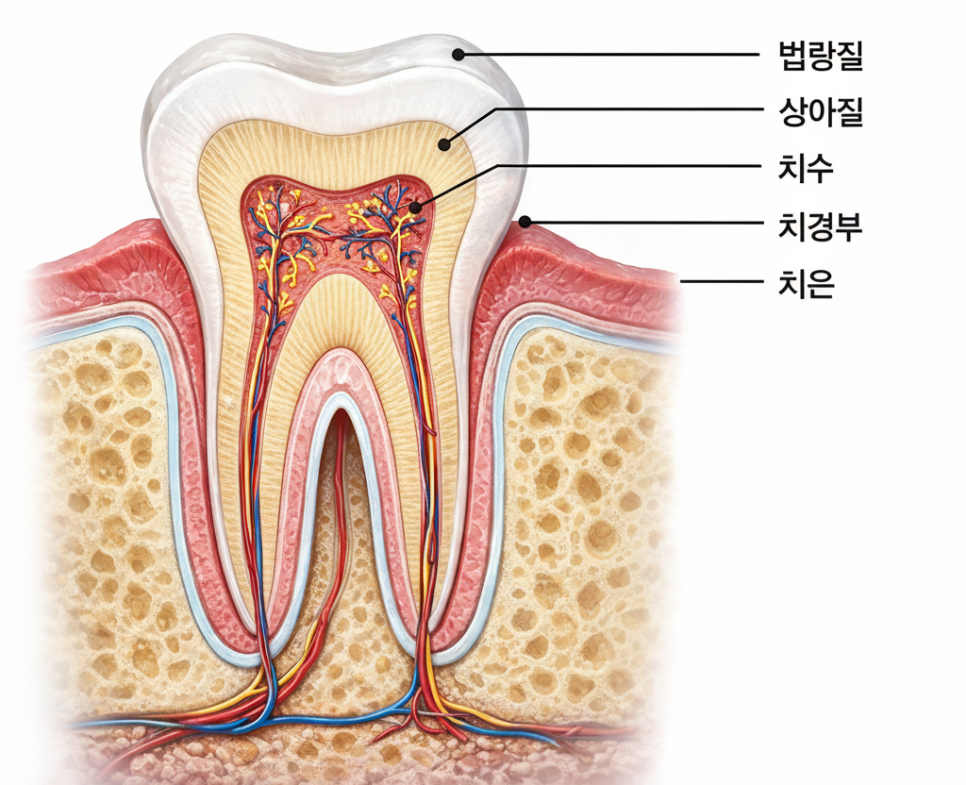
Looking at tooth structure,
the outer surface is covered by a hard layer called enamel.
Enamel is the hardest tissue in the human body
and protects the tooth from external stimuli.
However, as it gets closer to the cervical area,
the neck part of the tooth,
the enamel becomes thinner.
The cervical area refers to the boundary where
the crown and root of the tooth meet,
and it is located near the gum line.
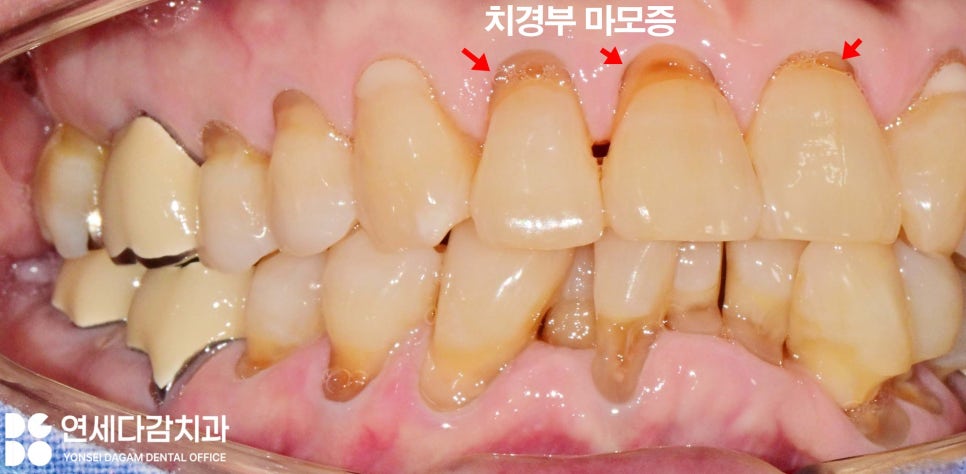
Because this area has thinner enamel than other parts,
it is more likely to be subjected to continuous force,
or to wear down or chip little by little
due to physical causes.
This phenomenon is called cervical abrasion.
Why do teeth become sensitive when they wear down?
Inside the enamel is a layer called dentin.
Dentin contains many tiny tubules,
and these tubules are connected to the tooth’s internal nerves,
so they are sensitive to external stimuli.
When cervical wear causes the enamel to wear away,
the dentin becomes exposed to the outside.
At this stage, if you eat cold or hot foods,
or sweet foods,
stimuli are transmitted through the microscopic tubules in the dentin,
causing sensitivity.
Just as an exposed wound on the skin stings
when it comes into contact with water,
a tooth that has lost its protective layer
also reacts sensitively to stimulation!
Causes of cervical abrasion
To explain the causes of cervical abrasion
at the Gareong Station dental clinic,
in the past, the prevailing view was that it was caused by improper brushing.
However, according to recent studies,
there are more findings showing that it is caused by strong occlusal force
that is continuously applied to the teeth,
such as clenching or grinding.
When you clench or grind your teeth, force is applied to them,
and that force is concentrated on the weak cervical area of the tooth,
causing it to chip away little by little.
At the Gareong Station dental clinic as well,
when examining patients with cervical wear,
it is often observed that many have a clenching habit.
Improper brushing can still be a cause, too.
As mentioned earlier, improper brushing refers to
a method called horizontal scrubbing,
in which the toothbrush is rubbed forcefully from side to side.
If you repeat brushing this way,
the bristles repeatedly rub against the gum line,
wearing down the thin enamel.
In addition, people who regularly enjoy hard or chewy foods
may also develop cervical abrasion.
This is because chewing ice or foods with a tough texture,
such as dried squid, places stress on the teeth.
What happens if it is left untreated?
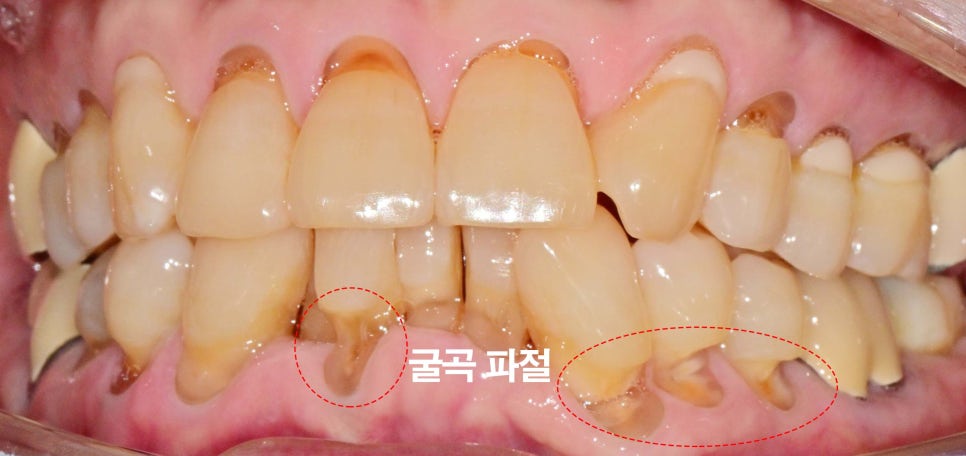
If cervical wear is left untreated,
the worn area can gradually deepen
and develop into a form called wedge-shaped defect.
This means the neck of the tooth is hollowed out
into a V-shape or wedge shape.
If this condition becomes severe,
it can progress beyond simple sensitivity
and cause pain.
If the stimulus is transmitted beyond the dentin and reaches the nerve,
it may even become a situation that requires root canal treatment.
Above all, the tooth structure itself becomes weaker,
which increases the risk of fracture.
That is why, at the appropriate time,
it is important to protect the tooth
by filling it with material.
Treatment methods
The treatment method is to fill the worn cervical area
with material
to prevent further damage.
This method fills in the already worn-away area
and protects the dentin from external stimuli.
The materials used here are broadly
resin and
glass ionomer (GI).
Each material has different characteristics,
and the choice depends on the area and the situation.
✅ Resin is similar in color to the tooth,
so it offers excellent aesthetics.
It also has good adhesion and high strength,
so it tends to last well.
However, it is a non-covered item
that is not covered by health insurance.
✅ Glass ionomer
releases fluoride, which helps prevent cavities,
and has the characteristic of chemically bonding with tooth tissue.
Its strength is lower than resin,
but because it is a covered item under health insurance,
the cost burden is lower.
When treatment is needed in multiple areas,
there is no need to use only one material throughout,
and at the Gareong Station dental clinic,
the two materials are sometimes used in combination,
depending on the situation.
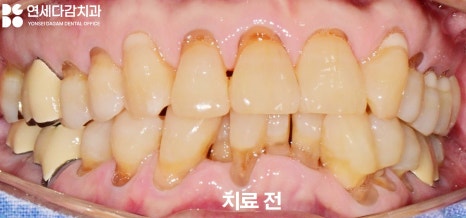
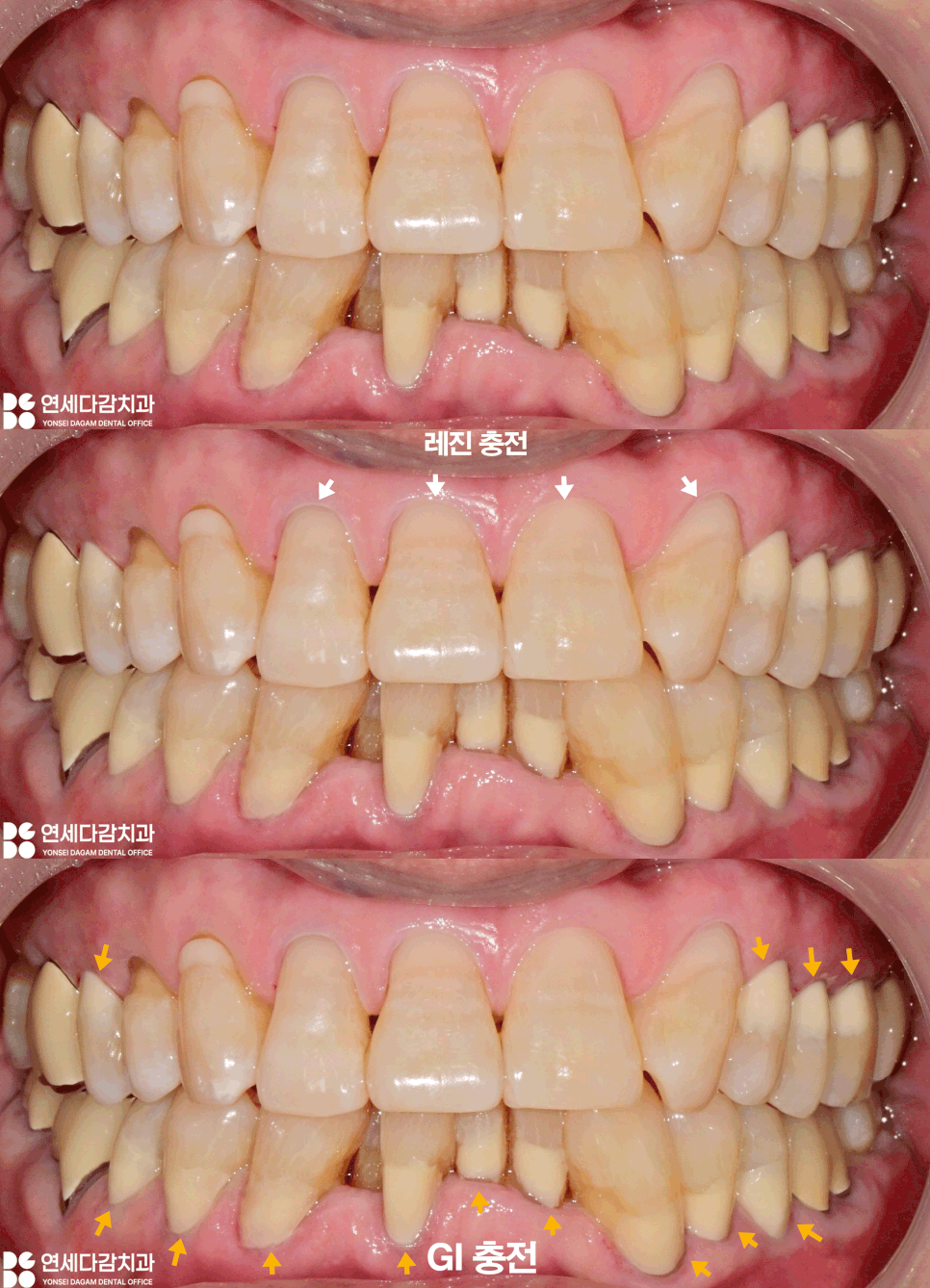
For the visible upper front teeth,
aesthetics are important, so they are filled with resin,
while areas that are not easily visible,
such as molars or lower teeth,
are filled with insurance-covered GI.
This way, the more noticeable areas
can maintain a natural color,
while the overall cost burden can be reduced.
During a consultation at the Gareong Station dental clinic,
you can check your wear condition and location,
and choose the appropriate material.
It is also important to address the root cause
If oral habits such as clenching or grinding continue
even after treatment,
the filled material may come off.
In addition, the same area may wear down again,
or new wear may occur in other teeth,
so
along with the filling treatment, it is important
to identify and address the root cause.
Please check whether you are using a night guard
or whether you are using an improper brushing method.
If you feel tooth sensitivity, do not leave it untreated;
please find out the cause!
This was Yonsei Dagam Dental Clinic near Gareong Station.
Treatment period: 2025.12.29