Hello^^
Ogeum Station Yonsei Dagam Dental Clinic
Chief Director Seo Hoyeon.
You lost a tooth, but are you putting off treatment thinking one tooth should be fine?
After losing an upper molar, you may later get examined to have an implant placed,
and be told that because there is not enough bone, a separate procedure is needed.
At times like this, a CT scan may show that the bone height is low and that there is a high risk of damaging the maxillary sinus.
Hearing unfamiliar terms for the first time and being told the surgery will become more extensive can be worrying.
What Is the Maxillary Sinus?
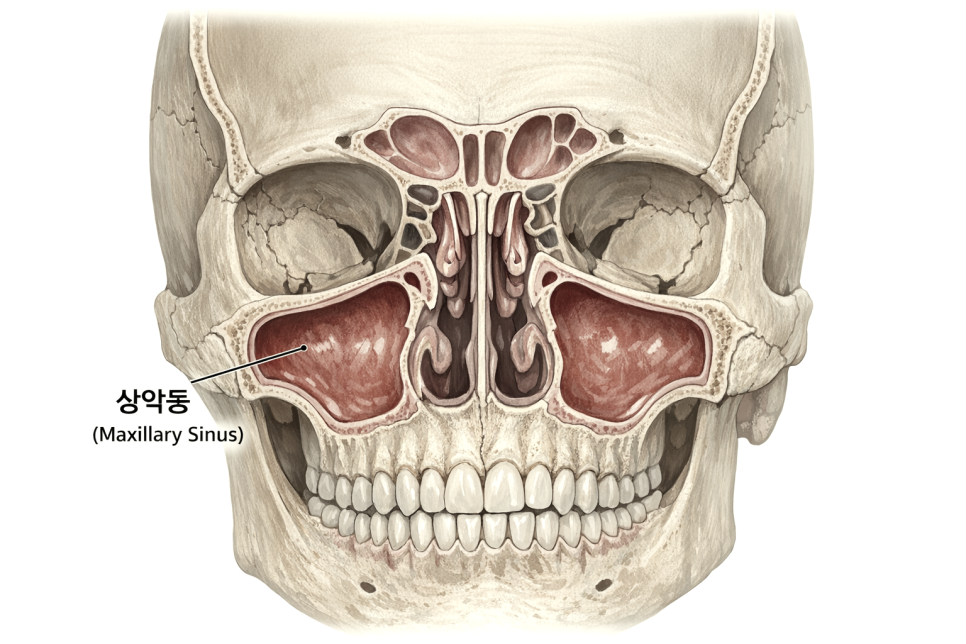
The maxillary sinus is a hollow space inside the upper jawbone.
It is located near the cheekbone beside the nose, above the roots of the molars, and there is one on each side.
This space, one of the paranasal sinuses, helps reduce the weight of the skull,
contributes to resonance in the voice,
and helps humidify air during breathing.
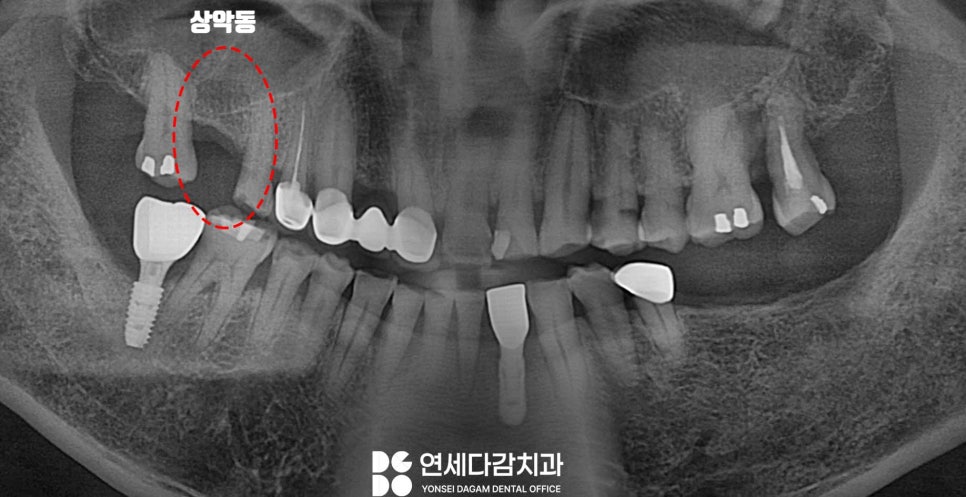
However, because it is located near the roots of the upper molars, this structure must be handled carefully when placing implants in this area.
💡
Why must it be handled carefully?
Because the maxillary sinus is covered with a thin mucous membrane,
it can be easily damaged during surgery.
If a perforation occurs,
bacteria can enter and cause inflammation,
which can also lead to implant failure.
In severe cases, liquid food may even leak out through the nose when eating.
Therefore, the procedure must be performed carefully so that the sinus membrane is not damaged.
However, the action that increases this risk of damage is leaving the area untreated after extraction.
Oral Changes After Tooth Extraction
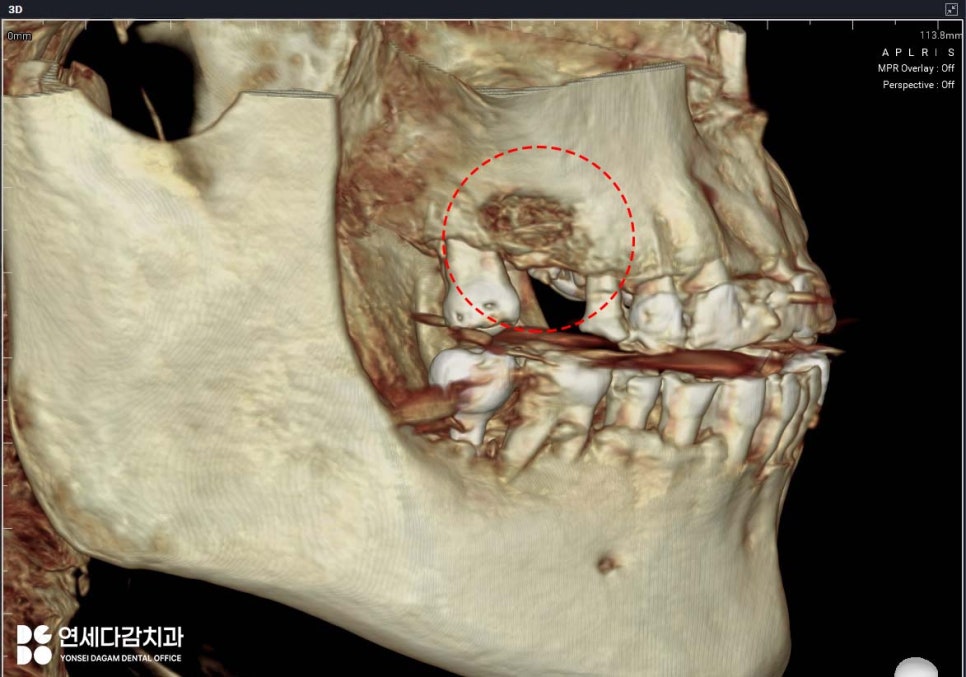
After a molar is removed, the jawbone is treated as unused bone,
so the gum bone gradually undergoes resorption.
As aging progresses, if sinus pneumatization—an enlargement of the maxillary sinus—also occurs,
the height of the jawbone decreases even more.
As a result, the remaining bone height available for implant placement may become significantly insufficient, at around 2–3 mm.
Therefore, to prevent damage,
Ogeum Station Dental Clinic performs a separate procedure called a sinus lift.
What Is a Sinus Lift?
Maxillary Sinus Lift
The sinus membrane is lifted upward, and bone graft material is placed in that space
to artificially create the height needed for implant placement.
In simple terms, it can be compared to securing enough height up to the ceiling.
The floor of the sinus is lifted,
and bone is placed underneath it
to create space for the implant.
During this process, it is important to carefully lift the sinus membrane so that it does not tear.
I will explain the two approaches.
Crestal Approach
(Crestal Approach)
Access is made through the pathway used for implant placement,
and the membrane is pushed upward from below.
An instrument called an osteotome may be used,
or pressure from hydraulic methods may be used to lift it.
This method involves a small gum incision range
and does not open the lateral bone,
so the surgery time is shorter and recovery is faster.
Because it can be performed at the same time as implant placement,
the treatment period is also shortened.
It is generally applied when the remaining bone height is at least 4 mm,
and is suitable when the required lift is within 3–4 mm.
Its characteristics are that it is difficult to directly confirm the membrane visually,
so it is hard to immediately detect whether a membrane perforation has occurred,
and there are limits to large-volume bone grafting.
Next, the second method explained at Ogeum Station Dental Clinic is the lateral approach.
Lateral Approach
(Lateral Approach)
Instead of approaching through the crestal area, a window is created on the lateral side of the maxilla to directly access the membrane.
After making an incision in the gum and exposing the bone,
an oval bony window is formed in the lateral wall of the bone.
Through this window, the membrane is directly observed and carefully detached and lifted.
The advantage is that because it can be lifted while being visually confirmed,
immediate response is possible if a problem occurs.
In addition, there is little limitation on the amount of lift,
so lifts of more than 10 mm are possible,
and a sufficient amount of bone graft material can be placed.
At Ogeum Station Dental Clinic,
this method is often used when the remaining bone is extremely insufficient, at 3 mm or less.
However, the surgical area is larger,
and there may be swelling and discomfort after surgery,
so enough healing time is also needed.
The appropriate method is chosen by comprehensively evaluating the remaining bone height, the required lift amount, and the bone quality.
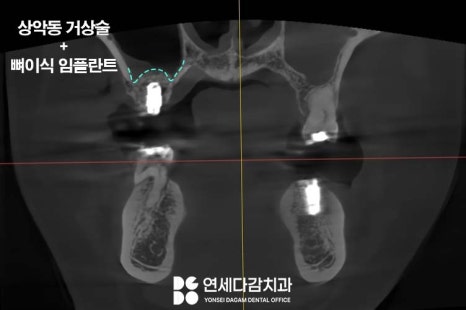
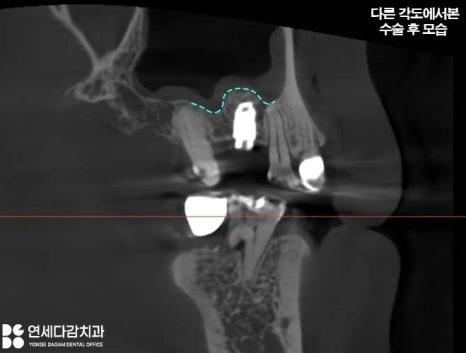
When the lateral approach is used,
after carefully lifting the membrane without damage,
bone graft material is placed in that space and covered with a barrier membrane,
and if possible, implant placement is also completed at the same time.
Depending on the remaining bone condition,
the implant may be placed simultaneously,
or after bone grafting, the implant may be placed after a healing period of 4–6 months.
Healing Period
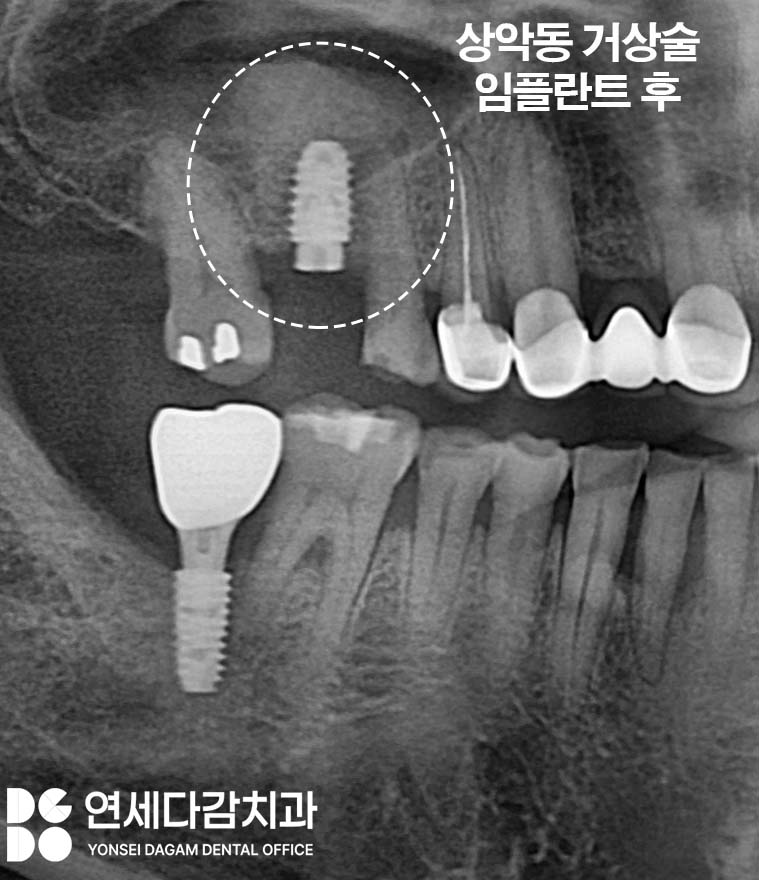
After the lateral approach explained at Ogeum Station Dental Clinic,
prosthetic treatment is usually carried out after a healing period of about 4–6 months.
Because such sufficient healing time is needed,
and because stable osseous maturation of the bone graft material is important,
postoperative care is very important.
Precautions
✔️ Do not blow your nose forcefully.
The pressure created when blowing your nose can affect the inside of the maxillary sinus.
When sneezing,
it is better to do so with your mouth open.
✔️ Avoid drinking through a straw
or smoking.
The sucking motion creates negative pressure inside the maxillary sinus and interferes with healing.
✔️ It is also better to avoid boarding an airplane for 2–4 weeks after surgery.
Changes in air pressure can have an effect.
✔️ Do not touch the area.
✔️ Be sure to attend regular checkups consistently.
Even if there is insufficient bone, you can restore oral function by proceeding with implant treatment using the methods explained by Ogeum Station Yonsei Dagam Dental Clinic,
so even if you were told that surgery is difficult,
I hope you can recover your oral health by receiving treatment from an experienced specialist.
Thank you!
Treatment period: 2025.8.20~2026.01.05