Hello.
This is Ogeum-dong Dental Clinic.
Teeth are made up of outer enamel,
inner dentin, and the pulp.
The pulp is the tissue where nerves and blood vessels are distributed,
and it plays the role of supplying nutrients and responding to stimulation.
However, when a cavity has progressed deeply
or the pulp is damaged by a strong impact,
root canal treatment is needed to remove this tissue.
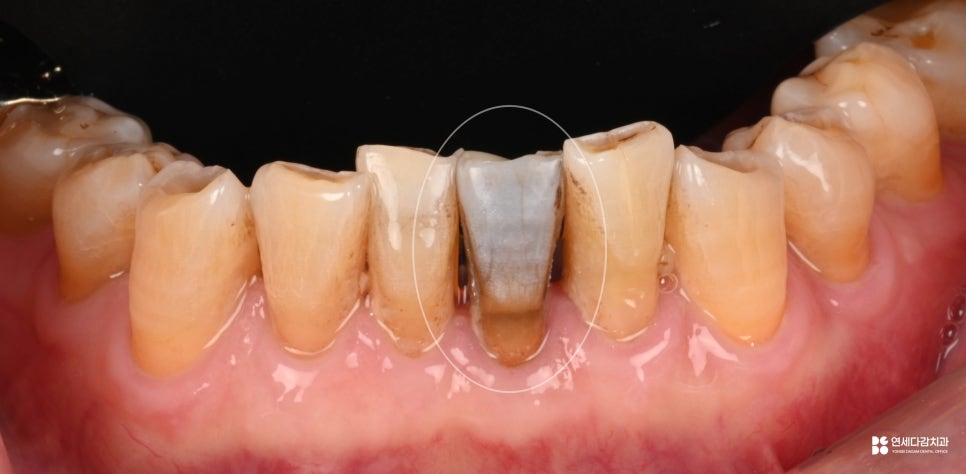
A tooth that has lost its pulp like this is called a nonvital tooth.
Even if it looks fine on the outside,
nutrient supply has been cut off.
As a result, over time the tooth becomes
increasingly dry, more vulnerable to impact,
and at the same time begins to gradually change color.
- What causes the color of a tooth to turn darker?
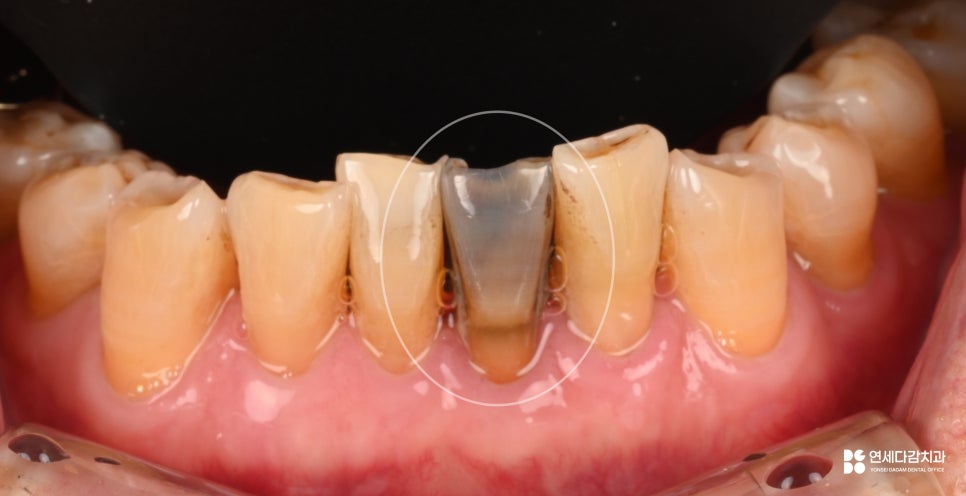
The cause of this discoloration
is the result of several processes acting together.
During root canal treatment, the blood vessels and nerve tissue are removed,
but it is difficult to completely clean out even microscopic blood components.
The remaining hemoglobin breaks down over time,
and during this process, its components penetrate the dentinal tubules
and gradually form dark pigment.
To add one more point from Ogeum-dong Dental Clinic,
the materials used for root canal filling can also be a factor.
For example, amalgam or certain sealer ingredients
can seep into the dentin and intensify staining.
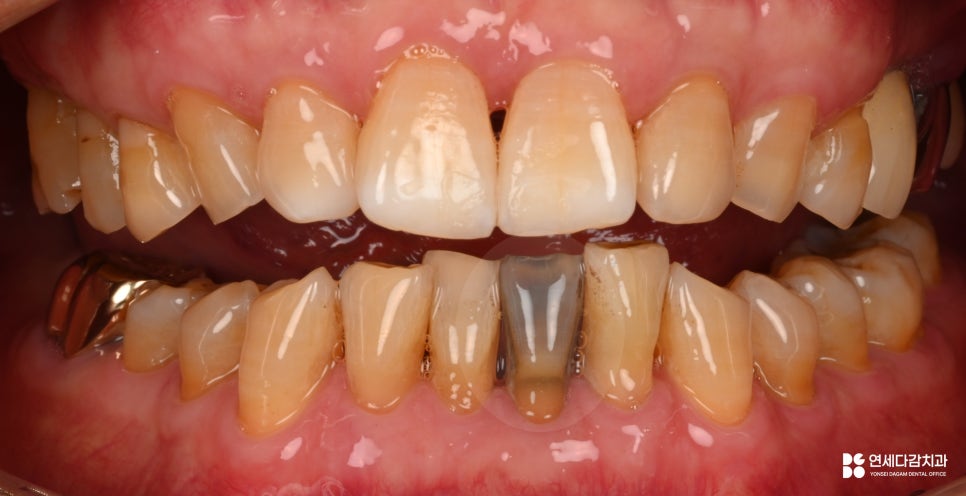
This is the mechanism by which the tooth becomes
gray or blackish in color.
The speed of this discoloration varies from person to person,
but it is often noticeable within months to years after treatment.
Of course, even if there is no problem with health itself,
if it is a front tooth that draws a lot of attention like now,
it may be worth considering whitening.
- Why ordinary whitening does not solve it
Discoloration caused by internal factors like this
is difficult to resolve with ordinary whitening.
No matter how much whitening agent is applied from the outside,
it cannot reach the layer containing the pigment,
so good results are essentially difficult to expect.
Therefore, in cases like the situation shown at Ogeum-dong Dental Clinic,
nonvital tooth whitening, which approaches from the inside, is chosen.
However, a careful assessment of the tooth’s health
must come first.
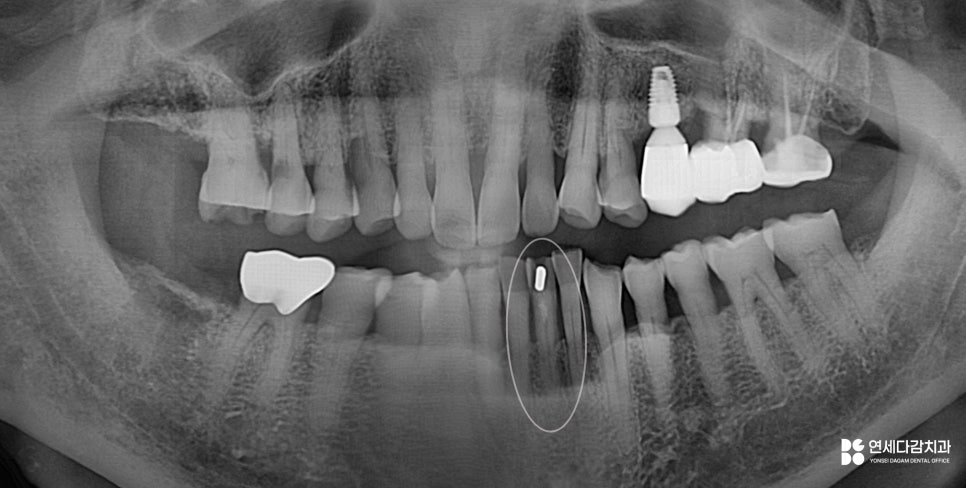
When looking at the X-ray,
we can confirm a history of previous root canal treatment,
but the internal filling was not properly completed.
This means that bacteria can enter the inside,
and there is a possibility that problems may recur at any time.
Therefore, proceeding with whitening as it is
is not considered appropriate.
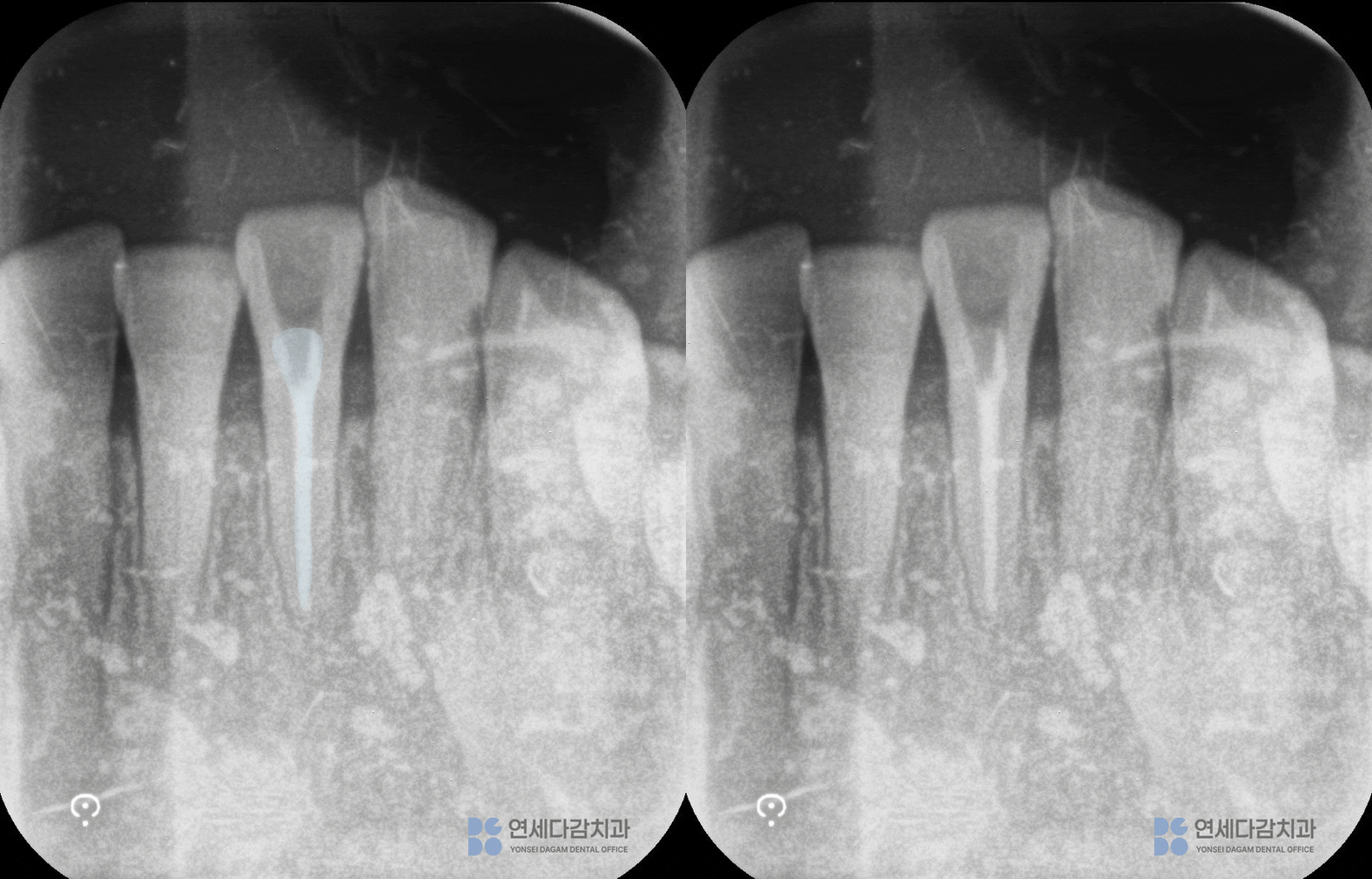
After removing the existing filling material and cleaning the root canal,
the canal is filled completely all the way to the root apex,
and whitening is performed only after the internal environment has stabilized.
- Nonvital tooth whitening process
The process of nonvital tooth whitening itself is simple.
A mixture of hydrogen peroxide and sodium perborate
is placed inside the internal space.
At this point, there is one thing
that needs to be explained at Ogeum-dong Dental Clinic.
If the agent seeps around the root,
it can lead to root resorption.
In severe cases, it can even lead to extraction,
so this situation must be prevented in advance.
Therefore, the opening of the root canal is thoroughly sealed
to prevent the whitening agent from leaking toward the root.
After placing enough of the agent and sealing it with temporary material,
we observe the progress for about 1 to 2 weeks.
At the next visit, the agent is replaced,
and the process is repeated depending on the change in color.
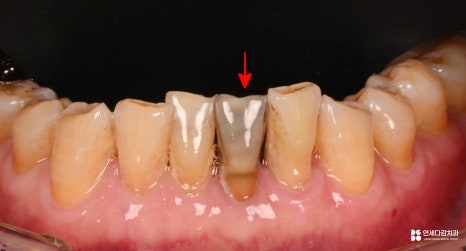
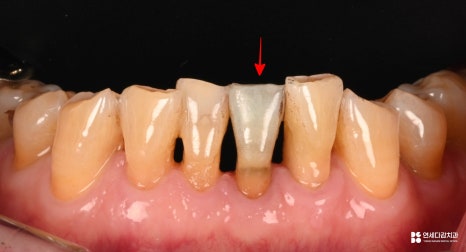
The case explained by Ogeum-dong Dental Clinic
was carried out over a total of three sessions.
As you can see in the photos, with each session
you can confirm that it becomes noticeably brighter.
- Things you must know after treatment
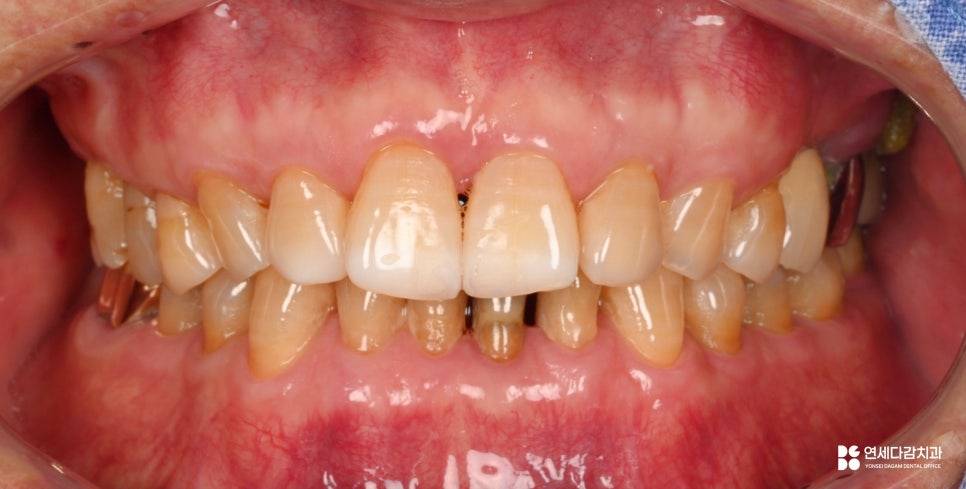
Once whitening is completed like this and the final filling is done,
the treatment is finally finished.
There is one point that must be emphasized.
The final filling is not performed immediately
just because the tooth has become brighter.
Because residual agent components inside can interfere
with the bond to the adhesive,
it is performed only after enough time has passed.
Following this sequence
is also more important than expected
for improving the prognosis of treatment.
In addition, the results are not permanent.
Over the years, it may gradually discolor again,
and in that case, retreatment should be considered.
If you understand this clearly from the beginning
and check the condition regularly,
that is one way to maintain the results for a longer time.
I hope this has been helpful to those who were worried
about a tooth that has turned dark,
and I will end the post here.
This has been Ogeum-dong Dental Clinic.
Thank you.
2025.11.15 ~ 2025.12.28