Welcome.
Songpa Station Dentist, 연세다감치과
I am Seo Ho-yeon, the director.
“My dentures keep moving,
and eating is uncomfortable.”
I often meet patients in the consultation room who say this
and are considering implants.
When dentures are first made, they fit the gums well,
and many people find that eating
feels more comfortable than before.
This is because dentures are made to match
the shape of the gums and the condition of the remaining teeth
at the time they are created.
However, as time passes,
the condition inside the mouth gradually changes.
The jawbone in areas where teeth have been lost may decrease,
and repeated chewing forces are transmitted
to the teeth that support the dentures.
If this burden accumulates over a long period,
the teeth supporting the dentures may become loose,
or may even break at some point.
However, the important point here is
that we should not make a judgment
by looking only at the single broken tooth.
I will explain this in more detail
through today’s case.
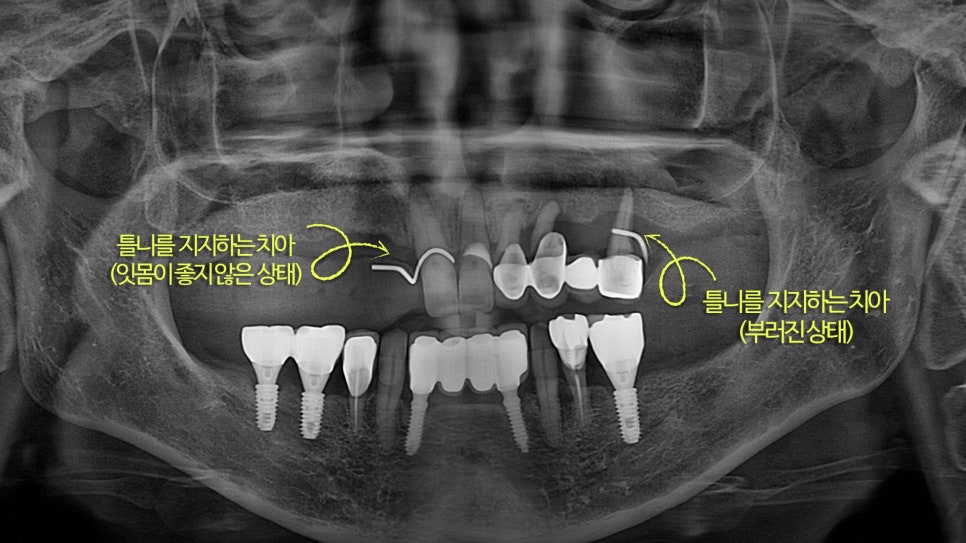
(November 10, 2025)
This patient had also been using dentures
for a long time.
Recently, the tooth that had supported the dentures
broke, making it more difficult to eat,
and the patient visited us for an implant consultation.
On the panoramic image, the tooth supporting the dentures
appears to still be present.
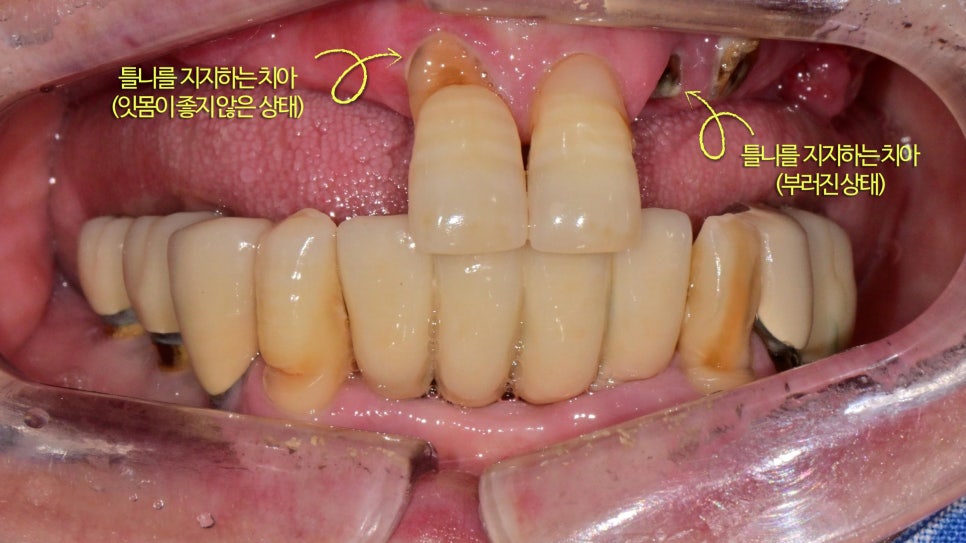
However, upon examining the oral condition,
we found that the tooth had already fractured.
With only the remaining teeth and the long-used prosthesis,
it was difficult to receive chewing forces stably.
In particular, there was almost no occlusion in the molar area,
so it was difficult to determine the standard
for where and how the upper and lower teeth should meet.
At that time, forces were concentrated mainly on the front teeth,
so it was necessary not only to determine
where to place the implants,
but also to plan together
where the upper and lower teeth should meet
in the future.
A method that can be used in this situation
is digital guided implant treatment.
What Is Digital Guided Implant Treatment?
Songpa Station Dentist, 연세다감치과
When people hear “digital guided implant treatment,”
most think of it as
“the process of deciding in advance where to place the implants.”
Of course, planning the position, angle,
and depth of the implants is important,
but what I consider even more important
is examining the position where the patient will chew in the future.
First, we determine the position where the teeth should ultimately be placed
so that the patient can chew naturally,
and then plan the implants in positions
that can stably support those teeth.
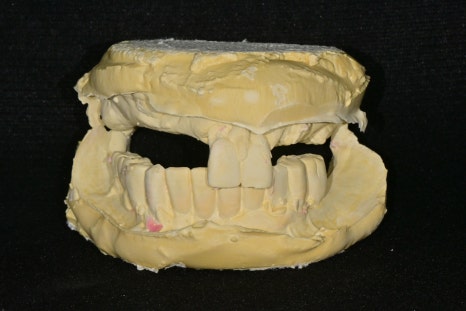
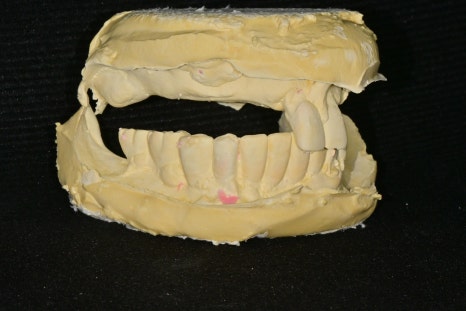
For this patient as well, we first took impressions of the upper and lower teeth
and made plaster models.
These models reproduce the patient’s oral condition
and serve as a basis for planning
where the teeth should meet in the future.
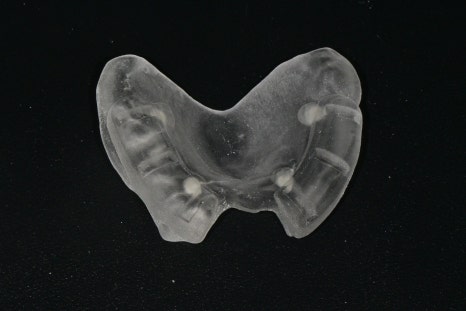
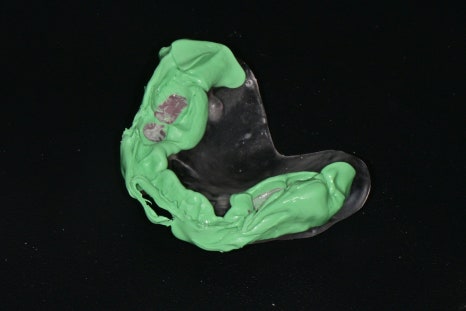
(November 14, 2025)
Next, we made a device for the CT scan.
This device is used to take the CT scan
based on the position of the teeth to be made in the future.
When the patient wears this device inside the mouth during the scan,
we can examine the relationship between the position where the teeth will be placed
and the jawbone.
Because this patient’s molars were barely meeting,
we first fixed the occlusion
so that the upper and lower teeth could meet
at the desired position.
When a CT scan and an intraoral scan are performed in this condition,
the implant placement position and prosthesis shape
can be designed on a computer.
During the virtual surgery,
we first planned where the prosthesis would be placed.
Next, we checked and determined the position, angle,
and depth of the implants one by one
so that they could stably support the prosthesis.
Once the virtual surgery was complete,
we made a dedicated digital guide
customized to the patient’s oral structure and treatment plan.
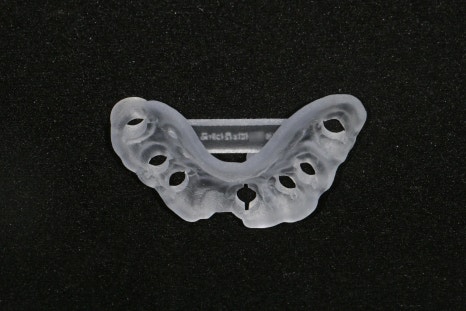
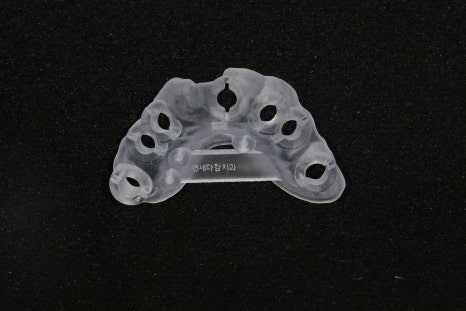
(December 16, 2025)
A digital guide is a device
that helps apply the plan established on a computer
to the actual surgical procedure.
By determining the direction of implant placement
based on the holes made in the guide,
the implants can be placed according to the position and angle
planned at the outset.
The advantage of digital guided implant treatment
is that various factors can be checked and planned
before surgery.
We can examine the condition of the jawbone,
where structures requiring caution,
such as nerves or the maxillary sinus, are located,
and where the final prosthesis should be placed.
We can also adjust the surgical area,
with a focus on the necessary regions,
because the planned positions are established in advance.
This can reduce the extent of gum incisions
and may also help lessen the burden of postoperative discomfort or swelling.
In particular, when several implants must be placed at the same time,
the direction and position of each implant
must correspond with one another.
That way, when the prosthesis is placed later,
it can be connected as a single structure
according to the initially planned occlusion and tooth positions,
rather than being joined forcibly.
At this stage, the digital guide also helps establish the implant placement plan
based on the position and occlusion of the final prosthesis.
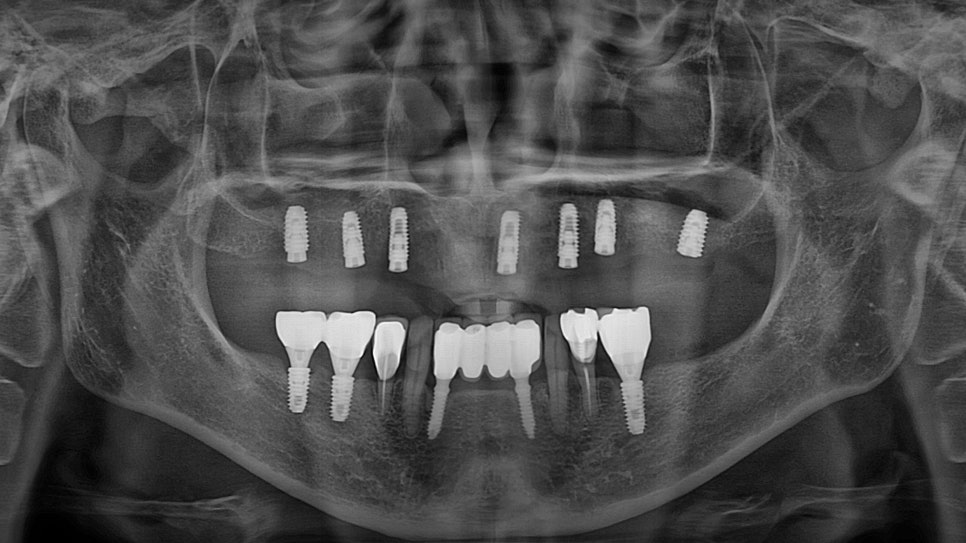
(April 20, 2026)
Here, you can see the implants placed
in the positions planned in advance.
Because the digital guide was made based on the positions and directions
planned on the computer before surgery,
we were able to proceed while checking the site, angle,
and depth for each implant
within the range determined in advance.
To summarize today’s discussion,
when occlusion has changed after using dentures for a long time,
it is not enough simply to decide where to place the implants.
We must also plan where the teeth should meet in the future,
at what height and with what occlusion they should be restored,
and in which direction chewing forces should be transmitted.
This can help reduce discomfort when chewing food after treatment
and allow the implants and prostheses to be used more comfortably.
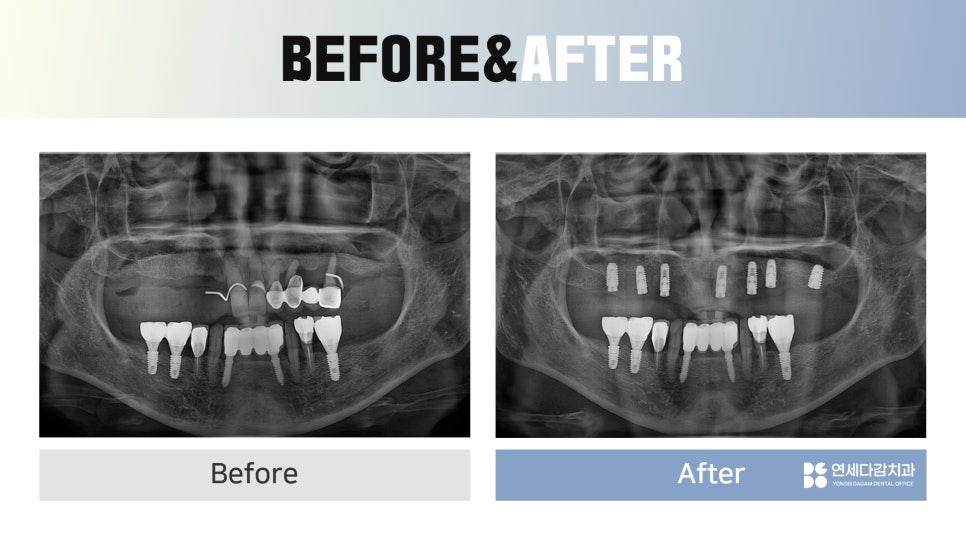
Songpa Station Dentist, 연세다감치과
examines the unseen jawbone structure
and occlusal relationship,
and works to establish a treatment plan
suited to each patient’s current condition.
In the next post,
I will continue by introducing the process
of how the full-arch implant treatment proceeded
through to the final prosthesis.
Thank you for reading this long post.
I hope you have a happy day today as well. ^^

👉 Naver appointment booking
👉 연세다감치과 website
👉 연세다감치과 KakaoTalk consultation channel
Songpa Station Dentist, 연세다감치과