Hello.
Geoyeo-dong Dental Clinic, Yonsei Dagam Dental Clinic
I am Dr. Seo Ho-yeon.
Some people visit the dentist because of pain or discomfort caused by cavities or gum disease,
while others come in for a consultation because they are concerned about the color of their teeth.
Sometimes all of the teeth may appear yellowish,
but when only one front tooth has become noticeably darker,
it should be examined somewhat differently from ordinary staining or general changes in tooth color.
In particular, if you have previously injured a front tooth by falling or bumping into something,
changes in the nerve inside the tooth may be the cause of the discoloration.
Today, through the case of a patient who had been concerned for a long time after their tooth changed color following trauma,
I will explain why a tooth may darken after trauma
and how non-vital tooth bleaching is carried out.
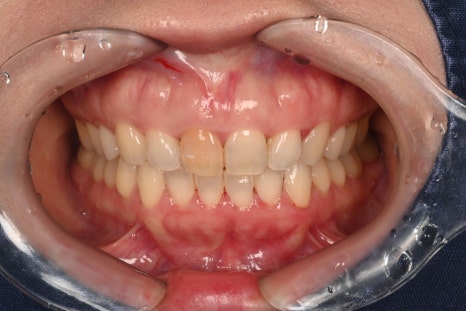
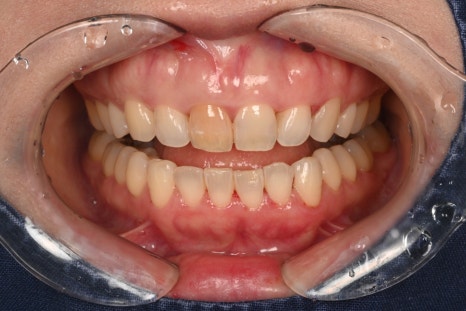
(May 23, 2026)
The patient said that after injuring their front tooth as a child,
the color of that tooth gradually became darker.
Because they had not experienced significant pain for a long time,
they had continued living with the condition,
but they said that the difference in the color of the front tooth continued to bother them when smiling or speaking,
and that their aesthetic concern had persisted for a long time.
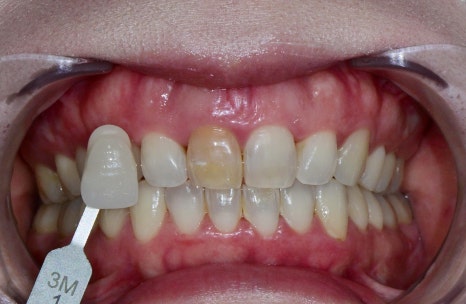
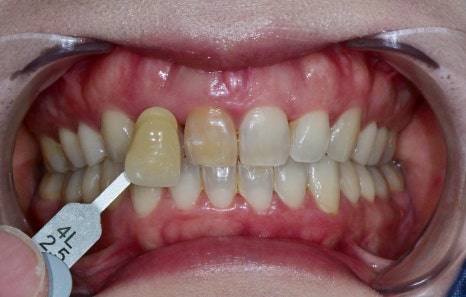
As you can see in the photos,
one of the front teeth was noticeably darker and discolored compared with the surrounding teeth.
Why do teeth become discolored after trauma?
Geoyeo-dong Dental Clinic, Yonsei Dagam Dental Clinic
Although teeth appear hard on the outside,
there is a space inside them through which nerves and blood vessels pass.
When a tooth is injured by falling, bumping into something, or similar trauma,
the nerve inside may be damaged even if the tooth does not immediately break.
When the nerve and blood vessels are damaged,
changes in color may occur inside the tooth.
At first, you may not notice a significant difference,
but over time the tooth may gradually become darker,
taking on a grayish or brownish color.
A tooth whose nerve is no longer alive in this way is also referred to as a non-vital tooth.
An important point is that the absence of pain does not necessarily mean that the inside of the tooth is healthy.
Even when the dental nerve has already been damaged,
some people experience no particular symptoms if there is no pus or inflammation around the root.
Therefore, when a tooth is discolored after trauma,
it is necessary to examine not only the visible color,
but also the condition of the tooth root and surrounding bone through radiographs.
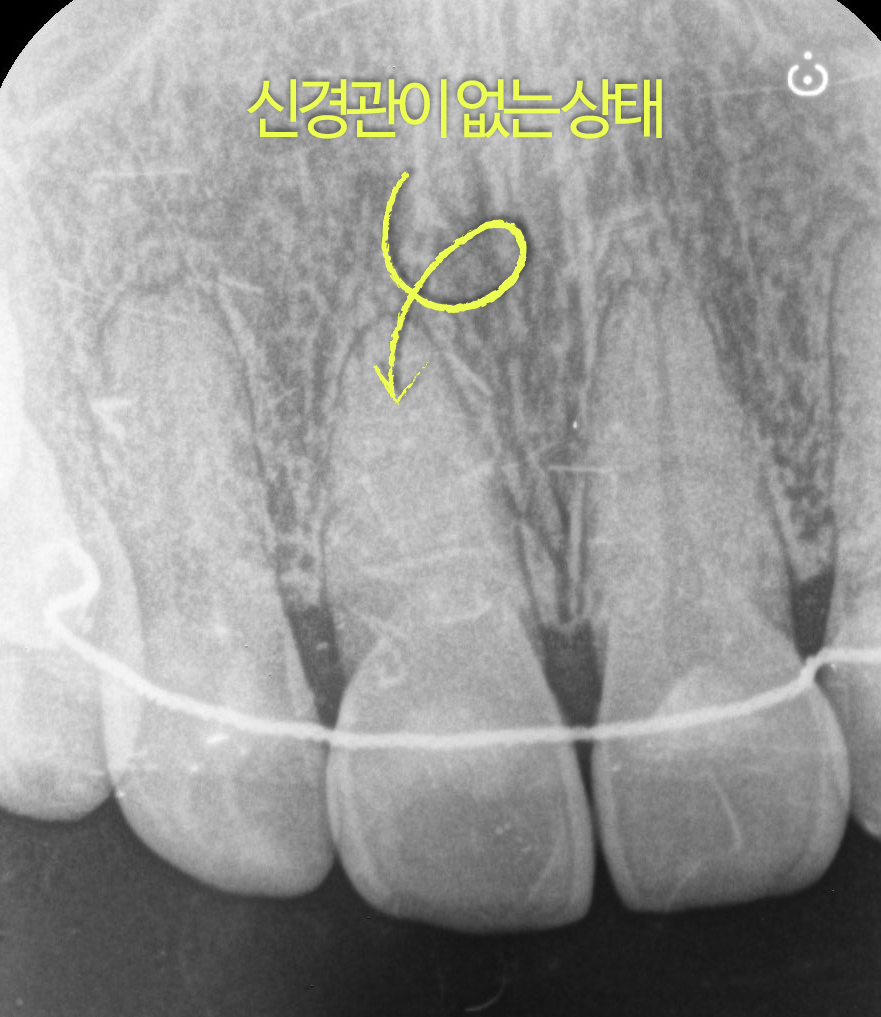
For this patient as well, radiographs were used to examine the space inside the tooth and the condition around the root.
The examination suggested that the nerve in the tooth had lost its function after the trauma,
but there were no clear signs of infection around the root.
However, because the tooth had not previously undergone root canal treatment,
root canal treatment was needed first before proceeding with non-vital tooth bleaching.
On a radiograph, a tooth that has undergone root canal treatment shows the filling material inside the tooth root as a white area.
These findings were not visible in the patient's tooth.
Therefore, root canal treatment was performed first to address the condition inside the tooth.
However, in teeth where a long time has passed since the trauma,
the root canal may have narrowed or become blocked.
In this case as well, the root canal had narrowed, making it difficult to secure sufficient access to the passage inside the root,
so treatment was carried out within the possible range.
What is non-vital tooth bleaching?
Geoyeo-dong Dental Clinic, Yonsei Dagam Dental Clinic
Non-vital tooth bleaching is a treatment that brightens a discolored tooth by applying a bleaching agent inside the tooth when the nerve is no longer alive.
With conventional bleaching, a bleaching agent is applied to the outer surface of the teeth to brighten their overall color.
Non-vital tooth bleaching, on the other hand, is different in that it accesses the space inside the tooth when only one tooth has become dark due to internal changes.
In simple terms, rather than brightening the tooth only from the outside,
it is a treatment that induces a change in color from inside the tooth, where the discoloration began.
However, non-vital tooth bleaching is not a treatment that can be started immediately.
As mentioned earlier, the condition inside the tooth and whether there is inflammation around the root must first be checked,
and, if necessary, as in this patient's case,
root canal treatment must be performed first before planning the bleaching process.

How is non-vital tooth bleaching carried out?
Geoyeo-dong Dental Clinic, Yonsei Dagam Dental Clinic
Non-vital tooth bleaching is performed by placing a bleaching agent inside the tooth
and checking the change in color over a set period of time.
Sometimes the desired color is achieved after a single procedure,
but in most cases, treatment is carried out in stages while observing the tooth's response.
The duration of discoloration, degree of internal discoloration,
and response of the tooth tissue vary from tooth to tooth,
so the speed and results of the color change may differ.
Therefore, non-vital tooth bleaching is not necessarily a treatment that is completed in one session;
it requires a process of checking the color change while monitoring the condition of the tooth.
(May 23, 2026)
In treatment for a discolored front tooth,
it is also important to consider not only how much brighter the tooth has become,
but also how naturally it blends with the surrounding teeth.
The front teeth are especially visible when smiling or speaking.
Therefore, if only one tooth becomes excessively bright,
it may instead look unnatural.
Before and after treatment,
a shade guide was used to compare the current tooth color
and check its harmony with the surrounding front teeth.
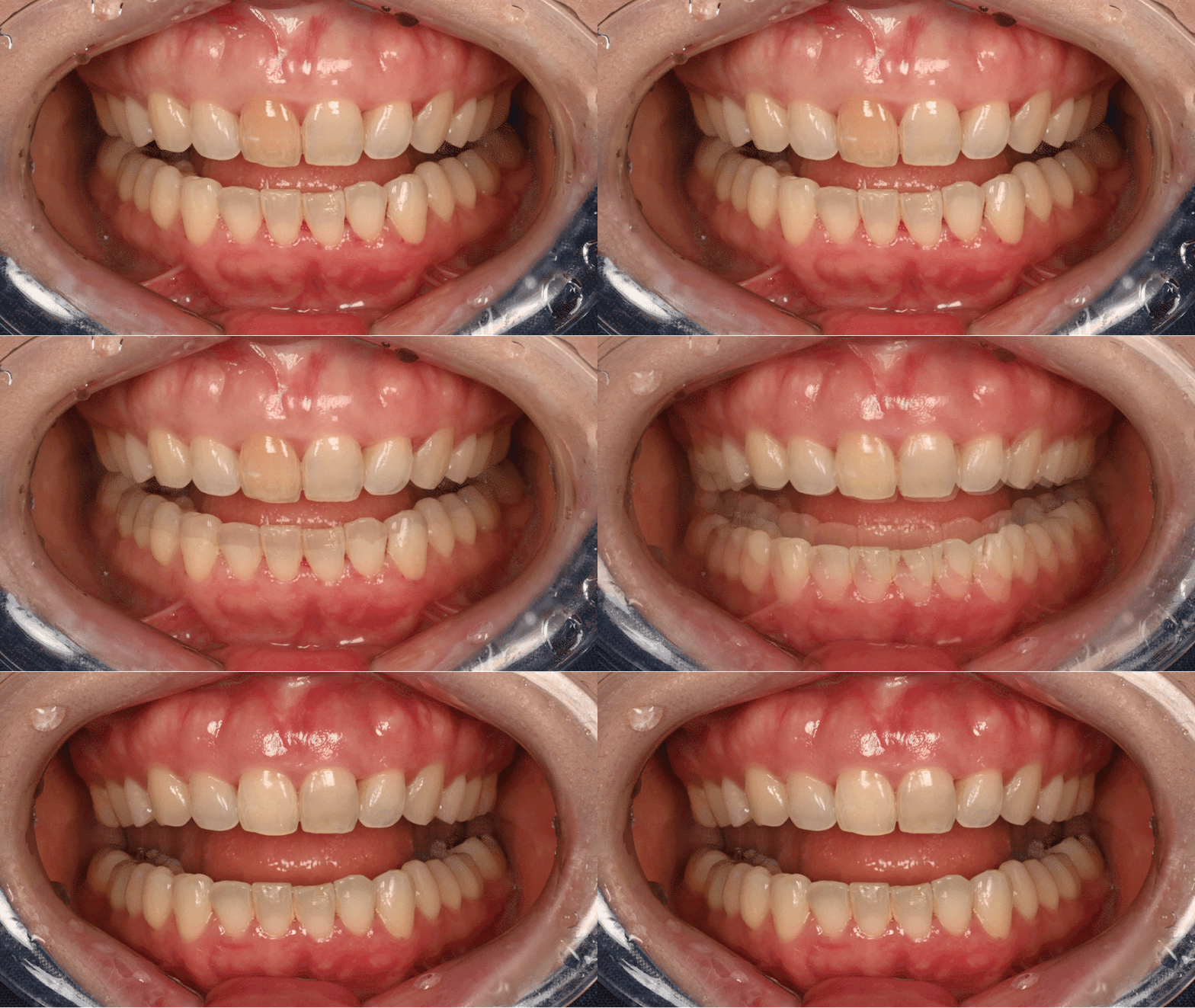
After non-vital tooth bleaching,
we checked how much the tooth color had changed
and whether it blended naturally with the surrounding teeth.
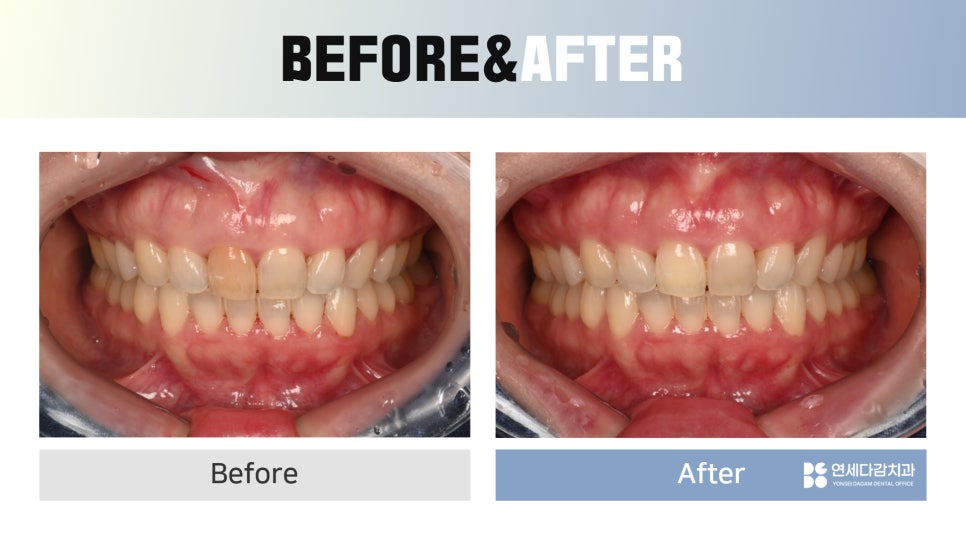
The post-treatment photos show that the dark color of the front tooth was reduced compared with before,
and the difference in color from the surrounding teeth had also decreased.
The patient was pleased that the color of the front tooth, which had been a concern for a long time, had improved.
Follow-up is also needed after non-vital tooth bleaching!
Geoyeo-dong Dental Clinic, Yonsei Dagam Dental Clinic
Non-vital tooth bleaching is a treatment that brightens a tooth,
but when the tooth itself has suffered trauma,
regular follow-up is still needed after treatment.
It is advisable to check whether new inflammation has developed around the root,
whether the tooth has begun to darken again,
and whether the tooth structure has weakened to the point that restorative treatment is needed.
In addition, after non-vital tooth bleaching,
properly finishing and sealing the space inside the tooth is also important.
Because non-vital tooth bleaching involves accessing the inside of the tooth and applying a bleaching agent,
the internal space must be carefully sealed after treatment
to prevent external contamination or renewed color changes.
For this patient as well, after treatment we checked not only whether the tooth color had become brighter,
but also whether it blended naturally with the surrounding teeth,
whether the inside of the tooth had been properly sealed,
and whether there were any issues around the root.
Immediately after treatment,
it is advisable to be careful with strongly colored foods and drinks.
As with care after conventional tooth bleaching,
foods that may cause staining, such as coffee, curry, and wine,
can affect changes in tooth color.
Geoyeo-dong Dental Clinic, Yonsei Dagam Dental Clinic
does not make judgments based only on the visible color of a tooth.
We examine why the tooth became discolored,
whether the nerve is still alive,
whether there is inflammation around the root,
and whether the tooth is in a condition that may require restorative treatment in the future,
then plan the appropriate treatment approach.
If one front tooth looks particularly dark,
or if the color of a tooth has changed after a past injury,
rather than simply continuing to worry,
we recommend having the condition of the tooth checked first.
Thank you for reading this long post.
I hope you have a wonderful day. ^^

[Naver Appointment Booking]
[Yonsei Dagam Dental Clinic Website]
[Yonsei Dagam Dental Clinic KakaoTalk Consultation Channel]