Hello.
Macheon-dong Dental Clinic, Yeonse Da Gam Dental Clinic
I am Seo Ho-yeon, the director.
When you are told that inflammation has developed at the tip of a tooth root, it may not be easy to understand what condition this refers to at first.
When a problem develops in a tooth, most people expect pain to appear first.
However, in actual clinical practice, there are cases in which inflammation around the tooth root is found even though there is little to no pain.
In particular, if you have hit your front tooth in the past or if only one tooth has become noticeably darker, it is also necessary to consider the possibility that the nerve inside the tooth has already been damaged and that this has led to inflammation at the root tip.
When the dental nerve is damaged and loses its function, you may not feel significant pain at first.
From the patient’s perspective, you may even wonder, “Do I really need treatment if it doesn’t hurt?”
However, over time, the cause of infection remaining inside the tooth can spread toward the area around the root tip.
A lesion that looks like an inflammatory pocket may also be visible on a radiograph.
The patient I will discuss today had a similar case.
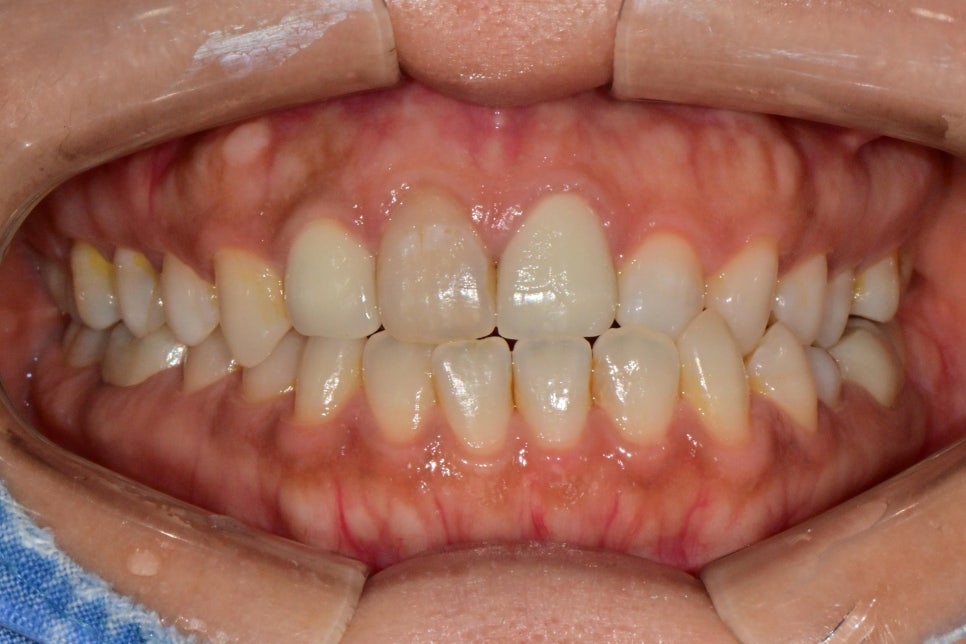
(May 26, 2026)
The patient visited because of concerns about discoloration of a front tooth, and as you can see in the photo, one of the front teeth had become darker than the surrounding teeth.
In such cases, you should not decide on whitening or a crown based only on the tooth color.
The first thing to determine is why only that tooth became darker.
As we discussed the situation with the patient and checked the possible cause, we learned that the patient had previously suffered trauma to the front tooth.
When a tooth is struck or receives a strong impact, it may not hurt significantly at the time, and there may be no visible problem on the outside.
However, the nerve inside the tooth can be damaged by the impact, and the tooth may gradually become darker over time.
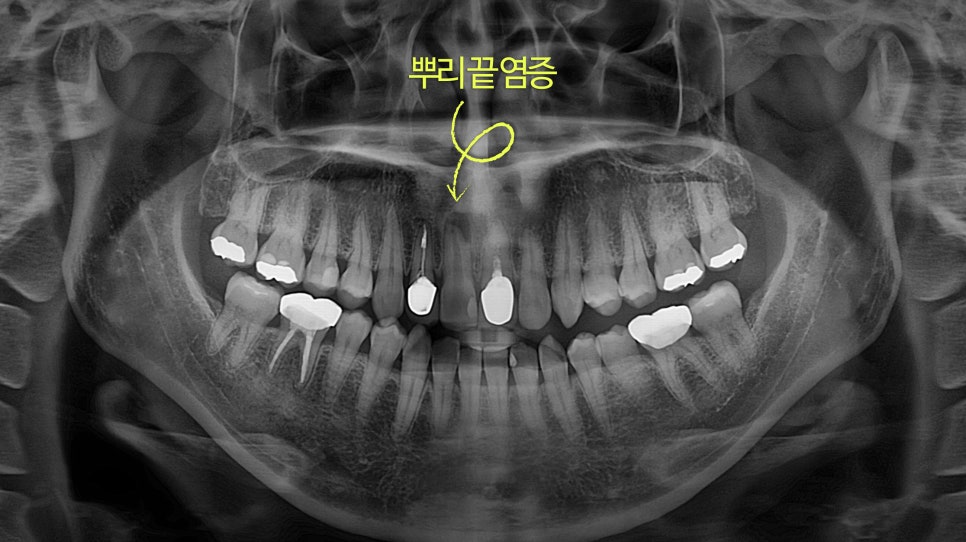
On the radiograph, the tooth had not previously undergone root canal treatment.
In addition, a dark area was visible around the root tip, which was a finding suggestive of inflammation.
In such cases, improving only the visible discoloration is not enough.
The cause of the infection inside the tooth and the inflammation at the root tip must be addressed first so that subsequent prosthetic treatment can proceed more stably.
Therefore, rather than making a crown immediately, we planned treatment for this patient to first address the cause of the inflammation inside the tooth and at the root tip through root canal treatment.
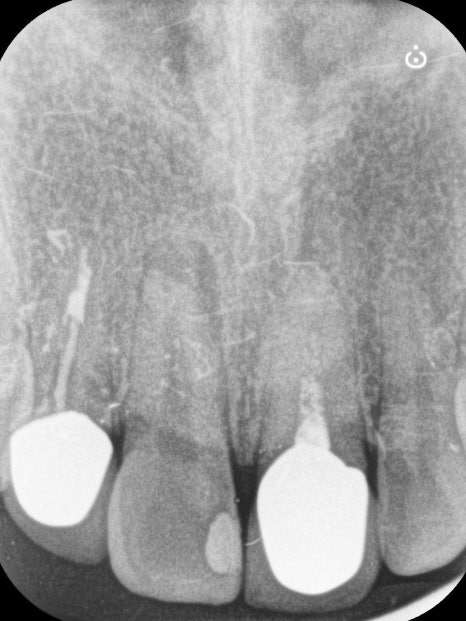
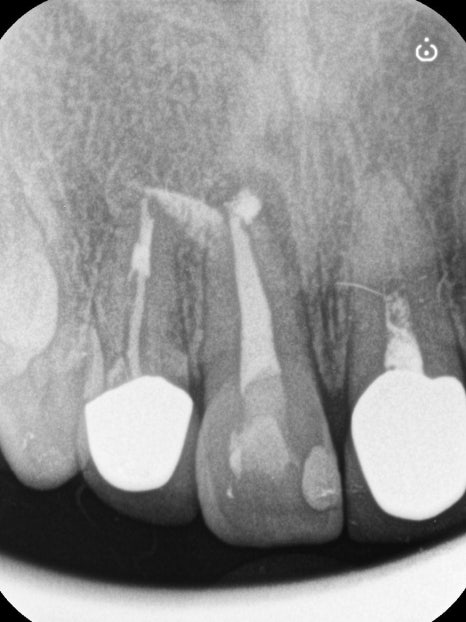
On the radiograph taken after root canal treatment, you can see that the space inside the tooth root has been filled in white.
This process addresses the area causing the inflammation at the root tip and treats the inside of the tooth, creating a foundation that helps the prosthetic restoration remain stable in the future.
After the root canal treatment was completed, we proceeded with making the anterior crown.
For an anterior crown, it is important not only that it function properly, but also that its color naturally blends with the surrounding teeth.
Especially when only one front tooth is covered with a crown, even a slight difference in color, brightness, or translucency compared with the adjacent teeth can be noticeable.
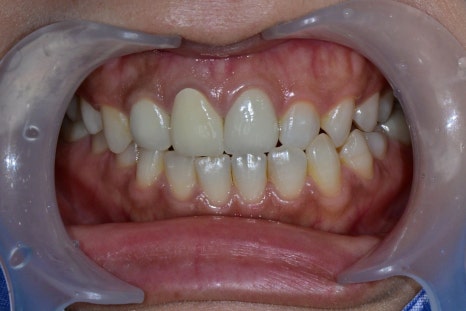
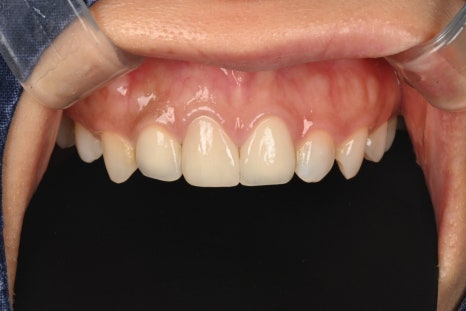
The first crown we made had an overall satisfactory shape, but compared with the surrounding teeth, it looked slightly more yellow.
Although it could be used functionally, the front teeth are an area where even small differences are easy to notice, so it felt like something that should not simply be overlooked.
I have a somewhat perfectionist tendency, so I wanted to match even this subtle difference in color as naturally as possible. ^^;;
Therefore, we reviewed the color again and adjusted the final crown so that it would blend more harmoniously with the surrounding teeth.
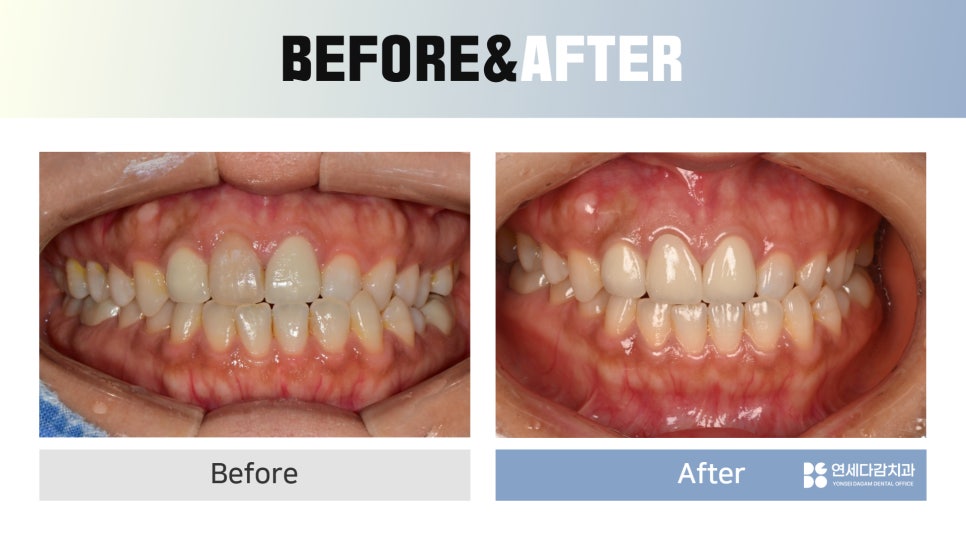
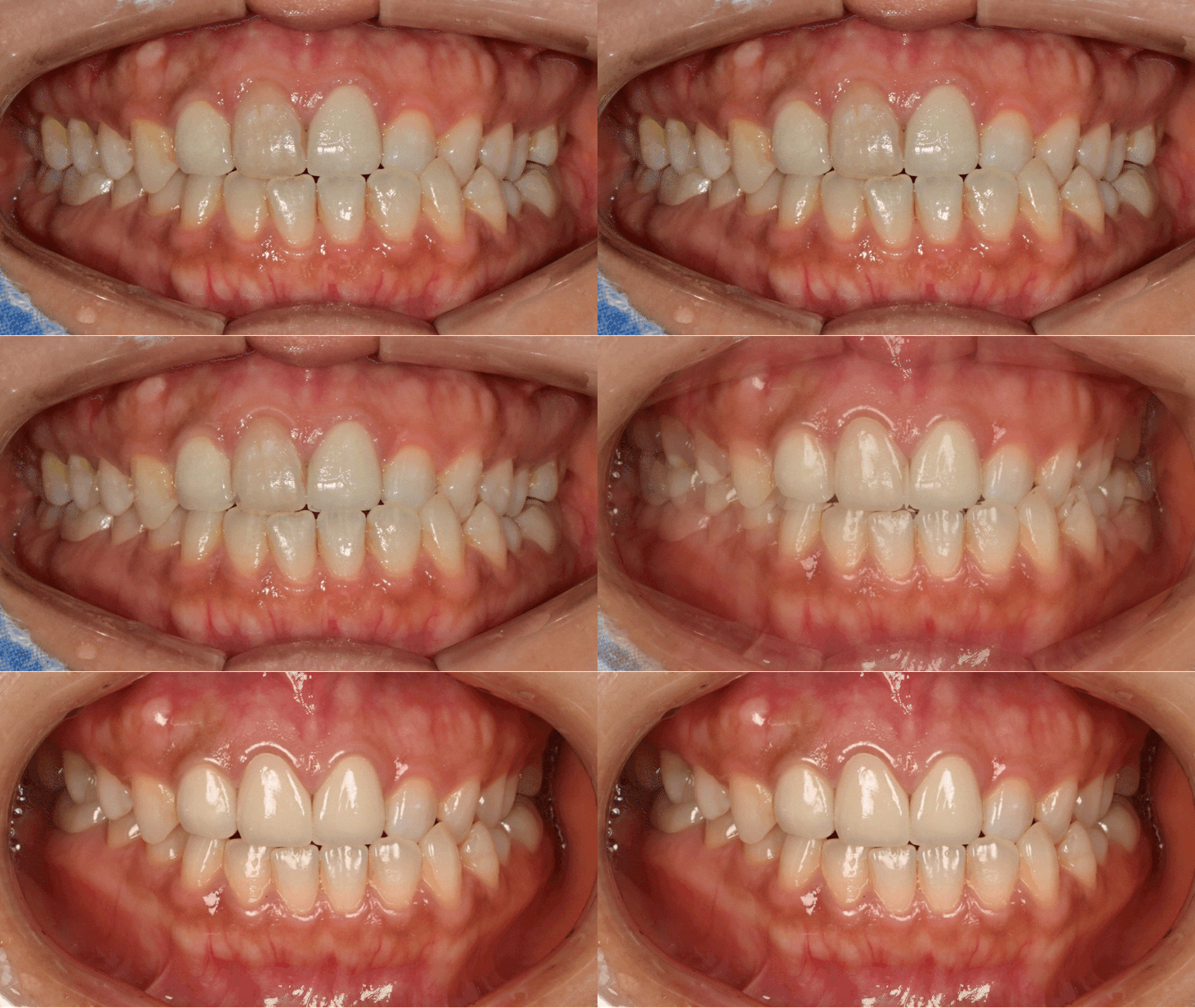
In this patient’s case, considering harmony with the existing teeth, we determined that a slightly brighter and more saturated shade would look natural.
After the final crown was fitted, we could see that not only the brightness of the color but also its translucency blended naturally with the adjacent teeth.
After treatment, the patient was also satisfied, saying, “There isn’t a significant difference between the treated tooth and my existing teeth.”
Care is also important after getting an anterior crown.
Macheon-dong Dental Clinic, Yeonse Da Gam Dental Clinic
After anterior crown treatment is complete, it is important not only that the color and shape blend in naturally, but also to maintain that condition for a long time.
Immediately after a crown is fitted, you may feel sensitivity for a few days or experience discomfort around the gums.
This usually improves as you adjust over time, but if the pain gradually worsens or the discomfort continues for a long time, the bite and gum condition should be checked again.
Although crowns are made of a durable material, repeatedly biting into chewy or hard foods can place excessive force on the crown.
In particular, an anterior crown plays a role in cutting food, but it is not an area intended to withstand strong force continuously, so it is best to be careful about habits such as biting ice or using the front teeth to break hard foods.
Also, although cavities do not develop on the crown itself, cavities can develop again at the boundary where the crown meets the tooth.
This is called recurrent decay.
If brushing is inadequate, food particles and bacteria can remain around the margin and cause problems.
Therefore, even after crown treatment, brush your teeth carefully as usual and use dental floss or an interdental brush.
You should regularly check the condition of the gums around the crown and your bite so that you can use it comfortably.

Macheon-dong Dental Clinic, Yeonse Da Gam Dental Clinic does not determine the course of treatment for anterior teeth based only on what is visible on the outside.
We examine why the tooth became discolored, whether root canal treatment is necessary, whether there is inflammation around the root, and whether the final crown can blend naturally with the surrounding teeth.
If only one front tooth looks noticeably darker or its color changed after previous trauma, rather than looking only at the visible color, we recommend having the current condition of the tooth checked first.
I hope you have a happy day today as well. ^^
Macheon-dong Dental Clinic, Yeonse Da Gam Dental Clinic

[Naver Appointment Booking]
[Yeonse Da Gam Dental Clinic Website]
[Yeonse Da Gam Dental Clinic KakaoTalk Consultation Channel]
Macheon-dong Dental Clinic, Yeonse Da Gam Dental Clinic