Welcome.
I am Dr. Seo Ho-yeon
of Yonsei Dagam Dental Clinic, a dental clinic specializing in implants in Munjeong-dong.
When discussing implants, some patients hear things like this:
“Because there is not enough bone,
it may be difficult to place the implant right away.”
“A sinus lift may be necessary.”
“Bone grafting may need to be performed together.”
Especially if you are hearing these terms for the first time,
you may naturally feel concerned from the patient’s perspective.
You may have thought that an implant would simply be placed where the tooth was lost,
but hearing the term “maxillary sinus” unexpectedly
may make you wonder whether the treatment is becoming complicated
and feel 부담스러울 수 있습니다.
However, the upper molar area requires a somewhat more careful evaluation than other areas when planning an implant.
One reason is the structure called the “maxillary sinus.”
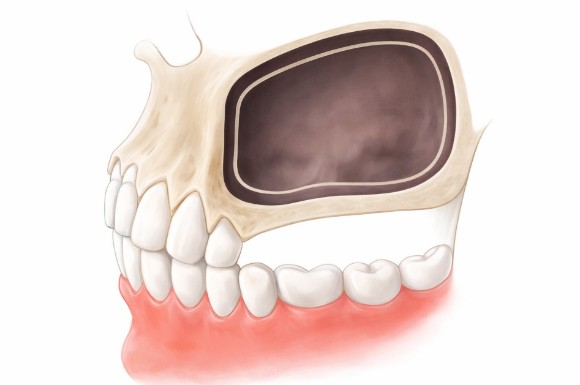
In simple terms,
you can think of it as an air-filled space located beside the nose,
above the roots of the upper molars.
When the upper molars are present,
the tooth roots and jawbone maintain a certain amount of height.
However, as time passes after tooth loss,
the jawbone gradually decreases.
In addition, if the maxillary sinus expands downward after tooth loss,
the bone height available for implant placement may become insufficient.
If an implant is placed forcefully in this condition,
it may be difficult to obtain sufficient stability,
and the implant may be too close to the maxillary sinus,
making the surgical plan more complicated.
Therefore, for implants in the upper molar area,
it is necessary to check the location of the maxillary sinus
and the height of the remaining bone.
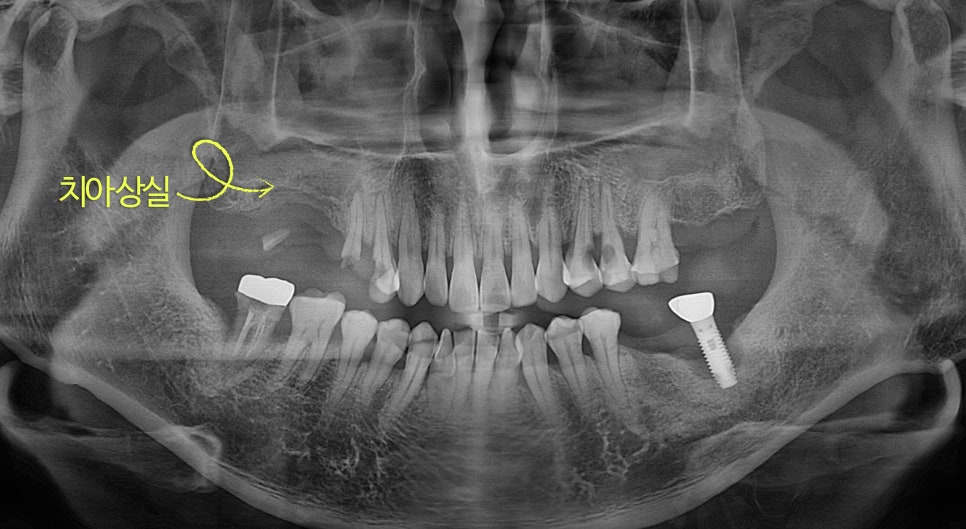
This patient also needed an implant in the upper molar area.
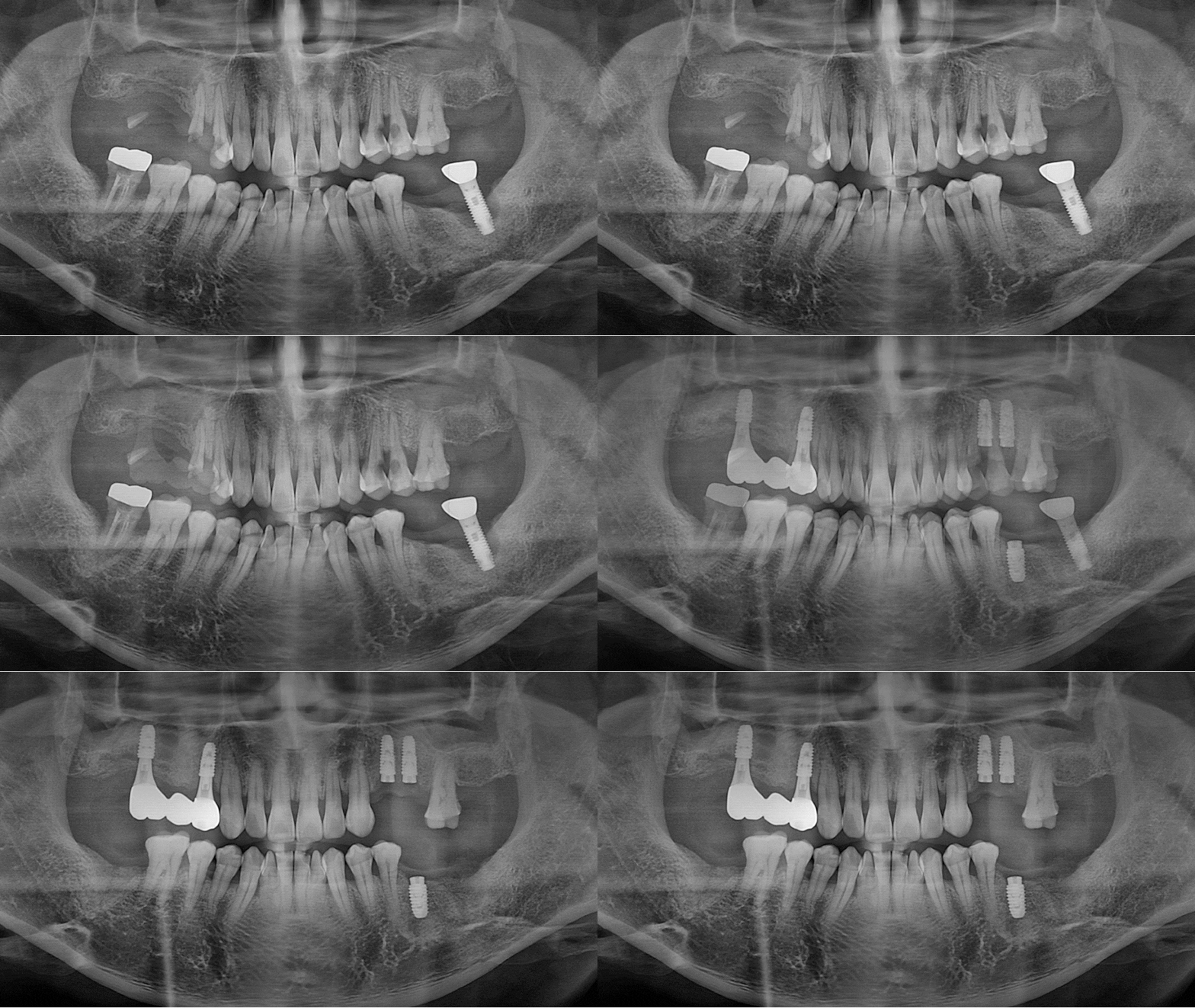
The panoramic image shows that the upper molar area was missing a tooth.
In this situation, it is necessary to assess how much bone remains beneath the gums,
how far down the maxillary sinus above it has extended,
and whether firm fixation can be obtained when the implant is placed.
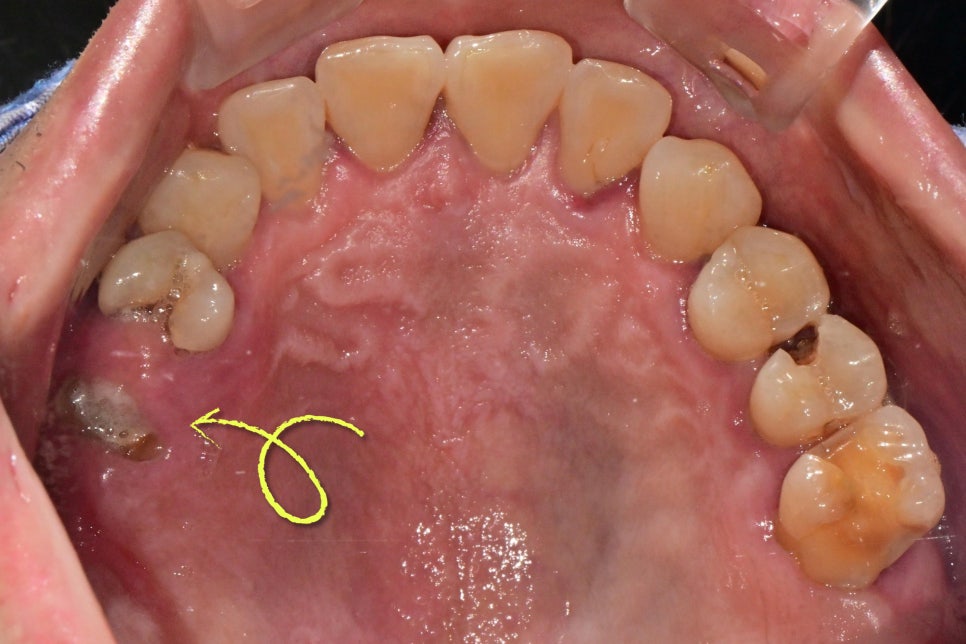
The intraoral photograph also shows the missing tooth in the upper molar area.
Therefore, for this treatment,
we decided to perform a sinus lift and bone grafting together with the implant surgery.
What Is a Sinus Lift?
Yonsei Dagam Dental Clinic, a dental clinic specializing in implants in Munjeong-dong
A sinus lift is a treatment performed when there is insufficient bone in the upper molar area. The sinus membrane is carefully lifted,
and the space beneath it is filled with bone graft material
to secure enough bone height for implant placement.
In simple terms, it is a process of reinforcing the bone beneath the maxillary sinus,
which is an air-filled space,
so that the implant can be stably positioned.
The method used for a sinus lift varies depending on the direction of access.
One method is to lift the sinus membrane upward from the implant placement site,
and another is to approach from the side of the gums and perform bone grafting.
In this patient’s case,
the remaining bone height was significantly insufficient,
and the area requiring reinforcement was also extensive.
Therefore, a sinus lift was performed using the lateral approach.
What Is the Lateral Approach?
Yonsei Dagam Dental Clinic, a dental clinic specializing in implants in Munjeong-dong
The lateral approach involves accessing the area from the side of the gums,
examining the surgical site through the lateral wall of the maxillary sinus,
carefully lifting the sinus membrane,
and filling the space beneath it with bone graft material.
Because the treatment area may be extensive,
before surgery it is necessary to use a CT scan to check
the location of the maxillary sinus,
the amount of remaining bone,
and the condition of the sinus membrane.
For this treatment as well, the plan focused on creating an environment in which the implant could become stably positioned.
After the sinus lift, the healing progress was checked regularly.
At first, the bone height was insufficient to the extent that it was difficult to fix the implant,
but through the sinus lift and bone grafting,
we gradually created a structure capable of supporting the implant.
After confirming that the grafted bone had settled
and that the implant was being maintained stably,
prosthetic treatment was performed.
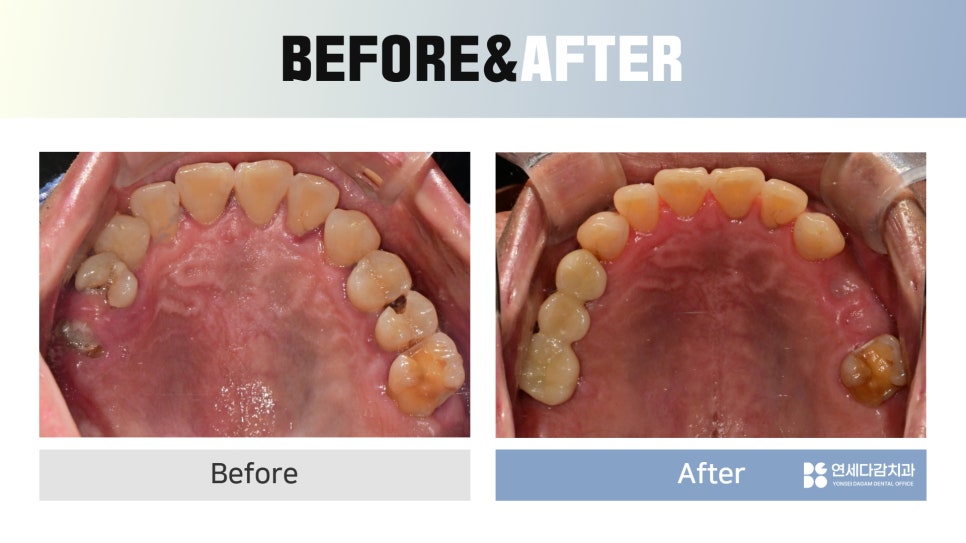
The post-treatment photograph shows the implant and prosthesis connected in the upper molar area.
For this patient, the implant and prosthetic treatment in the upper jaw were performed first.
Because there was also a missing tooth area in the lower jaw,
implant treatment is being continued in stages.
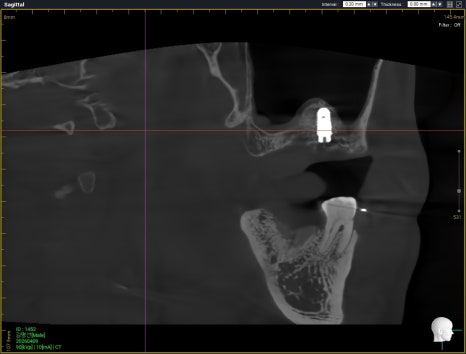
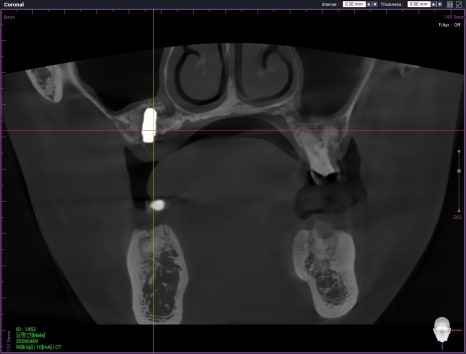
The post-treatment CT scan shows that the bone has been reinforced.
The grafted bone above the implant settled into place,
forming a supporting structure.
After undergoing a sinus lift,
there are several precautions to follow during recovery.
Precautions After a Sinus Lift
Yonsei Dagam Dental Clinic, a dental clinic specializing in implants in Munjeong-dong
Immediately after surgery, it is best to avoid blowing your nose forcefully
or sneezing while keeping your mouth closed.
Because the maxillary sinus is connected to the nose,
strong pressure may be transmitted to the surgical site
and place stress on it.
You should also be careful not to repeatedly touch the surgical site with your hands or tongue,
and during the period specified in your instructions,
you should be careful with hard or chewy foods.
Swelling or discomfort may occur for a certain period after surgery.
However, if the pain becomes more severe over time,
you feel as though liquid is passing into your nose,
you experience substantial bleeding,
or you notice symptoms that look like pus,
you should visit the dental clinic promptly to have your condition checked.
With a sinus lift, it is just as important to check the recovery process afterward
as it is to perform the surgery carefully,
and to monitor the progress regularly.
At Yonsei Dagam Dental Clinic, we first check the condition of the jawbone using CT,
and consider both the position where the implant will be placed
and the direction in which the prosthesis will be positioned afterward.
I also personally review this process,
assess the patient’s bone condition and potential for recovery,
and create a step-by-step treatment plan within a reasonable range.
If you are considering implants
or have been told that you do not have enough bone,
I hope you will first have your current oral condition checked.
Thank you for reading this far. ^^
I hope you have a happy day today as well.
Yonsei Dagam Dental Clinic, a dental clinic specializing in implants in Munjeong-dong

[Naver Appointment Booking]
[Yonsei Dagam Dental Clinic Website]
[Yonsei Dagam Dental Clinic KakaoTalk Consultation Channel]
Yonsei Dagam Dental Clinic, a dental clinic specializing in implants in Munjeong-dong