Hello, this is Gangnam Leon Dental Clinic😊
We are busy today as well, thanks to the many people who visit us for wisdom tooth extractions.
These days, many patients also visit Gangnam Leon Dental Clinic from overseas for our Newtis comprehensive front-tooth treatment.
From treatment for white spots on teeth and gum treatment to Newtis laminate, we cover the full range of front-tooth care and proceed step by step with only the minimum necessary treatment, so we are able to deliver good results.
Many people seem to recognize this and feel satisfied.
Today, we’re going to take a close look at the recovery process after wisdom tooth extraction.
After a wisdom tooth has been removed, when and how does it actually heal?

Is my wisdom tooth fully impacted?
Wisdom teeth are the last molars to erupt in the innermost part of the mouth as adults, usually between the ages of 16 and 25.
Some people are born without wisdom teeth, and if they do exist, a total of four erupt—one on each of the upper and lower left and right sides.
If you’re thinking, “Mine didn’t erupt?” it is likely impacted.
Impacted wisdom teeth are broadly divided into three types.
| Type of wisdom tooth | Description |
|---|
| Simple impaction | It grows outside the gum or is only slightly covered, so if it is well managed, extraction is not always necessary. If extraction is performed, it can usually be removed simply, and the pain is not severe. |
| Complex impaction | This refers to a wisdom tooth that is partially buried in the gum or lower jawbone, or one that has grown sideways. Because it is close to adjacent teeth or nerves, it can cause problems or pain, and food tends to get trapped in partially exposed teeth, making inflammation or cavities more likely. |
| Fully impacted | This refers to a condition where the tooth is deeply impacted within the gum. Because it cannot be seen with the naked eye, accurate assessment of its exact position and condition requires not only an X-ray but also a CT scan. Since it can damage other teeth or the roots of nearby teeth and cause various problems, extraction is often necessary. |
Do wisdom teeth really have to be removed?
The reason for wisdom tooth extraction is related to the position of the wisdom tooth and the way it erupts.
As you can see from the types of impaction above, modern people have narrower jaws, so wisdom teeth often grow in an impacted state, causing inflammation and pain. Even if they erupt properly, because they are located at the very back, they are difficult to keep clean, making cavities more likely.
In the case below, the upper and lower wisdom teeth had erupted normally, but because cavities had progressed, they were extracted before they could affect the surrounding teeth.
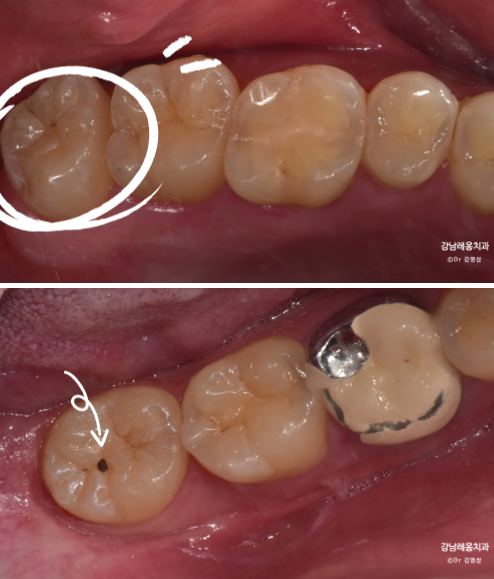
A Quick Look at the Recovery Process After Wisdom Tooth Extraction / Gangnam Station Wisdom Tooth Gangnam Leon Dental Clinic
The function of wisdom teeth is useful when eating very tough foods,
but since modern people rarely need them for that, it is hard to feel their function.
Therefore, we often recommend extraction at a younger age, when recovery is faster, before problems arise.
However, if the tooth has erupted properly, shows no signs of inflammation, and can be managed well,
there is no need to extract it unnecessarily.
Wisdom tooth extraction process
The wisdom tooth extraction process at Gangnam Leon Dental Clinic
is as follows.
Take the prescribed medication before extraction
(antibiotics/pain relievers)
🔻
Panoramic X-ray taken
(*Additional CT scan if needed)
🔻
Extraction guidance and consent form completion
🔻
Scaling for infection prevention
🔻
Local anesthesia followed by
wisdom tooth extraction
🔻
Instructions on precautions and care methods
🔻
Stitch removal and follow-up visit
one week later to check recovery
You can find the detailed extraction process and Q&A
in the post below.
Recovery after wisdom tooth extraction🩹
The healing period after wisdom tooth extraction may vary depending on the degree of impaction and age, but in general, it usually takes 1 to 3 months for the extraction site (the socket) to fill in and for the gums to fully recover.
✅Before extraction and the next day
This is before wisdom tooth extraction and the next day.
You can see the extraction area, which was opened by incision and then closed with stitches.
At this time, there may be slight bleeding for 2 to 3 days, and you may notice a faint metallic taste from the blood.
If the bleeding is not severe, this is a natural occurrence.
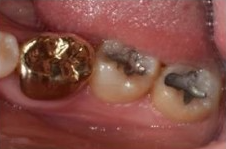
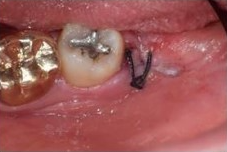
Before extraction / Next day
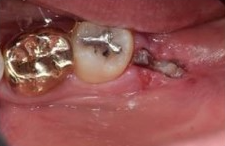
✅Day 3 / Day 4
This is what it looks like after the stitches were removed on day 4.
Usually, patients come back about a week after extraction to have the stitches removed and check their recovery.
By days 4 to 5,
The sutures may feel loose,
which is because the gums have already healed to some extent
and become stable.
Even if they come loose without you noticing,
there is no need to worry too much.
Just visit the dental clinic on the scheduled day to have the stitches removed and receive disinfection.
When the stitches are removed, you may feel them brushing against the gums, but there is usually little to no pain.
Of course, if they come loose earlier than this or come undone on the day of suturing,
you should contact the dental clinic
and receive appropriate care.
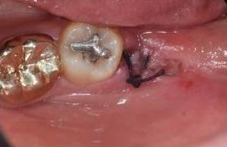
Day 3 / Day 4
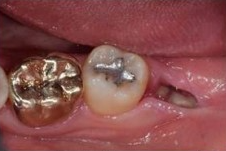
✅Day 5 / Day 10
Usually, after about a week,
the gums begin to close in earnest.
After the stitches are removed,
a white-looking substance may be faintly visible in the extraction socket.
This is not food debris or inflammation,
but tissue that appears during the normal healing process.
Day 5 / Day 10
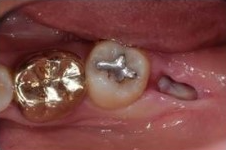
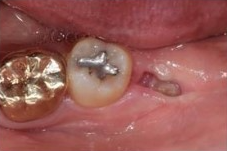
✅Day 12 / Day 17
The extraction socket is still noticeable,
but over time the gums become smoother
and the white tissue also normalizes into healthy gum tissue.
Day 12 / Day 17
✅Day 24 / Day 30
After about three weeks to a month,
the hole where the wisdom tooth used to be
has been almost filled in by the gums.
If another two to three months pass from here,
it will be fully healed.
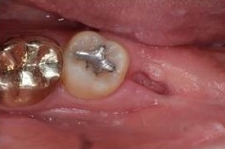
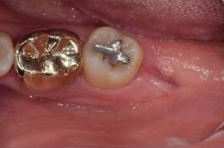
Day 24 / Day 30
Wisdom Tooth Extraction Q&A
Food gets stuck in the hole after extraction.
It is common for food to get stuck in the hole after extraction.
At this time, do not try to remove it with a tool;
it is better to rinse it out with a light gargle.
If it still does not come out easily and feels uncomfortable,
visit the dental clinic so we can disinfect the area,
remove the food, and check the condition.
There is red blood pooled after extraction
After bleeding has stopped,
if blood appears to be pooled in the extraction socket,
it is a blood clot that creates the environment needed for tissue to fill in.
Please do not spit it out and wait for it to come off naturally.
If bleeding does not stop and continues to flow,
use the extra gauze provided to apply additional pressure,
and if bleeding still does not stop even after the gauze becomes soaked,
please visit the dental clinic.
My neighboring teeth hurt after extraction
Because the gums were irritated during extraction,
the gums around nearby teeth may swell
or feel heavy and sore.
This may last as short as 3 to 4 days, or as long as about a week,
and after that the discomfort gradually goes away.
For symptoms such as throat pain, jaw joint pain, or swelling,
please check the post below!
Today, we looked at why wisdom tooth extraction is necessary
and the recovery process after extraction.
At Gangnam Leon Dental Clinic,
we also provide sedation dentistry for people who are afraid of wisdom tooth extraction
or have dental phobia.
In addition,
through the Gangnam Leon Dental Clinic KakaoTalk channel,
we provide consultation on bleeding control and pain after wisdom tooth extraction
even after clinic hours.

A Quick Look at the Recovery Process After Wisdom Tooth Extraction / Gangnam Station Wisdom Tooth Gangnam Leon Dental Clinic
If you need information about wisdom tooth extraction costs or related consultations,
please feel free to leave a comment at any time!
Gangnam Leon Dental Clinic
Comprehensive Front-Tooth Treatment, Newtis
This is a comprehensive front-tooth treatment that covers everything from treatment for white spots on teeth, gum grafting, and tooth shaping,
to gum contouring, teeth whitening, gum whitening,
front-tooth resin treatment, orthodontics, and Newtis lamination.







Previous image
Next image