Hello, this is Gangnam Leong Dental Clinic🙂
During dental treatment, some people occasionally feel
A hard, lump-like foreign body inside the mouth
and ask whether it might be a tumor
after seeing its unusual appearance.
There is a hard lump inside the mouth.
Could it be a tumor?
In many cases like this,
it is simply a bone prominence.
Today, let’s look at the causes and characteristics of bone prominences,
as well as the removal process.
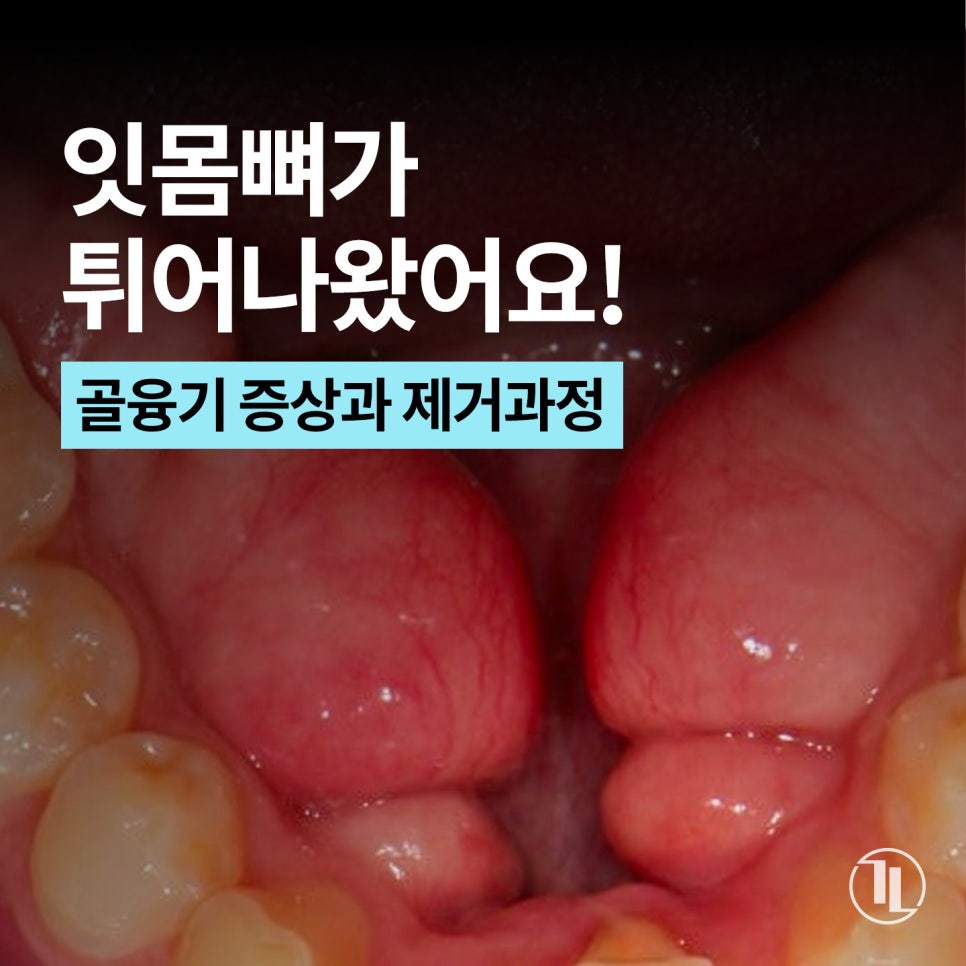
A hard lump inside the mouth:
What is a bone prominence?
A bone prominence refers to a localized
abnormal protrusion of bone inside the oral cavity.
Medically, it is classified not as a pathological condition
but as a normal anatomical variation,
and in most cases it is benign and does not require special treatment.
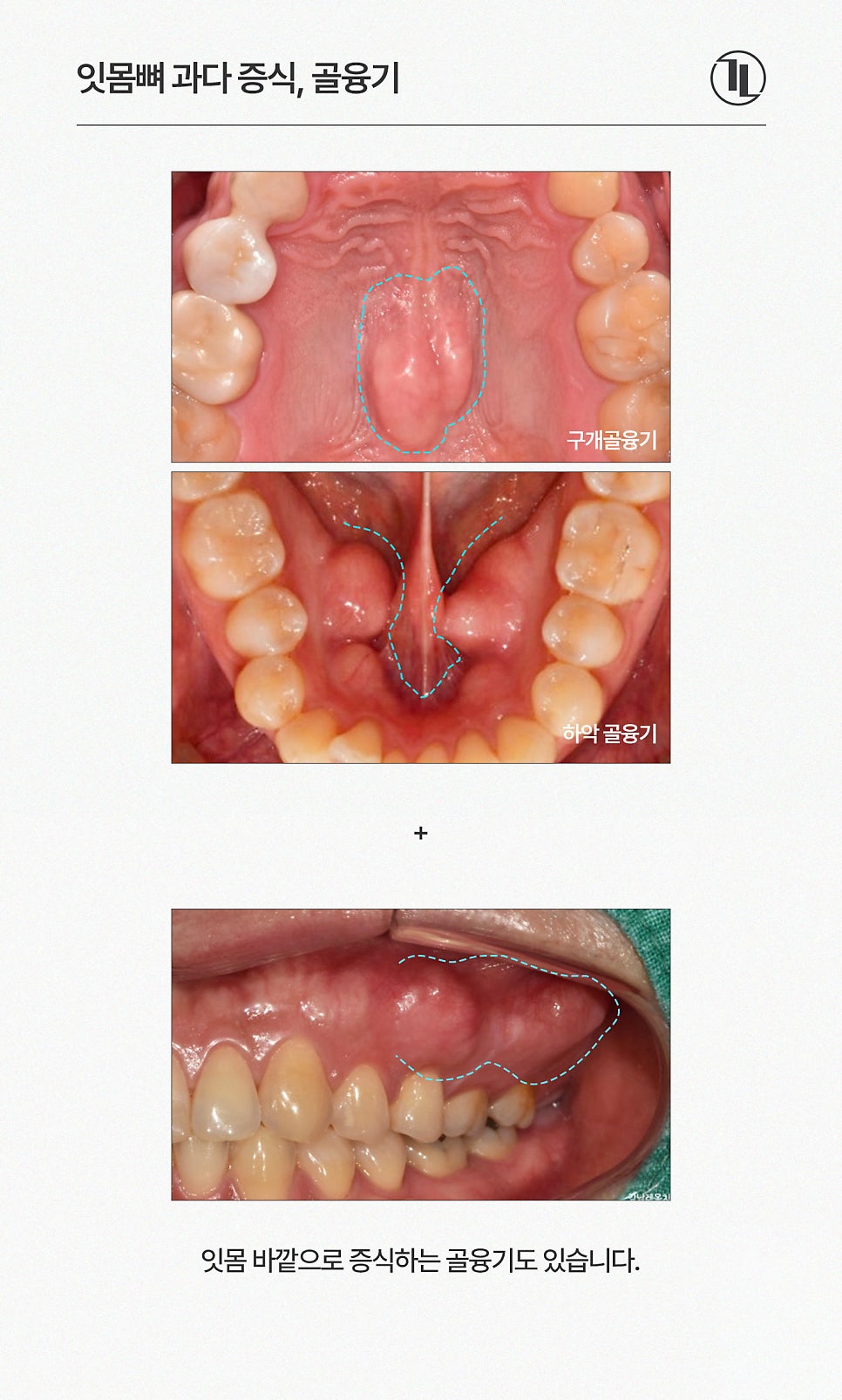
The two most commonly observed areas are the following.
It appears as a hard bony bump
and is usually not painful.
✔ Mandibular torus
Location: The inner gum area below the lower molars, under the tongue
Characteristics: Occurs symmetrically on both sides,
and may look like the gums are slightly swollen to the naked eye.
✔ Palatal torus
Location: The central area of the palate (roof of the mouth)
Characteristics: A hard lump protruding from the center of the palate
Causes of bone prominences
Depending on where they occur,
bone prominences are classified as mandibular torus and palatal torus.
Both forms develop through the same mechanism,
but there are slight differences in location and frequency.
✔ Mandibular torus
Mandibular torus is thought to be related to chewing habits
and the distribution of bite forces.
In other words, when chewing force is strong or
when a certain area of the teeth is used frequently,
the bone in that area may be stimulated
and gradually protrude.
✔ Palatal torus
Genetic factors or during the growth process
can cause a specific area to grow more, forming a prominence.
It is relatively more common than mandibular torus
and occurs more frequently in women.
In many cases, it is not noticeable in childhood
but becomes more distinct in adulthood.
Symptoms of bone prominences
Most bone prominences are found without symptoms.
That is, because there is no pain or inflammation,
many people discover them by chance
while feeling as though “a lump has formed in the mouth.”
However, if they become larger or are irritated,
various discomforts can occur.
✔ Asymptomatic
In most cases, there is no pain at all,
and only the sensation of a hard lump is felt.
Bone prominences are benign and non-pathological,
so there is no need to worry.
✔ Discomfort due to physical irritation
Bone prominence removal:
Necessity and surgical process
In most cases, bone prominences
are an anatomical variation that does not require treatment.
In other words, because it is not a disease,
if its shape does not cause any particular problem,
simple observation is sufficient.
However, in some specific situations,
surgical removal may be necessary.
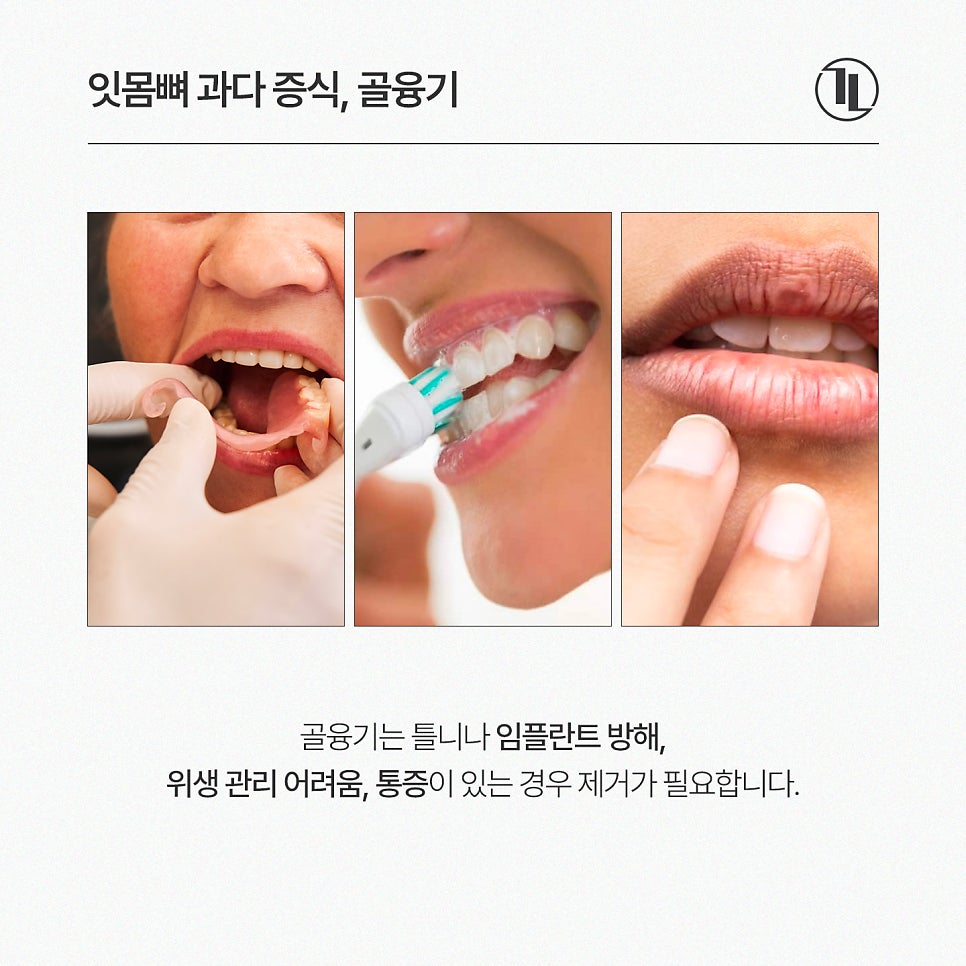
✔ When it interferes with prosthetic treatment
If the protruding bone makes it difficult to fit dentures,
implants, or orthodontic treatment,
removal of the bone prominence is necessary.
✔ Difficulty with hygiene management
If food easily gets stuck between the protruding areas
and is difficult to remove, or
if brushing is inconvenient and hygiene management
is difficult, removal is recommended.
✔ Aesthetic discomfort
Bone prominences are not very noticeable externally,
but if they feel bothersome to the tongue and create an unclean foreign-body sensation,
you may consider removal.
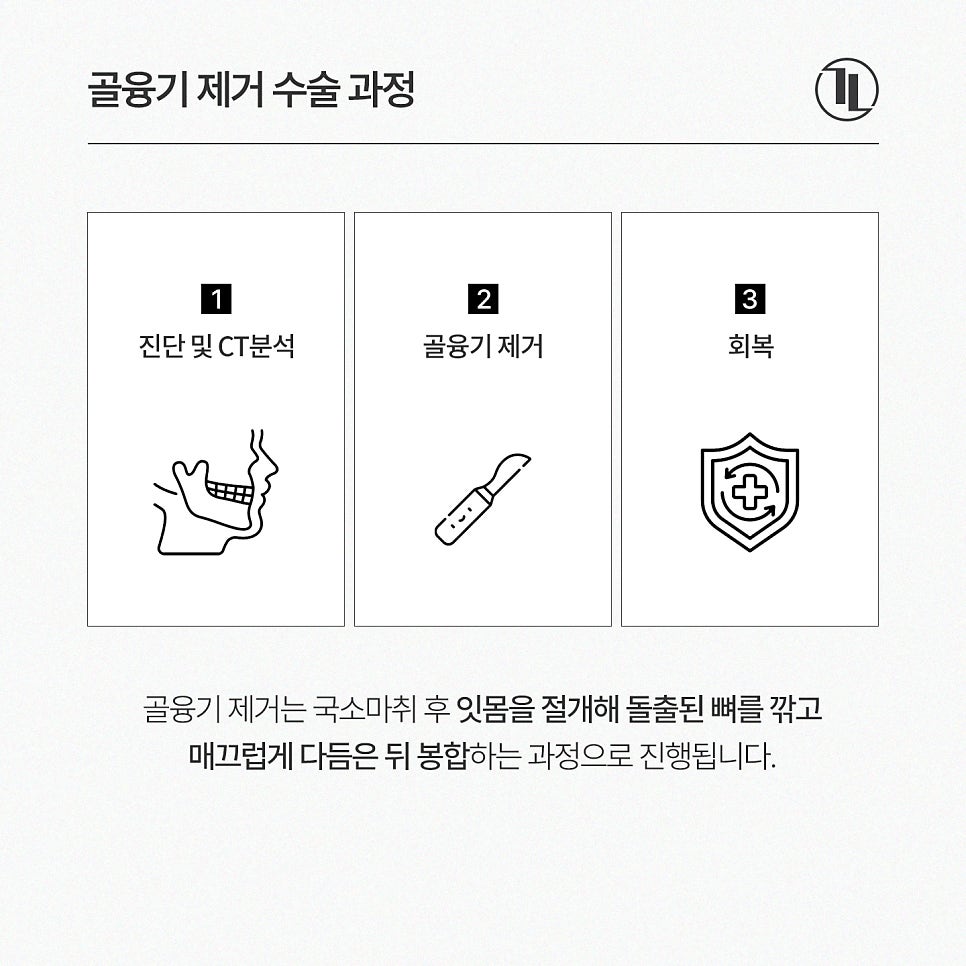
The surgical process for removing a bone prominence is as follows.
① Diagnosis and CT analysis
Through imaging examination, the bone structure and exact location are identified,
and the area and extent requiring removal are determined.
② Local anesthesia
Before surgery, local anesthesia is performed on the surgical site or surrounding area
to minimize pain.
③ Bone prominence removal
The mucosa covering the bone prominence is incised,
and the exposed bone prominence is gradually removed using a handpiece and bur.
④ Recovery
After the gingival tissue is covered again and sutured,
you return after about a week for stitch removal.
Bone prominence Q&A
Q. How should I brush my teeth after surgery?
Use a toothbrush gently around the surgical area, avoiding the site itself,
and rinse gently with mouthwash.
Q. Can I eat anything?
For the first 2 to 3 days, it is best to eat soft
and non-irritating foods.
Hard and spicy foods may irritate the surgical area
and interfere with recovery.
Q. Should I avoid alcohol and smoking?
Yes. It is best to avoid alcohol and smoking
for at least one week.
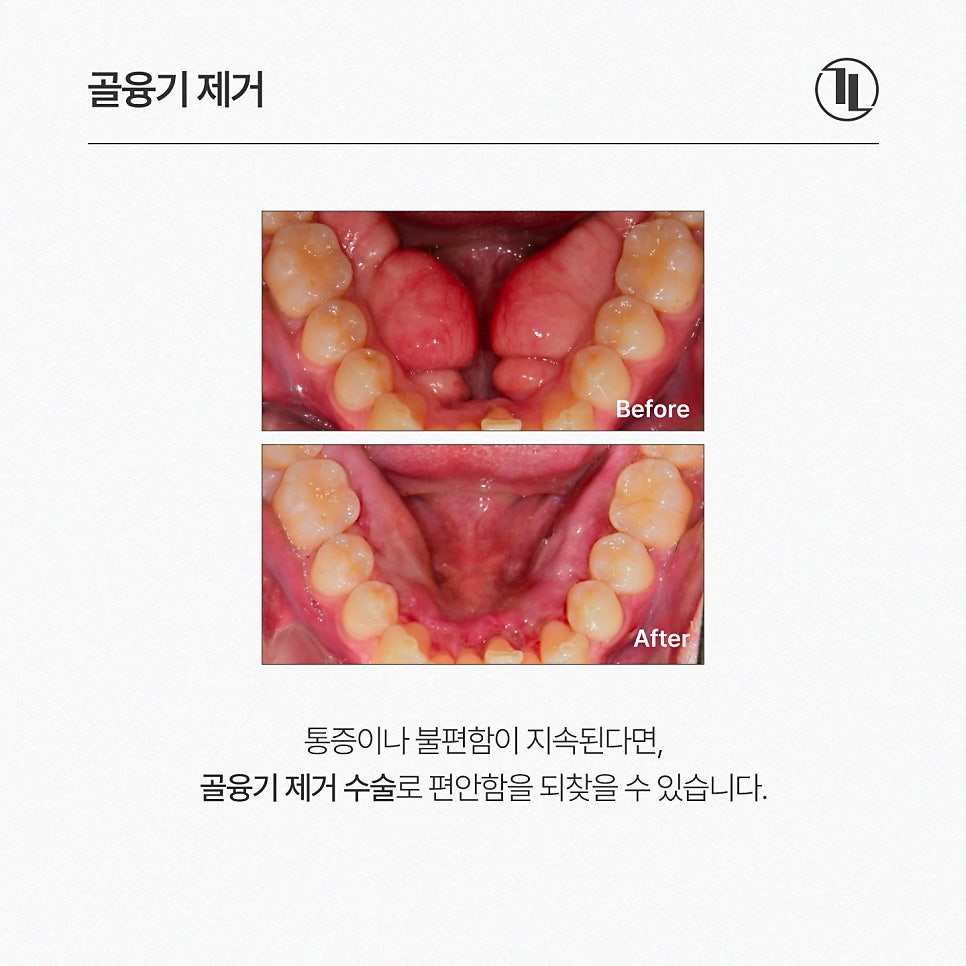
Today, we looked at bone prominences,
which are caused by excessive growth of the jawbone.
They are anatomical variations, and in most cases they are asymptomatic
and do not require special treatment.
However, if they interfere with other prosthetic treatments,
or if they cause hygiene-related or psychological stress,
removal may be worth considering.
If you have any other questions,
please feel free to leave a comment!
Gangnam Leong Dental Clinic
Comprehensive Anterior Tooth Treatment, Newtis
This is comprehensive anterior tooth treatment that handles everything from
white spot lesion treatment to gum grafting, tooth contouring,
gum contouring, teeth whitening, gum whitening,
anterior resin treatment, orthodontics, and Newtis lamination.
Through Newtis’s unique smile simulation,
check the result after treatment in video form
using only pre-treatment photos!






Previous image
Next image