
Hello.
I’m Board-Certified Plastic Surgeon Ban Ho-gyeong, and my specialty is eye surgery, with revision eye surgery as my strongest point.
By personality, I’m not very good at speaking in circles. So when I consult with patients, I speak honestly and directly. In a way that is easy to understand and clear.
In particular, when patients ask whether dark circles can improve through lower eyelid fat repositioning surgery, I explain even more clearly after diagnosis. That’s because many people have already been to several hospitals and end up confused by differing diagnoses.

One hospital may say it could improve if lower eyelid surgery is done together with fat grafting, while another may say the surgery itself is not recommended because the cause is pigmentation, or that pigment treatment should be done together after lower eyelid surgery. So it’s understandable to feel confused.
So, what is actually correct?
In today’s column, I’ll clearly organize which dark circles can be improved with lower eyelid fat repositioning, as well as how to self-diagnose them.
Also, lately there have been cases where lower eyelid fat grafting is being done rather indiscriminately, so I’ll also share my honest opinion on that.
Causes of Dark Circles (+How to Self-Diagnose Dark Circles)
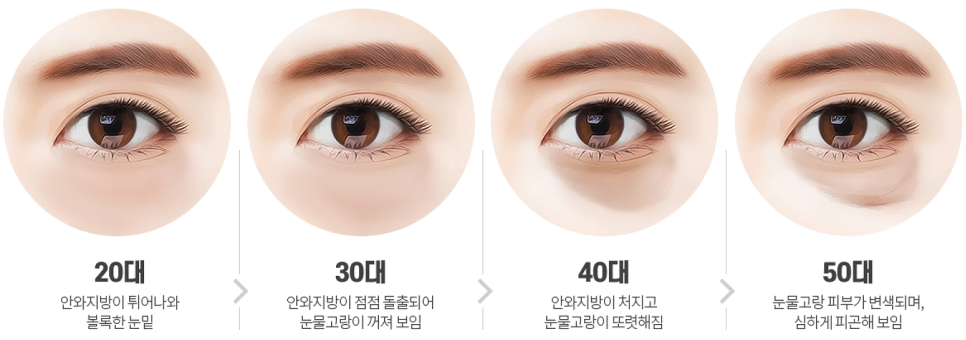
First, you need to understand that “dark circles” is not a specific medical term, but simply refers to the area under the eyes looking dark. It may not even be a problem with the skin itself.
That’s why the causes of dark circles can be broadly divided into three categories.
-
Skin pigmentation
-
Visible blood vessels
-
Shadow
In reality, the skin under the eyes may not actually be dark, but it can still look dark because of shadows. That also counts as dark circles.
And more importantly, although the causes of dark circles are theoretically divided into the three types listed above, in fact most dark circles are caused by number 3: shadows.
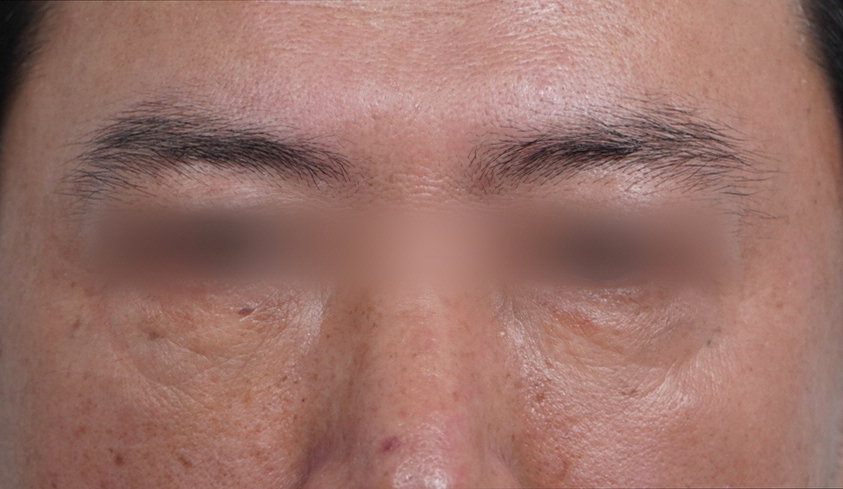
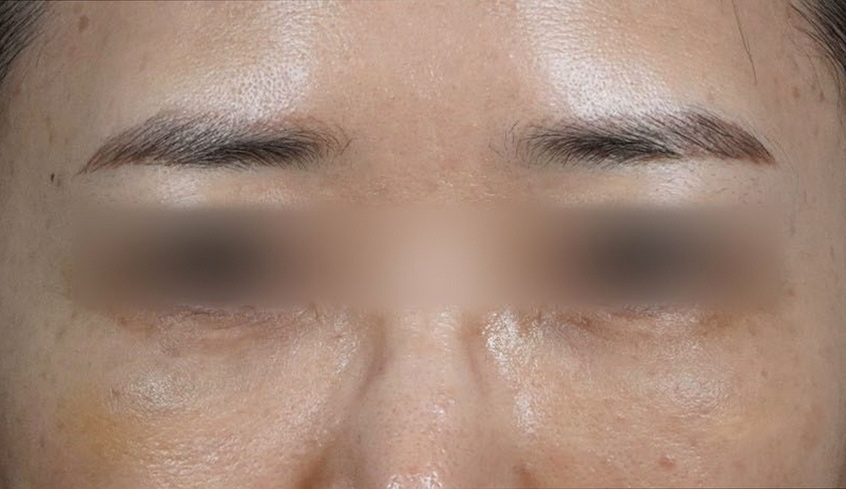
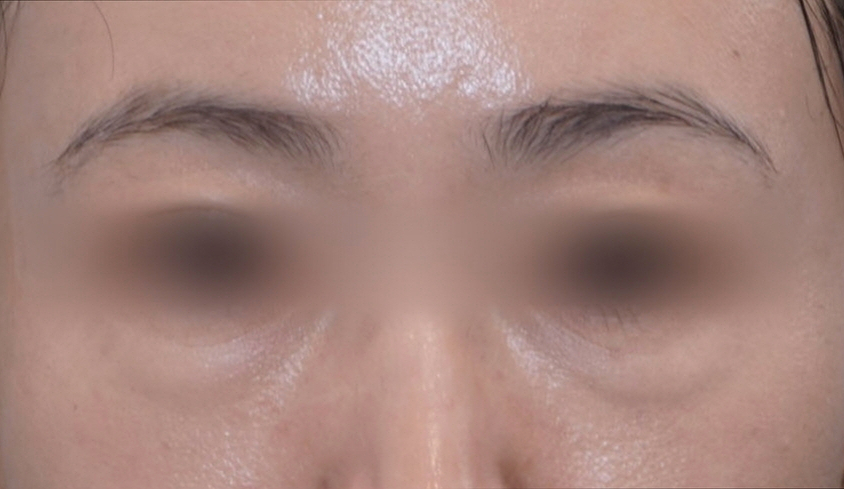 Before lower eyelid surgery
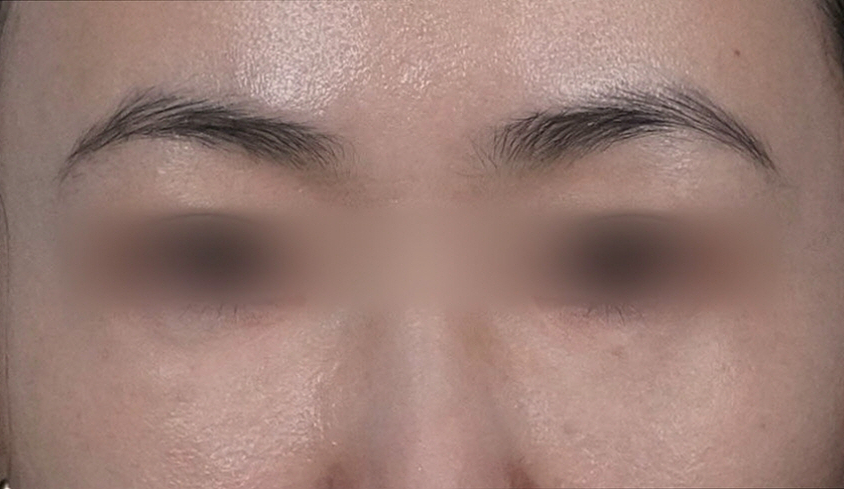 One month after lower eyelid surgery
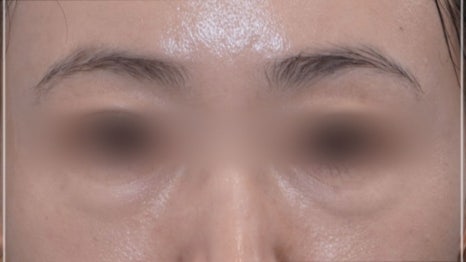
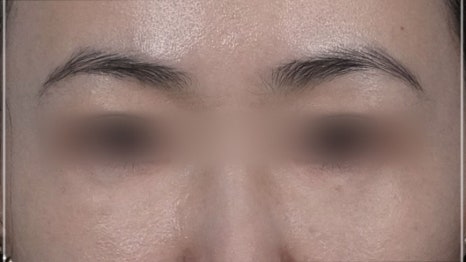
What causes the shadow? It’s simple.
The area below the protruding lower eyelid fat is sunken because of the ligaments, so a shadow forms.
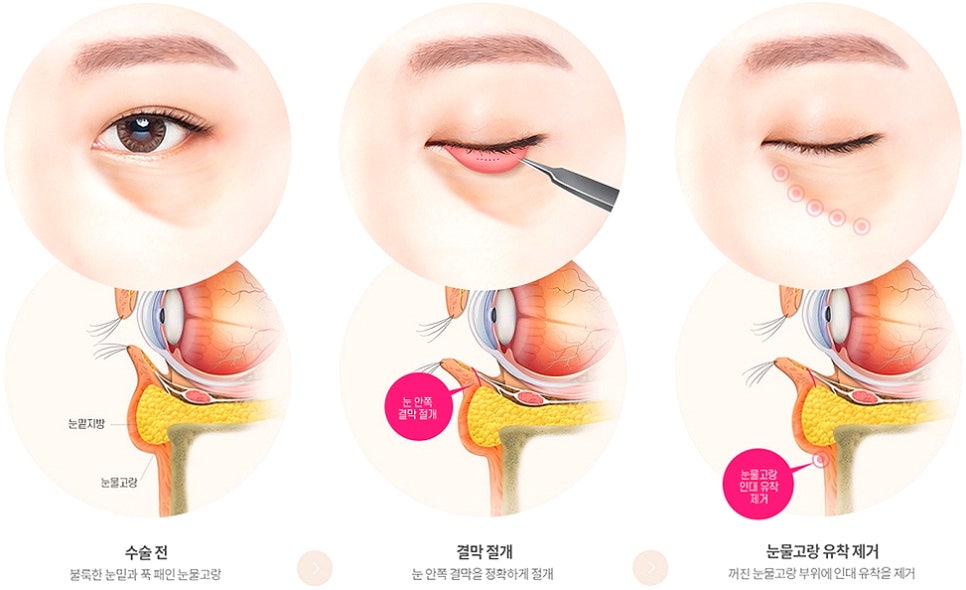
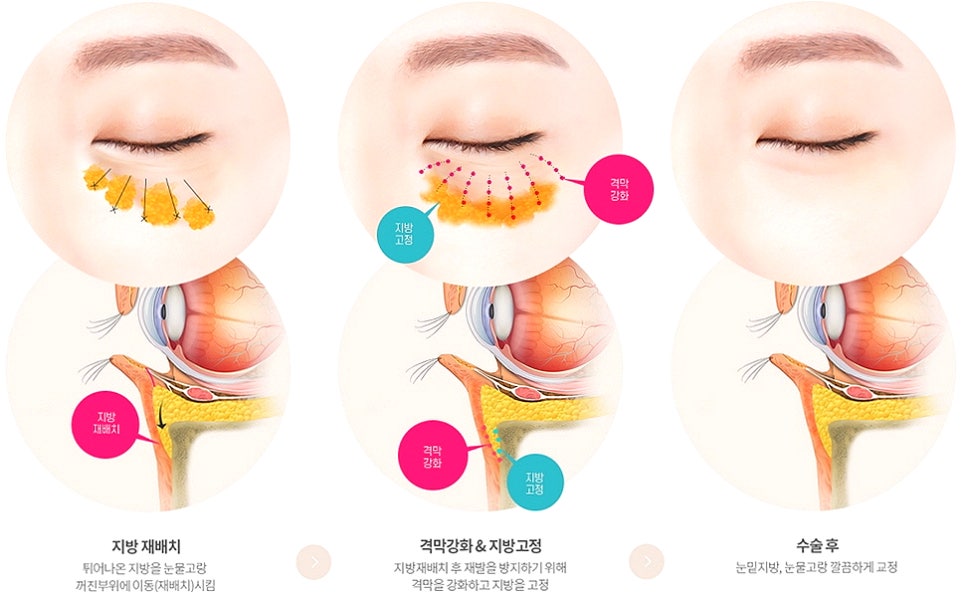
In cases where dark circles appear because the protruding lower eyelid fat casts a shadow under the eyes, lower eyelid fat repositioning is the appropriate procedure. By reducing the bulging fat and filling the hollow area to make the under-eye area flatter, the shadow no longer forms, so the dark circles naturally disappear.
Then how can you tell whether the cause of dark circles is shadow or something else?
How to Self-Diagnose Dark Circles
- Check under bright light
In general, light shines from top to bottom, so under bright lighting, lift your head and face forward toward a mirror. Then check whether the dark circles disappear.
If the dark circles that were there originally disappear, then yes, the cause is shadow, and it is a case that can be improved through lower eyelid surgery.

- Gently pull the skin with your finger
If the skin in the under-eye dark circle area becomes brighter when you gently pull it downward, the cause is likely shadow. On the other hand, if it stays just as dark whether you pull the skin or not, pigmentation is more likely the cause.

- Press the under-eye area
If you press under the eyes with your finger and the color changes, the cause is likely shadow. If the color remains the same, pigmentation may be the cause.

Most dark circles are caused by shadow, but if the cause is visible blood vessels or pigmentation, then rather than surgery, injections or laser treatment should be considered.
Visible blood vessels are suitable for vascular laser treatment or fillers, while pigmentation is better addressed with whitening treatment or pigment laser.
Lastly, one more thing
In addition to protruding under-eye fat, there is one more type of dark circles that should be improved with a surgical approach.
That is dark circles caused by sagging skin.
If the skin under the eyes becomes severely saggy, the sagging skin can gather over the hollow area and make the under-eye area look dark. In that case, lower blepharoplasty, which removes skin, is the appropriate procedure.
A self-check for under-eye skin sagging is to pull the skin downward and see whether the lower eyelid turns outward.
If there is no sagging, the lower eyelid will turn outward when you pull the skin. If there is sagging, the skin will be gathered in that area, so it will not turn outward.
A simple way is to shine bright light toward the front of your face and pull the sagging skin downward to see whether the dark circles disappear. If the dark circles disappear, then yes, lower blepharoplasty is the right case.
[Lower Blepharoplasty Procedure]
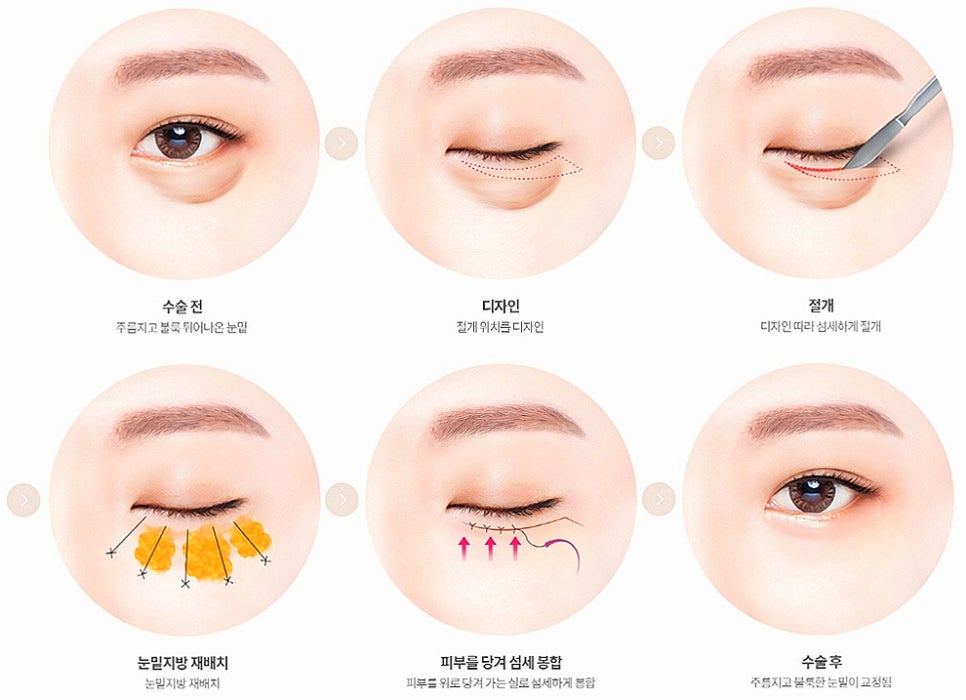
Have you understood the improvement methods for each cause of dark circles?
Then at this point, you may have this question.
If dark circles occur because the under-eye fat bulges outward while the area below is sunken due to ligaments, wouldn’t it be enough to simply fill only the hollow area with fat grafting?
As I said in the introduction, indiscriminate lower eyelid fat grafting should be avoided.
I’ll explain why in the next section.
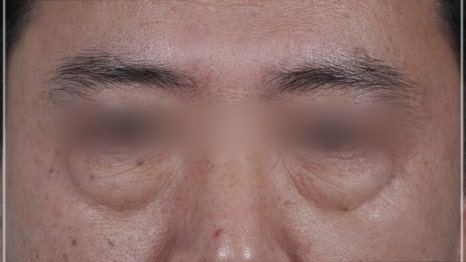
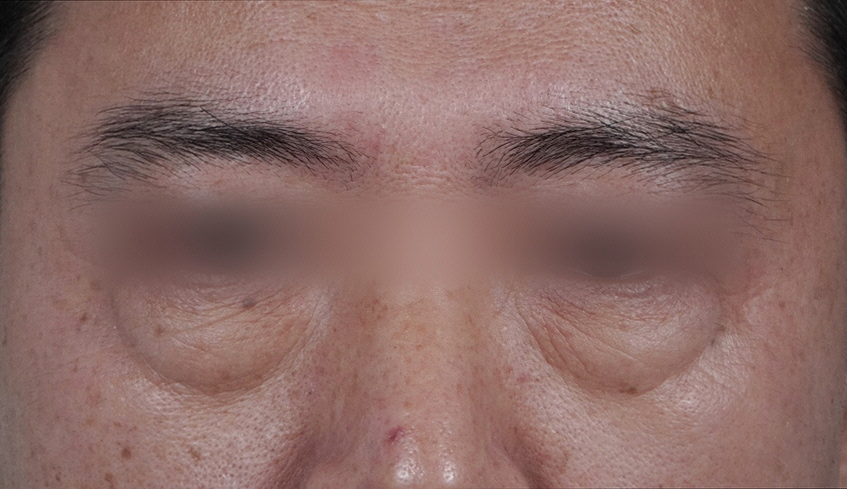 Before lower eyelid surgery
 One month after lower eyelid surgery
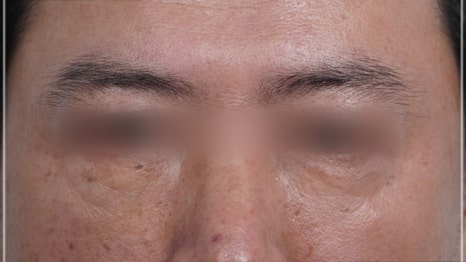
Indiscriminate lower eyelid fat grafting should be avoided.
I also perform fat grafting when it is truly needed.
The important point is that it should be done only in cases where it is truly necessary.
There are 3 + 1 major reasons for limiting fat grafting to cases where it is truly needed. First, I’ll go over the three reasons one by one.
- Structural issues with the ligaments
Under the eyes are ligaments, which serve to firmly connect the skin and deeper layers. As people age, these ligaments sag downward, and the surrounding fat decreases or shifts, making the area look hollow.
If fat is injected into an area where these ligaments exist, the fat is likely to be blocked by the ligaments and not spread evenly, causing it to clump in one place. If the fat doesn’t spread evenly, the surface can look uneven, and in some cases it may protrude like a lump.
- Difficulty with graft survival
Fat grafting doesn’t end with simply injecting the fat; the injected fat must survive, or take, in the tissue. The problem is that the under-eye area lacks enough tissue to support fat, so graft survival is likely to be unstable. If the fat does not settle properly, some of it may survive while some is absorbed, which can cause asymmetry. Also, because this area has very thin tissue and moves a lot, there is a possibility that over time the fat may shift or that swelling-like side effects may occur.
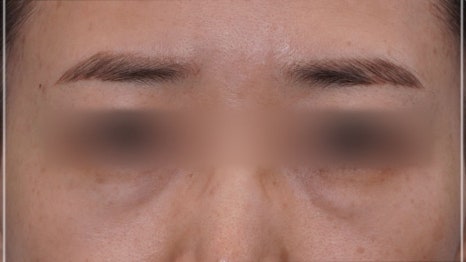
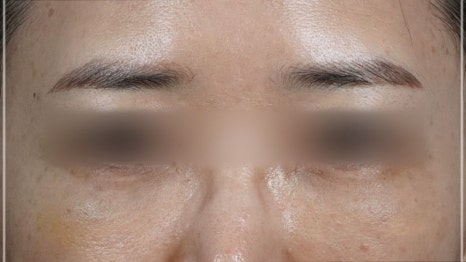
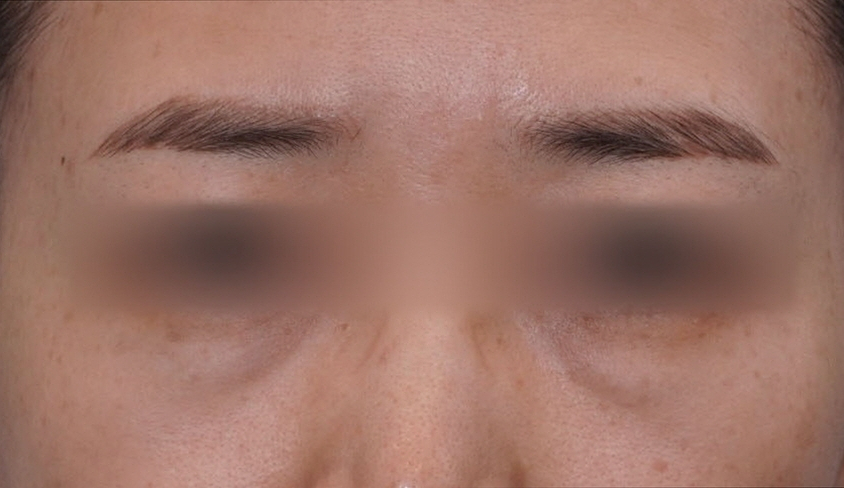 Before lower eyelid surgery
 One month after lower eyelid surgery
- The skin under the eyes is thin, so even small problems stand out
The skin under the eyes is one of the thinnest areas on the face, and the fat layer is also very thin. Therefore, if the fat does not spread evenly or is injected too superficially, even small irregularities can stand out easily.
Also, after fat grafting, some fat may appear to enlarge excessively over time, or swelling may occur due to interaction with surrounding tissue. This does not mean the fat itself is growing larger; rather, after fat grafting, the tissue may become fibrotic or swelling may occur, causing changes in volume.
+1 reason?
And lastly, the +1 reason is that there is a fitting alternative: lower eyelid fat repositioning.
Above all, for a medical professional who can perform lower eyelid fat repositioning properly and well, the likelihood of needing fat grafting drops significantly.
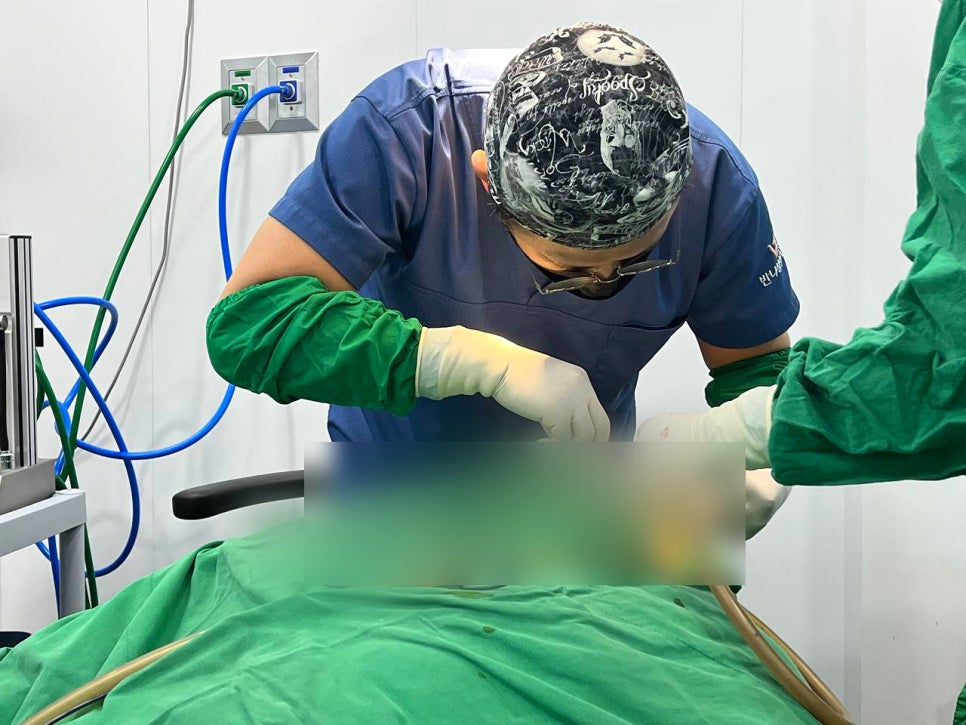
In general, as people age, the amount of fat decreases, so when performing lower eyelid surgery, the original fat should be preserved as much as possible. In other words, it is not removed but preserved and moved downward. Then the septum is tightened and reinforced to prevent the lower eyelid fat from protruding again, thereby blocking recurrence in advance.
The problem is that the surgical process I just described is quite difficult and bothersome.
So, there are often cases where the protruding fat is removed and that is the end of it, and then the hollow area is filled with fat grafting.
In other words, if the medical team truly knows how to perform lower eyelid surgery properly, smooth results can be achieved with lower eyelid surgery alone, without separate fat grafting. Fat grafting should only be considered in cases where it is truly necessary, such as when the hollowing is too severe or there is not enough fat to reposition.
The important thing is that lower eyelid fat grafting should be performed only when truly necessary, by an experienced specialist.
[Lower Eyelid Fat Repositioning Procedure]
Today’s conclusion
Rather than trying to solve dark circles blindly,
you need to understand them properly and make the right decision.
The most important thing is finding the treatment that suits you.
The approach should change depending on the cause and condition of the dark circles.
So rather than someone saying, “We’ll make it pretty no matter what,” look for a medical professional who first says, “We’ll diagnose it accurately and find the best method.”
To avoid wasting time and money on unnecessary procedures and surgery, accurate diagnosis and honest consultation are the most important things. When it comes to under-eye surgery, principles should come before trends.
This is Ban Ho-gyeong, the one you can’t help but like.
Thank you.


[Why a Cheap and Well-Performed Lower Eyelid Surgery Clinic Is the Truly Good Hospital]
https://blog.naver.com/rush_724/223737127404
[Conditions of a Hospital Where You Can Return to Daily Life Quickly After Lower Eyelid Surgery]
https://blog.naver.com/rush_724/223747252948