Gangnam-gu Office Station dentist, this is Dr. Kim Sun-min, the representative director of Ceramic Dental Clinic. Today, I’d like to introduce a somewhat special case. It is the story of laminate treatment for a 71-year-old Russian American female patient who visited us all the way from San Francisco, USA.
She was also the oldest patient among the laminate cases we have recently treated, and because she had aesthetic standards different from those of Korean patients, it was an interesting case in many ways. I will share in detail the process of combining gingivectomy and laminate treatment to improve the shape of the front teeth, the gum line, and the spaces between teeth.
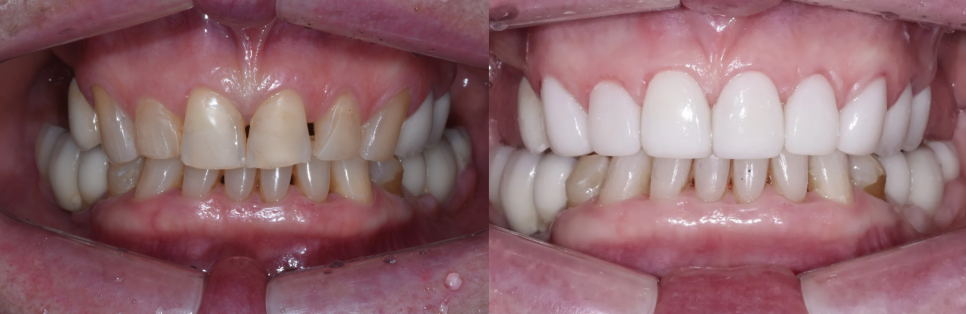
Before-and-after photos
A 71-year-old patient who came from the United States through her son’s introduction
This patient is a Russian American woman living in San Francisco. In fact, our first connection came through her son. Last year, her son received eight laminate restorations on his upper teeth at our clinic, and he was so satisfied with the results that this time he brought his mother back for treatment. For reference, she was scheduled to have plastic surgery the very next day after treatment at our clinic, which was also a case that let us truly feel the power of K-Beauty.
The patient’s concerns: front tooth shape, gum line, and spaces between teeth
There were three main things that bothered the patient. First, she felt that the shape of her front teeth and her gum line were not attractive. Second, she was concerned about the spaces visible between her teeth. Third, she wanted a bright white “Hollywood style” with a straight incisal line.
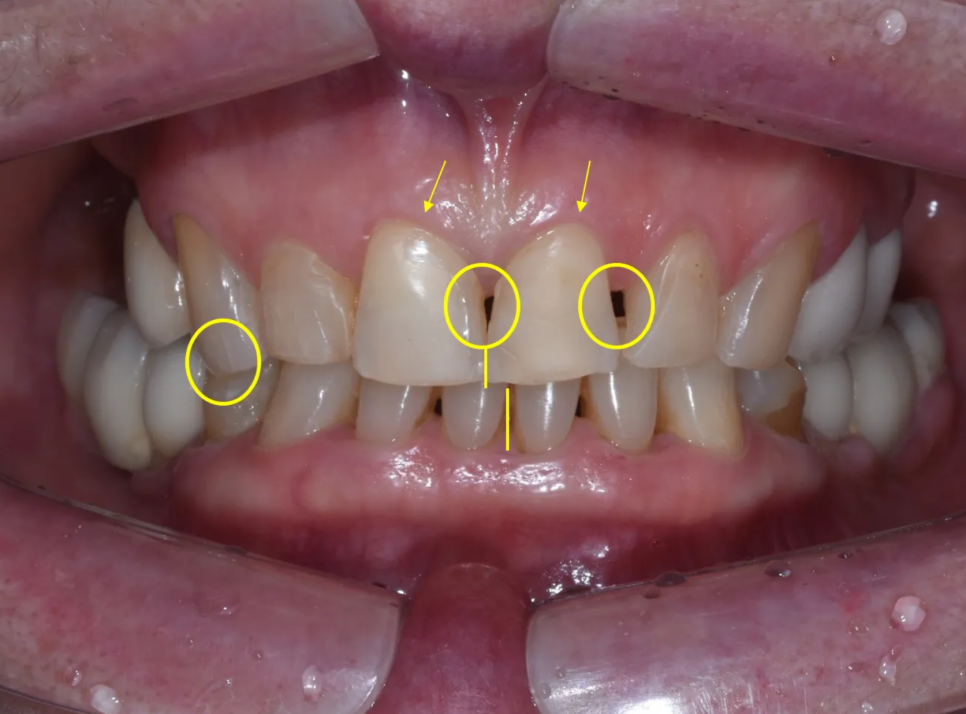
When we actually examined the oral cavity, there were several issues present at the same time.
| Issue | Details |
|---|
| Tooth size | The two upper front teeth (central incisors) were relatively large, while the right lateral incisor was small, creating an imbalance in proportion |
| Black triangle | A black triangle-shaped space was present between the two upper front teeth |
| Between teeth | A gap existed between the left front tooth and the lateral incisor |
| Gum asymmetry | The left and right gum heights were different and unbalanced |
| Wear | The tip of the right lateral incisor was worn down, making it shorter |
| Shade difference | The color of the previously restored resin area was different from the surrounding teeth and stood out |
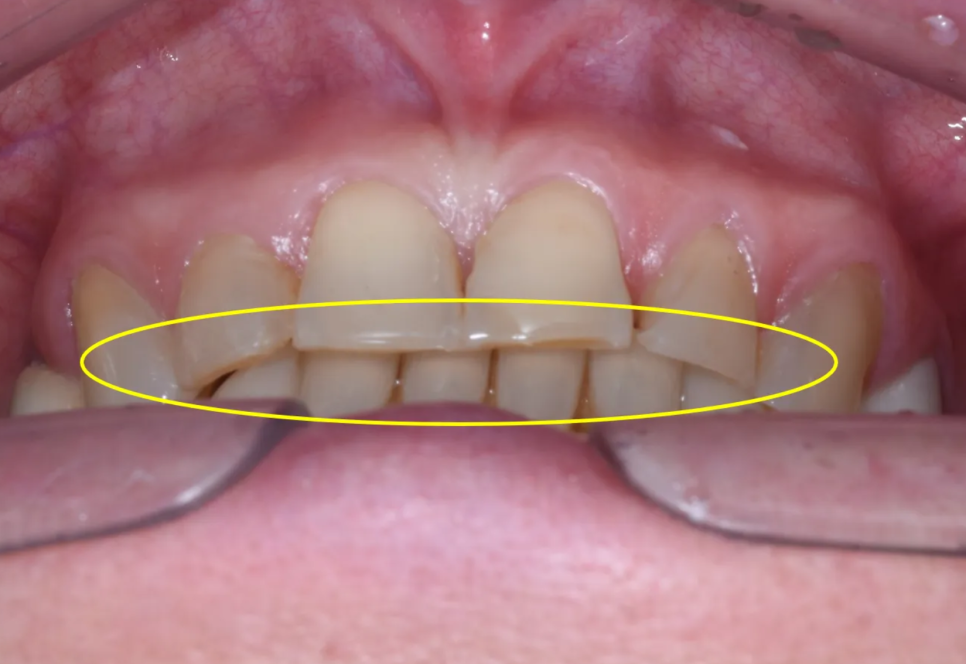
The upper and lower teeth were in very tight contact. In cases like this, laminate debonding can occur frequently, so caution is needed.
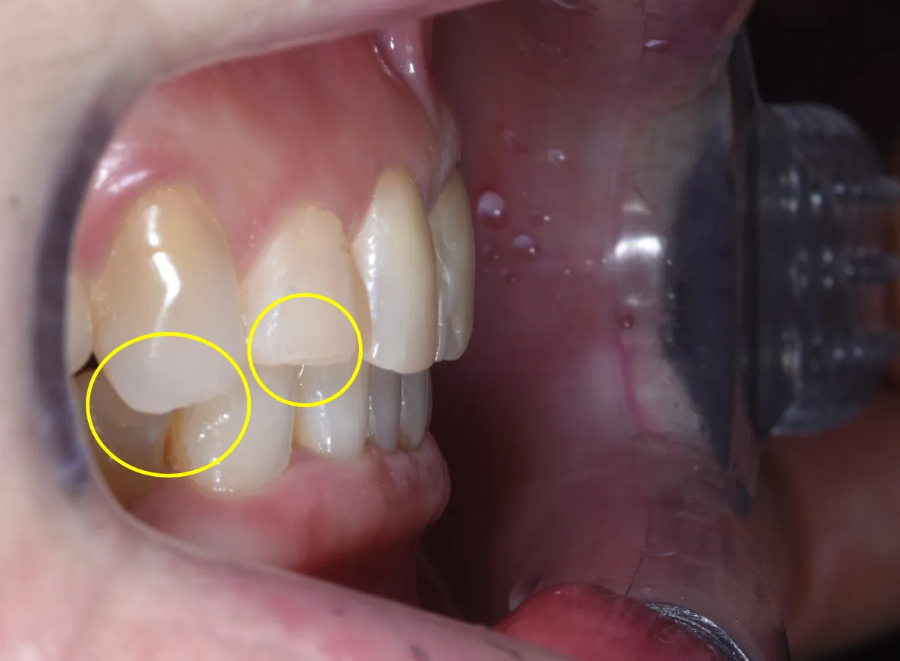
Wear on the incisal edge of the right lateral incisor shortened the tooth, and extrusion of the canine can be observed.
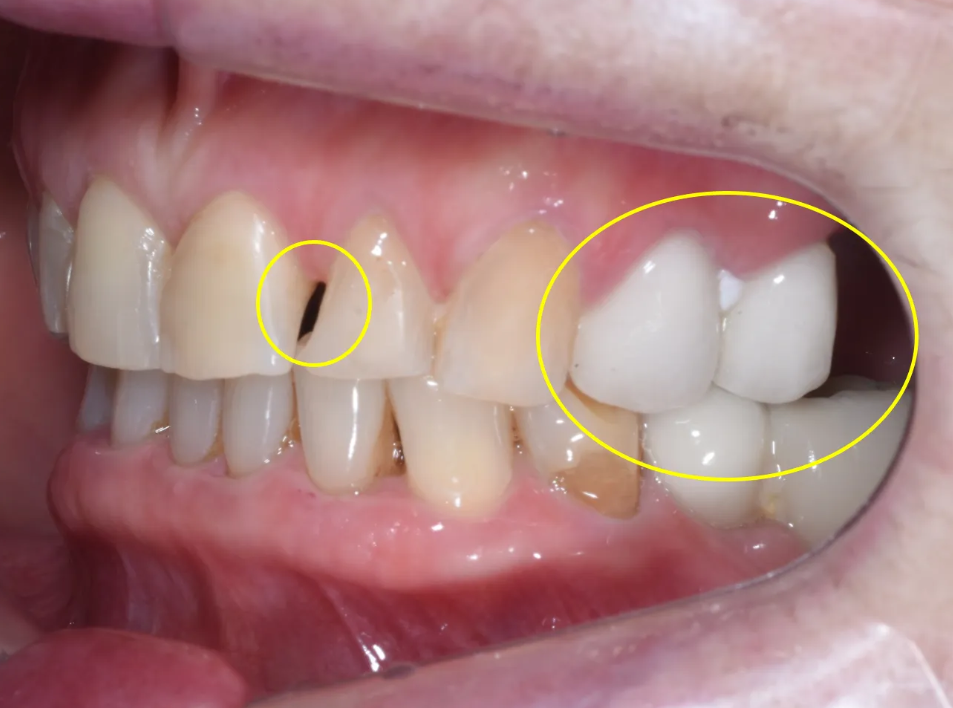
The space between the left front teeth and the all-ceramic crown in the existing premolar area are visible.
Fortunately, even though several upper molars were missing, the occlusion, degree of wear, and tooth inclination in the front tooth area were relatively well maintained. If the tooth size and proportions were properly adjusted and only the black triangle and spacing were improved, this was a case where good results could be expected.
Refining the gum line
Before proceeding with laminate, gingivectomy was needed first. Gingivectomy is a procedure that removes excessively covered gum tissue to increase the visible length of the teeth and balance the symmetry of the gum line.
In this patient’s case, the gum line of the two upper central incisors was asymmetrical from left to right, and the gums were covering the teeth significantly, making the teeth look short. The right lateral incisor was also short due to wear, so gingivectomy was performed on a total of four tooth areas, including both lateral incisors, to secure left-right symmetry.
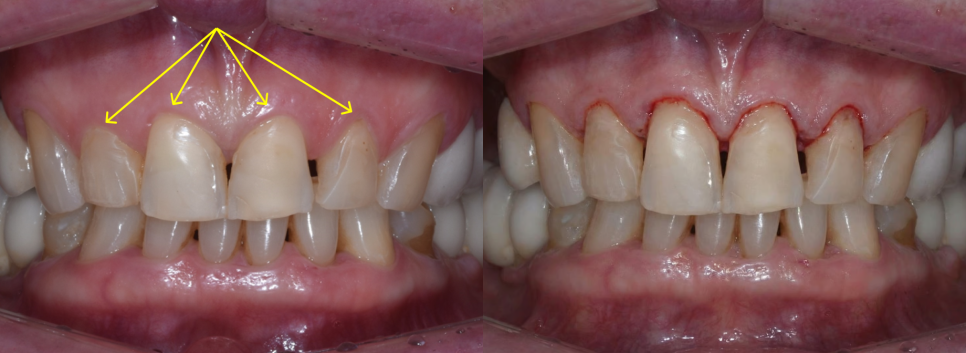
After refining the gum line, the previously cramped-looking tooth length changed dramatically. (The unpleasant bleeding was lightly corrected with AI in this photo.)
When gingivectomy and laminate are performed together, it is possible not only to change the tooth surface, but also to improve the harmony between the width and length ratio of the teeth and the gum line all at once. However, an important point is that the final restoration must be set after the gums have stabilized sufficiently. If setting is done while the gums are unstable, bleeding may occur or marginal fit may be compromised.
Treatment process
The treatment proceeded in the following order.
Step 1: Gingivectomy
- Gingivectomy was performed in the area of the four upper front teeth (both central incisors + both lateral incisors) to balance the gum line and increase the visible tooth length.
Step 2: Minimal reduction for laminate
- Minimal reduction for laminate was performed on a total of six teeth from canine to canine in the upper jaw. The procedure was carried out precisely to minimize tooth reduction as much as possible while still achieving a beautiful aesthetic result.
Step 3: Shade matching
- This part was especially important. Because the patient already had all-ceramic crowns on her two left premolars, the laminate shade had to be matched so that it would blend naturally with the existing crowns. Using the VITA shade guide, we selected the bright white Hollywood-style color the patient wanted.
Step 4: Occlusal adjustment
- Because the incisal edge contact between the upper and lower front teeth was very tight, we also considered reducing the lower front teeth in the necessary areas to eliminate occlusal interference and prevent the laminate from fracturing.
In addition, a temporary denture was made for the multiple missing upper molar areas. Since the implants were planned to be placed overseas later, we first made sure she could use them functionally in the meantime.
Final result – black triangle resolved, symmetrical gum line, Hollywood smile completed
The final setting result neatly improved all of the issues the patient had been concerned about.
| Before treatment | After treatment |
|---|
| Black triangle between the upper front teeth | ✅ Effectively improved |
| Gap between the left front tooth and lateral incisor | ✅ Gap resolved |
| Imbalance in tooth size and proportions | ✅ Harmoniously adjusted |
| Asymmetrical gum line | ✅ Stabilized symmetrically after gingivectomy |
| Shade mismatch | ✅ Naturally harmonized with the existing crowns |
| Patient’s desired style | ✅ Bright, straight Hollywood style completed |
What was especially pleasing was that the gingivectomy area stabilized healthily, and there was no bleeding at all at the time of setting. Even at the age of 71, the patient showed very good gum healing and laminate fit.
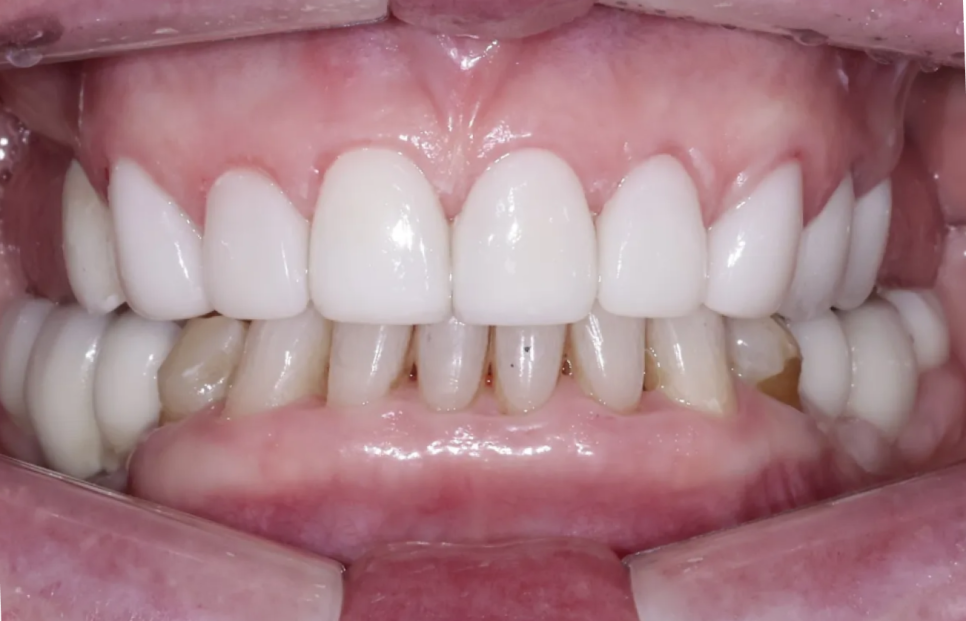
Overall view after final setting was completed. Occlusal balance and shade harmony are maintained stably.
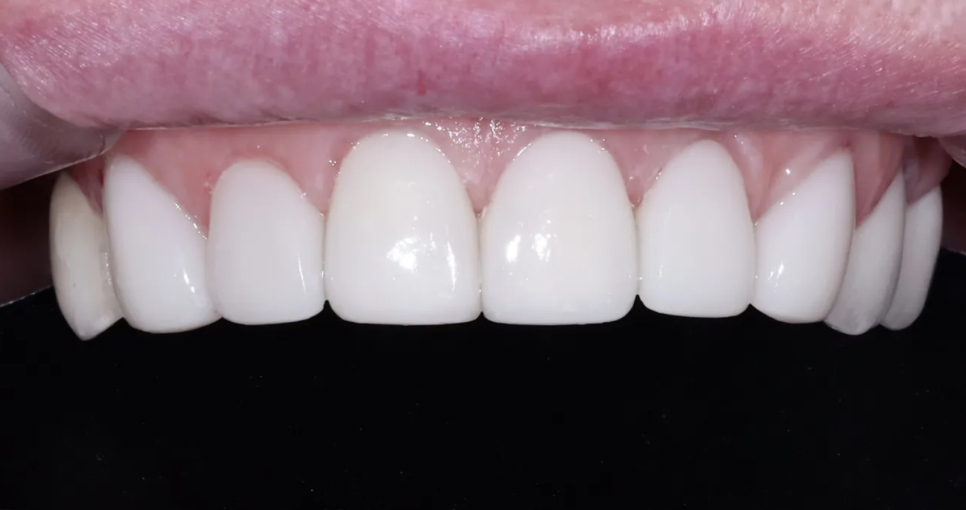
The black triangle and spaces were neatly improved, and the gum line was completed symmetrically.
The bright, straight incisal line of the Hollywood style the patient wanted was well expressed.
Differences in aesthetic standards between Korea and other countries: “naturalness” vs. “Hollywood style”
While working on this case, I was reminded once again that the standard for “beautiful teeth” differs depending on the country and culture.
| Category | Preference of Korean patients | Preference of Western patients |
|---|
| Color | Natural color close to natural teeth | Bright white color |
| Shape | Soft lines that do not look artificial | Straight, uniform, linear incisal edge |
| Overall impression | Not looking obvious whether restorations were done | Clearly beautiful and neat impression |
The style commonly called a “Hollywood smile” is characterized by a bright, glossy color, balanced alignment, and a straight incisal edge. This patient also wanted exactly this style, so the design and shade were determined to match her expectations.
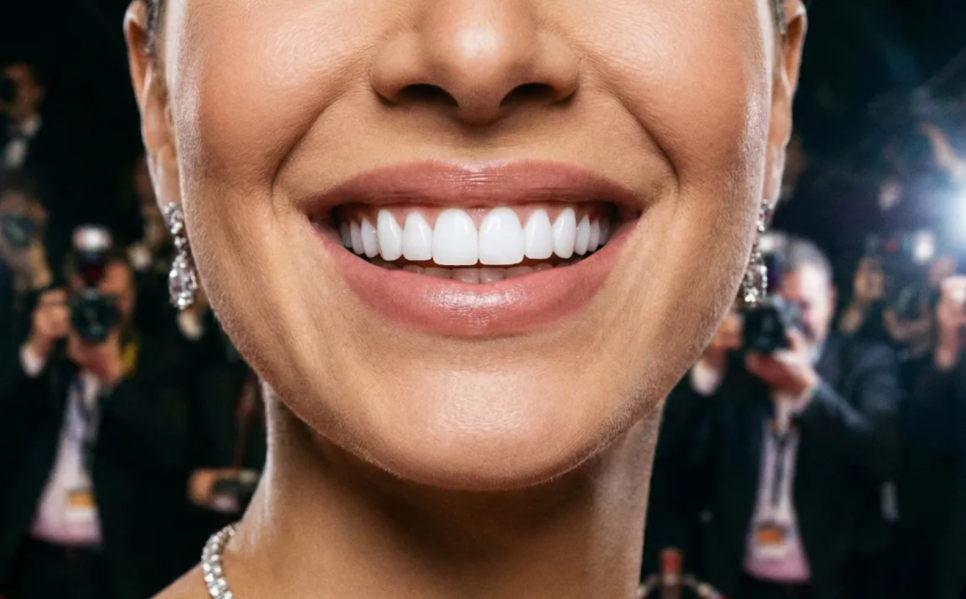
An example of the Hollywood style. It is characterized by bright, uniform color, a straight incisal edge, and balanced alignment.
As a dentist, I cannot say that one style is more correct than another. I believe it is most important to respect each patient’s cultural and personal aesthetic standards and reflect them accurately.
A warm connection with an older laminate patient
This case was the oldest patient among the laminate patients I have treated recently, at 71 years old. What I felt once again through this case is that, regardless of age, the desire for a beautiful smile exists in everyone.
Even though several upper molars were missing, the occlusion, wear, and tooth inclination in the front tooth area were relatively well maintained, so it was a case where a good prognosis could be expected. The gingivectomy area also stabilized neatly, allowing us to achieve a very satisfying result.
This treatment, which began through her son’s connection, was also a special experience for me. I became close with her son every time he visited, and on the day of setting we exchanged contact information; even now, we continue to stay in friendly contact. I also heard that her mother is very satisfied with her laminate teeth.
Since she made the decision to come from overseas to Korea for treatment, it was truly rewarding to be able to deliver a result that lived up to that trust. If you are concerned about the shape of your front teeth, your gum line, or the spaces between your teeth, please feel free to consult with us. Thank you.