Black triangles in the front teeth are a problem that patients in the clinic worry about very often. Hello, I’m Kim Sun-min, director of Ceramic Dental Clinic. Today, I’d like to talk about this topic.
"Doctor, I can see a black gap between these teeth."
There are quite a few people who say this. Especially when it appears in the front teeth, it can be hard not to notice when smiling, and it may even make some people cover their mouth or feel less confident.
It is often noticed after scaling, but that is usually because tartar is removed, making the space easier to see and feel; scaling does not create black triangles.
In this post, I’ll organize the following topics carefully.
What is a black triangle?
A black triangle refers to a triangular black space between teeth that the gums cannot fill. Its formal name is Open Gingival Embrasure, but the term black triangle is much more intuitive than the technical term.
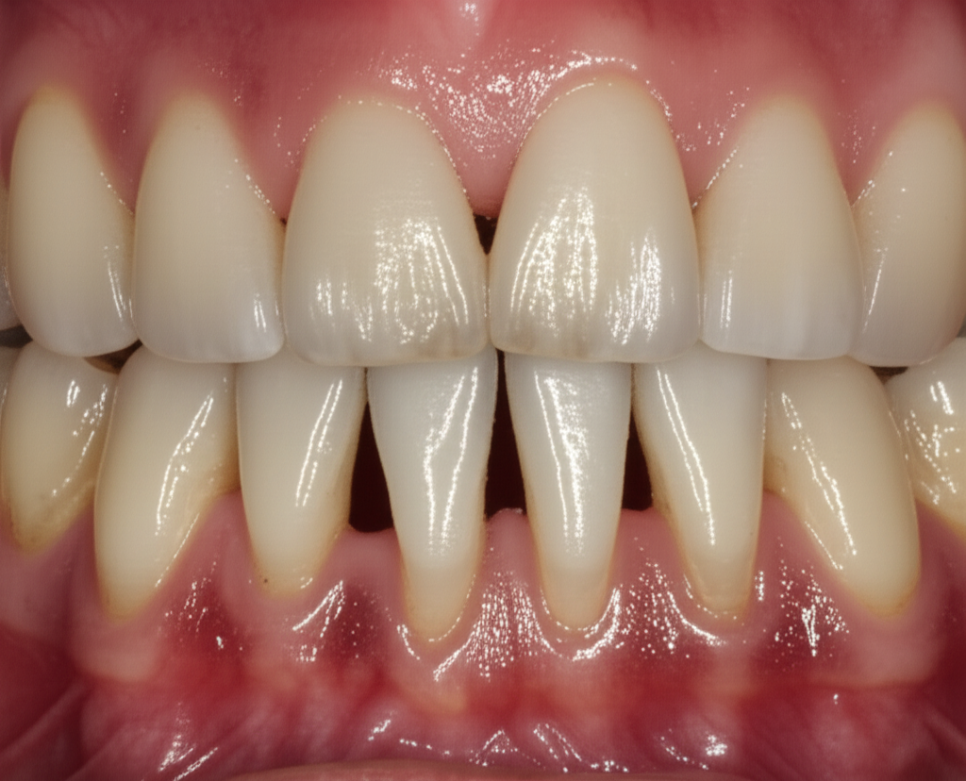
The black gap visible between teeth. This is called a black triangle.
Black triangles are especially noticeable in the front teeth, so they often become a source of aesthetic concern. However, black triangles are not just a cosmetic issue; they can also cause functional discomfort, such as food trapping and changes in pronunciation. For that reason, they often require appropriate management and treatment rather than being dismissed as a minor appearance issue.
Main causes of black triangles
There is not just one cause of black triangles. In many cases, several factors work together. Here is a summary of the main causes in a table.
| Cause | Description |
|---|
| Gum disease | This is the most common cause. When inflammation develops in the gums, the bone that supports the teeth (alveolar bone) is destroyed, and the gums recede. |
| After orthodontic treatment | This happens when teeth that were overlapping become aligned, revealing gum loss that had been hidden before. Rather than orthodontics being the direct cause, it is closer to an existing problem becoming visible. |
| Aging | This refers to the natural shrinkage of gum tissue over time. To some extent, this is a natural change. |
| Tooth shape | When the teeth are inverted triangle-shaped (wider at the top and narrower at the bottom), the contact point between teeth is higher, making black triangles more likely to form. |
In particular, when black triangles appear after orthodontic treatment, many people worry, "Did I have the braces done wrong?" In most cases, however, it is exposed gum recession that had been hidden between crooked teeth and becomes visible once the teeth are aligned. It is a good idea to discuss this possibility in advance when planning orthodontic treatment.
Problems caused by black triangles
The problems caused by black triangles are more varied than you might think.

The biggest issue is, of course, aesthetics. If a black space is visible between the front teeth when smiling, it can lower confidence and may even make a person look older than they are. In the clinic, this is the most common reason people come in for consultations.
But it is not only a cosmetic issue. When there is space between the teeth, food can trap easily, and if this is not properly managed, the risk of cavities and gum disease increases. Air may also leak through the front teeth, which can subtly affect sounds such as "s" pronunciation.
One point that requires special attention is the vicious cycle: food gets trapped → bacteria multiply → gum inflammation worsens → the black triangle grows larger. That is why, once a black triangle is found, it is important not to leave it untreated and instead manage it actively.
Treatment options for black triangles
 It was already pretty, but treating the black triangles and spacing makes it even prettier.
The treatment for black triangles varies depending on the size, cause, location, and desired level of aesthetic finish. Here is a comparison of the main treatment methods.
| Treatment method | Advantages | Disadvantages |
|---|
| Resin restoration | Relatively simple and economical | Not as aesthetically beautiful as laminate |
| Laminate/Veneer | Because the tooth shape itself can be changed to reduce the space, the final result is the most aesthetically pleasing | Traditionally, tooth reduction was a drawback, but no-prep and minimal-prep laminates are now possible |
| IPR + orthodontics | After performing a small amount of interproximal reduction (IPR), orthodontics is used to lower the contact point so the gums can naturally fill the space | Additional orthodontic time is required |
Resin restoration is a method of filling the space by bonding resin between the teeth. It is the simplest method and relatively low in cost, but it is important to know that finishing the interproximal area perfectly can be difficult, and over time it may discolor or deteriorate.
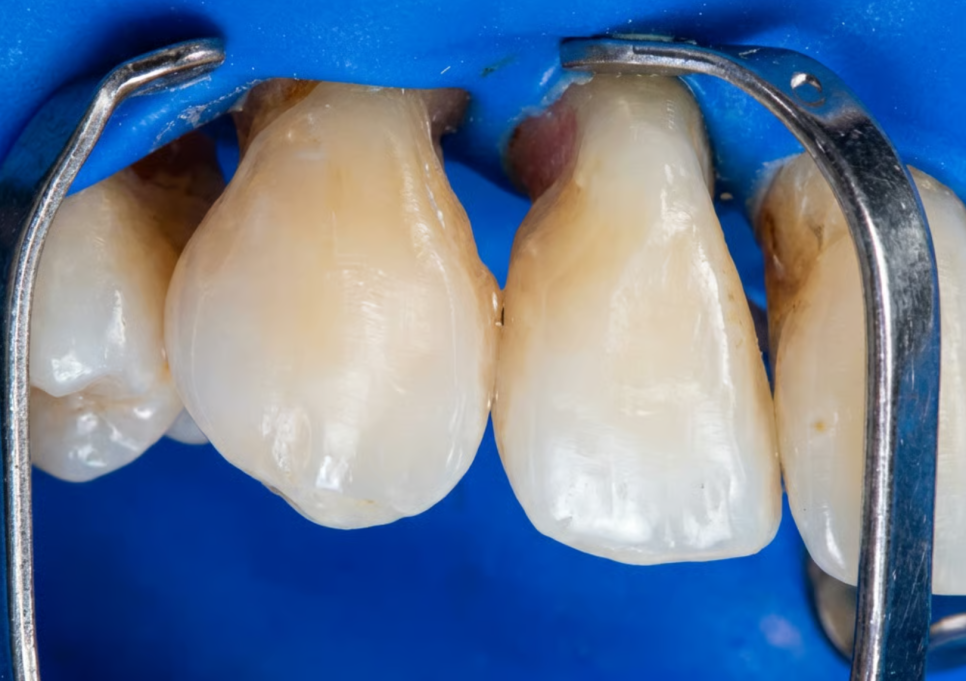
To do resin treatment, first this space between the teeth has to be filled with something like modeling clay to create the shape.
It is difficult to make it perfectly beautiful.
Laminate (veneer) is a method of changing the tooth shape itself by covering the front surface of the tooth with a thin ceramic layer. Its biggest advantage is a high level of aesthetic completion. In the past, the burden of having to shave down a lot of tooth structure was a drawback, but recently no-prep or minimal-prep laminate techniques have developed, greatly reducing that concern.
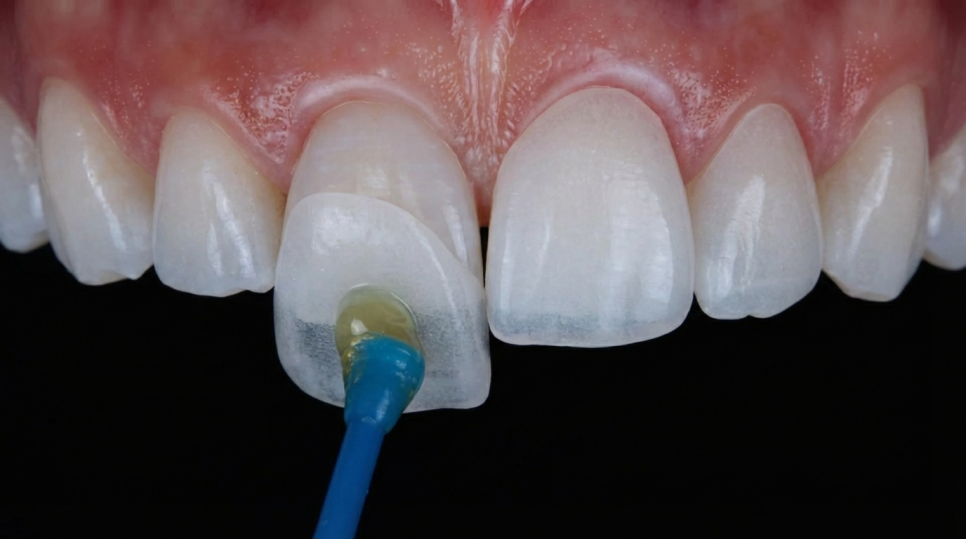
Laminate treatment is the best in terms of aesthetics.
IPR + orthodontics is a method in which a very small amount is trimmed between the teeth, and then orthodontics is used to bring the teeth together. The principle is to lower the contact point between the teeth so that the gums can naturally fill the space. In principle, it is a very good treatment method, but because it is still orthodontic treatment, the downside is that it takes a long time.
The most suitable method depends on each individual situation, so I recommend making the decision only after sufficient consultation with a specialist.
Tips for preventing and managing black triangles
If possible, prevention is the most important thing.
Since it is not easy to reverse a black triangle once it has already formed, the best approach is to pay attention to daily care.
-
Proper brushing: Brush gently without using excessive force, as if massaging the gums. Brushing too hard can actually damage the gums.
-
Regular scaling and gum checkups: Detecting and treating periodontal disease early is key to preventing black triangles.
-
Proper interdental care: Use dental floss and interdental brushes in the correct size. Be careful, because using an interdental brush that is too large can damage the gums.
-
Quit smoking: Smoking is very harmful to gum health. If you want to maintain healthy gums, quitting is essential.
-
Pre-treatment consultation for orthodontics: If you are planning orthodontic treatment, discuss the possibility of black triangles with a specialist in advance.
Even if a black triangle has already developed, there is no need to worry too much. You can visit a dental clinic and discuss the treatment options that are right for you.
Frequently Asked Questions (FAQ)
Q. Do black triangles recover naturally?
Unfortunately, once the gum tissue between the teeth (interdental papilla) and bone have been lost, it is very difficult for them to recover naturally. That is why, if a black triangle is found, improvement through appropriate dental treatment is needed.
Q. I developed black triangles after orthodontic treatment. Was it caused by orthodontics?
We get this question very often. In most cases, orthodontics itself is not the direct cause; rather, the gum loss that had been hidden while the teeth were overlapping becomes visible once the teeth are aligned. In other words, it is closer to an existing problem becoming visible.
Q. Can black triangles keep getting bigger?
Yes, they can. In particular, if the underlying cause, such as gum disease (periodontal disease), is not addressed, they may gradually become larger. That is why it is very important to identify the cause and manage it continuously.
Black triangles are a problem that can be bothersome both visually and functionally. But if you identify the cause accurately and choose the right treatment method, they can be improved sufficiently.
The most important thing is prevention and early management. I recommend maintaining proper oral care habits and getting regular dental checkups. If you already have black triangles, do not worry alone—consult a specialist and find the solution that is right for you.
Thank you. If you have any questions, feel free to ask anytime! 😊