Hello, I’m Dr. Kim Seon-min of Sera Dental, an orthodontic clinic near Unju Station. Today, I’d like to talk in detail about a question many people are curious about: “Can an underbite improve with orthodontic treatment alone, without surgery?” I’ll explain it through a real treatment case.
Many people who are concerned about an underbite hesitate to seek treatment because they feel 부담감 about surgery, but not every case necessarily requires it. The case I’m introducing today is a good example of that.
What is an underbite (Class III malocclusion)?
An underbite is medically called mandibular prognathism. Simply put, it means the lower jaw is positioned forward relative to the upper jaw. In such cases, the bite relationship is often reversed from normal.
When there is an edge-to-edge or reverse bite relationship, it is not only an appearance issue. Chewing function may be reduced, pronunciation can become unclear, and many people also experience significant psychological stress. In general, severe underbites are known to require double-jaw surgery, but with an accurate diagnosis, there are cases that can be sufficiently improved with non-surgical orthodontic treatment alone.

Jinse Jo, famous for Short Box, is a representative example of an underbite.
Before treatment
The patient introduced today was a woman in her early 30s, and her main concerns were an underbite and reverse bite.
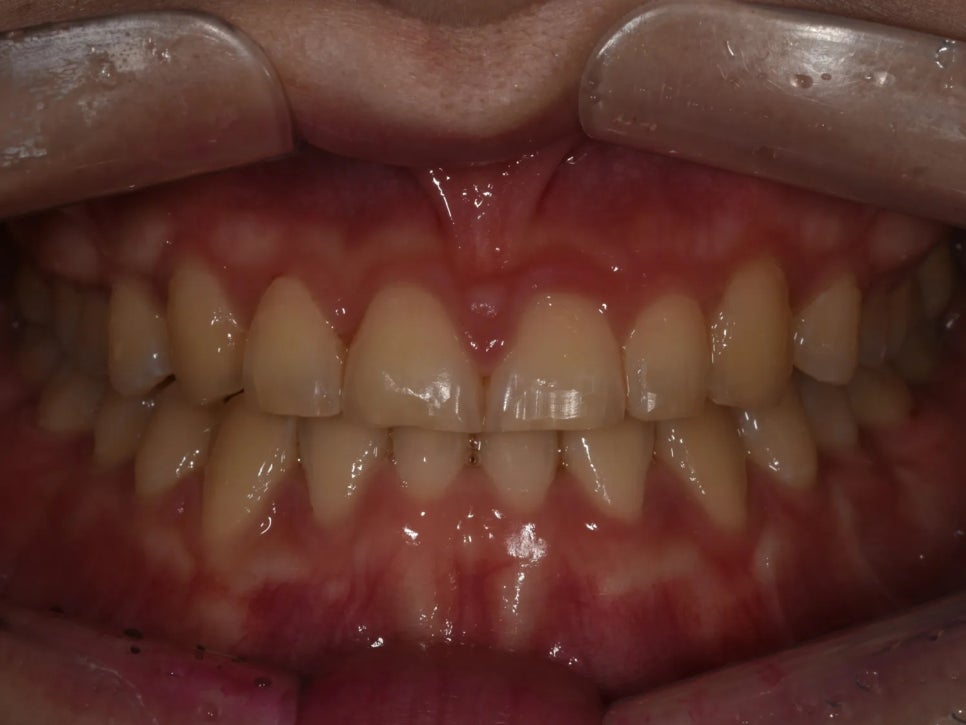
First, looking at the inside-mouth photo, a clear reverse bite in the front teeth area can be observed. The upper front teeth are biting behind the lower front teeth.
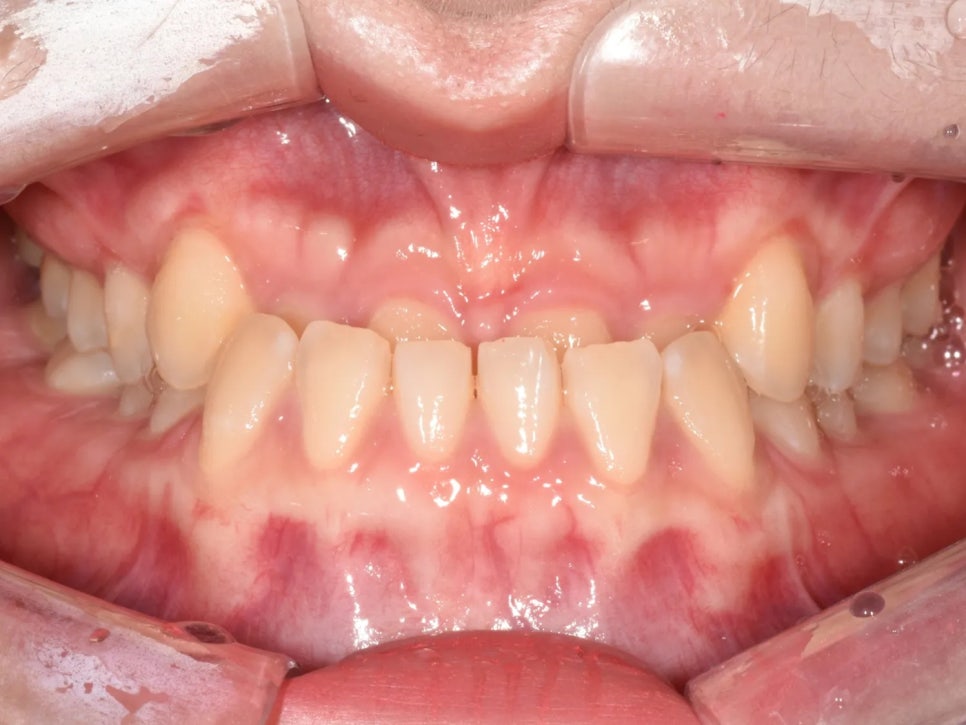
The lower teeth are positioned in front of the upper teeth in a reverse bite, and the bite depth is also deep, showing a deep overbite.
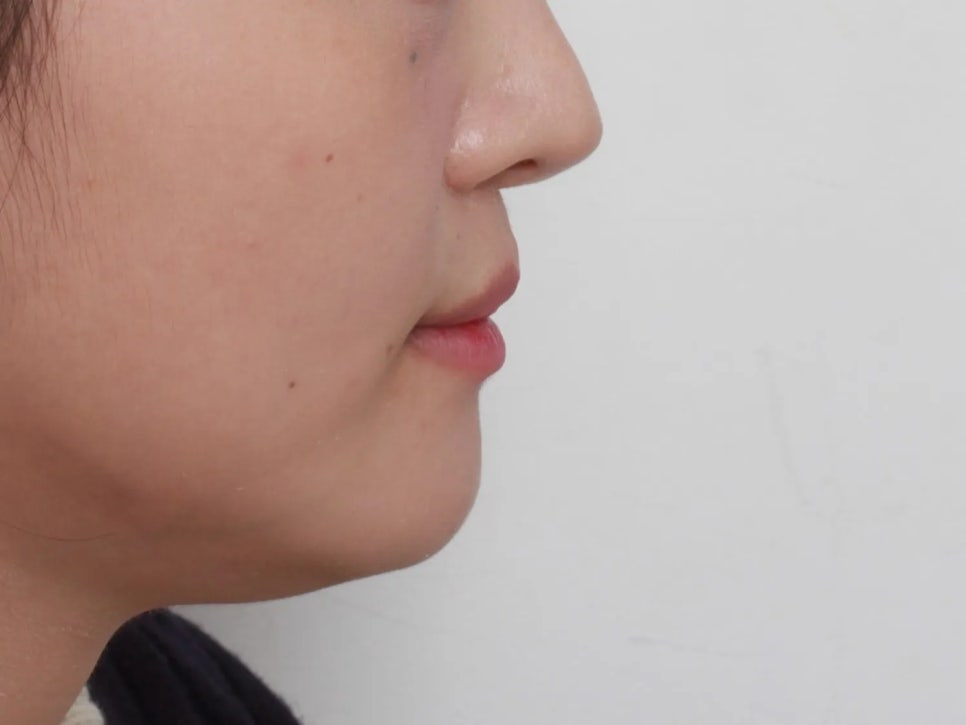
Looking at the side view, the lower jaw is clearly protruding forward. A typical underbite facial profile was present.
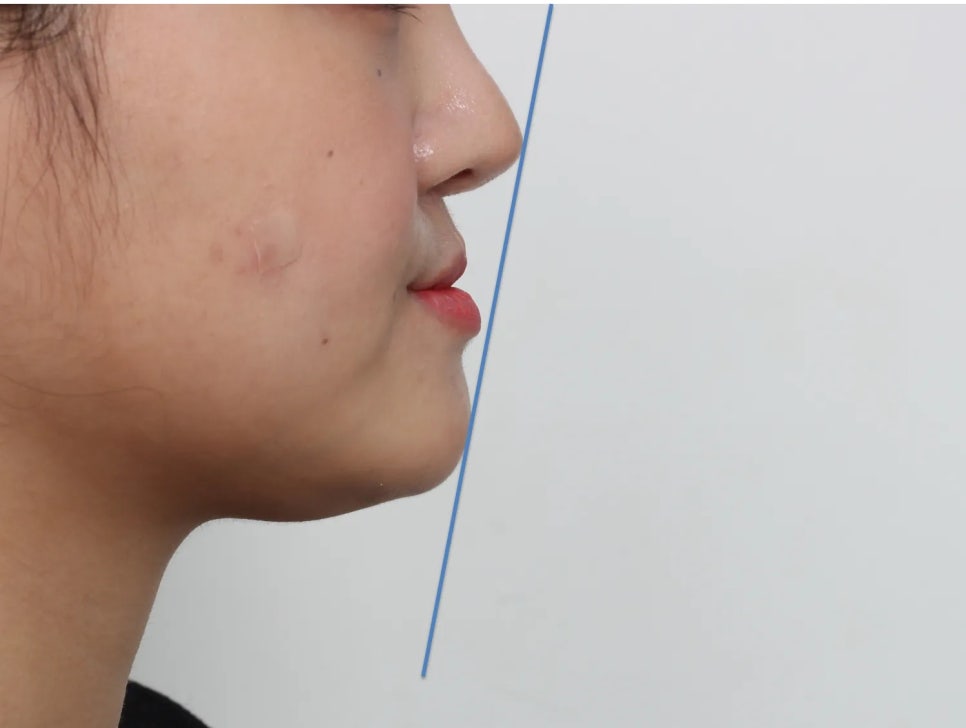
Forward protrusion of the lower jaw (underbite) is observed.
Let’s also look at the photo taken from above the upper teeth. There is an important point here: the second incisors (lateral incisors) were positioned inward, while the canines were relatively prominent. In other words, the upper jaw had somewhat insufficient size for all the upper teeth to be properly aligned.
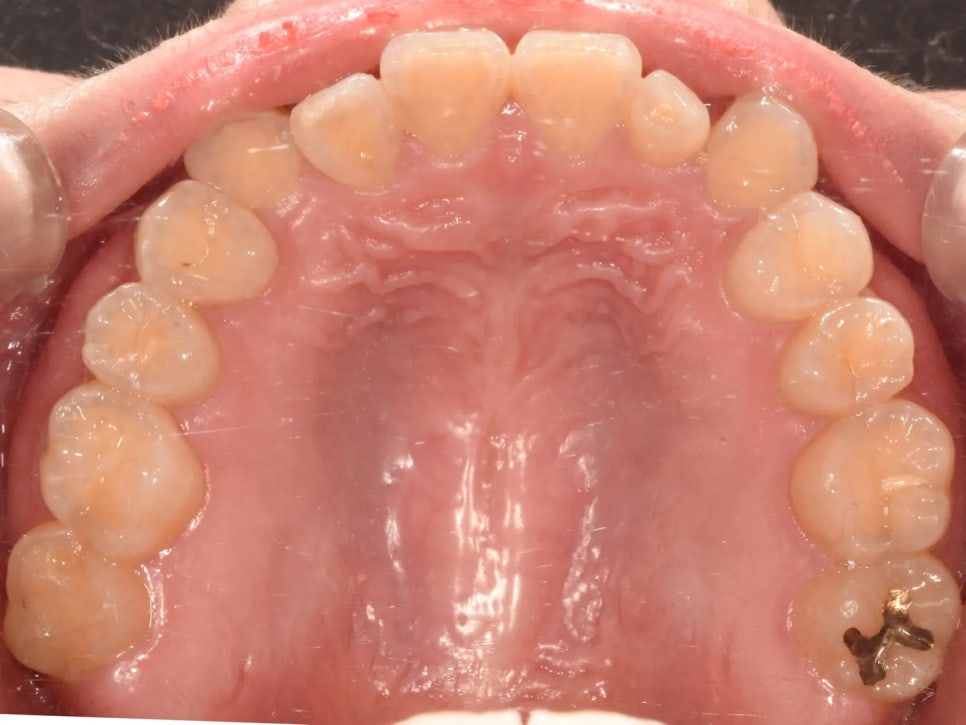
Intraoral photo before treatment
Overall, the diagnosis showed a combination of underbite originating from the jaw structure itself, underdevelopment of the upper jaw, and lack of space for tooth alignment.
Treatment plan – Is it possible with orthodontics alone, without surgery?
In this patient’s case, she had already been judged to need surgery at a university hospital. Of course, in severe underbite cases, double-jaw surgery is usually considered. However, in this patient’s case, although surgery was an option, it seemed that non-surgical orthodontic treatment alone could produce sufficiently good results.
The main treatment strategy had two major parts.
| Strategy | Purpose | Method |
|---|
| PBP appliance application | Raise the bite | Remove the interference so the upper teeth can pass over the lower teeth |
| Use of mini-screws | Move the lower teeth backward | Retract the protruded lower dentition |
PBP (Posterior Bite Plane) is an appliance placed on the palate, and it serves to raise the height so that the upper and lower teeth do not directly contact each other. To allow the upper front teeth to move forward over the lower teeth, the front teeth that are biting in reverse need to be separated from each other.
The final goal was to resolve the reverse bite and establish a normal bite relationship, thereby improving facial appearance as well.
Stage 1 of treatment – Upper jaw expansion and creation of space for the front teeth
In the first stage, the PBP mentioned above was applied. This appliance is positioned on the palate and helps widen the upper dental arch to both sides.
While expanding the upper jaw, space was also created between the front incisor and the canine. This is because doing so creates room for the second incisor that had been positioned inward to move into its correct place.
Here is an interesting point: because the premolars and molars behind the canines are sturdier teeth that provide resistance, once space is secured, the front teeth naturally tend to move forward (toward the lips). This is the first step in resolving the reverse bite.
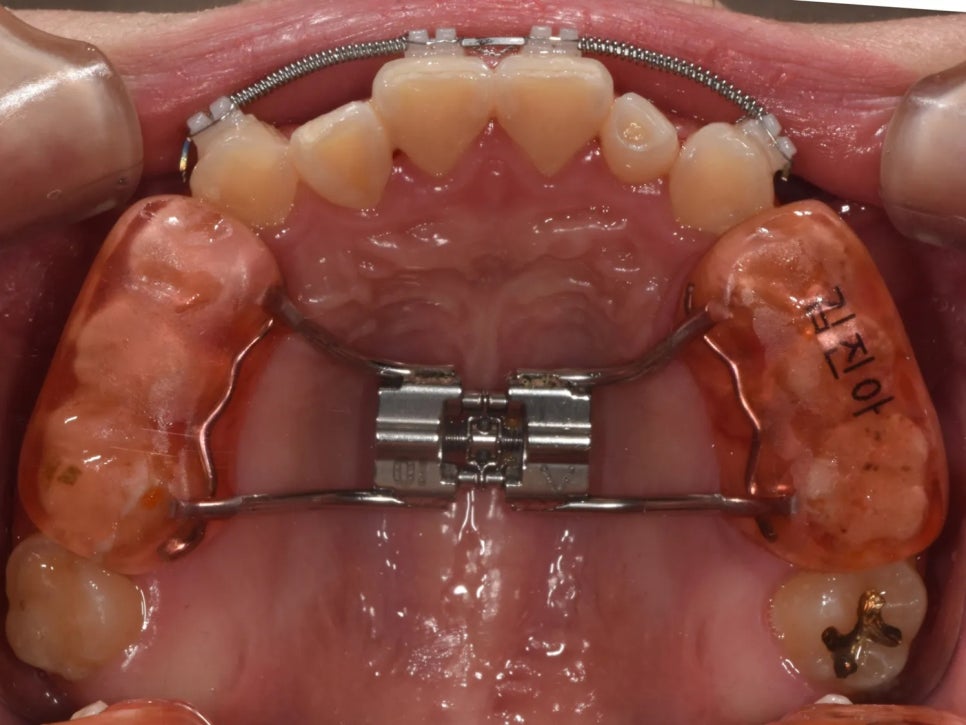
The upper jaw is being widened with the expansion appliance (PBP), creating space for the alignment of the second incisors.
Stage 2 of treatment – Backward traction of the lower teeth using mini-screws
As work on the upper jaw progressed, active treatment for the lower jaw also began. Mini-screws (very small screw-shaped anchorage devices) were placed in the lower jaw, and the entire protruded lower dentition was pulled backward.
Because mini-screws are fixed directly into the bone, they serve as an absolute reference point that does not move. By applying continuous force with springs or chains using this fixed point, the lower dentition gradually moves backward.
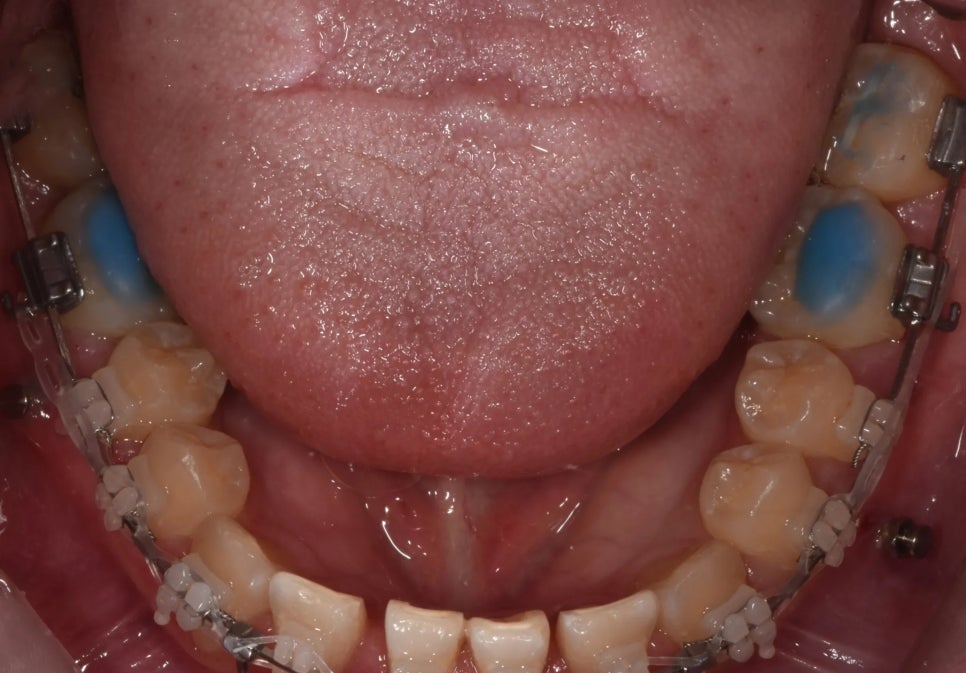
The process of moving the lower dentition backward using mini-screws
In short, this was a strategy to correct the reverse bite through a dual effect: moving the upper front teeth forward and the lower dentition backward. Approaching from both sides at the same time can improve the relationship between the upper and lower teeth much more than moving only one side.
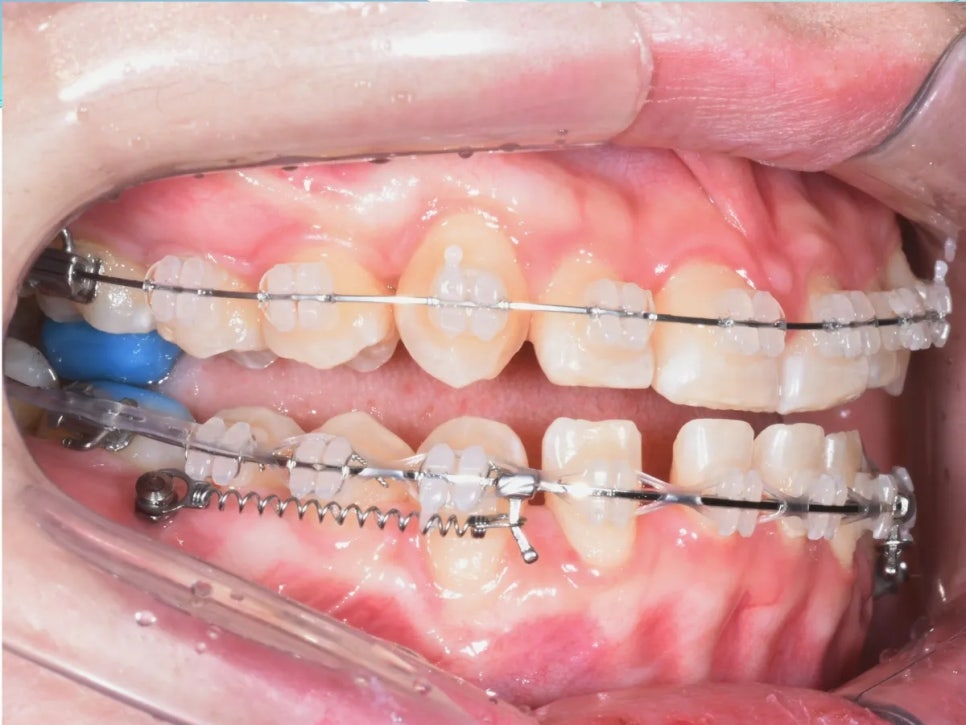
The entire lower dentition is being moved backward.
Treatment results – Reverse bite resolved and normal occlusion established
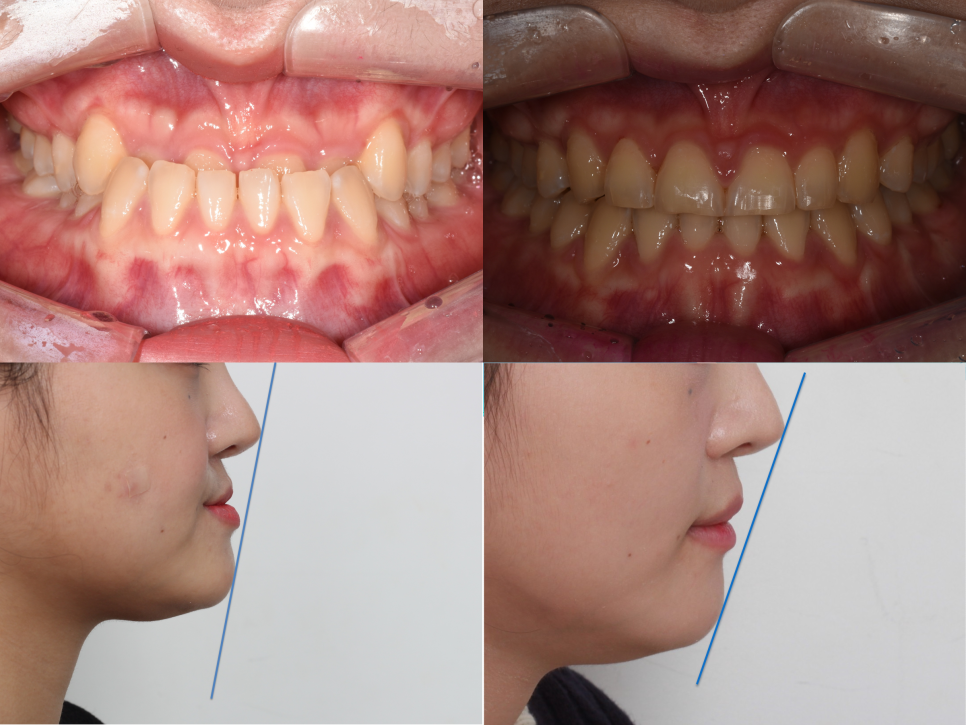
This is how the patient looked after treatment was completed. The reverse bite was completely resolved, and a normal bite relationship was established!
The treatment is complete. Normal occlusion has been restored.
Treatment completed – The reverse bite has been resolved, and the space in the lower dentition has been neatly organized
If you compare before and after treatment, isn’t the change quite clear?
| Item | Before treatment | After treatment |
|---|
| Front tooth bite | Reverse bite (lower teeth in front) | Normal bite (upper teeth slightly overlap the lower teeth) |
| Second incisors | Inwardly impacted | Aligned into normal position |
| Space in lower dentition | Protruded and irregular | Neatly organized |
| Bite function | Difficulty chewing and speaking | Functional stability secured |
The second incisors that had been positioned inward also found their proper place, and the unnecessary spacing in the lower dentition was all neatly resolved. This was a result that secured both functional stability and esthetics.
Facial changes – This much can change without surgery
As the bite relationship normalized, noticeable changes also appeared in the side profile of the face. Before treatment, the protrusion of the lower jaw was quite evident, but after treatment, that protrusion was significantly reduced.
Even with orthodontic treatment alone, without surgery, we can confirm that facial harmony and balance were greatly improved. Of course, the degree of change may differ from surgery, which moves the bones themselves, but the important point is that there are cases like this patient’s where orthodontics alone can bring about a sufficiently satisfying facial improvement.
After treatment – The protrusion of the lower jaw has decreased, and overall facial balance has improved.
The patient was also very satisfied with the results. It was a truly rewarding case in that such a degree of change could be achieved with orthodontic treatment alone, without the burden of surgery.
A patient I remember well
Many people consider surgery, but this patient is especially memorable as a meaningful case in which an underbite and reverse bite were overcome with orthodontic treatment alone, without surgery. Because it was a difficult case, precise diagnosis and a careful step-by-step approach were essential, and everything came together well to produce excellent results.
Of course, not every case can be corrected without surgery. But for patients like this, in some respects we really do not understand why a university hospital would determine that surgery is needed. Of course, surgical orthodontics can also reduce bone size to make the face smaller, but I wonder whether that degree of change could also be achieved with contouring surgery after orthodontics. (Especially if you consider the risks of surgery itself...)
Even though we showed the patient many case photos before treatment, she still felt uncertain at first, thinking, “Is this really going to work...?” until the stage where we expanded the upper teeth. The day we moved the front teeth over and removed the blue bite resin from the molars was when she was happiest, and I still remember that moment. By that day, the face was already almost complete.
The total treatment period was about 1.5 years. We were really happy to see our efforts reflected in the outcome, and if every patient were like this, we would love for them to come every day.