Hello, this is Ceramic Dental Clinic, Cheongdam Dental Clinic.
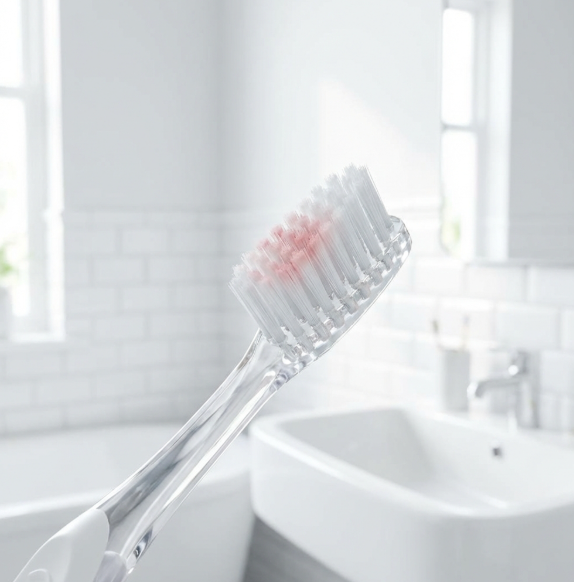
“Did I press too hard when brushing? I started bleeding...”
So many people say this when talking about gum bleeding. Or they brush it off, thinking, “My mother had it too, and my father did as well, so I guess that’s just what happens as you get older.”
If you search for “gum bleeding” online, you’ll find various causes such as vitamin C deficiency or using the wrong toothbrush, but there is another cause that is the most common and important.
Blood mixed in with the saliva you spit out when brushing is your body’s warning sign that “there is inflammation in the gums.”
Gum disease progresses with almost no pain. That is why it has earned the nickname “the silent visitor.”
Today, I’d like to speak carefully about this quiet condition.
What exactly is gum disease?
Gum disease (periodontal disease) is a condition in which bacteria cause inflammation in the tissues that surround and support the teeth. (This includes the gums, bone, and ligaments.)
The core cause is the bacterial film that continuously forms on the tooth surface, and the tartar that hardens from it. Tartar can never be removed by brushing alone.
The progression of gum disease
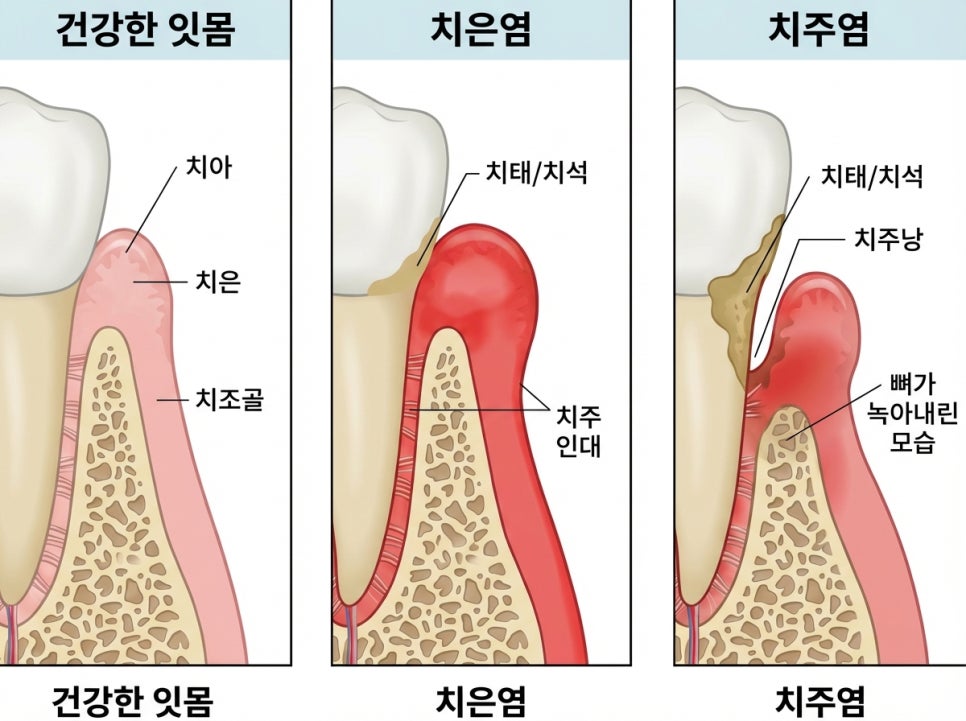
Gingivitis – damage limited to the surface
Gingivitis is the early stage where inflammation occurs only in the gums. The gums become red and swollen, and bleeding occurs when brushing.
But the bone (the foundation) is still intact. If treated at this stage, a full recovery is possible.
Periodontitis – the stage where even the bone begins to collapse
If gingivitis is left untreated, the inflammation spreads deeper below the gums. The jawbone starts to dissolve.
Deep pockets (periodontal pockets) form between the gums and teeth, and as the bone decreases, the teeth become loose.
Eventually, the teeth fall out.
| Category | Gingivitis | Periodontitis |
|---|
| Extent of inflammation | Limited to the gums (soft tissue) | Progresses to the gums + bone |
| Bone loss | None | Present (dissolution) |
| Recovery potential | Full recovery possible | Dissolved bone cannot naturally recover |
| Tooth looseness | None | Becomes more severe as it progresses |
Gingivitis can be reversed, but bone lost to periodontitis does not naturally grow back. Timing is critical.
For reference, about 75–80% of adults in Korea experience periodontal disease to varying degrees. It is the number one disease treated in outpatient health insurance claims.
It is that common, and also that often left untreated.
Common misconceptions about gum disease, corrected
Misconception 1: “Isn’t it normal for teeth to fall out as you get older?”
“Don’t teeth all fall out anyway once you get old?”
I’ve heard this so many times.
But it’s not true. Aging can cause the gums to recede slightly, but teeth becoming loose and falling out is not due to “aging”; it is the result of a disease called periodontitis.
With proper care, you can keep all 28 teeth even at age 80.
Misconception 2: “If it bleeds, I should brush more gently”
That statement is partly right and partly wrong.
Brushing too hard is a problem, but if you avoid the gum area because you’re afraid of bleeding, bacterial film will build up even more. The inflammation worsens.
You need to brush consistently and correctly for the bleeding to gradually decrease.
Misconception 3: “Scaling makes the gaps between teeth wider”
“After scaling, it felt like my teeth were worn down and spread apart.”
Some people say this. Scaling removes tartar from the tooth surface; it does not wear down the teeth themselves.
The feeling of gaps after treatment is because the space once occupied by tartar is now empty. It means tartar had been filling that space.
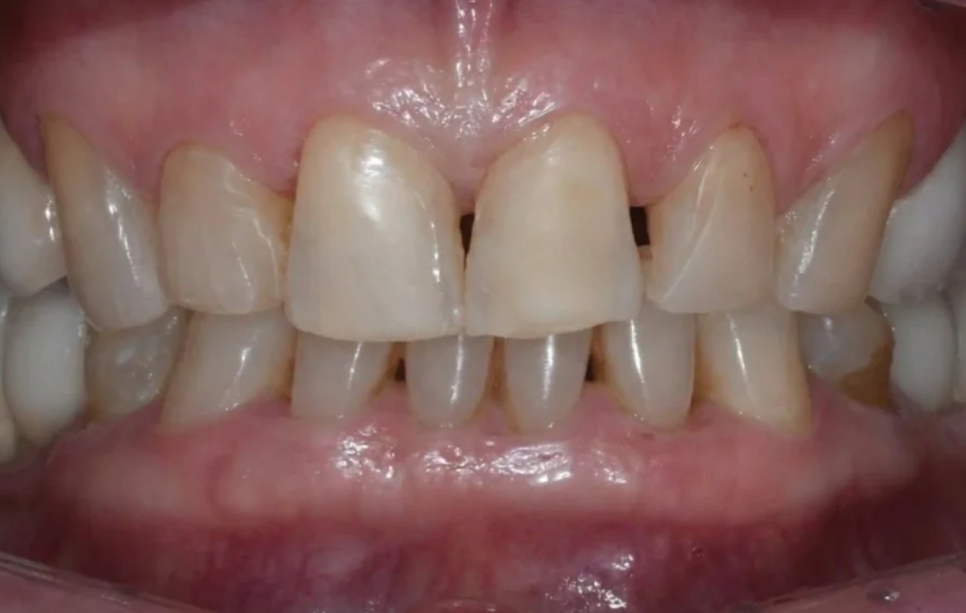
If you see this after scaling, it means you are now seeing the space that was originally blocked by tartar
To compare it to cleaning a room, it’s like removing the clutter that had been piled up on the floor, making the room look bigger. This state is actually healthier.
Misconception 4: “Gum disease is only a problem inside the mouth”
“Isn’t it just that my gums aren’t in great shape? What does that have to do with overall health?”
This is the most dangerous misconception. The bacteria and inflammatory substances from periodontal disease travel through the bloodstream throughout the body. Chronic inflammation in the gums can be compared to
“a small ember that never goes out.” This ember, quietly burning in the mouth, threatens the health of the whole body through the blood vessels.
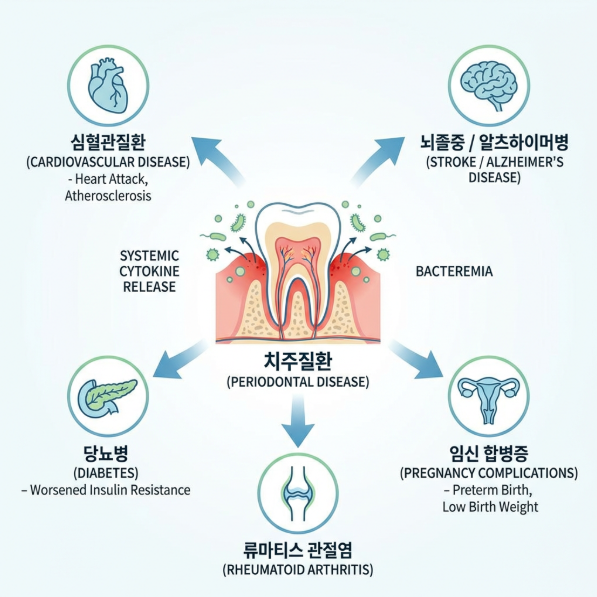
The systemic effects that have actually been reported include the following.
-
Cardiovascular disease — Many studies have found that patients with periodontal disease have a 1.5 to 2 times higher risk of heart disease and stroke. Oral bacteria can trigger inflammation in the inner lining of blood vessels and promote atherosclerosis.
-
Diabetes — Periodontal disease and diabetes have a “bidirectional relationship.” If you have diabetes, gum disease worsens, and if gum disease is severe, blood sugar control becomes more difficult. Some studies also report that HbA1c improved after periodontal treatment.
-
Pregnancy complications — Pregnant women with periodontal disease may have a higher risk of preterm birth and low-birth-weight infants. Oral care before and during pregnancy is especially important.
-
Others — Associations with rheumatoid arthritis, Alzheimer’s disease, pneumonia, and more are also being continuously studied and reported.
How is gum treatment performed?
The key point is that gum treatment is not a “one-time procedure,” but rather “step-by-step management.”
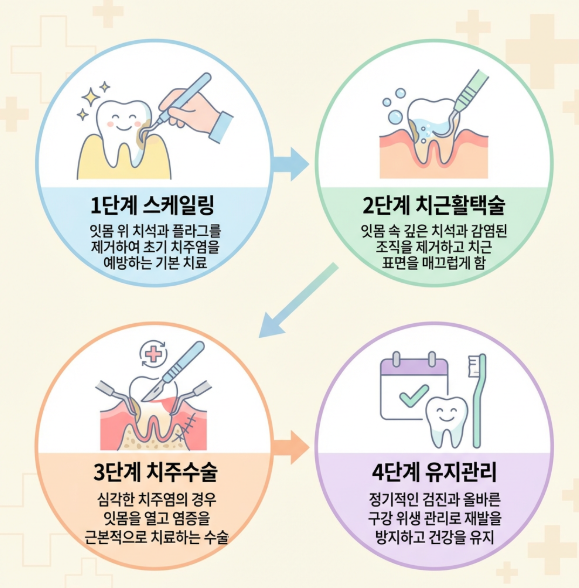
1st stage – Scaling (tartar removal)
The most basic treatment to remove tartar visible above the gums. It is covered by health insurance once a year for adults aged 19 and older,
with an out-of-pocket cost of about 10,000 to 20,000 KRW. It is the most basic, yet one of the most important preventive treatments.
2nd stage – Deep scaling below the gums (root planing)
This removes tartar and infected tissue attached to the roots of the teeth below the gums. It is performed under local anesthesia and is usually done over 2 to 4 sessions. It is effective for moderate periodontitis with periodontal pocket depths of 4–6 mm.
3rd stage – Gum surgery (periodontal surgery)
This is performed when deep scaling does not improve deep periodontal pockets or in cases of severe bone loss. The gums may be opened so the dentist can directly see and remove tartar, and bone grafting may also be performed. This applies to severe periodontitis.
4th stage – Maintenance (regular care)
Regular checkups and care every 3 to 6 months after treatment.
The real success of periodontal treatment depends on “maintenance.”
Who especially needs a gum examination?
-
People who repeatedly bleed when brushing
-
People whose gums are swollen or feel loose
-
People whose bad breath has gotten worse
-
People whose teeth look longer than before
-
People with systemic conditions such as diabetes or cardiovascular disease
-
Smokers
-
People who are pregnant or planning to become pregnant
Conversely, if teeth are already severely loose, it may be better to consider alternatives such as extraction followed by implants rather than trying to save them at all costs.
Judging “which teeth can be saved and which ones should be let go” is also an important part of periodontal treatment. If a clinic says, without hesitation, “We can save everything,” it’s worth being cautious.
“Gum treatment is not something you do once and finish; it is something you maintain together with the dental clinic.”
 Periodontal disease is often already fairly advanced by the time it starts hurting. Visiting the dentist while symptoms are still mild is the wisest choice in terms of time, cost, and preserving your teeth.^^
So that your teeth can stay with you for life, we will help protect your gums and keep you healthy from the start. This has been Cheongdam Dental Clinic, Ceramic Dental Clinic.