Hello, this is Kim Sun-min, the chief director of Ceramics Dental Clinic.
Today, I’d like to introduce an orthodontic case of a 24-year-old male patient who came in to correct a protruding mouth, only to find that there were much more complicated issues than expected. In addition to the protruding mouth, there were also a bite problem where one side did not meet at all, extrusion of teeth that had come down abnormally, deep bite, cavities, and even missing teeth… It was truly a case with many hidden, complex problems.
Because this was not a case that could be solved simply by pulling the front teeth back, I have carefully organized the entire process from diagnosis to treatment completion. I hope this is helpful for those considering orthodontic treatment.
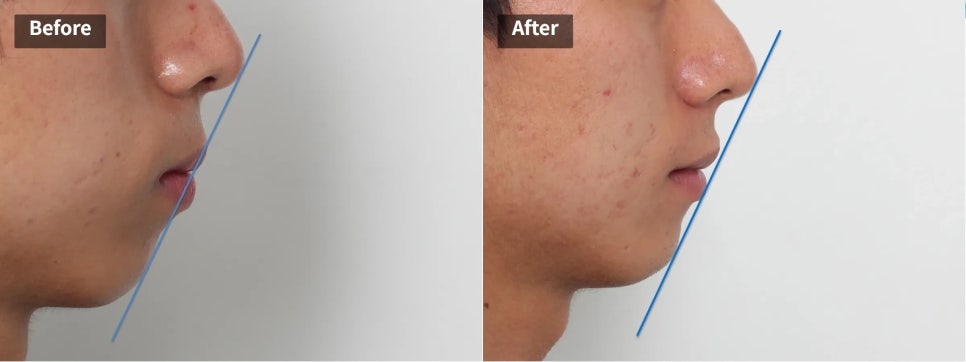
He came in because of a protruding mouth, but that was not the only problem
This patient was a 24-year-old man who visited the clinic because he wanted to improve his protruding mouth. He said that his mouth looking forward had bothered him for a long time.
However, as soon as the examination began, several issues besides the protruding mouth became apparent. A bite problem on the right side where the teeth did not meet at all, an abnormally descended molar (extrusion), a deep bite where the upper and lower front teeth overlapped too deeply, severe cavities, and even missing teeth. This was clearly not a simple protruding-mouth correction case, but one that required comprehensive orthodontic treatment.
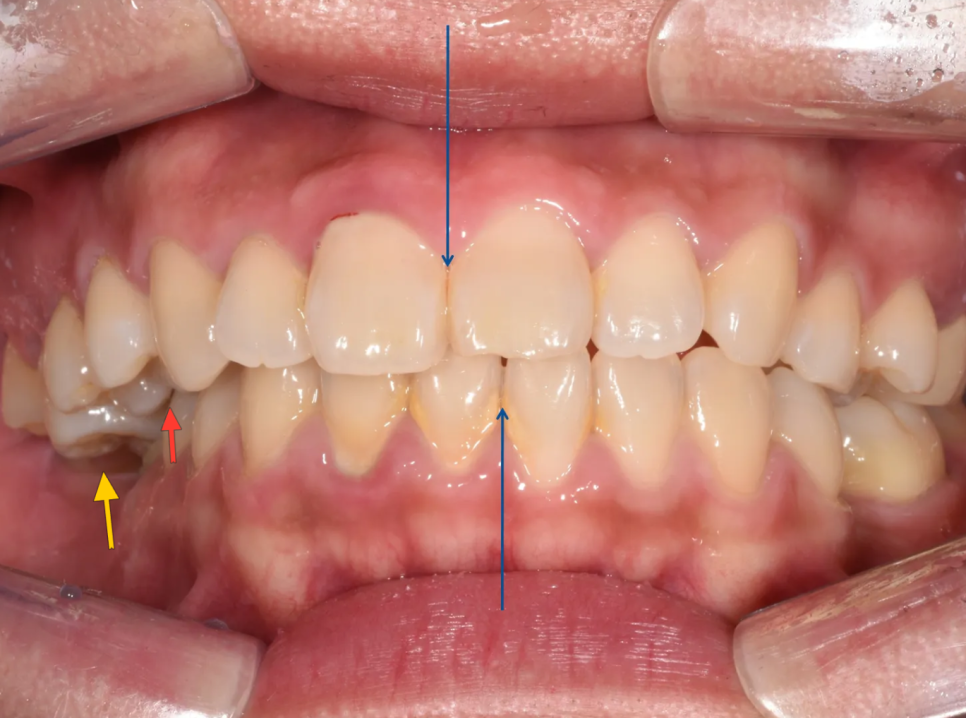
The upper molar has descended (yellow), the right side does not meet (red), and of course the midline of the front teeth does not match (blue).
Diagnosis ① – Right-side bite problem: extruded molar and deviated jaw
The first issue that stood out was the upper right first molar. Because this tooth was not properly meeting the lower teeth, it had gradually moved downward. This phenomenon is called “extrusion.”
What is extrusion?
When there is no opposing tooth, or when occlusion is not properly established, a tooth moves or grows outward toward the opposite side as if extending
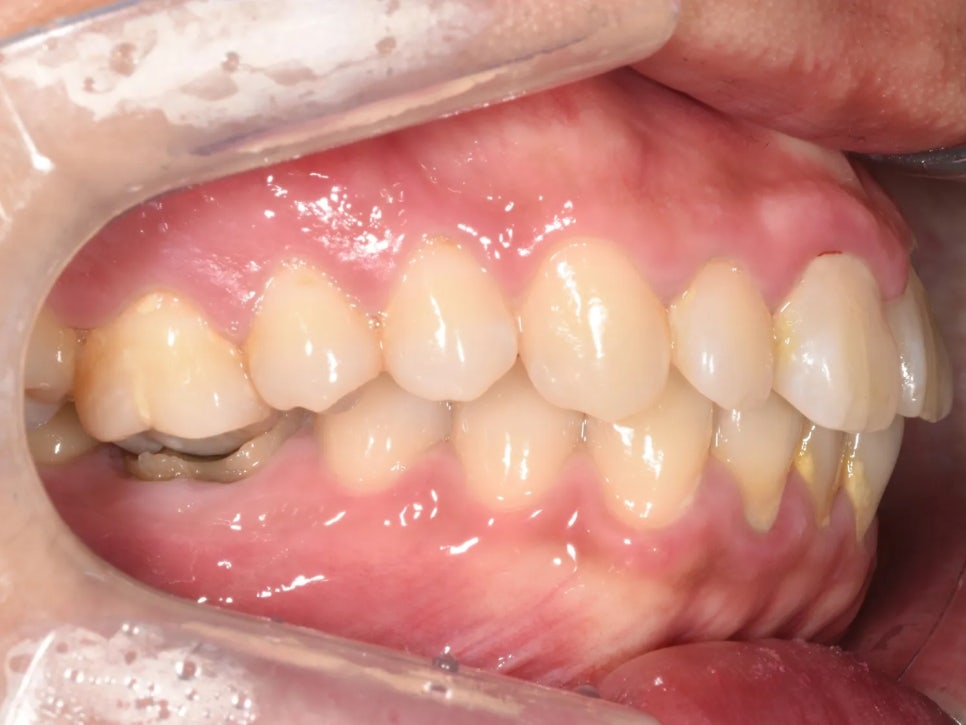
A view showing how the upper molar easily extruded (dropped) as decay developed
The problem was that this descended molar caused occlusal interference. When closing the mouth, this tooth would hit first (interference), so the patient naturally had to twist the lower jaw to the left in order to bite down. This is called “mandibular deviation.” Fortunately, there was no major problem with the temporomandibular joint itself, but if this condition continues for a long time, it can even lead to temporomandibular disorders.
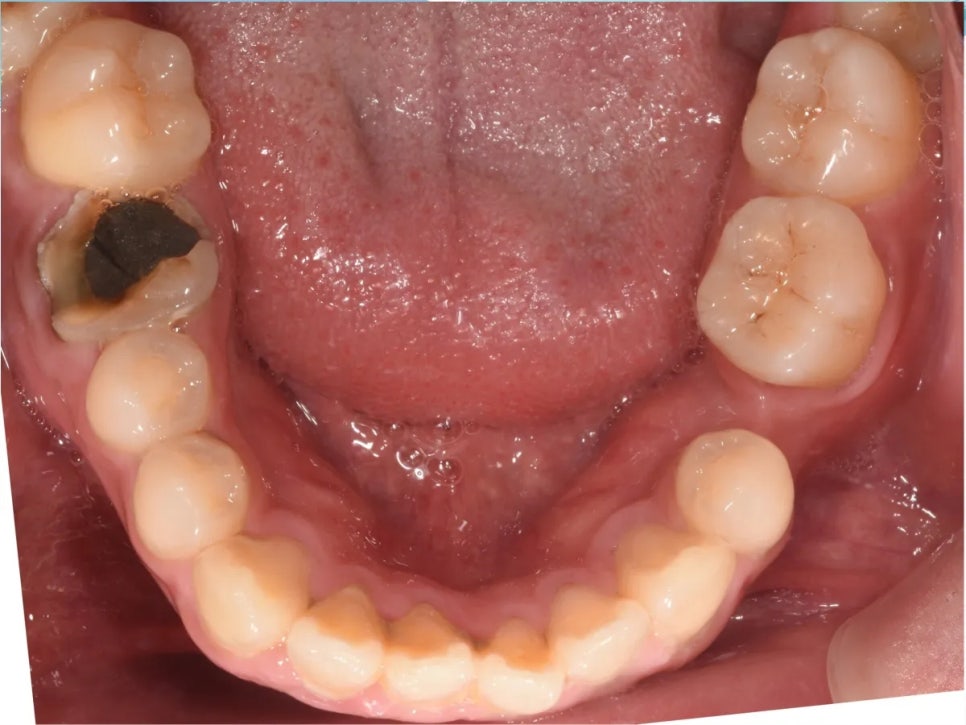
Severe decay on the lower right and a missing tooth on the opposite side
In addition, the lower right first molar had severe decay, and the lower left second premolar on the opposite side was already missing (absence). As the tooth height was reduced due to decay, the upper molar extruded even more quickly, and in the missing-tooth area, the adjacent teeth had tilted toward the empty space. In the photo below, you can also see that for all these reasons, the patient was ultimately biting with the lower jaw twisted.
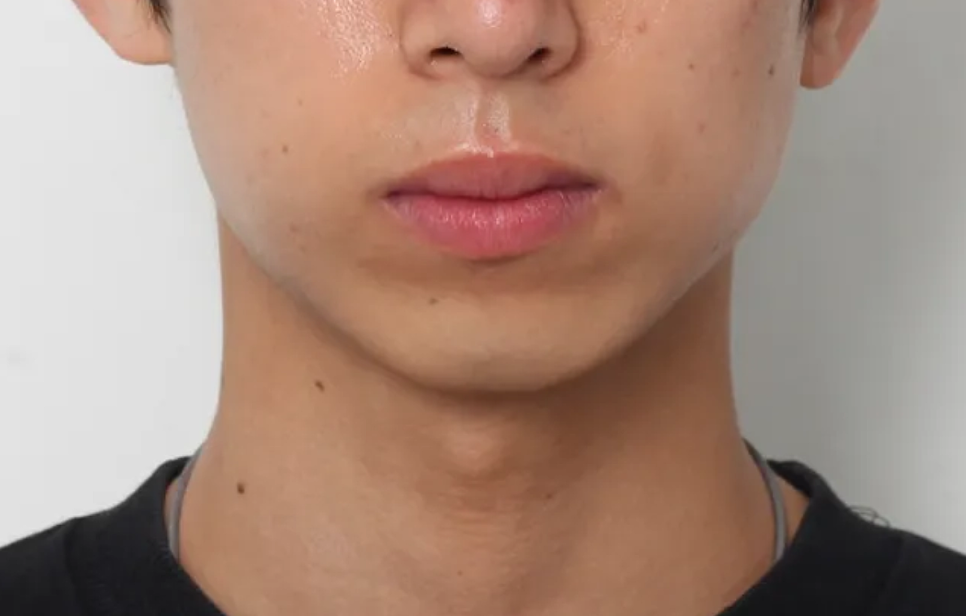
Can you see that the lower jaw is biting slightly to the left (→)?
Diagnosis ② – Protruding mouth and deep bite
The protruding mouth that worried the patient was also confirmed. From the side, both the upper and lower front teeth were tilted forward, making the mouth appear protruded.
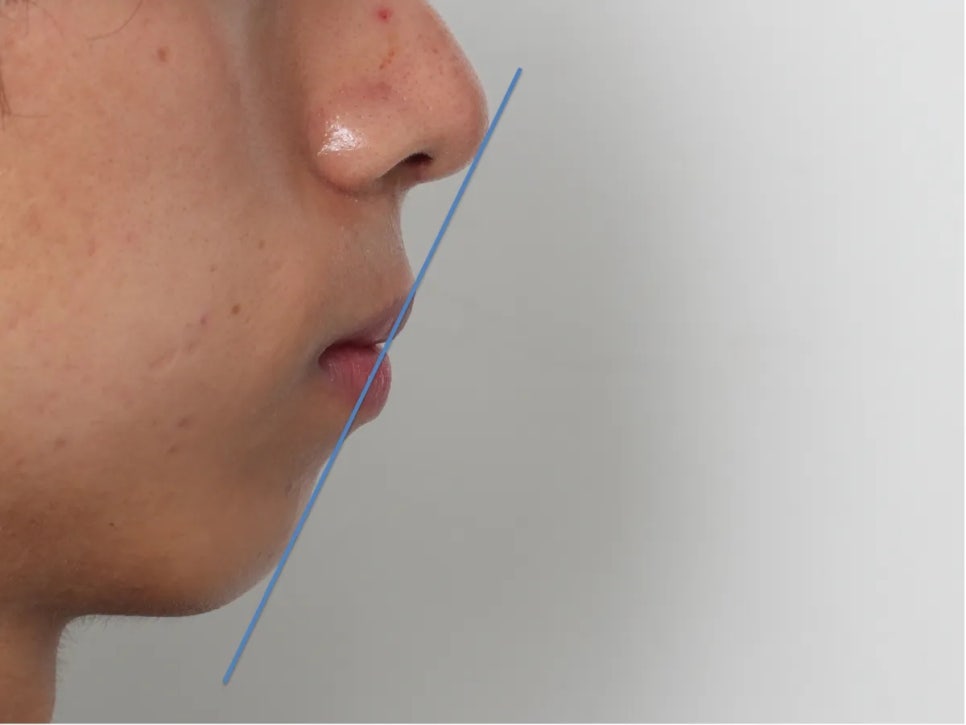
The protruding mouth condition seen from the side
However, detailed analysis (cephalometric analysis) revealed something interesting. It was true that the mouth was protrusive, but the lower jaw itself was rather small, which also made the protrusion appear more pronounced than it actually was. This is something that is difficult to know without detailed examination, and it becomes very important when setting up the treatment plan.
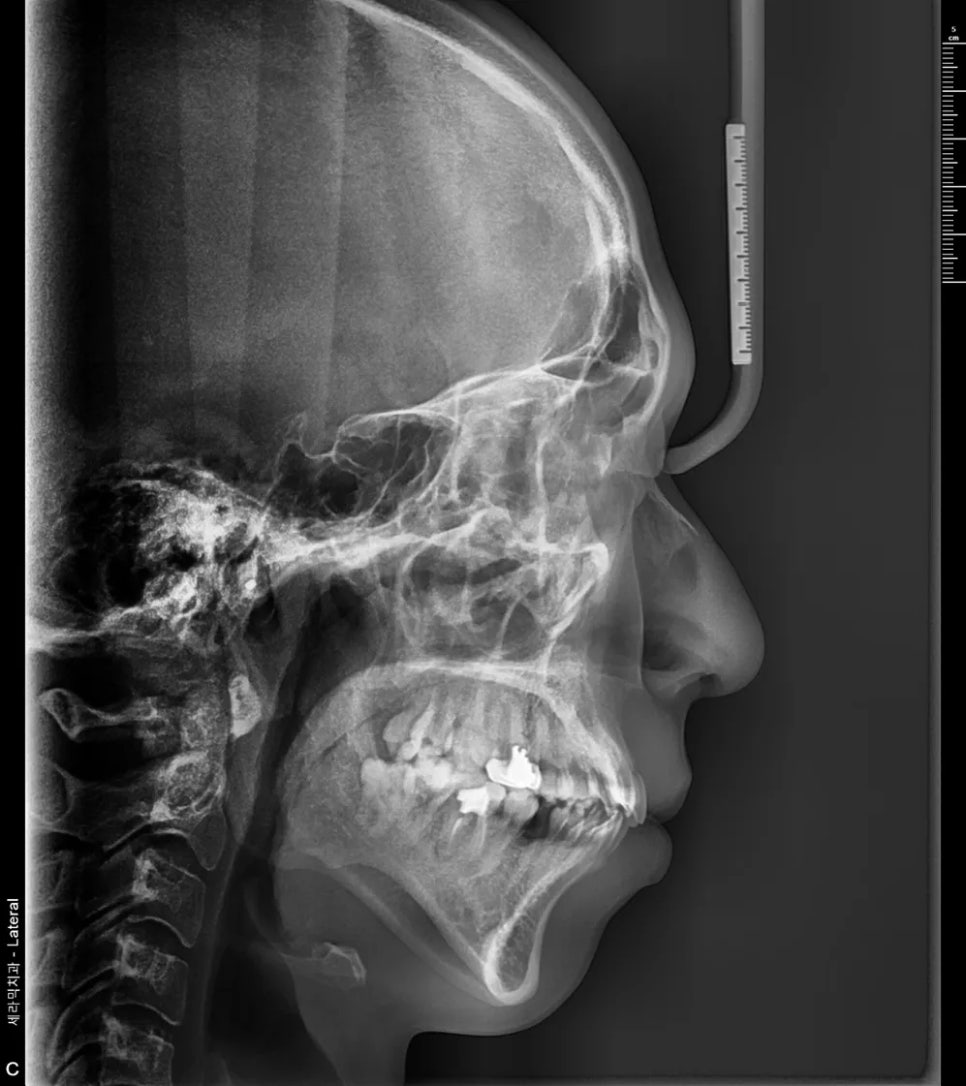
Cephalometric (side skull X-ray) analysis – the mouth is protrusive, but the small lower jaw makes the protrusion appear more pronounced
There was also a deep bite. A deep bite refers to a condition where the overlap depth between the upper and lower front teeth is excessively deep. Normally, it is ideal for the upper teeth to cover the lower teeth by about 2 mm, but in this patient, the bite was deeper than that. Although it could easily be overlooked because it was overshadowed by the larger issues of the protruding mouth and molar bite problem, it was still something that needed to be treated together.
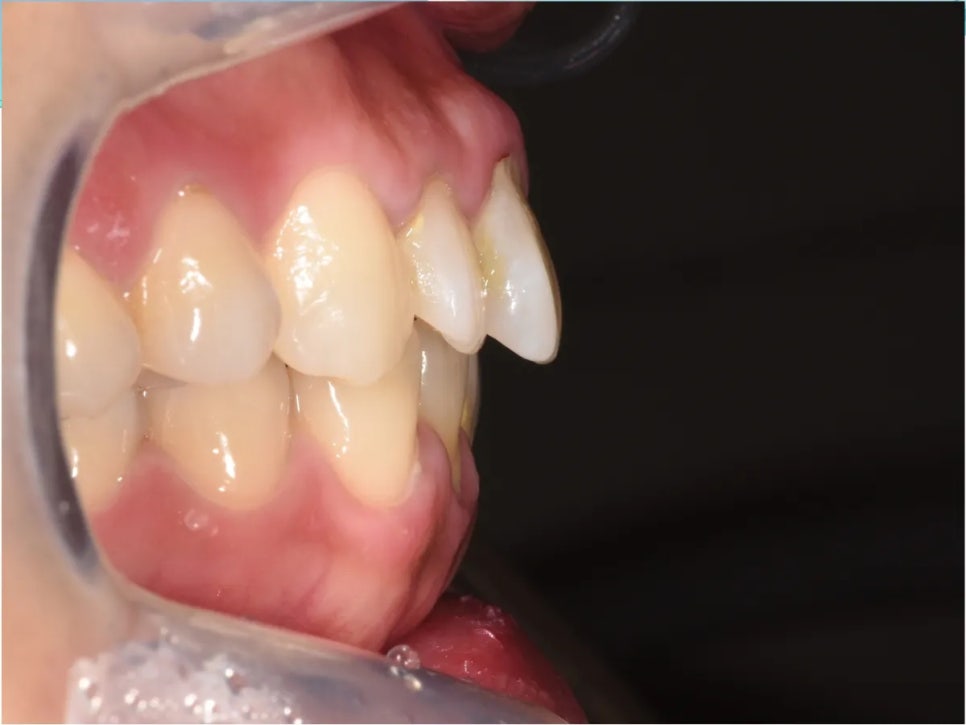
Deep bite – a condition where the overlap depth of the upper and lower front teeth is excessively deep
To summarize, the diagnostic findings for this patient were as follows:
| Problem | Details |
|---|
| Protruding mouth | Upper and lower front teeth tilted forward + small lower jaw made the protrusion look more pronounced |
| Right-side bite problem | Upper first molar extrusion → one side does not meet → jaw deviates to the left |
| Deep bite | Upper and lower front teeth overlap too deeply |
| Cavities | Severe decay in the lower right first molar |
| Missing tooth | Lower left second premolar already lost |
Treatment plan – extraction orthodontics + mini-screws
Because several problems had to be resolved at once, the treatment plan also had to be carefully designed. The treatment goals and specific plan were as follows.
Treatment goals:
-
Improve the protruding mouth
-
Intrude the extruded upper right first molar back to its original position
-
Improve the deep bite
-
Align the teeth
-
Establish proper molar occlusion on both sides
Extraction plan:
| Tooth to be extracted | Reason |
|---|
| Upper right first premolar | Create space to improve the protruding mouth |
| Upper left first premolar | Create space to improve the protruding mouth |
| Lower right first molar | The decay was too severe to preserve. (Extracted instead of the premolar usually removed for orthodontics.) |
The lower left side did not require additional extraction because the second premolar was already missing. As a result, the plan was to use the spaces from two upper extractions, one lower extraction, and one existing missing tooth space, for a total of four spaces.
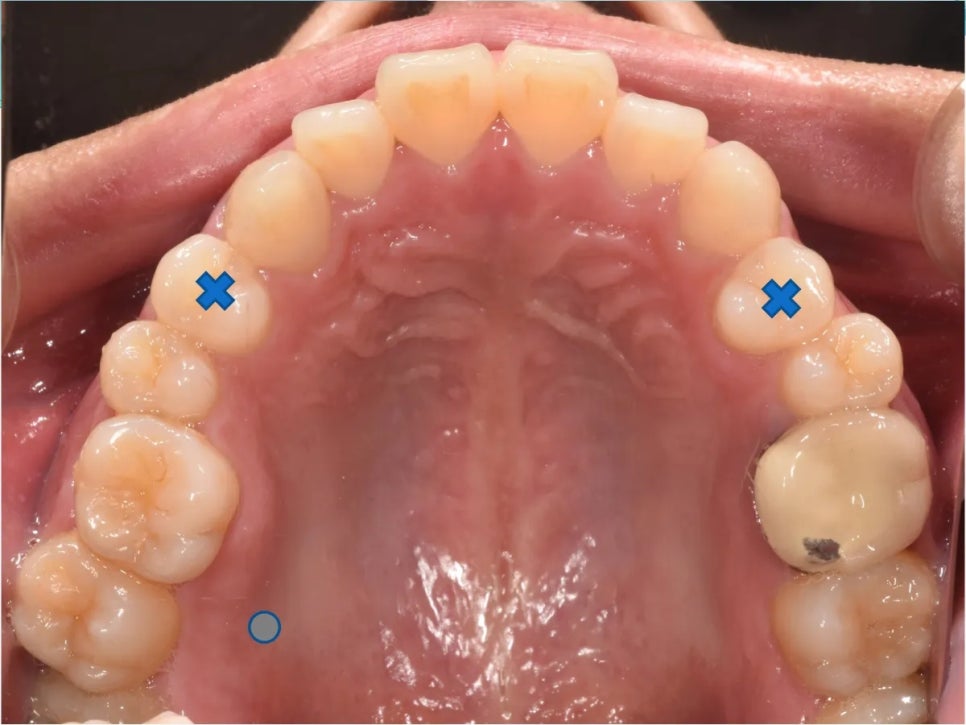
Upper plan – extraction of both first premolars
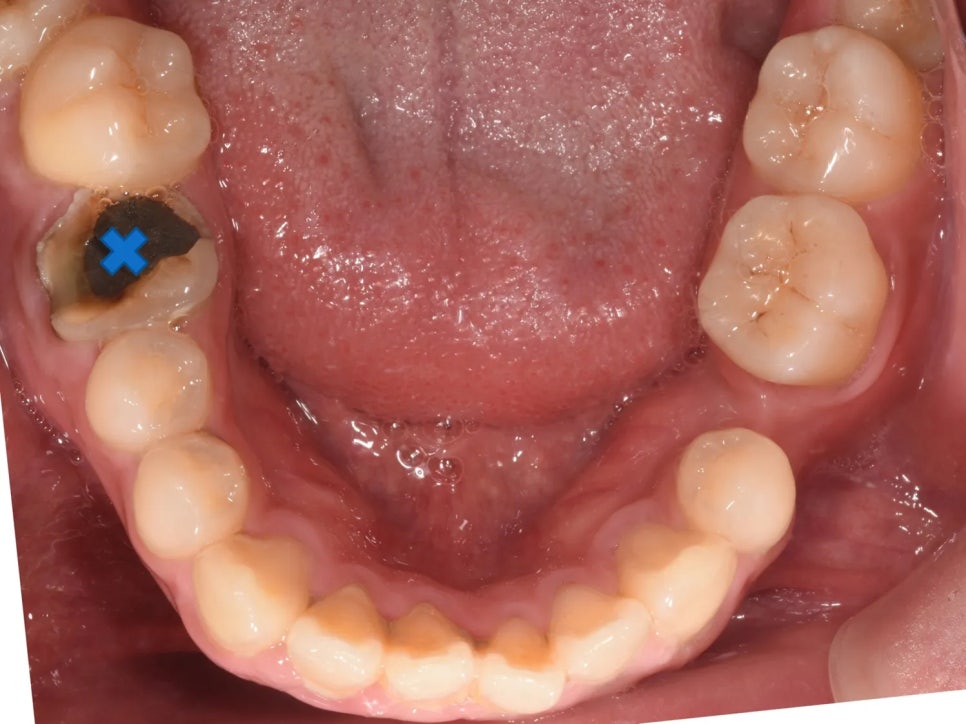
Lower plan – extracting the molar with severe decay and using the already missing space on the opposite side
The key tool was a mini-screw (TAD). A mini-screw is a very small screw inserted into the jawbone and serves as an absolute anchorage source in orthodontics. It is a necessary device for intruding an extruded molar into the bone or for pulling the front teeth back firmly. In this patient’s case, two screws were planned on the outer and inner sides.
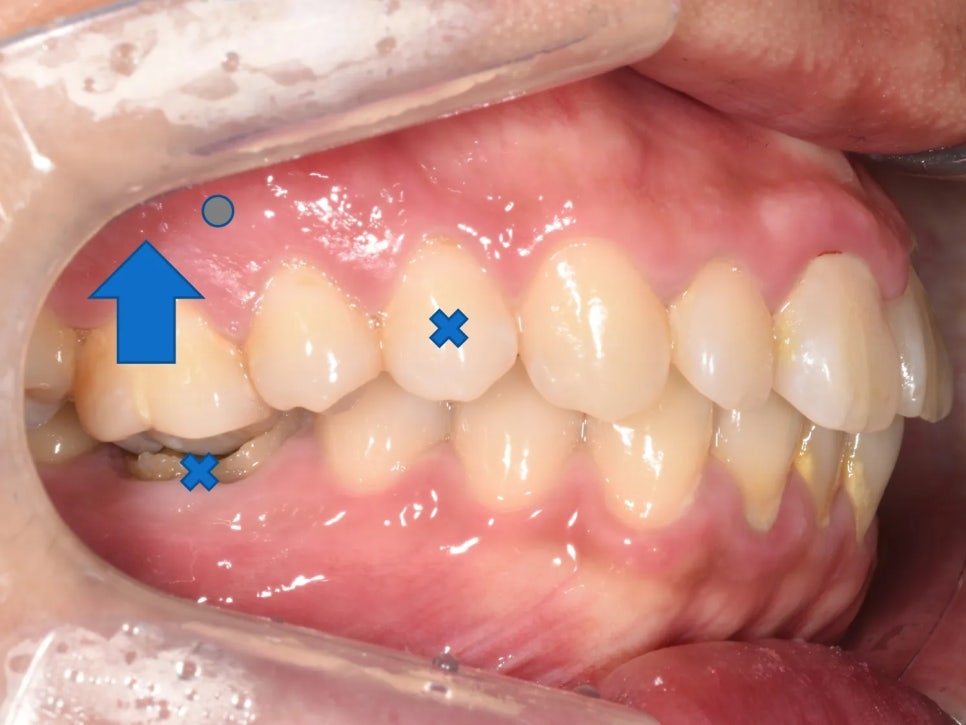
Side-view treatment plan – extraction sites, molar intrusion direction, and screw positions are marked in gray.
Treatment process ① – Intruding the extruded molar
At the beginning of orthodontic treatment, the first step was to push the extruded upper right first molar back into place. As long as this molar remained lowered, the right-side bite could not be normalized.
Using the mini-screw as anchorage, an intrusive force was applied to the extruded molar. Intrusion means moving a tooth upward into the bone. In fact, intrusion is one of the most difficult tooth movements in orthodontics. Without modern tools such as mini-screws, this degree of intrusion would have been very difficult.
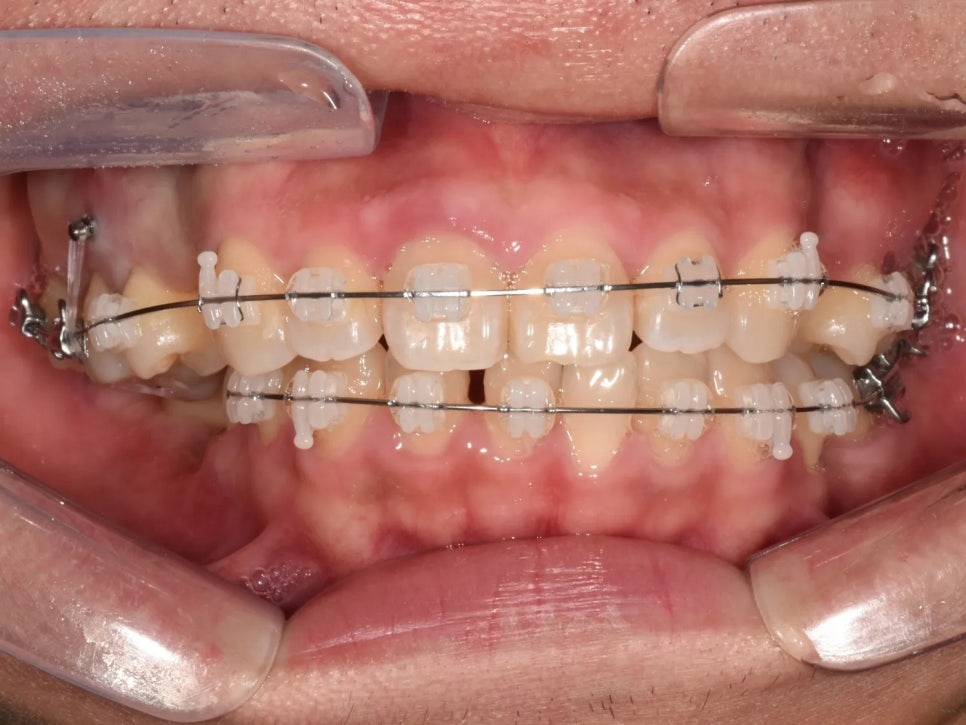
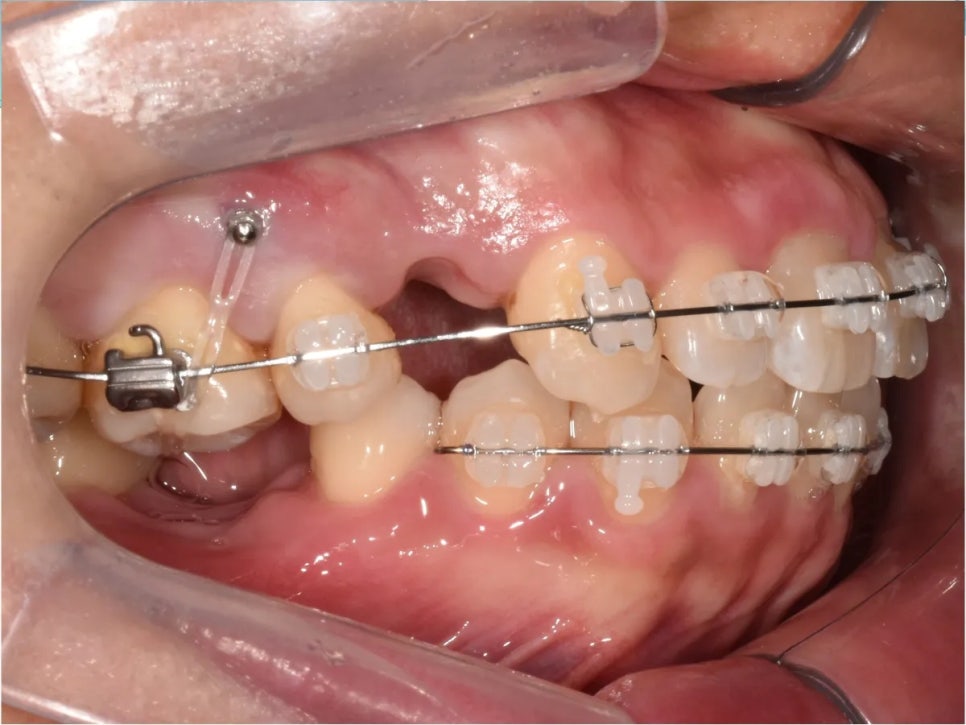
In this way, force is applied from the mini-screw to push the molar into the bone
Meanwhile, the opposite side (lower left) also needed work. The teeth next to the missing second premolar had tilted significantly toward the empty space. Straightening these teeth was also carried out at the same time.
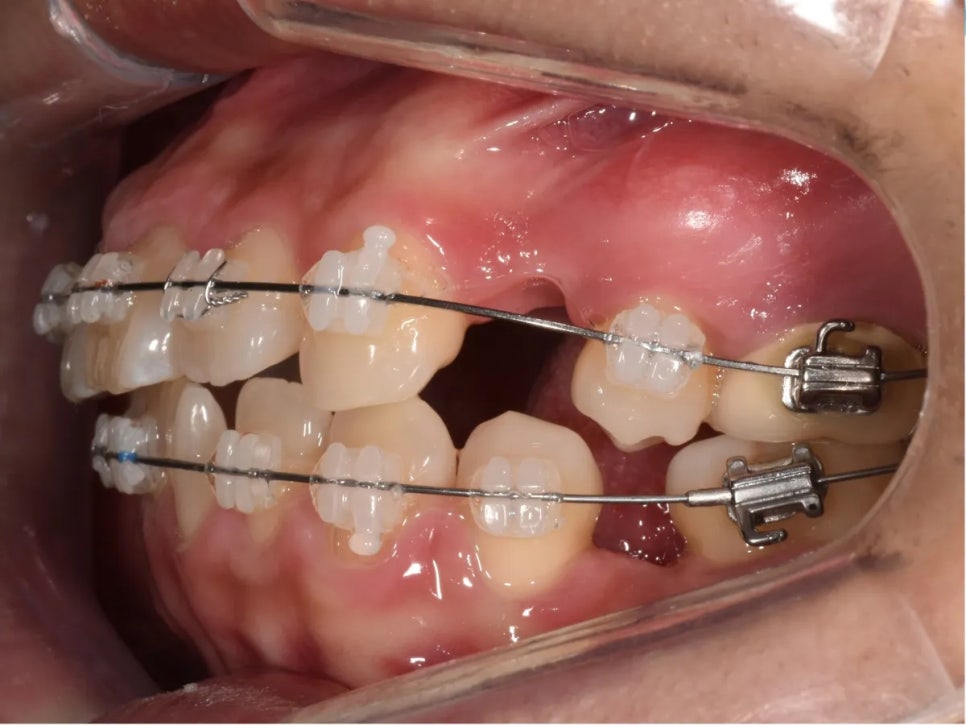
The adjacent teeth in the missing-tooth area had tilted significantly, so they needed to be uprighted.
Treatment process ② – Protruding mouth improvement after intrusion
As time passed, the intrusion of the upper right first molar progressed significantly. The occlusal surface became almost flat, and the biting depth approached normal. Compared with the initial state, this is really a big change.
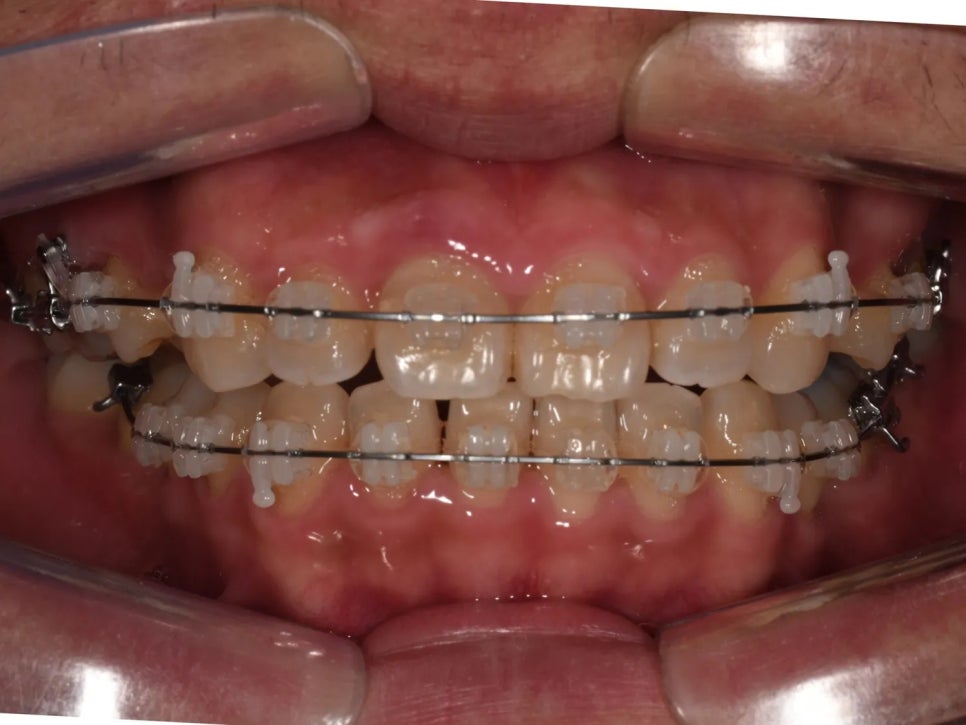
The intrusion had progressed significantly, making the occlusal surface almost flat and the bite depth close to normal
However, improvement of the protruding mouth still remained. Since the upper front teeth were still protruding forward quite a lot, we began in earnest to pull them back into the spaces created by extraction.
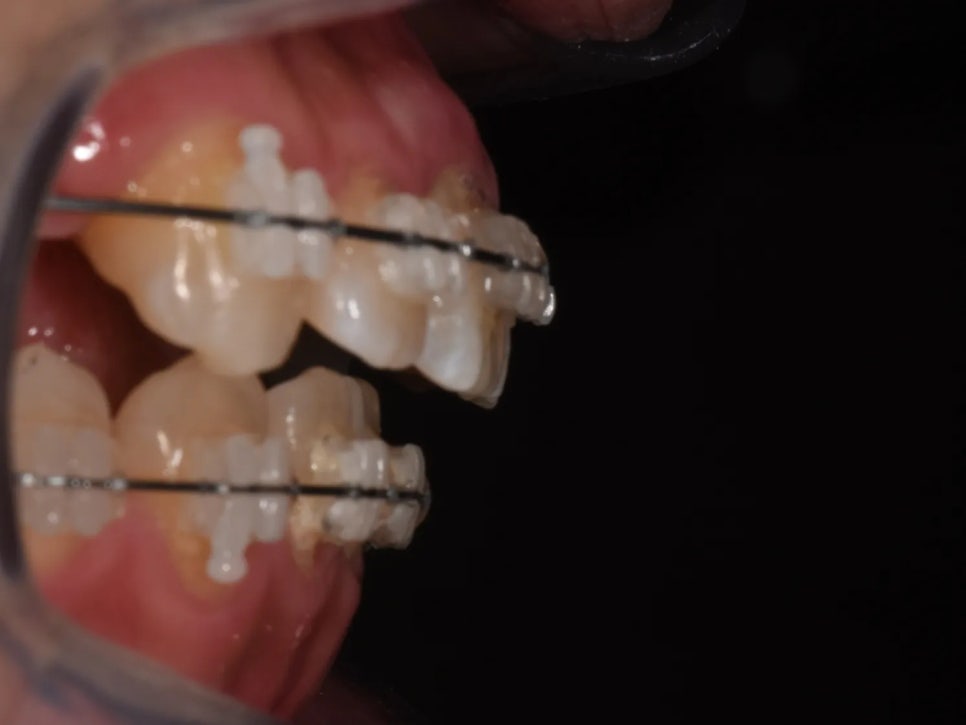
The upper front teeth were still protruding forward quite a lot and needed to be moved backward.
At the same time, we also worked on pulling the molar that had extruded outward toward the cheek back inward toward the palate. The molar must be positioned accurately in its proper place in order to bite normally with the lower teeth.
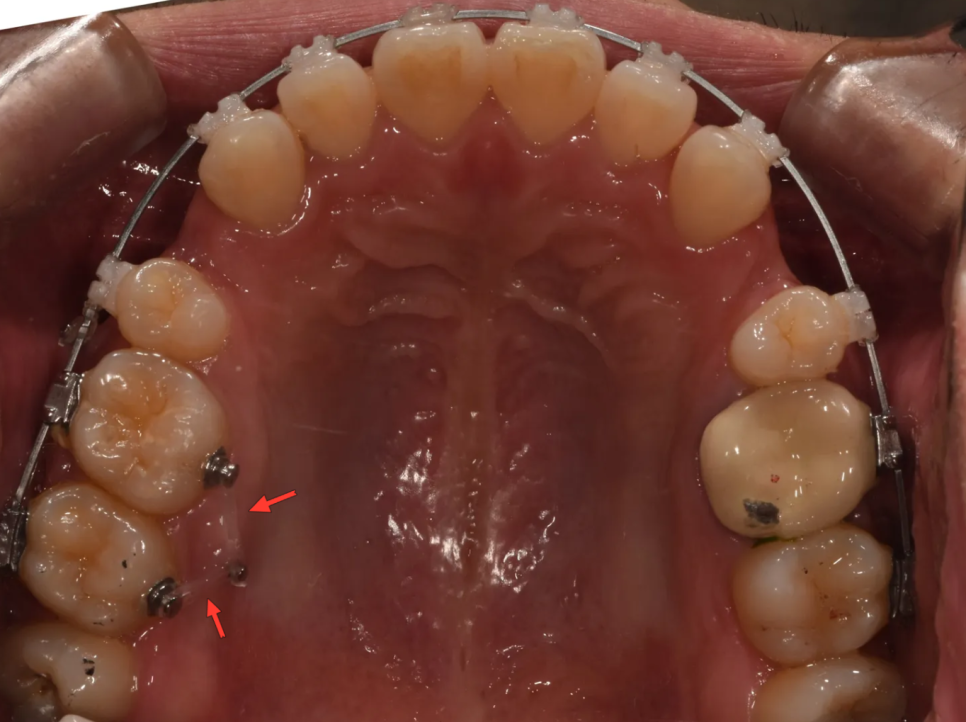
The process of pulling the molar that had extruded outward back inward
At this stage, one careful procedure was needed. While moving the molar inward, interference with the lower teeth could occur, so we created a device called a “bite plane” on the opposite teeth.
What is a bite plane?
A plastic block attached to the teeth that temporarily raises the bite height so that certain teeth do not contact each other
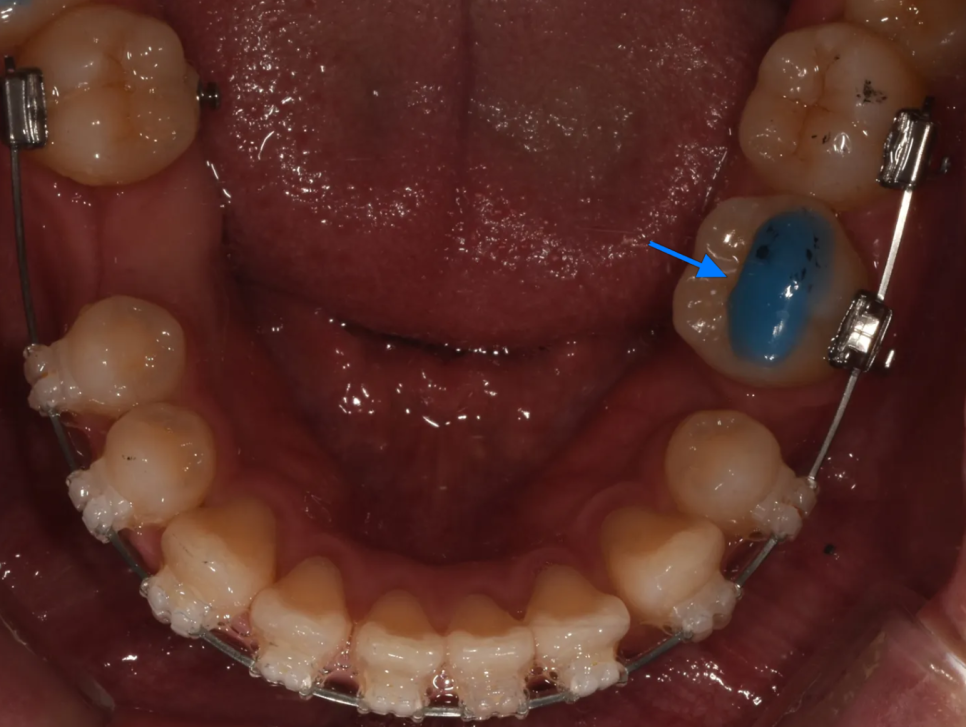
A bite plane was created on the opposite side to temporarily prevent full biting and avoid occlusal interference
Treatment completed – improved protruding mouth, normal occlusion, aligned teeth
Finally, the orthodontic appliances were removed and the final results were confirmed.
The teeth were beautifully aligned, and the protruding mouth that the patient had been most concerned about was also improved nicely. The side profile changed significantly.
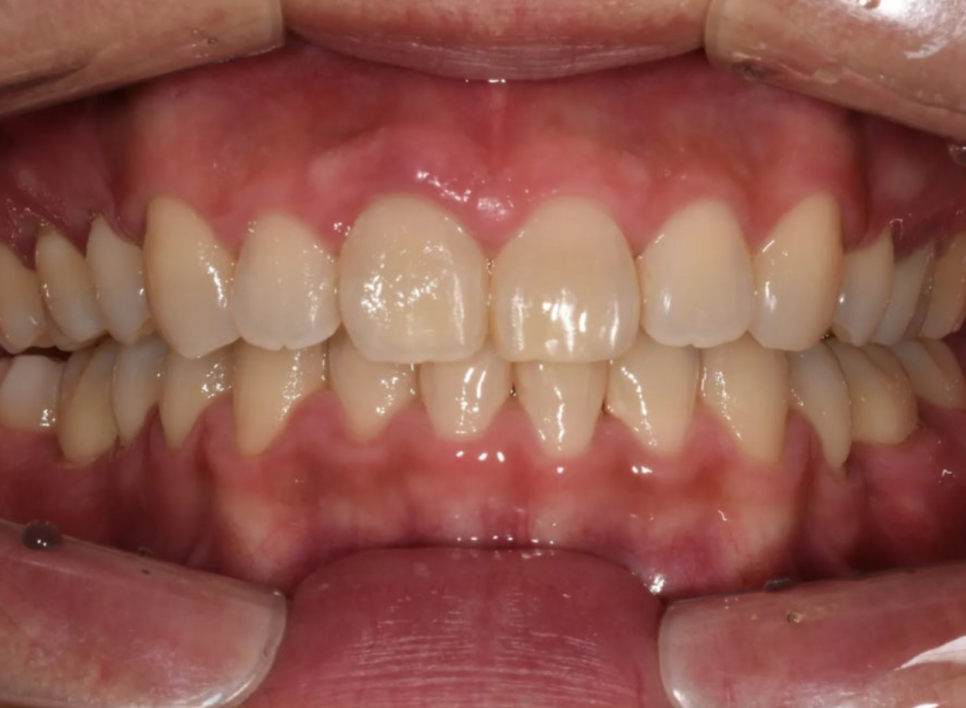
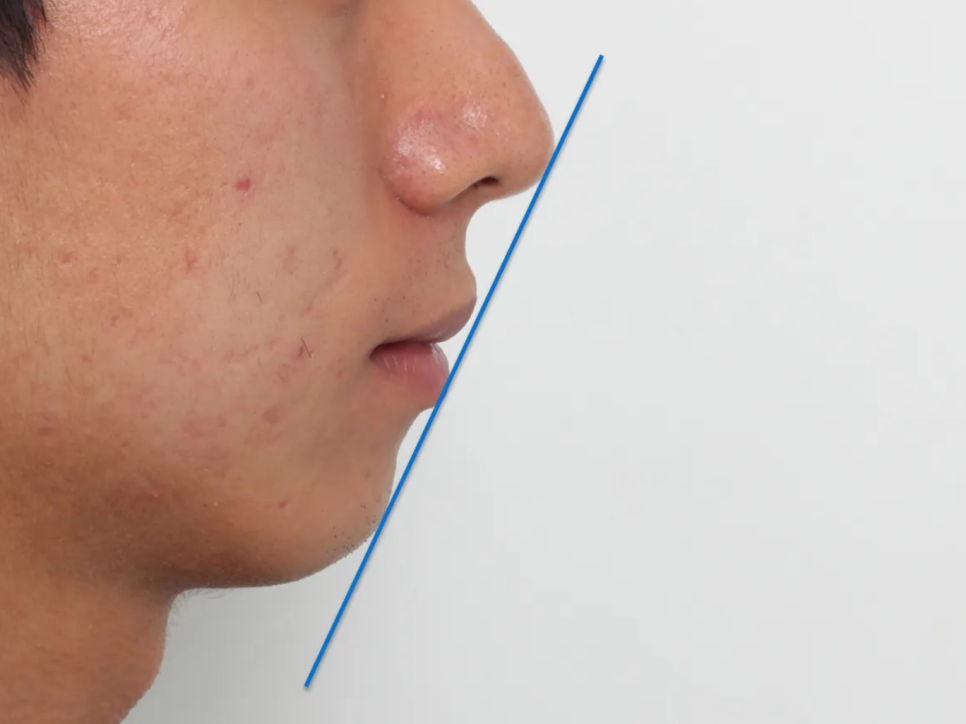
More importantly, the right-side bite was restored to normal occlusion. The discomfort of having to twist the jaw to the left in order to bite was resolved, and the deep bite was also improved so that the overlap depth between the upper and lower front teeth returned to the normal range.
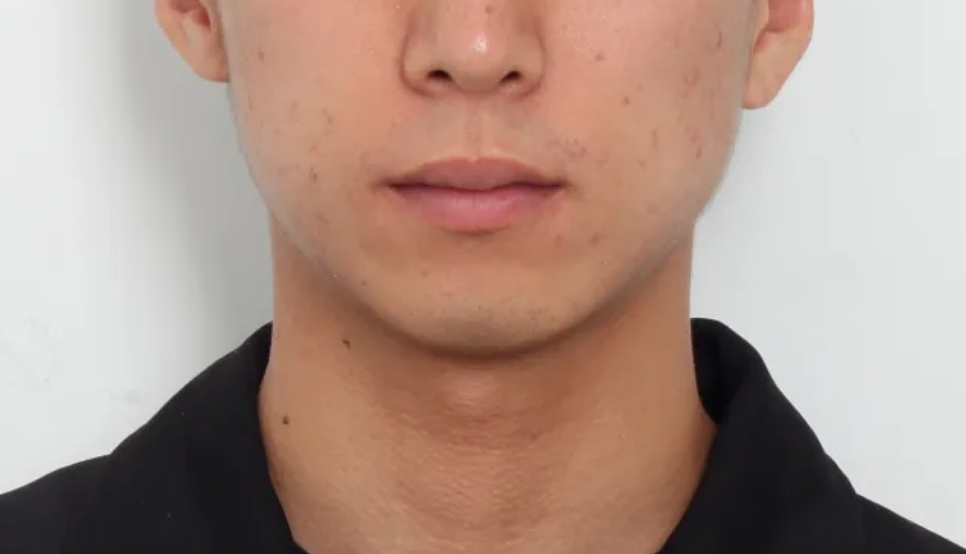
Can you feel how comfortably the bite looks?
Although he initially came in for a protruding mouth, this was a case in which comprehensive diagnosis allowed us to improve occlusion (function), aesthetics, and long-term health all at once.
| Item | Before treatment | After treatment |
|---|
| Protruding mouth | Forward protrusion of the upper and lower front teeth | Front teeth were moved inward, improving the side profile |
| Right-side bite | Did not meet at all (interference caused by extrusion) | Normal biting restored |
| Jaw deviation | Had to bite with the jaw twisted to the left | Resolved |
| Deep bite | Front teeth overlapped too deeply | Improved to within the normal range |
| Teeth alignment | Irregular, with tilted teeth | Aligned neatly |
Importance of comprehensive diagnosis
There are a few things I would like to share through this case.
First, the problem a patient feels may not be the whole story. This patient came in only aware of the protruding mouth, but in reality, there were multiple hidden issues such as extrusion, bite problems, deep bite, and missing teeth. That is why a comprehensive diagnosis through detailed pre-orthodontic examinations (cephalometric analysis, panoramic X-rays, intraoral photos, etc.) is so important.
Second, the essence of orthodontic treatment is “occlusion.” Straightening the teeth is important, but the real key is making sure the upper and lower teeth meet normally so that chewing function works properly. In this case, if we had only retracted the front teeth, the right side would still not have met and the jaw would have continued to deviate. We cannot rule out the possibility that temporomandibular joint problems could have developed.
Third, many treatments have become possible thanks to modern orthodontic tools such as mini-screws (TADs). In the past, tooth movements like molar intrusion were very difficult. But now, by using mini-screws, more effective and predictable treatment is possible.
Lastly, please remember that leaving a missing tooth untreated for a long time can create a chain of problems. Adjacent teeth tilt toward the empty space, and the opposing tooth extrudes… this chain reaction can destabilize the entire bite. If a tooth is missing, we recommend receiving treatment as soon as possible.
If you have any questions, please feel free to contact us for a consultation. Thank you!