If someone has undergone retreatment for a protrusive mouth three times, you might be quite surprised. But cases like this happen more often than you might think. After a long period of treatment, it is only natural to expect a satisfying result. But what if protrusion remains even after extraction orthodontic treatment?
The case I’m introducing today is a 35-year-old male patient who had already undergone orthodontic treatment twice, including extraction treatment, but wished for a third retreatment because he was still dissatisfied with the protrusion. This time, I will explain in detail a case in which the protrusion was improved by moving the entire dentition backward using mini-screws, without any additional extractions.
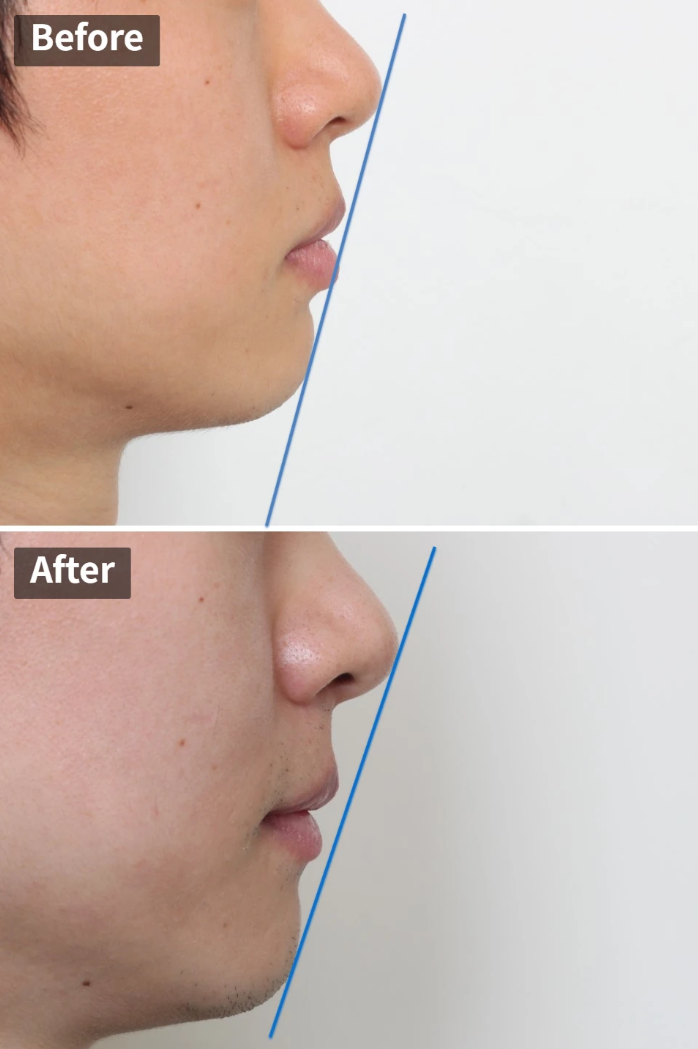
Before treatment
First, we carefully examined the patient’s current condition.
After checking the intraoral photos, there was slight spacing between the teeth. It seems there may have been a mild relapse after the previous orthodontic treatment. In the occlusal photos, a deep bite was also confirmed, with the upper front teeth covering the lower front teeth a bit too much.
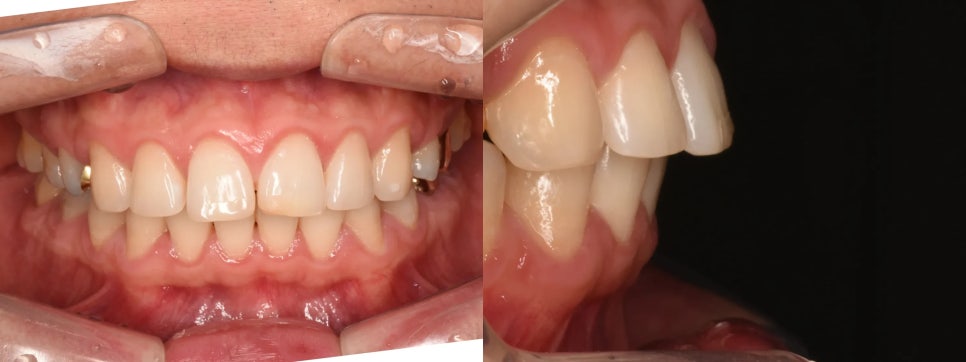
It cannot be said that there were severe problems, but despite having a history of extraction orthodontic treatment, protrusion remained, especially in the facial photos, and the overall tooth alignment was also not perfect. Above all, what mattered was that the patient himself felt, “I want my mouth to be pulled back.” More than anything, self-satisfaction is what matters.
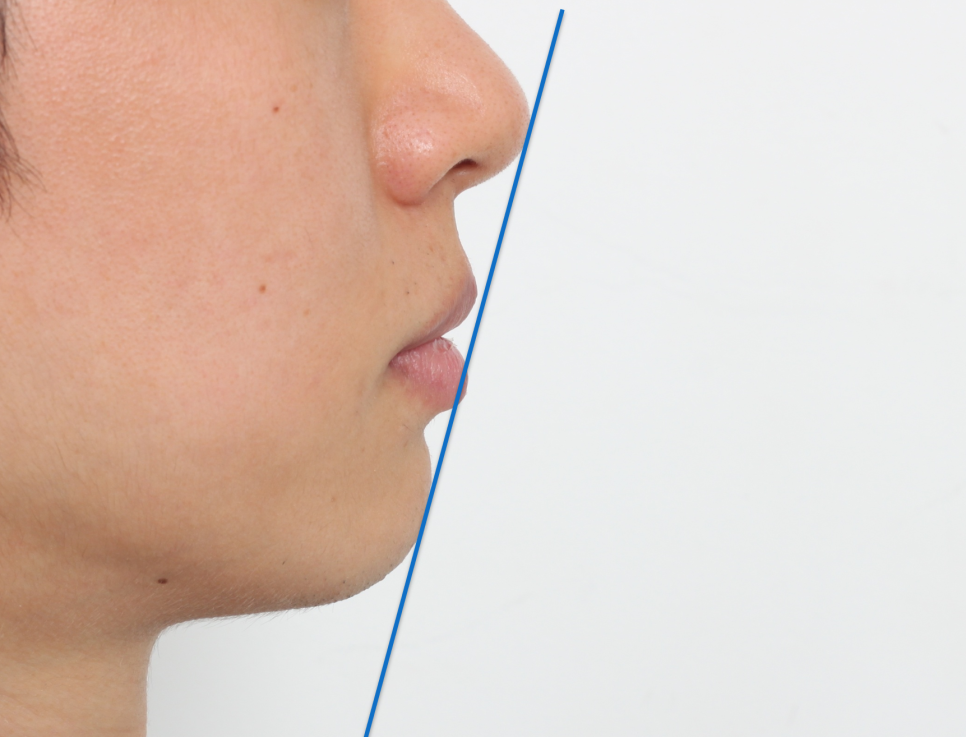 Mild protrusion is confirmed
Precise examination - evaluating the possibility of posterior movement with X-ray and CT
The most important thing was to confirm whether there was space to move the teeth backward further. To do this, we comprehensively analyzed the lateral X-ray, panoramic image, and CT scan.
Lateral X-ray analysis
After analyzing the lateral cephalometric radiograph, it was confirmed that the upper front teeth were pressing against the lower lip, causing the lip to protrude. Simply put, the upper front teeth were positioned forward and pushing the lower lip outward. This also means that if the upper front teeth are moved backward, the lower lip can naturally move back as well.
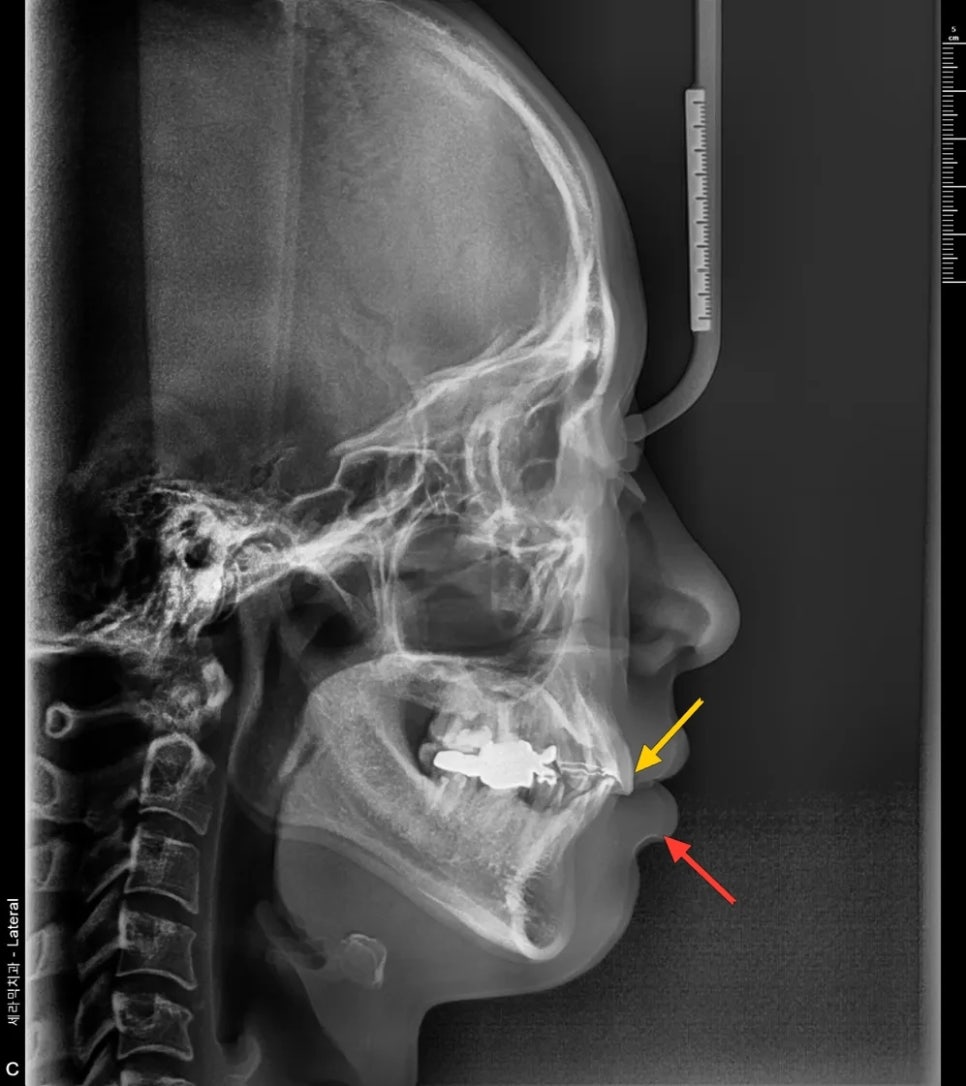
The upper teeth (yellow) are seen pushing the lower lip (red)
Panoramic review
On the panoramic image, it was confirmed that the wisdom teeth had already been extracted. And behind the area where the wisdom teeth had been removed, there appeared to be enough bone space left, so the possibility of posterior movement seemed high.
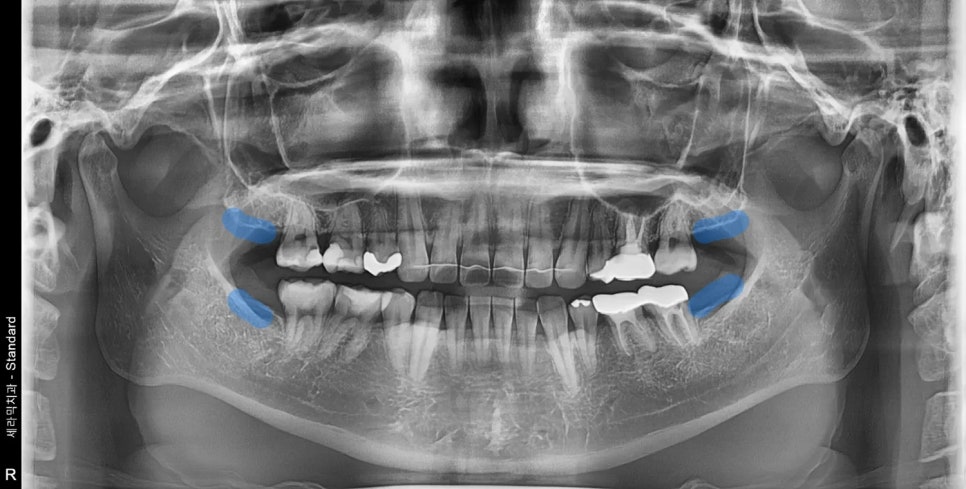
Panoramic image – posterior space is confirmed after wisdom tooth extraction (blue)
Detailed imaging (CT)
It can be difficult to judge the exact amount of bone from two-dimensional X-rays alone. So we reconfirmed it three-dimensionally with CT. In the end, we once again confirmed that there was sufficient bone extending posteriorly, meaning there was enough space to move the entire dentition backward.
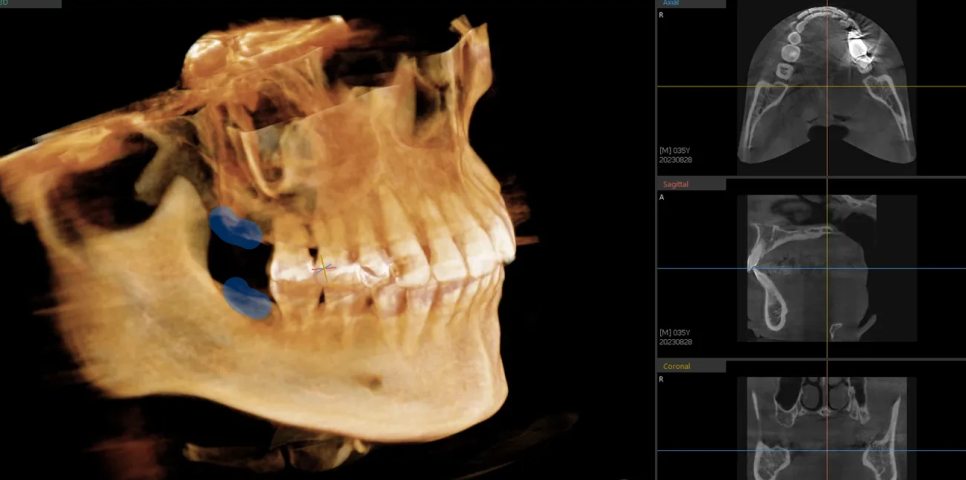
CT image – sufficient posterior bone space confirmed in three dimensions
We determined that sufficient posterior movement was possible even without extraction.
Problem list and treatment planning
Based on the results of the detailed examination, we organized the problem list and treatment plan.
Problem List
| No. | Problem | Details |
|---|
| 1 | Lip protrusion | Protrusion remained despite previous extraction orthodontic treatment |
| 2 | Poor tooth alignment | Overall alignment needed to be corrected |
| 3 | Deep bite | The upper front teeth excessively covered the lower front teeth |
Treatment plan: Non-extraction orthodontic treatment
We decided not to extract any teeth. Since the patient had already undergone extraction orthodontic treatment, removing additional teeth could significantly reduce chewing efficiency, so a non-extraction approach was the best option if possible.
The specific treatment plan was as follows:
-
Placement of orthodontic appliances on both upper and lower arches
-
After aligning the teeth, spaces between the teeth (black triangles) were expected to appear → slight interproximal reduction (IPR) followed by close contact
-
Improvement of protrusion by moving the entire dentition backward using mini-screws
-
Expected orthodontic treatment period: about 1.5 years
Treatment process ① - Tooth alignment
Before the main posterior movement, the first thing to address was tooth alignment.
Tooth alignment
First, the teeth needed to be aligned into a perfectly straight arch. The reason this had to come first was that evenly aligned teeth allow force to be transmitted efficiently through the wire. If posterior movement is attempted while the alignment is uneven, the force will not be directed as intended and the teeth may tip over.
Unlike patients undergoing orthodontic treatment for the first time, this patient already had a relatively good alignment, so this process could proceed fairly quickly.
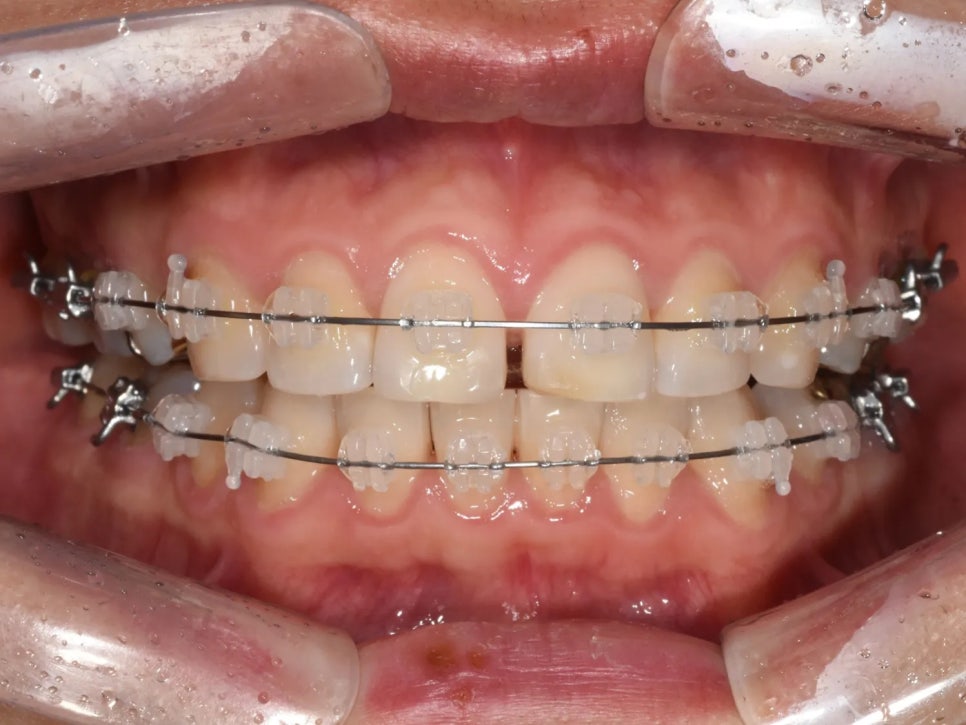
We quickly aligned the teeth into a straight line so that they could be pulled back.
Treatment process ② - Whole-arch posterior movement using mini-screws
After the tooth alignment and deep bite improvement were completed, we finally began the main posterior movement.
The key device here is the mini-screw (TAD, Temporary Anchorage Device). A mini-screw is a very small screw placed directly into bone, serving as an absolute anchorage point when pulling teeth.
In conventional orthodontics, because teeth push and pull against each other, there was a limitation in that moving one side backward would cause the opposite side to move forward. But because mini-screws are fixed in bone, they make it possible to move the entire dentition in one direction (backward).
| Category | Without mini-screws | With mini-screws |
|---|
| Whole-arch posterior movement | Impossible | Possible |
| Anchorage | Interdependent between teeth | Directly fixed to bone |
| Non-extraction protrusion improvement | Limited | Effective |
Using the space where the wisdom teeth had been removed, we gradually moved the entire dentition backward with elastic chain connected to the mini-screws.
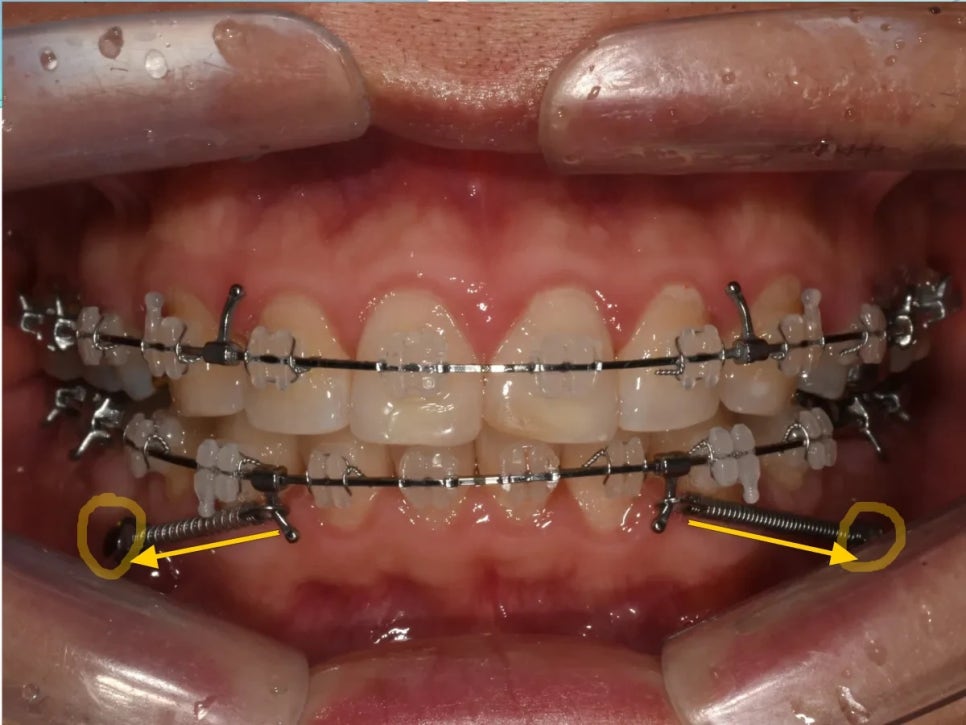
After mini-screw placement, the whole dentition has started moving backward
Treatment results - changes after orthodontic completion
Let’s look at the results after all treatment was completed.
Changes inside the mouth
Looking at the intraoral photos after completion, the dentition has been neatly organized and the protrusion has improved significantly. One note: the front surface of the upper left front tooth is slightly worn, so it is planned to be restored later with resin treatment.
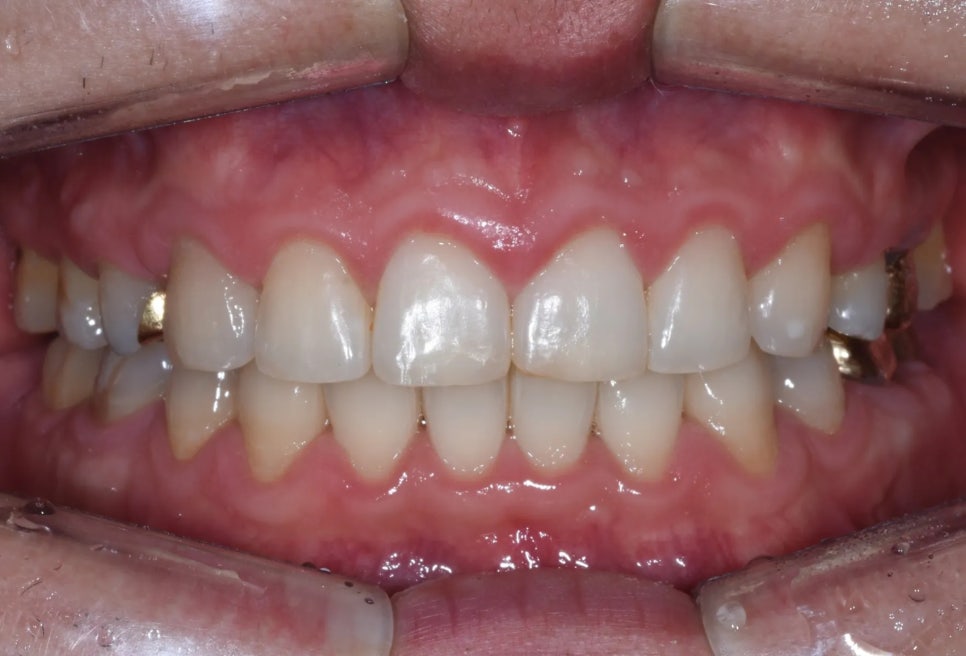
After completion – the dentition has been aligned and the protrusion improved
Changes in profile
The most noticeable change is, of course, the profile. As the lips moved noticeably backward, the protrusion was clearly resolved.
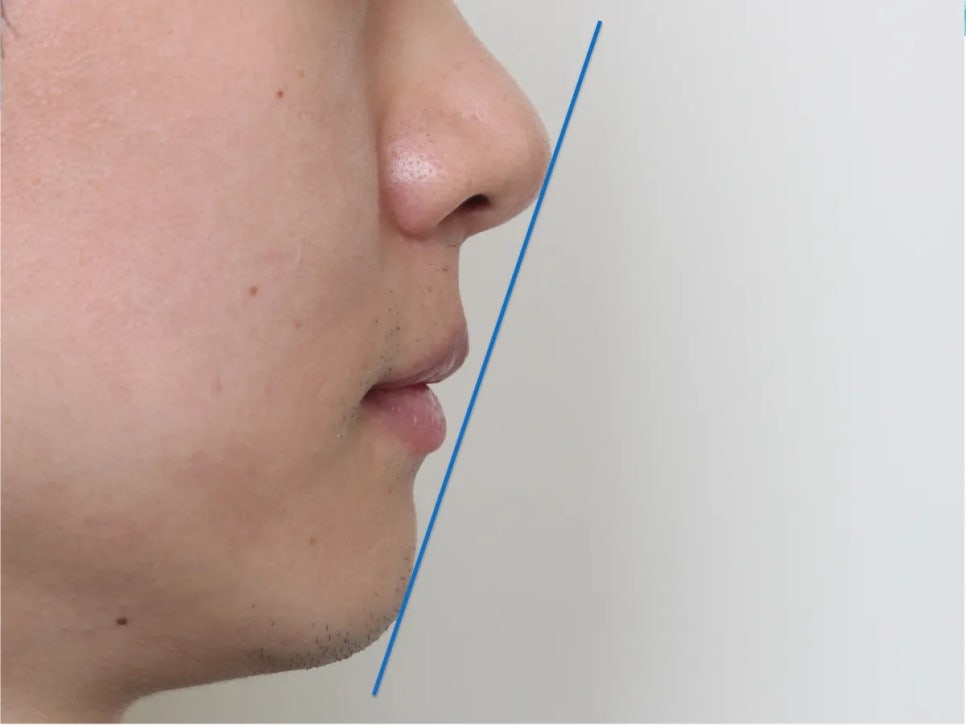
Profile after orthodontic treatment – the lip line has naturally moved backward
Before-and-after X-ray comparison
A before-and-after comparison of the lateral X-rays makes the change even clearer. Previously, the upper front teeth were pushing the lower lip outward, making the lips look protruded. But after the upper front teeth were moved sufficiently backward, the cause itself disappeared. As a result, the balance between the upper and lower lips improved, and sufficient posterior movement was achieved.
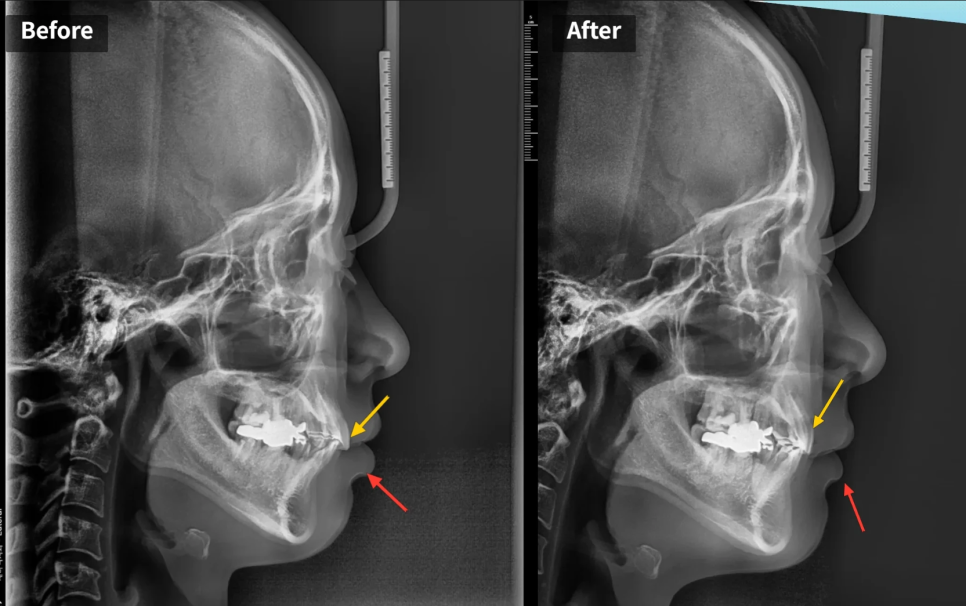
Before-and-after comparison: the appearance of the front teeth (yellow) pushing the lower lip (red) has disappeared
The significance of retreatment with non-extraction posterior movement
In cases like this patient, where lip shape remains unsatisfactory even after extraction orthodontic treatment, additional extractions can significantly reduce chewing efficiency. In such situations, a good alternative is non-extraction posterior movement using the space where the wisdom teeth were.
The amount of posterior bone space varies from person to person, but in most cases, there is enough available space to some degree. In the past, this was not possible, but with the development of mini-screws (TADs), it has become fully possible to move the entire dentition backward without extracting teeth. Even among orthodontists, many still believe that posterior movement is not possible without extraction, but as you can see, if the bone allows it, it is entirely possible.
After finishing orthodontic treatment, this patient was very happy and said, “At last, I’ll be able to avoid retreatment in my 40s.” Since he had gone through a long period of dissatisfaction even after two orthodontic treatments, it is easy to understand how great that joy must have been.
If you are considering retreatment because protrusion remains even after extraction orthodontic treatment, please remember that non-extraction posterior movement is an option. If a detailed examination confirms that there is enough bone space, you may achieve the desired result without additional extractions.
Thank you.