Can severe overbite correction only be done with surgery?
Hello, I’m Kim Seon-min, chief director of Ceramics Dental Clinic at Hagdong Station. Today, I’d like to introduce a non-surgical orthodontic case of a woman in her 20s who was concerned about a severe overbite. She had been advised to undergo surgical orthodontic treatment at another dental clinic and felt that “if surgery is the only option, I’d rather do nothing.” This was a case in which a satisfying result was achieved with non-surgical orthodontic treatment alone.
Many people still think that surgery is the only answer when the overbite is severe. However, thanks to recent advances in orthodontic techniques, many cases can be improved sufficiently with non-surgical orthodontic treatment using mini-screws. Through this post, I will explain in detail what overbite is and how it can be treated without surgery.
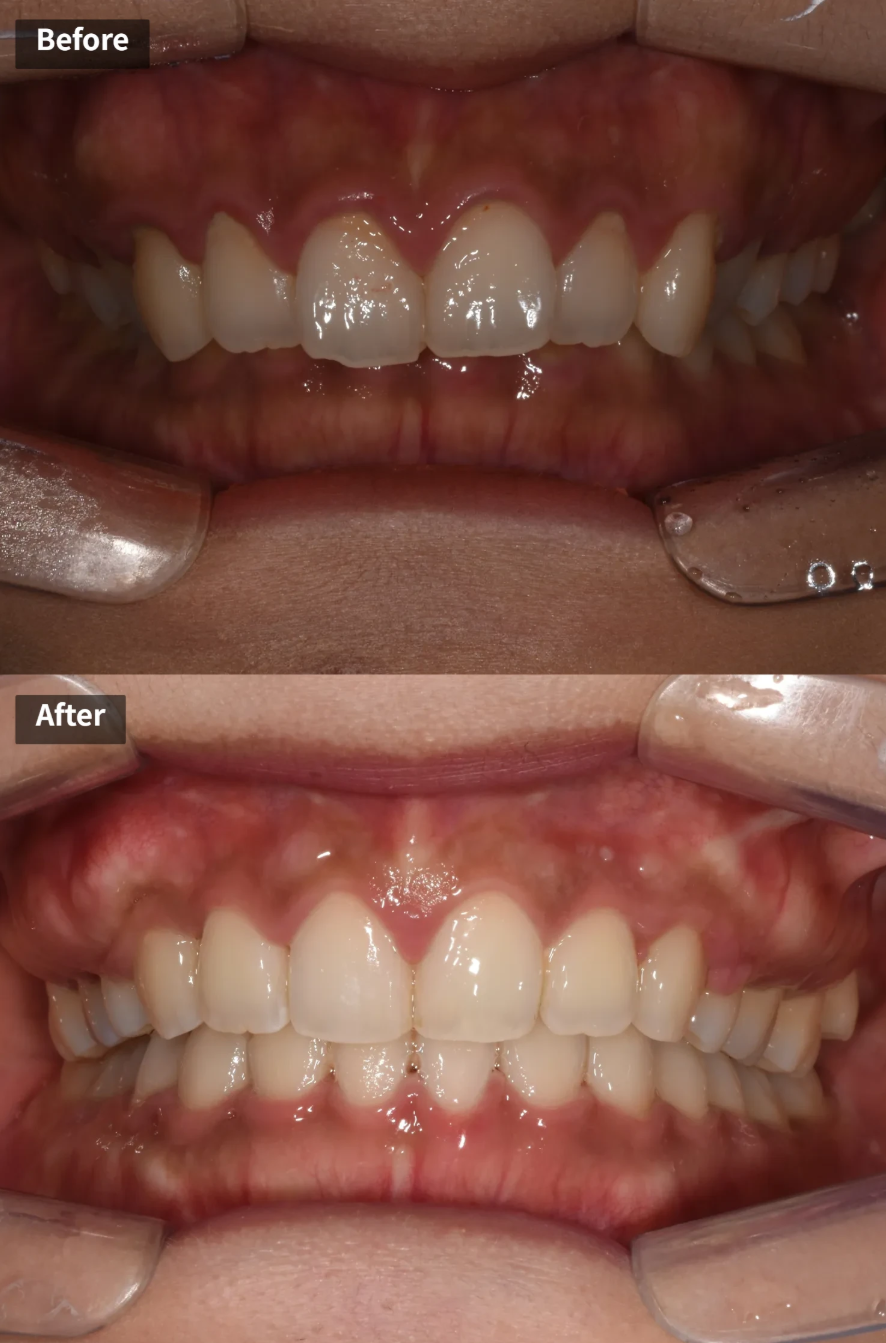
Before and after non-surgical overbite correction
A woman in her 20s worried about “rabbit teeth”
This patient was a woman in her 20s who visited us because she wanted to fix her “rabbit teeth.” When she smiled, her front teeth showed excessively, and a so-called gummy smile, with a lot of gum exposure, was also severe.
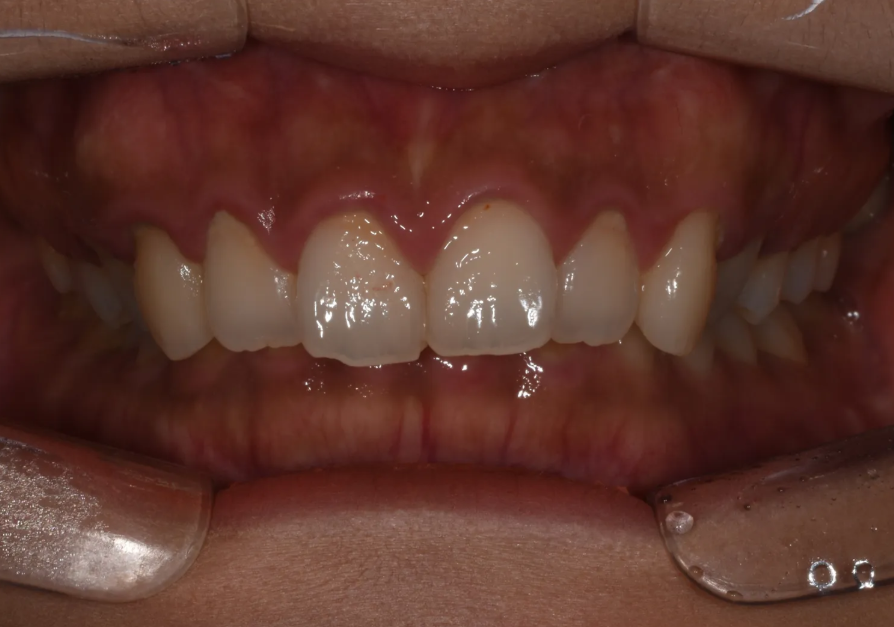
Frontal intraoral view at the first visit. A severe overbite where the lower teeth are completely hidden when the teeth are fully closed.
I still remember being surprised when the patient herself showed me by saying “ee~,” because the degree of overbite was truly severe. She had already been advised to undergo surgical orthodontic treatment at another dental clinic, but she was reluctant to have surgery and was considering giving up on treatment altogether.
However, after a detailed diagnosis, I judged that although the amount was large, the mechanism itself was no different from that of a mild overbite. Therefore, I explained that improvement would be possible even without surgery, and we began orthodontic treatment.
Initial analysis: identifying the patient’s problems
The problems identified through the initial examination are summarized below.
| Problem item | Details |
|---|
| Protruding front teeth | The so-called “rabbit teeth” appearance |
| Severe overbite | The upper front teeth almost completely cover the lower teeth |
| Poor tooth alignment | Overall, the teeth are not aligned evenly |
| Narrow dental arch | The upper dental arch is narrow |
| Overjet issue | A large overjet is expected once the overbite is corrected |
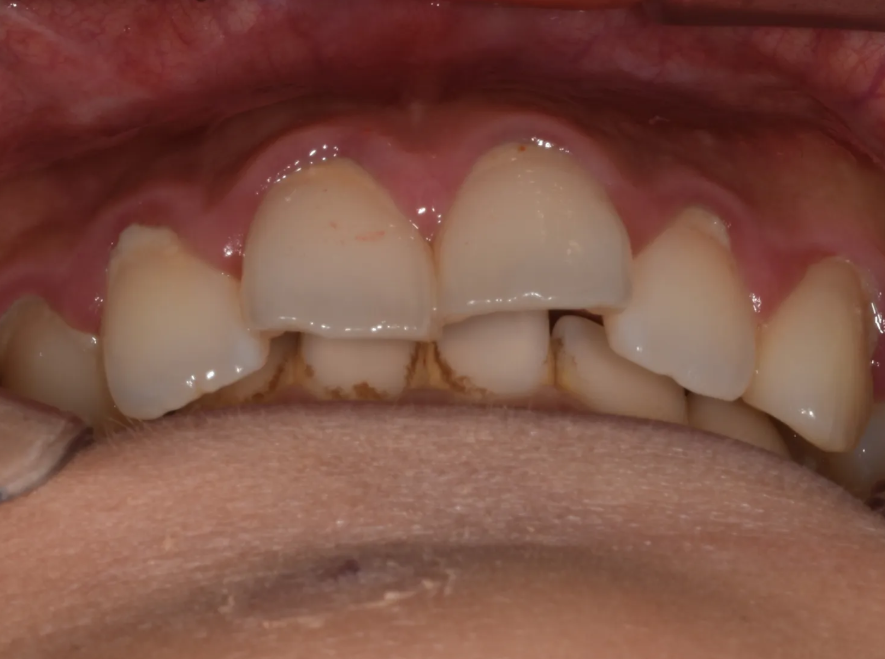
There is an important point here. Right now, it may seem as though there is no front-to-back spacing (overjet) between the upper and lower teeth because they are almost touching, but that is only because of the overbite. Once the overbite is corrected, a fairly large overjet was expected to become apparent. This needed to be taken into account in advance when planning the treatment.
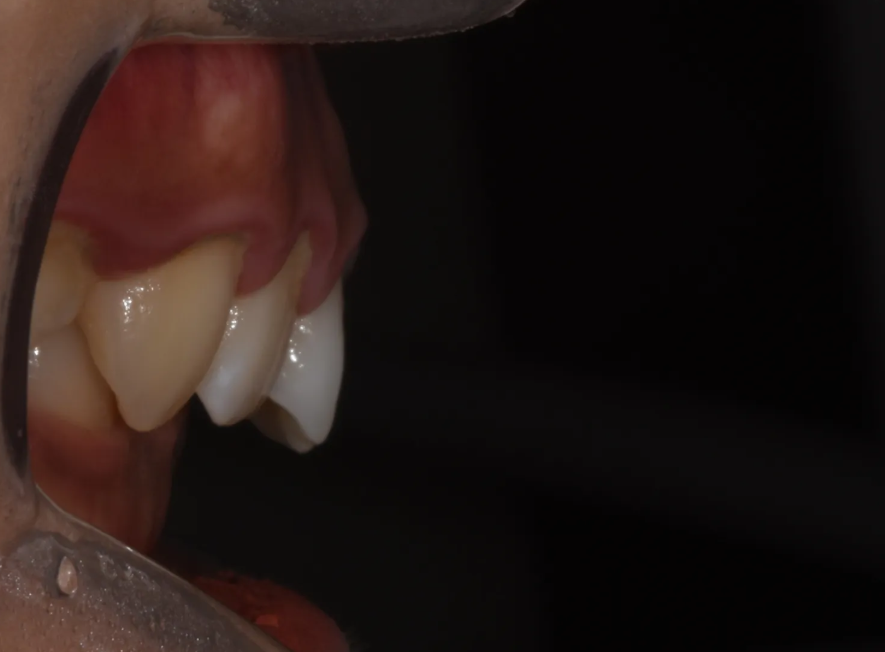
The overjet issue is a little more visible from the side
In fact, this patient had previously undergone chin tip surgery (surgery to bring the chin forward) because her lower jaw was small. For patients like her, the upper teeth are positioned much farther forward than the lower teeth, so the chin can appear relatively recessed.
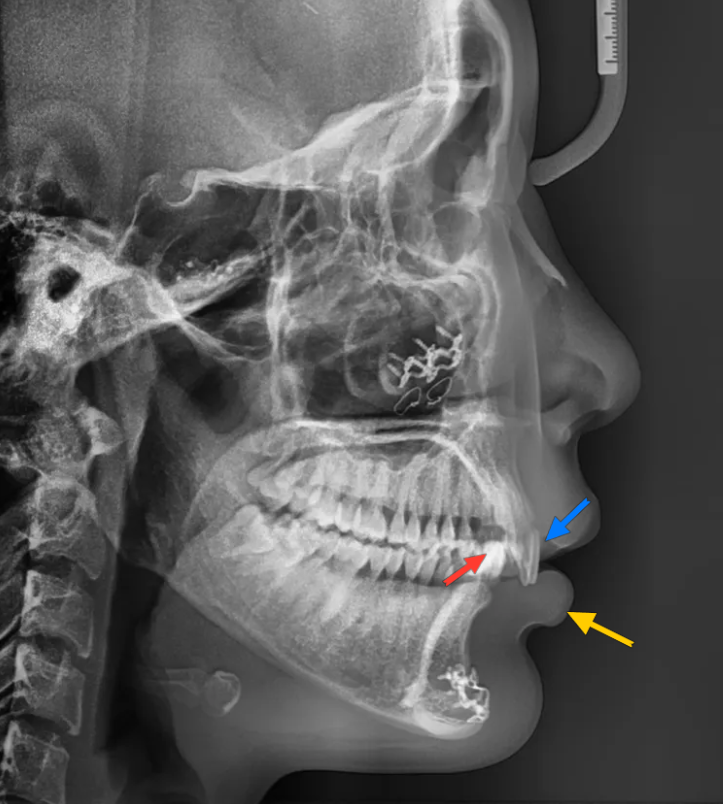
On the X-ray, the upper teeth (blue) are pressing on the lower lip (yellow).
The lower teeth (red) are touching the roots of the upper teeth rather than the middle part, unlike in a typical person.
Why choose non-surgical orthodontics instead of surgery?
In the past, if one wanted to move the upper front teeth upward (intrusion), the only option was to use a headgear device with elastics attached. For adults, this was not a practical option, so severe overbite was strongly associated with surgical orthodontic treatment.
But things have changed a lot recently. Thanks to the development of mini-screws (TAD, temporary anchorage devices), it has become possible to place small screws in the jawbone and apply force toward the front teeth, effectively moving the front teeth upward.
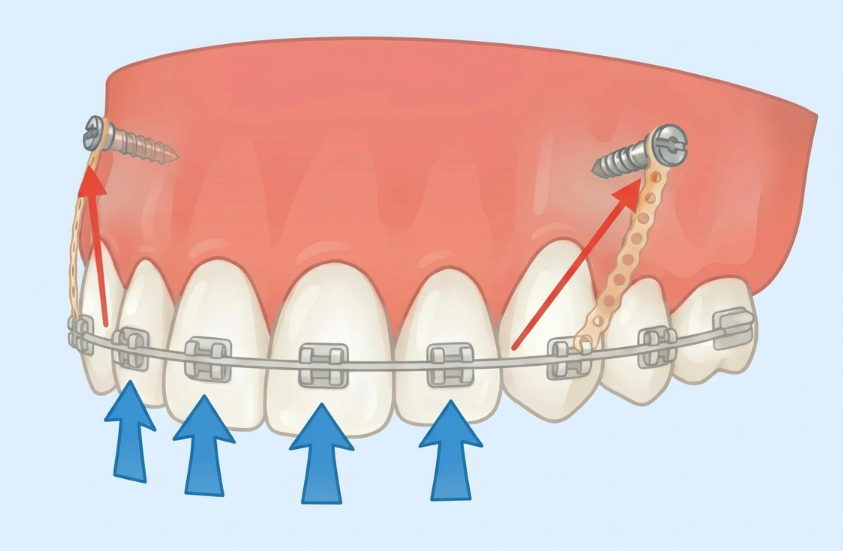
Conceptual diagram of upper front tooth intrusion using mini-screws
In this patient’s case, the overbite was severe, which is likely why another clinic recommended surgery. But in my judgment, although the amount was large, the principle of applying force was the same as in mild overbite. It was well within the range that could be handled with mini-screws.
Most importantly, the patient had a firm intention: “If it requires surgery, I’d rather do nothing.” Only after learning that non-surgical orthodontic treatment was an option did she decide to proceed. If sufficient improvement is possible without surgery, there is no need to take on the burden of surgery.
Treatment plan
After comprehensively analyzing the patient’s condition, we established the following treatment plan.
| Stage | Treatment details |
|---|
| Stage 1 | Placement of upper and lower orthodontic appliances (brackets) |
| Stage 2 | Placement of upper mini-screws → start upper front tooth intrusion |
| Stage 3 | Extraction of upper premolars → pulling the front teeth backward using the extraction spaces |
| Stage 4 | Extraction of upper wisdom teeth (lower wisdom teeth extracted if they cause discomfort) |
| Stage 5 | After tooth alignment, tooth reduction (IPR) and closing of black triangle areas |
Because the overjet that would appear once the overbite was corrected was expected to be very large, we planned premolar extractions. The strategy was to use the space created by extraction to move the front teeth backward. The estimated orthodontic treatment period was about 20–24 months.
Starting treatment: appliance placement and screw insertion
From the early stage of treatment, we actively inserted mini-screws and began moving the upper front teeth upward. At the same time, to achieve the patient’s requested goal—reducing the prominence of the front teeth—we extracted the upper premolars. This was because it would maximize the amount of backward movement of the front teeth.
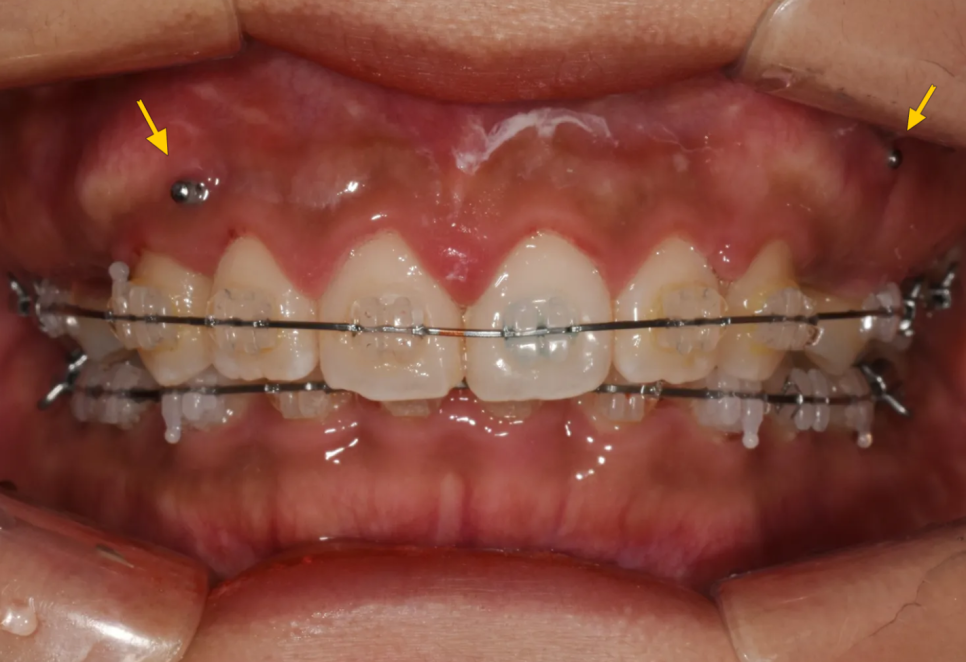
Treatment start after screw (yellow) placement and premolar extraction
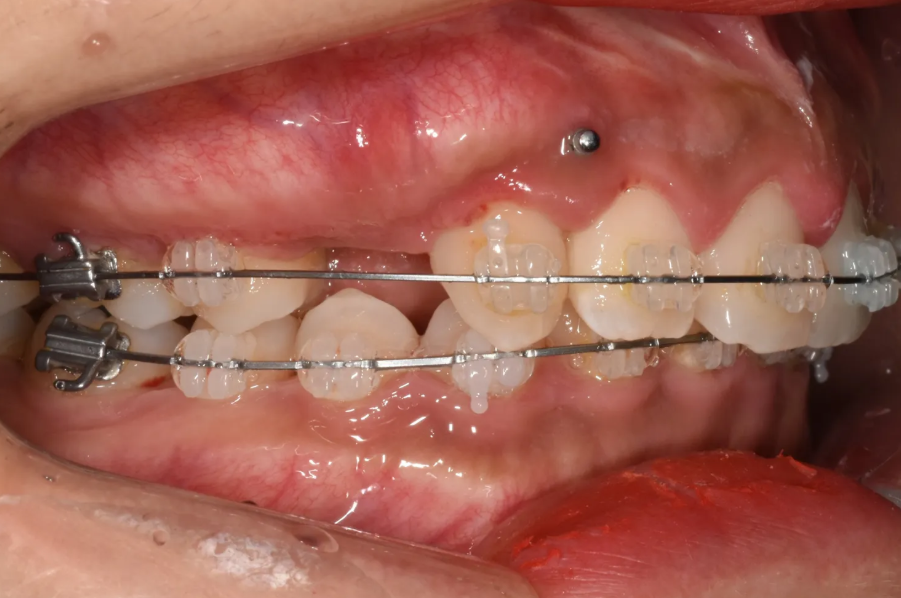
Side view. The upper front teeth are pulled back into the extraction space.
We placed orthodontic appliances (brackets) on both the upper and lower teeth and expanded the dental arch while improving the overbite at the same time. This was a strategy to efficiently solve multiple problems at once.
Treatment process: while correcting the overbite
As the upper front teeth were gradually moved upward using mini-screws, we could see the overbite slowly improving. As the improvement became visibly noticeable, the patient also followed along with greater satisfaction and anticipation. Orthodontic treatment takes quite a long time, so it is important to share these moments of progress with patients and work together with motivation throughout the process.
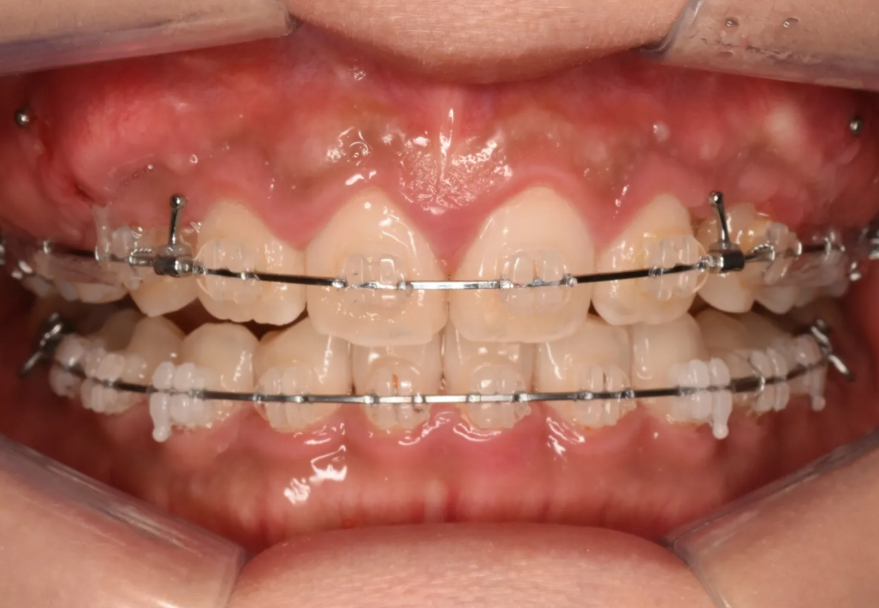
A stage in which the overbite is gradually being corrected. The lower front teeth are now clearly visible.
Treatment completed: results of overbite correction and retraction
After two years of treatment, the process was finally completed. The overbite was fully corrected, and the amount by which the upper teeth overlap the lower teeth vertically returned to the normal range. Compared with the time of the first visit, when the upper teeth almost completely covered the lower teeth, this was a truly significant change.
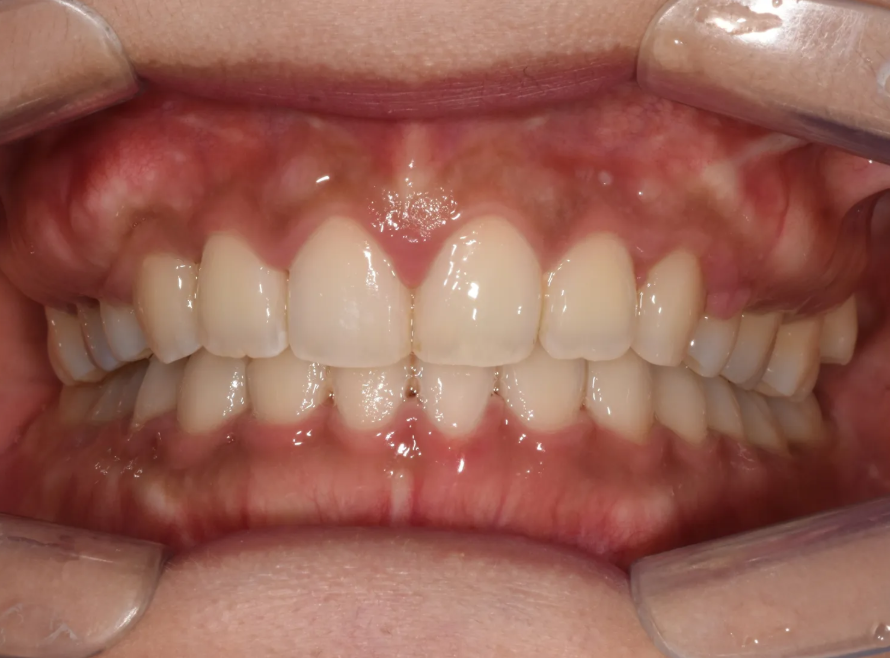
You can also see that the upper and lower teeth are each aligned very nicely.
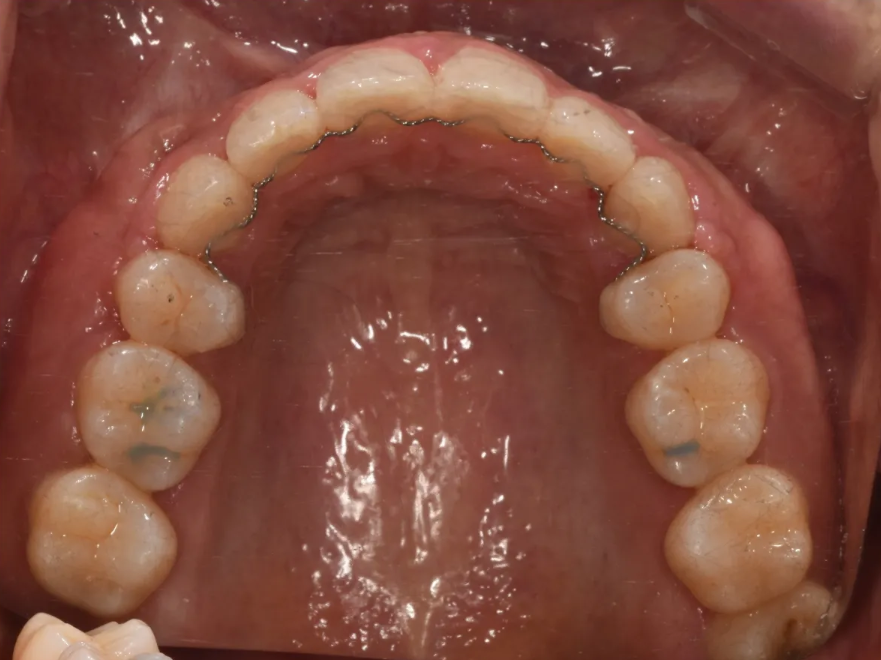 Treatment result: upper teeth alignment – neatly organized appearance
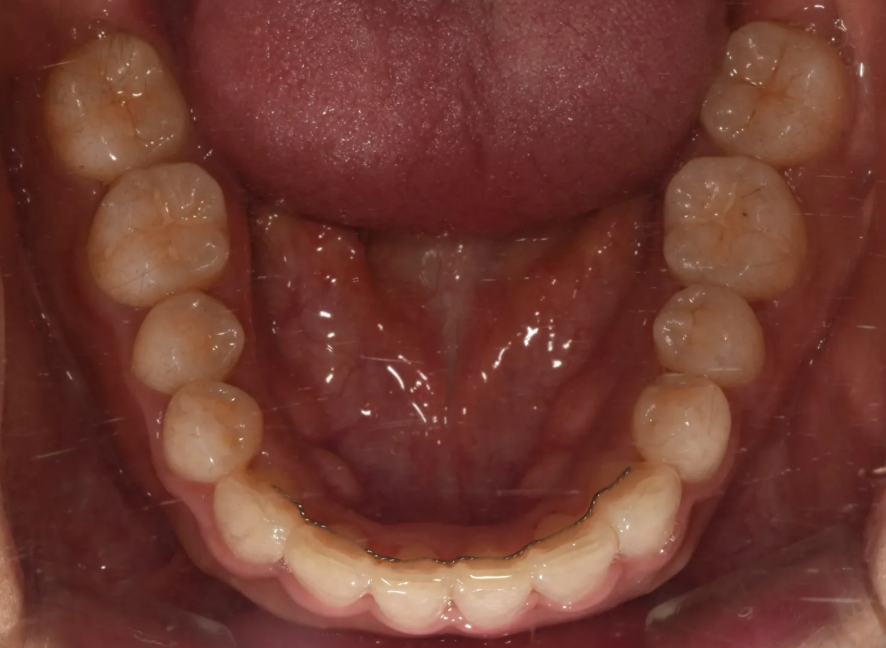 The lower teeth are also evenly aligned
Using the extraction space from the upper premolars, we moved the front teeth backward and also resolved the protruding appearance. The “rabbit teeth” impression that had been the patient’s biggest concern disappeared, and the lip protrusion improved, completing a natural smile line.
Before & After comparison and overall review
This case is a representative example showing that severe overbite can be sufficiently treated with non-surgical orthodontics alone. If you compare the before-and-after photos, you can clearly feel the difference. First, as the upper teeth that had been completely covering the lower teeth moved upward, the appearance when the teeth are closed became much more attractive. Of course, the rabbit-teeth impression also disappeared completely.
When comparing the changes in the side view on X-ray, the difference is even more dramatic. As the front teeth (yellow) moved inward and upward, the condition in which they were pressing on the lips (red) disappeared completely. Accordingly, the protruding-mouth impression disappeared completely, and especially when relaxed, the lips now close naturally.
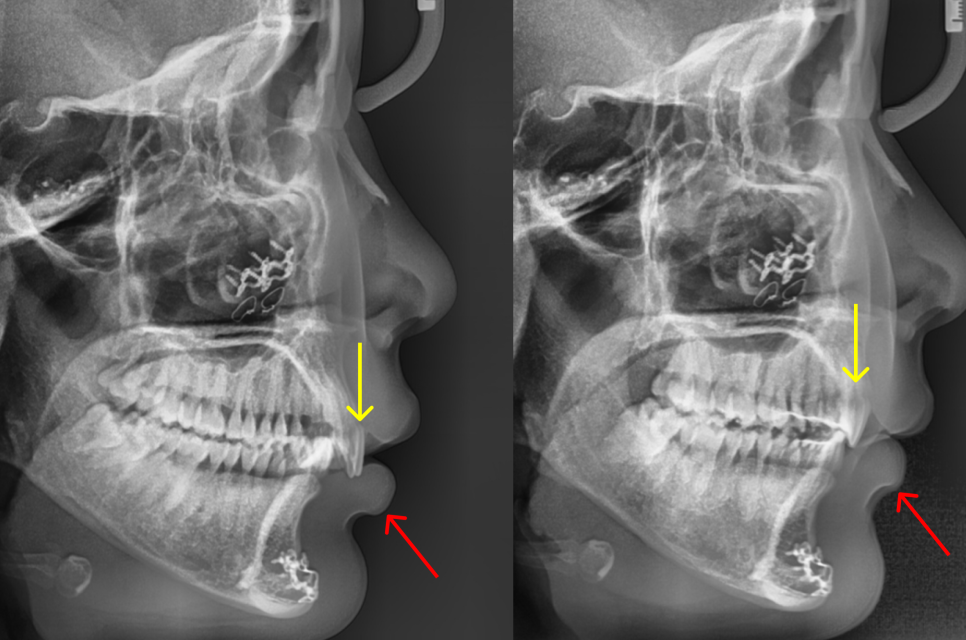 As the front teeth (yellow) moved, the lips (red) returned completely to their proper position.
The protruding-mouth appearance disappeared, and the lips close naturally.
As the front teeth (yellow) moved, the lips (red) returned completely to their proper position.
The protruding-mouth appearance disappeared, and the lips close naturally.
With regard to this treatment, from a dental functional standpoint, there is very little to regret about the results of the “non-surgical treatment.” However, it is true that if surgery had been performed, we could also have expected a slight reduction in facial length while moving the front teeth upward. But whether one would choose a major option such as surgery for that level of benefit is, in my view, entirely a matter of personal desire and preference. After all, non-surgical treatment can already achieve such excellent results.
| Comparison item | Non-surgical orthodontics | Surgical orthodontics |
|---|
| Overbite correction | ✅ Fully possible | ✅ Possible |
| Improvement of protruding front teeth | ✅ Fully possible | ✅ Possible |
| Restoration of tooth function | ✅ Little difference | ✅ Possible |
| Shortening of facial length | ❌ Limited | ✅ Possible |
| Surgical burden | ✅ None | ❌ General anesthesia and hospitalization required |
| Recovery time | ✅ Short | ❌ Relatively long |
In conclusion, most overbite cases can now be treated with non-surgical orthodontics using mini-screws. The choice between surgery and non-surgery should be based less on tooth function and more on the patient’s expectations regarding facial change.
For those concerned about overbite
Even if the overbite is severe, surgery is not the only answer. Non-surgical orthodontic treatment using mini-screws can provide sufficient improvement, and this case is a good example of that.
Like this patient, who was about to give up on treatment because surgery felt too burdensome, it is truly regrettable to do nothing out of fear of surgery. I hope you will keep in mind that there is an option called non-surgical treatment.
However, if you actively want facial changes such as a shorter face, surgical orthodontics may also be worth considering. The important thing is to decide on the treatment method that fits your condition and expectations through sufficient consultation with an orthodontic specialist.
If you are concerned about overbite, please feel free to find the best option for yourself through a consultation. Thank you.