Hello, I’m Kim Sun-min, Chief Director of Ceramic Dental Clinic at Hakdong Station.
Today, I’d like to introduce in detail the treatment process of a 19-year-old female patient who had several complex problems involving the front teeth, including microdontia, retained primary teeth, congenital absence of teeth, and an impacted tooth. It was a very complex case in which multiple issues existed in one patient at the same time. Let’s go through the entire treatment process together, from orthodontic treatment to the final esthetic prosthetics.
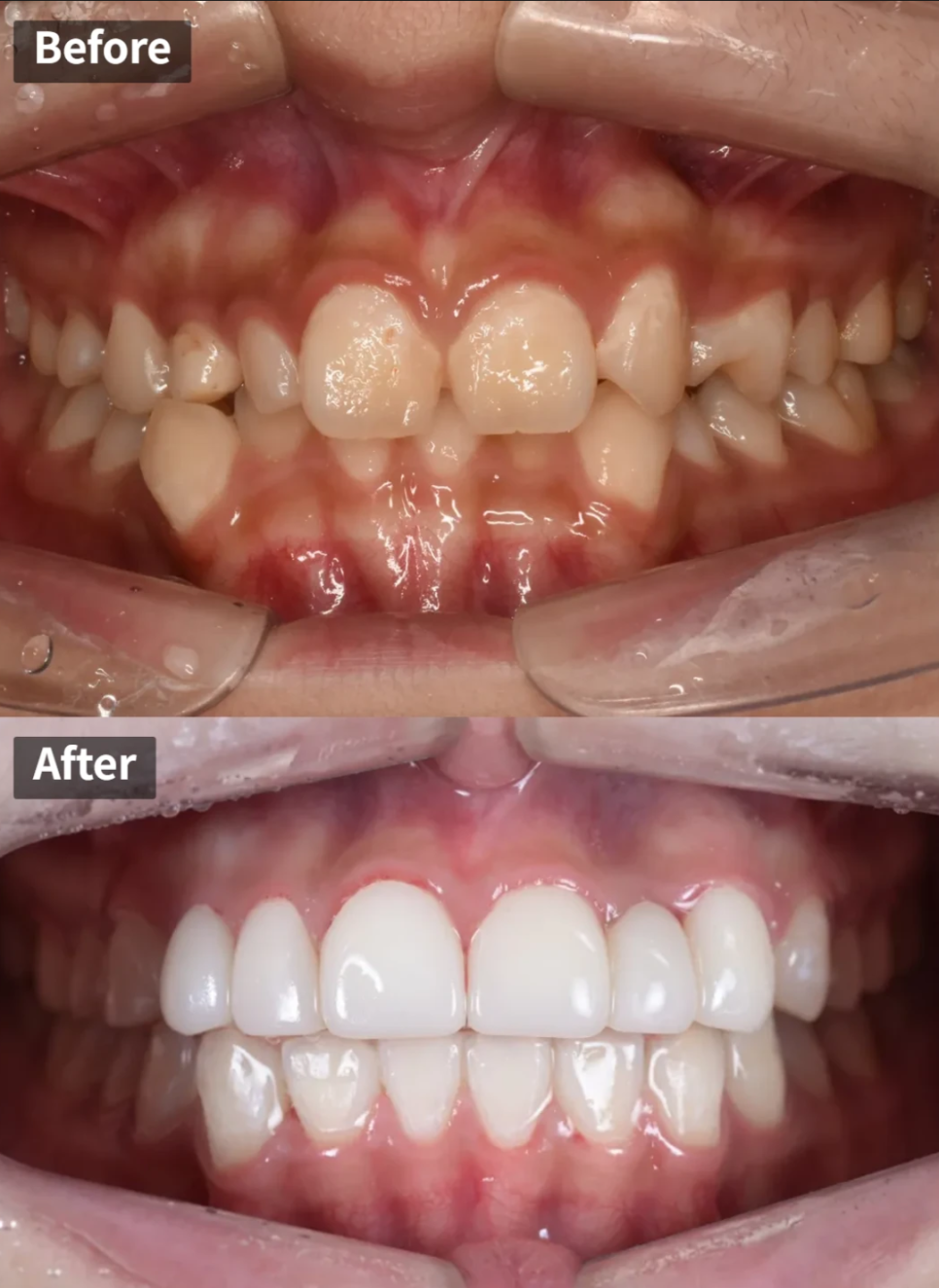
19-year-old female patient with complex anterior tooth problems
This patient was a 19-year-old woman with multiple issues in the upper front teeth area, including microdontia (teeth smaller than normal), retained primary teeth (baby teeth that did not fall out), congenital absence of teeth (areas where permanent teeth never developed), and an impacted canine (a canine buried in the gum).
Especially considering that she was in her late teens, esthetics were more important than anything else because the prosthetics would need to be used for decades to come. This was a case in which I felt a strong sense of responsibility not only to restore function, but also to create a natural and beautiful smile.
The treatment was carried out according to a systematic plan in the order of orthodontic treatment → esthetic prosthetics.
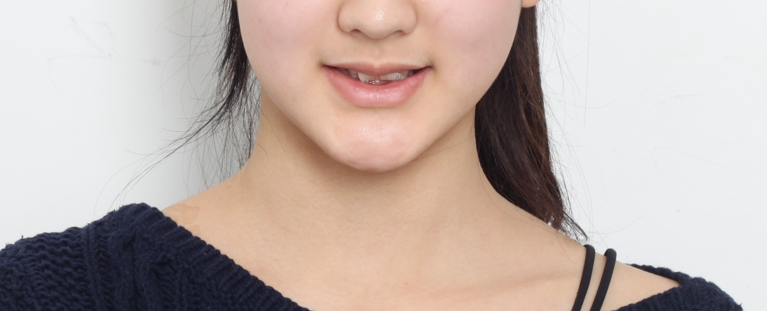
Facial photo at the first visit – irregular tooth alignment is visible
Initial analysis – the problematic upper front teeth
Let’s divide the many problems by type and look at them one by one.
The first and most noticeable issue was the presence of unusually small teeth. In the figure below, the red arrows indicate retained primary teeth that should have fallen out in elementary school but remained in place. That is why they are smaller than the other teeth (permanent teeth). The yellow arrows indicate microdontia, a condition in which a tooth is congenitally formed smaller than normal.
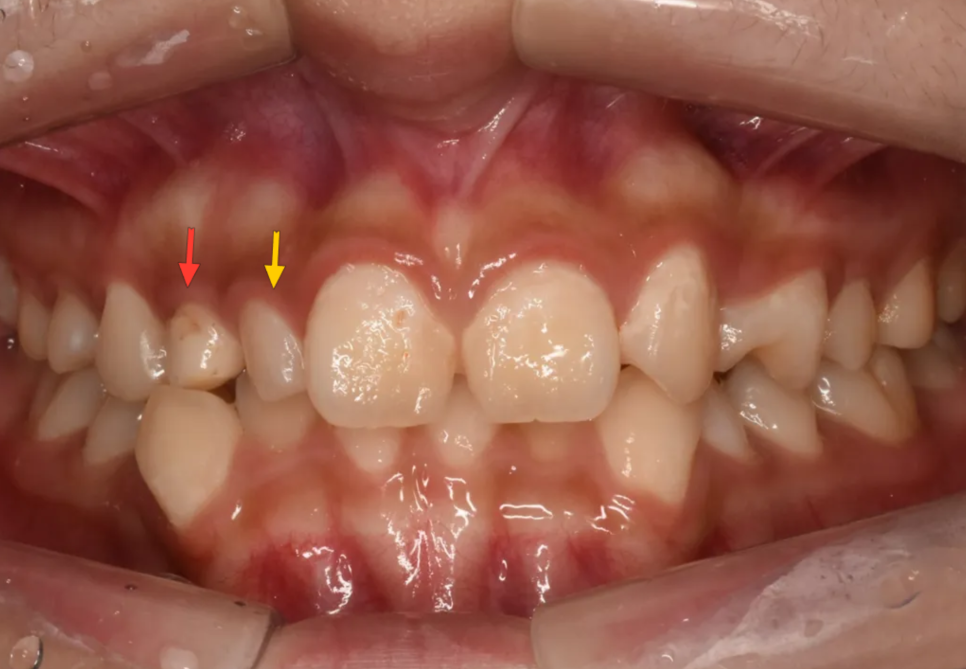
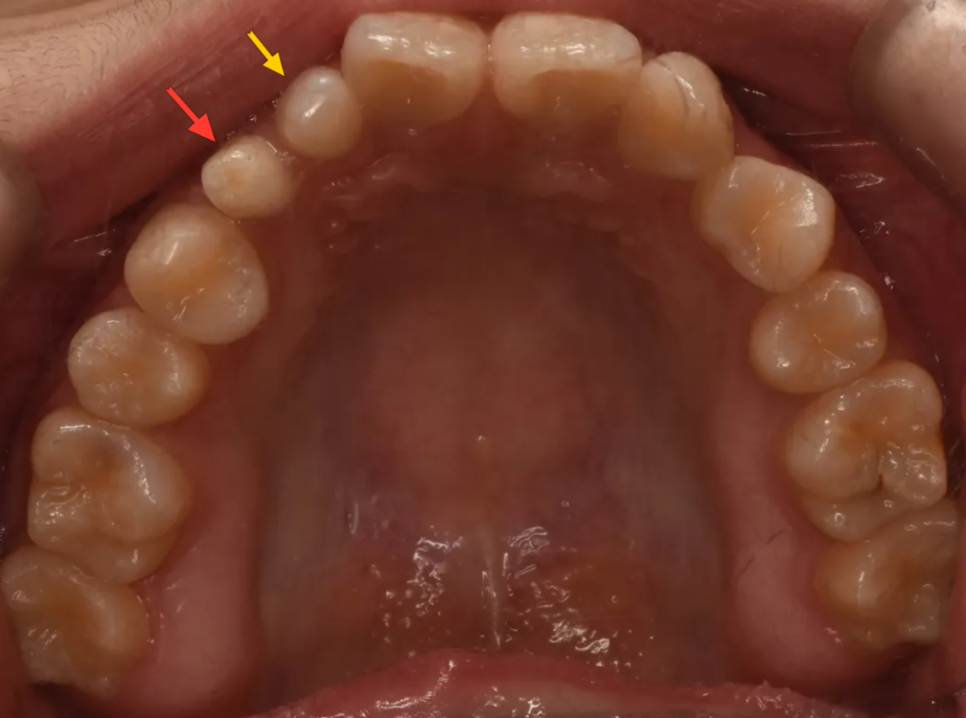
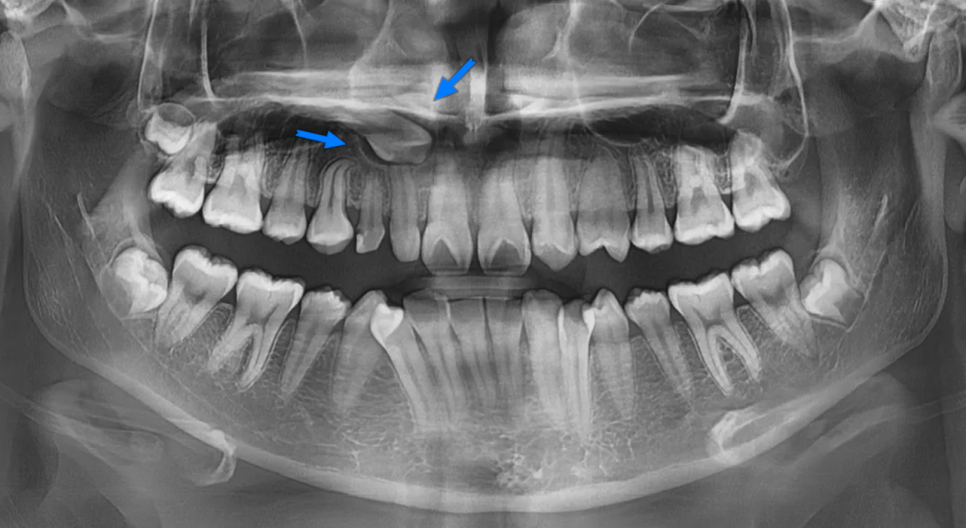
The reason the baby tooth was still present is that the permanent canine was impacted and could not erupt. This can be confirmed on an X-ray, where the canine is seen buried deeply.
Next, there was the case of a missing tooth where a tooth should have been present (tooth agenesis). In the figure below, the tooth marked is located in the position of the lateral incisor, but it is actually a canine. In other words, the lateral incisor is missing, and the canine from the back has drifted forward into that space. Because space remained, the premolar behind it moved to fill the space and can be seen rotated.
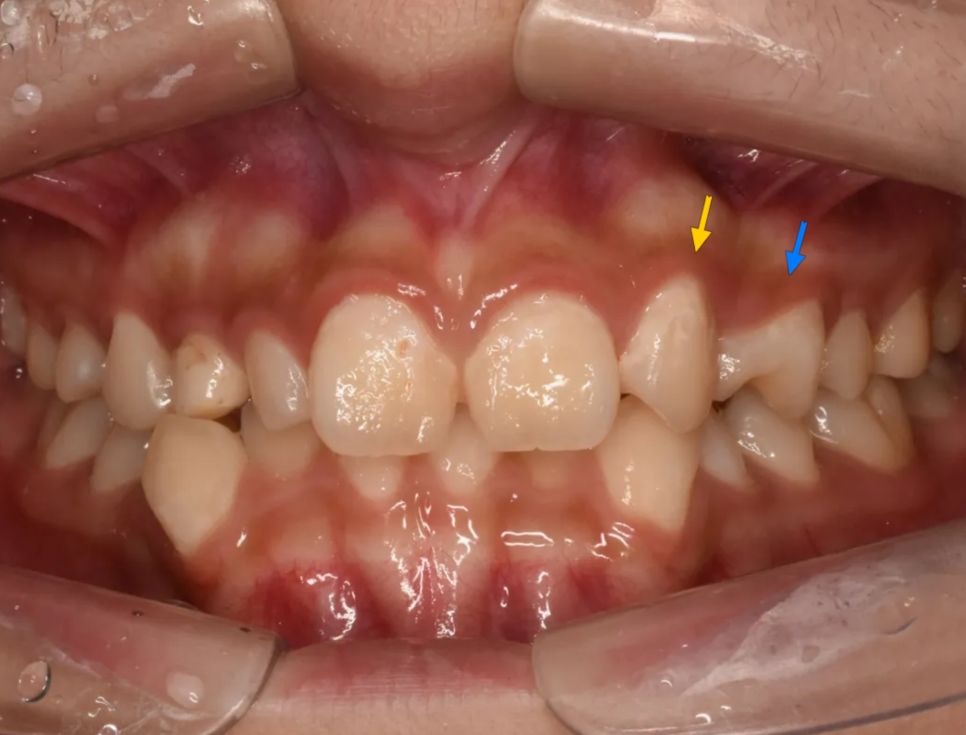
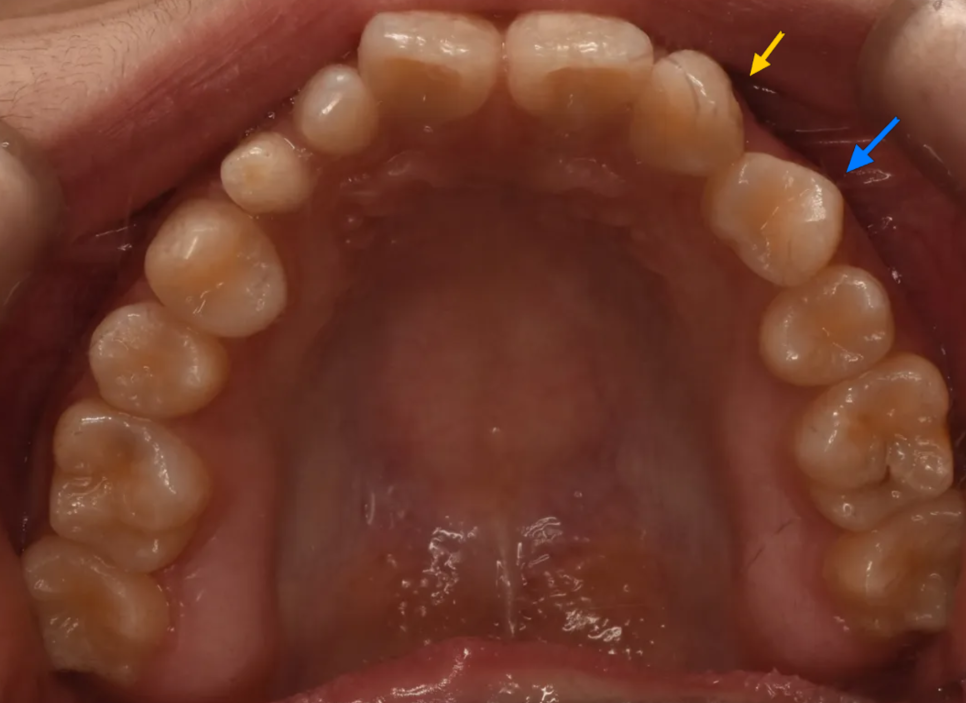
Yellow: canine that drifted into the missing lateral incisor position / Blue: premolar rotated to fill the space
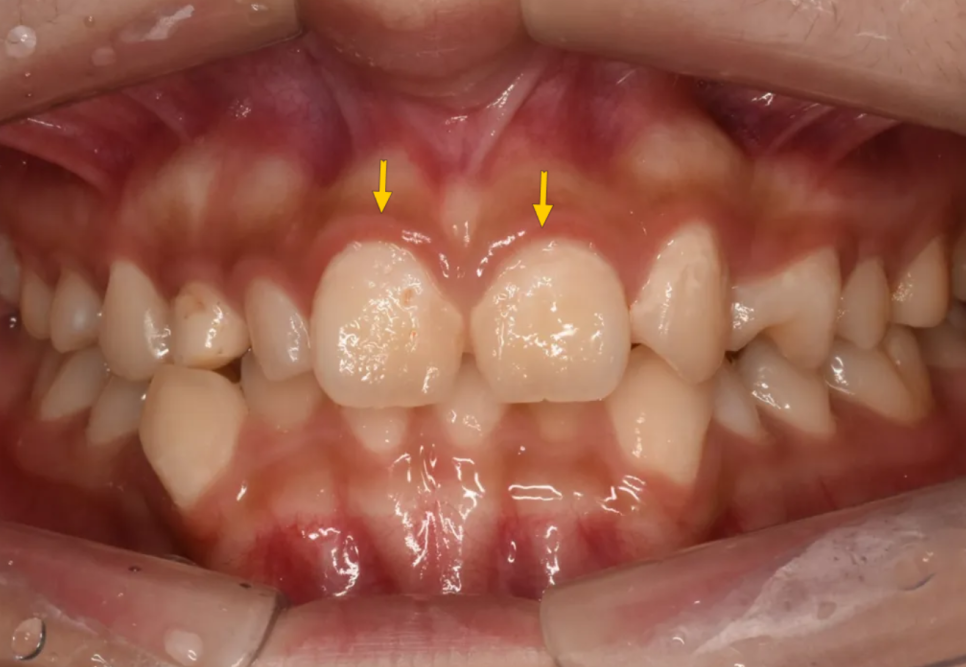
Finally, the two central incisors had a somewhat unaesthetic shape. Their form was somewhat unattractive, and their size was relatively large compared to the adjacent teeth. While this was not as serious as the other problems mentioned above, it was still not an esthetically desirable form.
Terminology – What are microdontia, retained primary teeth, impacted teeth, and tooth agenesis?
Let’s briefly define the terms that appeared frequently in this article.
Microdontia refers to a condition in which a tooth is formed smaller than normal. It is most commonly seen in the upper lateral incisors (the teeth right next to the front teeth), and because of their small size, spaces appear between teeth and the overall harmony is disrupted.
A retained deciduous tooth means that a primary tooth (baby tooth) has remained in place because the permanent tooth is missing or impacted and the baby tooth did not fall out. Primary teeth are smaller than permanent teeth and have shorter roots, so they have limitations for long-term use.
An impacted tooth is a tooth that is buried in bone or gum tissue and cannot erupt normally. In this patient’s case, the upper right canine was impacted.
Congenital absence means that the permanent tooth itself never formed, so no matter how long you wait, the tooth will not appear. In this patient, the upper left lateral incisor was congenitally missing.
When these four problems occur together in one patient, the difficulty of treatment increases exponentially.
Because the solutions for each problem affect one another, it is essential to establish a treatment plan from a comprehensive perspective.
Stage 1: Orthodontic treatment – securing space for prosthetics and organizing alignment
Orthodontic treatment began in December 2022. At that time, the goal of orthodontics was not simply to align the teeth neatly. The key objective was to secure the optimal space needed for successful esthetic prosthetics in the future.
Specifically, the following were carried out:
-
Securing appropriate space for prosthetic work around the upper right lateral incisor (microdontia) and retained primary tooth
-
Attaching a tooth-shaped temporary device to maintain esthetics during orthodontic treatment in the area of the missing upper left lateral incisor
-
Improving the rotation of the upper left first premolar
-
Organizing the overall tooth alignment
For this patient, orthodontic treatment was not merely alignment; it was an important preparatory step for prosthetic success. Please remember that orthodontics and prosthetics must be organically linked to achieve a good final result.
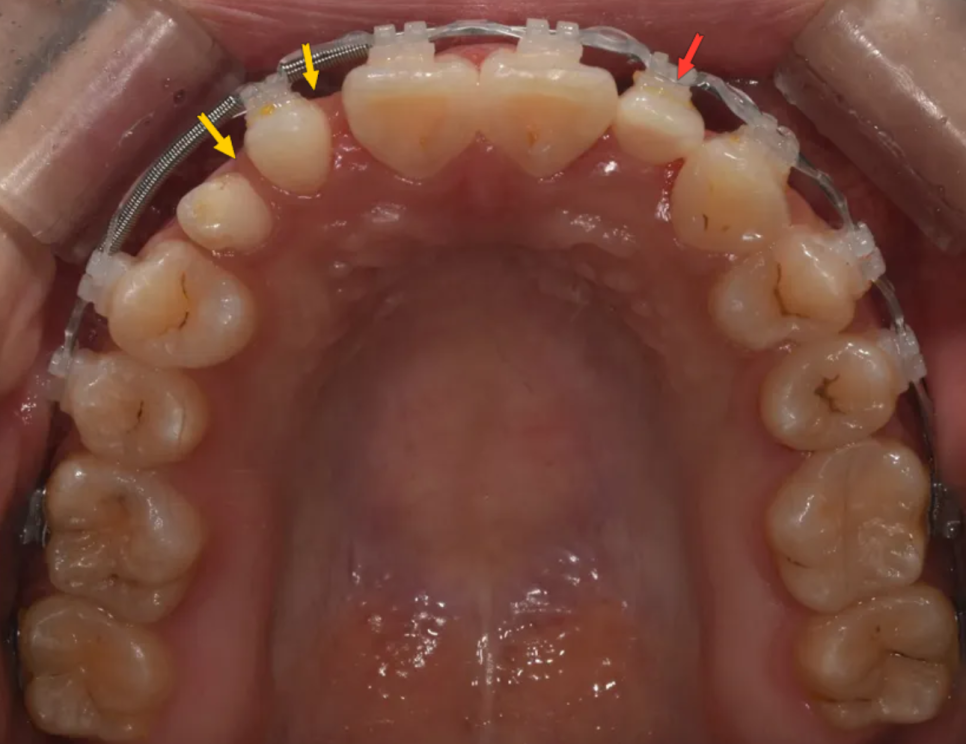
After orthodontic treatment – the space for prosthetics (yellow) has been secured, and a temporary tooth (red) has been attached to the missing area
Stage 2: Esthetic prosthetic treatment planning
After orthodontics was completed, we began planning esthetic prosthetics for the six upper front teeth in earnest, from the right canine position to the left canine position. The six key points are summarized below.
| | Details | Purpose |
|---|
| ① | Reduce the size/width of the two upper central incisors | Adjust the balance in proportion to the adjacent teeth |
| ② | Reinforce the microdontia and retained primary tooth areas with resin core | Secure retention and durability of the prosthesis |
| ③ | Gum contouring in the microdontia and retained primary tooth areas | Raise the gum line to secure tooth length |
| ④ | Fabricate a bridge for the missing upper left lateral incisor area | Design symmetrically with the upper right lateral incisor |
| ⑤ | Correct the gingival asymmetry of the two upper front teeth | Match left-right symmetry through gum contouring |
| ⑥ | Preserve vitality in all teeth (teeth with living nerves) | Minimize the possibility of root canal treatment |
Stage 3: Preview with temporary teeth
Before making the final prosthetics, we first go through the step of placing temporary teeth (provisional restorations). Typically, the temporary teeth are used for about 1 week to 1 month.
The temporary stage is important for the following reasons:
-
You can directly check how the tooth shape, size, and color actually look
-
The patient can use them personally, confirm satisfaction, and provide feedback
-
If there are issues, they can be corrected and reflected in the final prosthetics
This temporary stage is especially important in anterior esthetic prosthetics. Once the final prosthesis is set, it is difficult to make changes, so sufficient verification during the temporary stage is necessary.
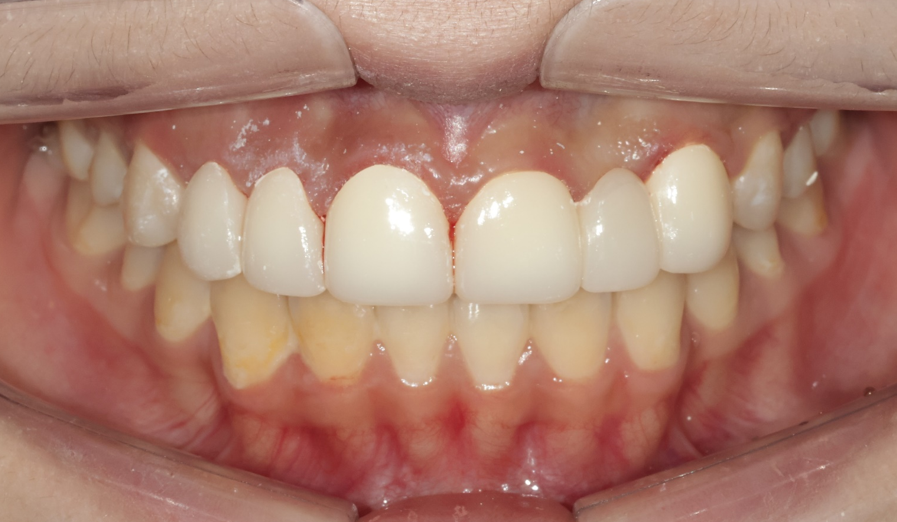
Temporary teeth in place – previewing the shape and feel before the final prosthetics
Stage 4: Final prosthesis placement – the completed smile
Based on the shape confirmed during the temporary tooth stage, the final prosthetics were fabricated. In the end, left-right symmetry, tooth proportion, and harmony of the gingival line were all achieved. And most importantly, all teeth were treated while preserving vitality (keeping the nerves alive). By removing only the minimally necessary amount, the treatment was completed without root canal treatment.
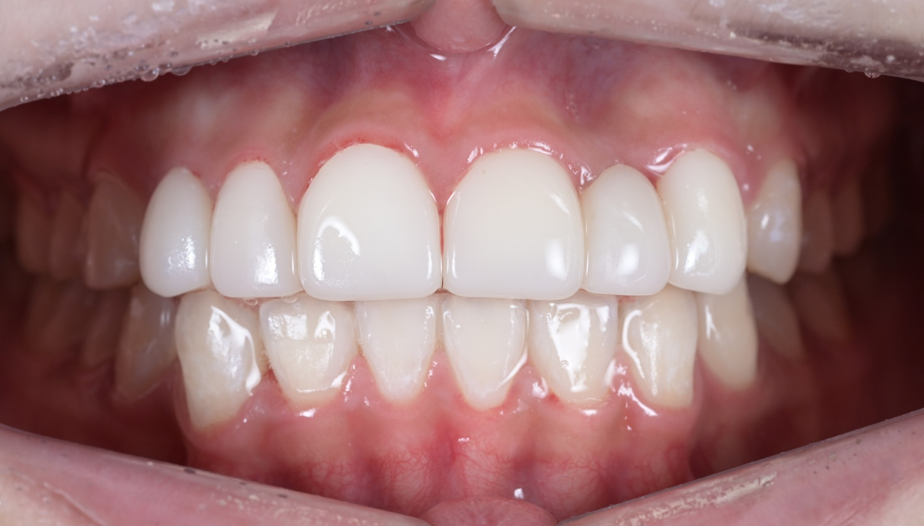
Final prosthetics in place – a natural and harmonious smile has been completed
Before & After – comparison before and after treatment
Comparing before and after treatment, the change is clearly visible.
| Before treatment | After treatment |
|---|
| Tooth shape | Microdontia, retained primary tooth, and missing tooth present | Natural and uniform tooth shape |
| Gingival line | Left-right asymmetry, irregular | Left-right symmetry, harmonious line |
| Tooth proportion | Front teeth were relatively large and unbalanced | Overall harmonious proportions |
| Overall impression | Irregular and unaesthetic | Natural and beautiful smile |
This is the result of a comprehensive approach combining orthodontics + gum contouring + esthetic prosthetics. The patient was also very satisfied with the treatment outcome.
Key points to learn from this case
Let me summarize the key points I want to emphasize through this case.
-
A multidisciplinary approach is essential for complex problems. When microdontia, retained primary teeth, and missing teeth are present at the same time, orthodontics and prosthetics must work together organically to achieve the best result.
-
Orthodontics plays a strategic role in securing space for prosthetics. It is not simply about aligning the teeth; it also creates the ideal environment for the future prosthesis to fit properly.
-
The gingival line is just as important as tooth shape. No matter how beautiful the prosthesis is, if the gingival line is not harmonious, a natural smile cannot be achieved.
-
It is important to check in advance during the temporary tooth stage. To achieve a satisfying result, the final outcome must be previewed with the patient and adjusted if necessary.
-
Preserving vitality is key in young patients. Considering the patient’s young age of 19, she will need to use these prosthetics for decades. Keeping the teeth vital without root canal treatment is very important for long-term prognosis.
-
Overall balance must be considered. Not only the shape of a single tooth, but also the relationship between teeth, the harmony of the upper and lower teeth, and the balance with the face as a whole must be considered comprehensively to complete true esthetic prosthetics.
What it means to work as an esthetic prosthodontist
For a young patient in her late teens, creating prosthetics that she will use for a long time comes with great responsibility. Even under difficult conditions, we carried out orthodontics, gum contouring, and esthetic prosthetics in a comprehensive manner, adjusting the balance step by step. In the end, seeing the patient very satisfied after the final prosthetics were set was a case that gave me a great sense of fulfillment as an esthetic prosthodontist.
If you are concerned about esthetic problems with your front teeth, especially if you have complex issues such as microdontia, retained primary teeth, or missing teeth, I recommend consulting to create a treatment plan that suits you. With a systematic plan and a step-by-step approach, you can regain a natural and beautiful smile.
Thank you. This was Kim Sun-min, Chief Director of Ceramic Dental Clinic at Hakdong Station.