"I had an X-ray, and they said there’s no permanent tooth."
"My baby tooth still hasn’t fallen out... is that normal?"
Patients with tooth agenesis are often surprised when they say things like this.
In particular, teenagers and people in their 20s are often very surprised.
There is also a lot of anxiety, like, "Am I the only one with this...?"
Today, to help ease that worry even a little,
I’d like to talk honestly about congenital tooth absence.
Congenital tooth absence — what exactly is it?
Simply put, it means there is no permanent tooth germ from birth.
Usually, our teeth go through this sequence:
-
A permanent tooth germ (tooth bud) is formed inside the gums
-
Over time, it pushes out the baby tooth and erupts
-
The permanent tooth settles into place
But when there is tooth absence,
there is no permanent tooth to come up at step 2.
So the baby tooth may remain for a long time without falling out,
or nothing appears in the space where it has fallen out.
It’s more common than you might think,
and some statistics suggest that about 5–8% of Koreans are affected.
You are absolutely not "the only one".^^
Why does this happen?
The exact cause has not yet been identified 100%.
But three main factors are known.
-
Genetic factors
This accounts for the largest share.
If one parent has tooth absence,
there is a higher chance it will appear in the child as well.
-
Problems during development
During the fetal stage, while teeth are being formed,
mutations may occur in certain genes.
Does that sound complicated?
Simply put, it’s like one or two pages missing
while drawing the blueprint for the teeth.
- Environmental factors
Studies suggest that infections during pregnancy, poor nutrition, and medication use
may also have an effect.
However, this area is still being researched.
Which teeth are usually missing?
Not all teeth are missing with the same probability.
There are areas where it appears more often.
| Rank | Area | Simple explanation |
|---|
| 1st | Mandibular second premolar | The second small molar in the lower jaw |
| 2nd | Maxillary lateral incisor | The second tooth from the front in the upper jaw |
| 3rd | Maxillary second premolar | The second small molar in the upper jaw |
If it’s in the front teeth area, it directly affects the smile line,
and if it’s in the molar area, chewing function can be affected.
So the treatment direction changes completely depending on the location.
This part is really important.
"If the baby tooth is still there, can’t I just leave it alone?"
That’s both right and wrong.
If the baby tooth is strong and holding up well,
it can be an option to keep watching without removing it right away.
In fact, some people keep using their baby teeth into their 30s and 40s.
But baby teeth are naturally shorter-rooted.
So if the baby tooth starts to loosen,
starting treatment only then may actually be too late.
Planning ahead.
That is the key to treating congenital tooth absence.
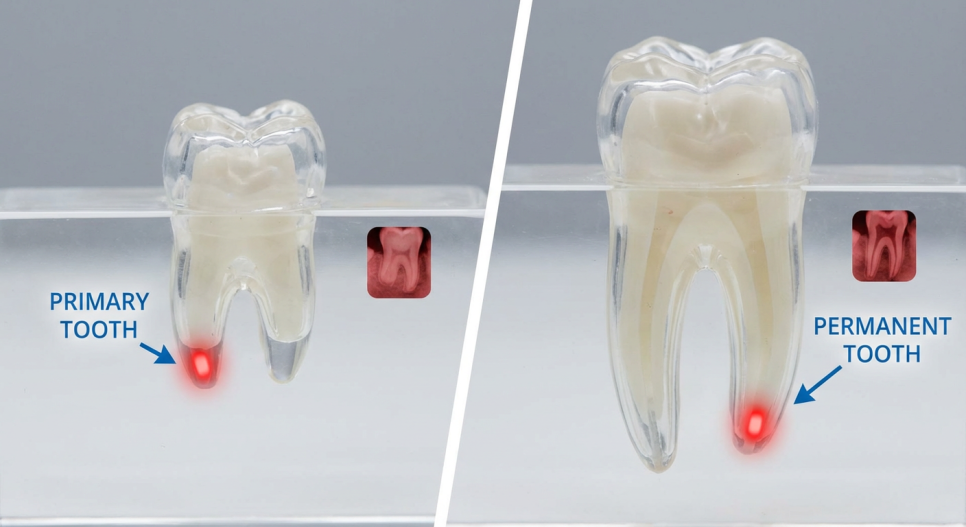 Baby teeth and permanent teeth differ greatly in root length
What treatment options are there?
There are four main directions.
Depending on the situation, you may do just one,
or combine several.
- Preserving the baby tooth (observation)
As mentioned earlier,
this is a strategy of using the baby tooth for as long as possible if it is healthy.
It is important to take X-rays regularly
and check the root condition.
Suitable cases:
-
When the baby tooth root is still sufficiently present
-
When there is no loosening
-
When the patient is still in the growth period
- Orthodontic treatment (space management)
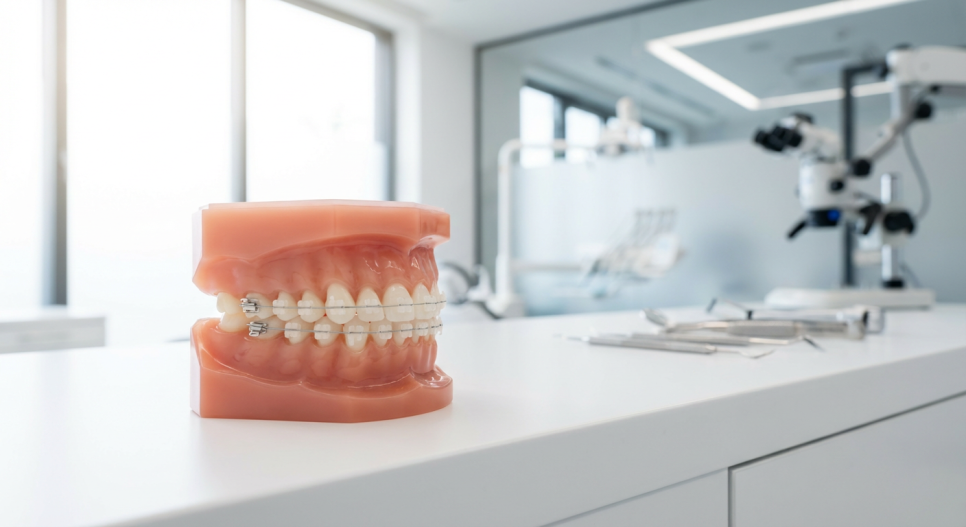
This is a method of closing the space where the permanent tooth is missing.
The adjacent teeth are moved orthodontically
to naturally fill the empty space.
Especially when a premolar is missing,
if there are signs of slight protrusion, treatment is often planned in a way similar to extraction orthodontics.
Advantages:
Considerations:
- Implants
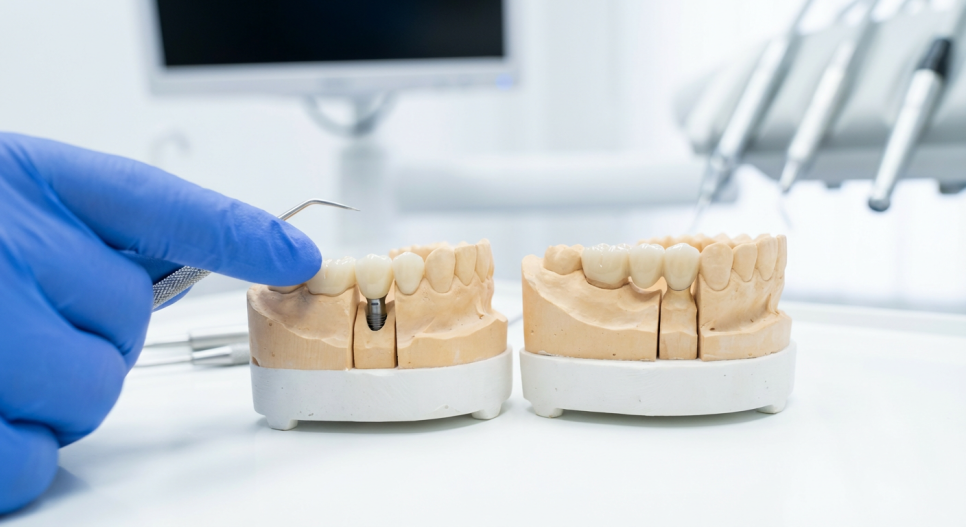
This is a method of placing an artificial tooth root in the empty space.
It is one of the most common and proven treatments.
Advantages:
Considerations:
-
It is possible only after growth is completely finished (usually after age 18–20)
-
The condition of the jawbone must be checked first
-
If there is insufficient bone, bone grafting may be needed
In congenital missing-tooth areas,
because the tooth has been absent for a long time, the bone is often thin.
That is why the process of accurately checking bone condition through a CT scan
is extremely important.
- Bridge (fixed prosthesis)
This is a method of shaving down the teeth on both sides of the empty space and connecting them like a bridge.
Just as a bridge needs supports on both sides, the teeth on both sides serve as pillars.
Advantages:
Considerations:
For younger patients,
it can feel wasteful to reduce healthy teeth,
so implants are often recommended over bridges.
So which treatment is the best?
To be honest,
it is difficult to say, "This is the correct answer," with certainty.
Because we need to make a comprehensive judgment based on all of these:
-
Where the missing area is
-
What the condition of the remaining baby tooth is
-
Whether there is enough jawbone
-
How old the patient is
-
What the bite condition is like (how the upper and lower teeth fit together)
If a clinic says that implants are always the answer,
it is worth being a little skeptical.
At Ceram Dental Clinic, before treatment
we perform CT scans, bite analysis, and growth evaluation together.
From our experience with a wide variety of cases over more than 10 years,
we believe the initial plan determines 80% of the outcome.
Our role is to help ensure there is no "I wish I had done it differently" after treatment.
The missing tooth space — it’s best to take care of it early
Congenital tooth absence is actually a problem because it does not hurt.
Since there is no immediate discomfort, people tend to put it off.
But as time passes,
-
The neighboring teeth tip into the empty space
-
The opposing tooth descends
-
The jawbone gradually becomes thinner
When treatment is attempted later,
there are often fewer options.
We know very well that it’s not that you want to delay it just for the sake of delaying it.
Still, one consultation can help you set a big-picture direction for the future,
so please feel free to visit without pressure.^^
This has been Ceram Dental Clinic.