Hello, this is Ceramic Dental Clinic.
Although it is not familiar to most people, some people are born without certain teeth, especially permanent teeth. This is called a congenital missing tooth or congenital tooth agenesis. Some people are missing just one or two teeth, while in rare cases, more teeth may be absent. Because it does not cause immediate discomfort in daily life, it is often left untreated. However, if treatment is not provided at the appropriate time, it can adversely affect other teeth or make treatment more difficult later than expected.
Why Missing Teeth Need Treatment Even When They Do Not Hurt

The gum bone (alveolar bone) in the area of the missing tooth gradually decreases in both vertical and horizontal directions, even without any symptoms. The eruptive pressure created when a permanent tooth grows in stimulates the alveolar bone and helps maintain its shape, but that stimulation is absent from the beginning in an area where a tooth is missing. Just as a muscle that has not been used for a long time gradually becomes thinner, alveolar bone left without stimulation quietly decreases without pain or swelling.
When it decreases vertically, there may not be enough height to place an implant. When it decreases horizontally, the bone width required for implant placement may fall below the necessary standard. In either case, bone grafting may be needed when treatment is eventually started, increasing the treatment period and cost beyond the initial plan.
If you have been diagnosed with congenital tooth agenesis,
Even if you currently have no discomfort, checking the present condition of your alveolar bone first
is the starting point for developing a treatment plan.
If the Baby Tooth Is Healthy, Does It Really Need to Be Extracted?

When the succeeding permanent tooth is missing, the baby tooth often remains for a long time. In particular, a baby tooth that is not loose and continues to hold up well may seem like a positive sign, but clinically, it can sometimes be a warning sign instead.
Because there is no succeeding permanent tooth, there is no eruptive pressure. Without that pressure, the root is not naturally resorbed and remains in place. If this condition continues for a long time, ankylosis progresses. Ankylosis is a phenomenon in which the tooth root gradually becomes attached to the alveolar bone. When ankylosis is severe, extraction can be difficult, and even when the tooth is successfully removed, the surrounding alveolar bone may also be damaged. Significant bone damage during extraction means that the amount of bone available for implant placement has also decreased. Therefore, bone grafting may be necessary.
Why Does Treatment Become More Difficult If It Is Delayed?

When the space left by a missing tooth remains empty for a long time, the adjacent teeth tilt toward the empty space—not only their crowns (the visible parts of the teeth), but also their roots. When teeth are moved with orthodontic treatment, the crowns are what we can see, but the roots must be positioned properly to achieve a stable result. Uprighting tilted roots requires much stronger force and more time than moving the crowns, and the risk of root resorption (shortening of the tooth root due to orthodontic force) also increases.
Even while the space is being left open with the intention of placing an implant later, the adjacent teeth tilt and the alveolar bone decreases.
If the alveolar bone falls below the minimum standard required for implant placement, an additional 6–12 months of waiting may be needed after bone grafting,
so it is not uncommon to find that “waiting has actually made implant treatment more difficult.”
Ultimately, leaving a missing tooth untreated for a long time can make both implant treatment and orthodontic treatment more difficult. In some cases, it may be possible to choose to retain a baby tooth for an extended period, but it is important to consult a specialist first.
When Can Adolescents Who Are Still Growing Receive Implants?
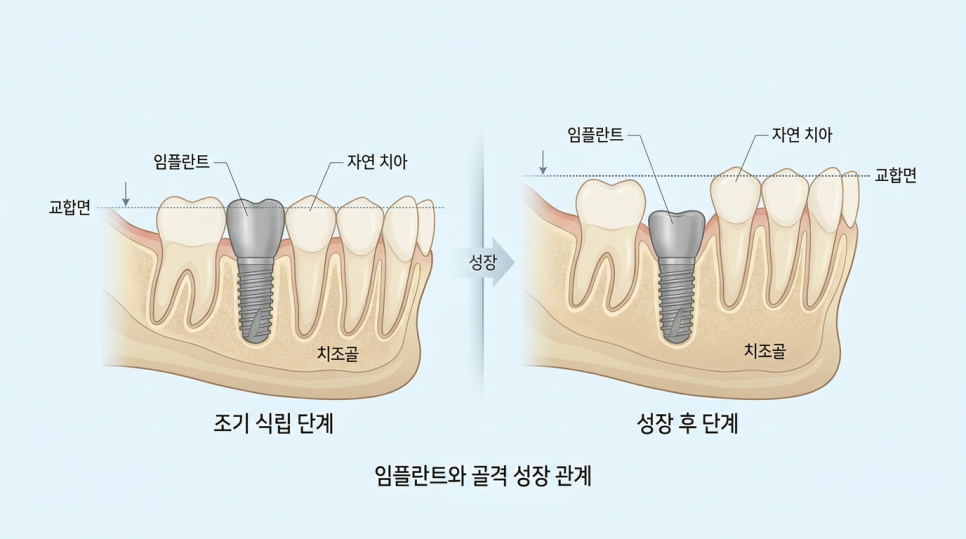
Does that mean treatment is always better when started as early as possible? In fact, that is not necessarily the case. For example, if the missing tooth is replaced with an implant, placing the implant too early means doing so before growth has finished.
When an implant is placed during the growth period, the implant itself normally becomes attached to the alveolar bone. However, while the surrounding teeth and bone continue growing upward, the implant may appear to sink below the occlusal plane (the chewing surface). The implant has not failed; rather, because osseointegration (normal fixation to the bone) has worked so well, the implant cannot follow the growth of the surrounding structures. This paradoxical phenomenon is called infraocclusion.
This is why the general principle is to place an implant after growth has been completed. The timing varies from person to person, so it is difficult to determine based on age alone. Growth plates may also be checked directly through methods such as wrist-bone radiography.
Of course, this does not mean simply waiting until growth is complete. During that period, managing the empty space with orthodontic treatment or a removable prosthesis (a temporary prosthesis that can be taken in and out) and positioning the alveolar bone and teeth in advance are key parts of the treatment plan. Understanding this period as a stage for creating the conditions needed for implant success can make the overall schedule look very different.
Where and How Should You Take the First Step?
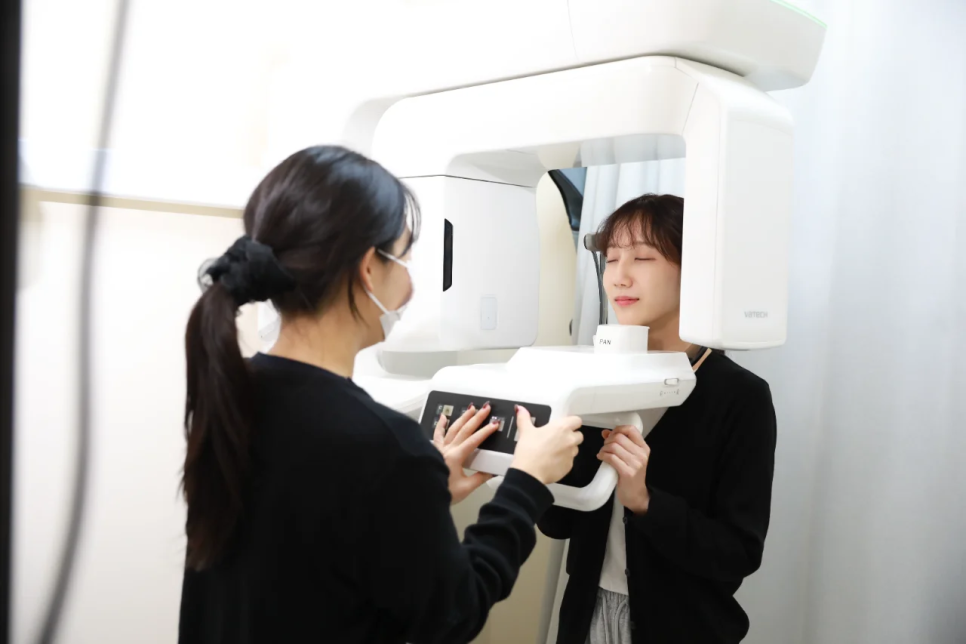
What should you do if treatment for missing teeth is this complex? Of course, the best approach is to visit a dental clinic and develop a treatment plan together with a specialist you can trust.
The first things to check when treating congenital tooth agenesis are the current thickness of the alveolar bone and the angulation of the adjacent teeth. These two factors are the key points that practically determine whether space closure or an implant is the more realistic option and whether intervention is needed right away. If a baby tooth remains, it is also necessary to check whether ankylosis with the alveolar bone is progressing so that the timing of extraction and the subsequent treatment schedule can be planned in detail.
Even if you have no discomfort now, if you have congenital tooth agenesis, you can begin with a single panoramic X-ray. This is where you first check how much alveolar bone remains, how much the adjacent teeth have tilted, and the likelihood of ankylosis in the baby tooth. Since the time when you have no symptoms is actually when the widest range of treatment options can be preserved, we recommend having your current condition examined and discussing it with a nearby dental or orthodontic clinic.
We hope today’s information has been even a little helpful to those with missing teeth. This has been Ceramic Dental Clinic.