
The moment you hear, “I can’t see the permanent tooth here,” at the dentist’s office where you took your child for a routine checkup, your mind may go blank.
When you come home and look at your child’s face, you may feel strangely sorry and wonder, “Did I do something wrong?”
You may find yourself overwhelmed by thoughts of whether that space will have to remain empty for the rest of your child’s life or whether major surgery is needed right away.
In this article, I’ll address the uncertainty surrounding congenitally missing teeth step by step.
Let me start with the conclusion.
Congenitally missing teeth are not as rare as you might think,
and in most cases, this is not a situation where you need to make an immediate decision.
However, it is also not something that should simply be ignored, so I’ll explain both points together.
Congenitally Missing Teeth Are Not Rare—and They Are Not the Parents’ Fault
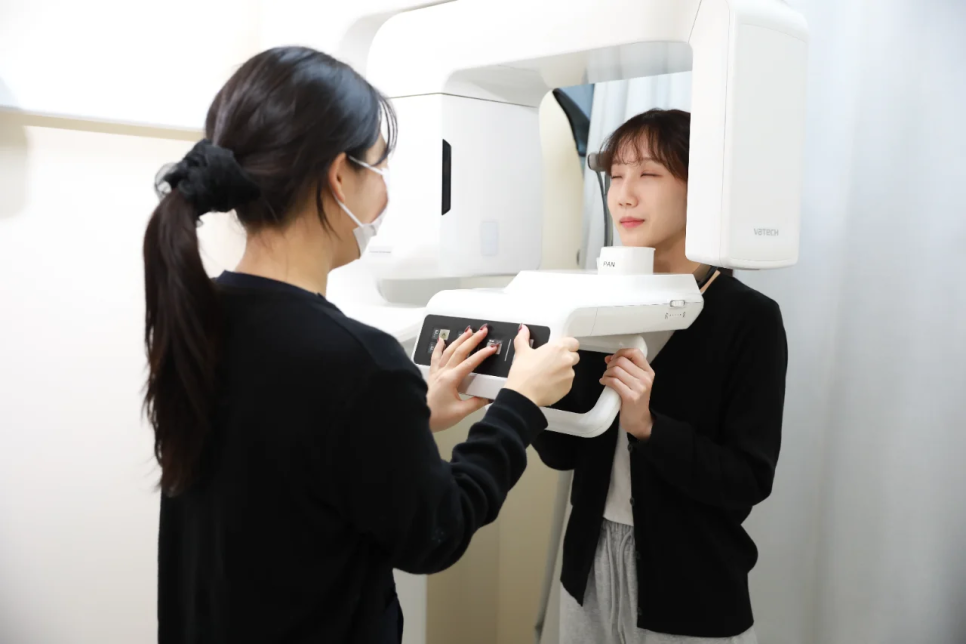
Congenitally missing teeth refers to a condition in which the bud of a permanent tooth never forms in the first place, so no tooth develops in that location.
When you first hear this, it may feel like something that has happened only to your child, but that is not actually the case.
In many cases, it is first discovered during the mixed-dentition period, when baby teeth and permanent teeth are both present—roughly between the ages of 6 and 12.
For example, a baby tooth that should have fallen out does not, or a permanent tooth has emerged for children of the same age while your child’s space remains empty. A panoramic X-ray then shows that there is no permanent tooth bud beneath it.
In other words, this is usually not something that happened because the parents missed something; it simply becomes apparent when the time comes for the permanent tooth to emerge.
Excluding wisdom teeth, missing permanent teeth have been reported in approximately 1.6–6.9% of the population.
That means a considerable number of children have this variation.
The locations where it occurs most often are also relatively consistent. It is most common in the mandibular second premolars and maxillary lateral incisors, followed by the maxillary second premolars.
The fact that there are common locations also means this is a situation dentists encounter and manage relatively often.
There is another point that may offer some reassurance.
Most people with missing teeth—about 80%—are missing only one or two teeth. Multiple tooth agenesis involving six or more missing teeth is much rarer, occurring in approximately 0.3–0.4% of people.
In most cases, this means the issue is limited to a specific area.
“Did I eat something wrong during pregnancy,
or could it be genetic?”
It is completely natural to have these thoughts.
However, multiple factors act together during the process in which tooth buds form.
Because this is closer to a variation in the developmental process that commonly occurs in certain areas, it is not something for which one particular action by the parents can be identified as the cause.
I want to emphasize first that this is not something you should blame yourselves for.
That said, a tendency for similar patterns to occur within the same family has also been reported.
So, if your child has siblings, it may be helpful to have them checked as well at the next dental visit.
Knowing in advance allows that child, too, to be monitored calmly with sufficient time, if necessary.
Fortunately, There Is Time
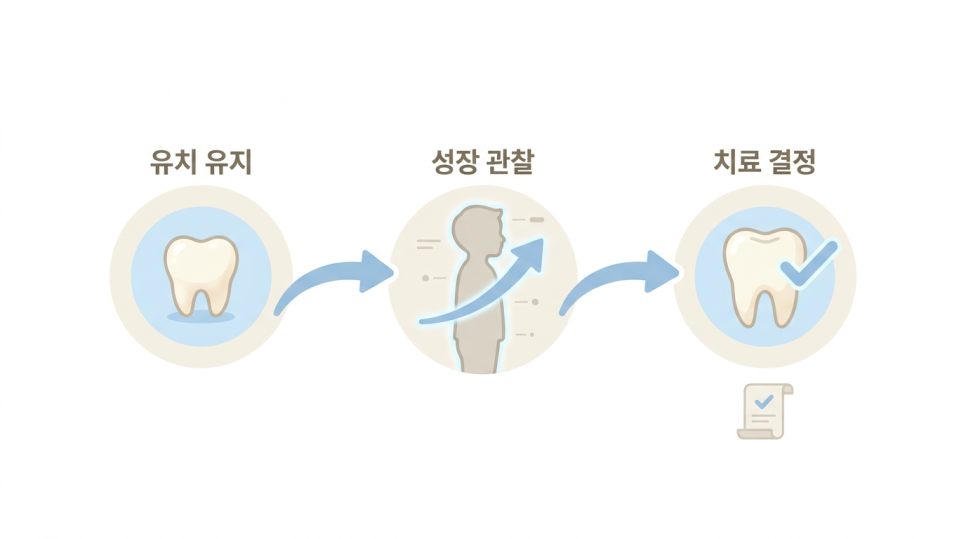
The question that worries parents most is, “Does that mean my child needs an implant right now?”
In most cases, the answer is no.
Even when a permanent tooth is absent, the baby tooth that has been occupying that space often remains for some time.
As long as the baby tooth continues to do its job, it can buy time. In the meantime, a careful plan can be made while observing the child’s growth and tooth alignment.
The treatment approach is not fixed from the beginning either. The options vary depending on the child’s age, the condition of the remaining baby tooth, the size of the space, facial structure, and the severity of the malocclusion.
So rather than “congenitally missing teeth always require implants,” it is more accurate to think of this as choosing the approach that best fits the situation over time.
There is a clear reason for taking time to decide.
An implant, as it is commonly understood, involves placing an artificial tooth root in the jawbone, making it difficult to use while the child’s jaw is still growing.
As growth continues, the surrounding teeth and gums grow with it, while the implant remains fixed in place, which can cause its position to become misaligned.
Because this treatment is generally considered after growth is complete, there is no need to rush into it at a young age.
This is not a condition that requires you to make a major decision right now. You do not need to worry and reach a conclusion today.
One Reason You Should Not Simply Leave It Alone

After reading this far, you may think, “Then we can just wait,” but there is one thing you should understand.
Having “time”
and “not needing to do anything”
are different.
A space where a tooth is missing changes over time.
According to research, the width of the alveolar bone is known to decrease by approximately 25–35% during the three years after a baby tooth is lost. Resorption is greater on the outer side in particular.
Also, if the teeth on either side gradually tilt into the empty space, it can become difficult to regain that space later.
If this happens, the available treatment options may be reduced by the time treatment is actually needed.
For example, once the space has collapsed, additional steps may be necessary to reopen it before orthodontic space management or restorative treatment that might otherwise have been possible.
What initially required attention to only one issue may later involve more stages.
That is why the important point is not “Let’s start treatment now,” but rather, “Let’s have the situation accurately evaluated once it is discovered.”
Knowing how much time you have and waiting accordingly is completely different from leaving it unattended without knowing.
Different Things Can Be Done at Different Stages

Treatment for congenitally missing teeth is not completed all at once; it is approached in stages as the child grows.
Having an overall plan can help reduce vague anxiety.
| Stage | What is mainly considered |
|---|
| Childhood | Managing retained baby teeth, monitoring progress, and maintaining space if necessary |
| Growth period | Closing the space with orthodontic treatment, or securing and organizing space for restoration |
| After growth is complete | Restoring the space with a prosthesis, implant, or other treatment |
Treatment generally takes one of two directions.
One option is to close the empty space with orthodontic treatment. The other is to maintain the space and fill it later with a prosthesis or implant.
The general characteristics of the two approaches are as follows.
| Approach | When it is generally considered |
|---|
| Closing the space orthodontically | When the adjacent teeth can be moved to fill the space and the alignment and bite are suitable |
| Maintaining the space and restoring it later | When closing the space is difficult, or when preserving the shape and function of a natural tooth is preferable |
The appropriate approach is determined by considering the child’s age, the condition of the baby tooth, the size of the space, facial appearance, and bite together, as mentioned above.
Even with “a single missing tooth,” the recommended direction can differ depending on which tooth is missing and where it is located. The presence of a missing tooth alone does not determine the treatment method.
One additional point is that if the baby tooth in the area without a permanent tooth is healthy enough, preserving that baby tooth for as long as possible can itself be a strategy.
While the baby tooth continues to function, it helps maintain both the alveolar bone and the space.
So the important choice is not only “filling the space that is empty right away,” but also “taking good care of what is still there.”
Because there are so many factors to consider, it is safer to seek advice at a practice where orthodontics and pediatric dentistry work together rather than making a decision from the perspective of only one specialty.
A plan that considers growth, the bite, and the space together is needed to ensure that time is not wasted.
No Immediate Decision Is Needed, but an Evaluation Is Necessary
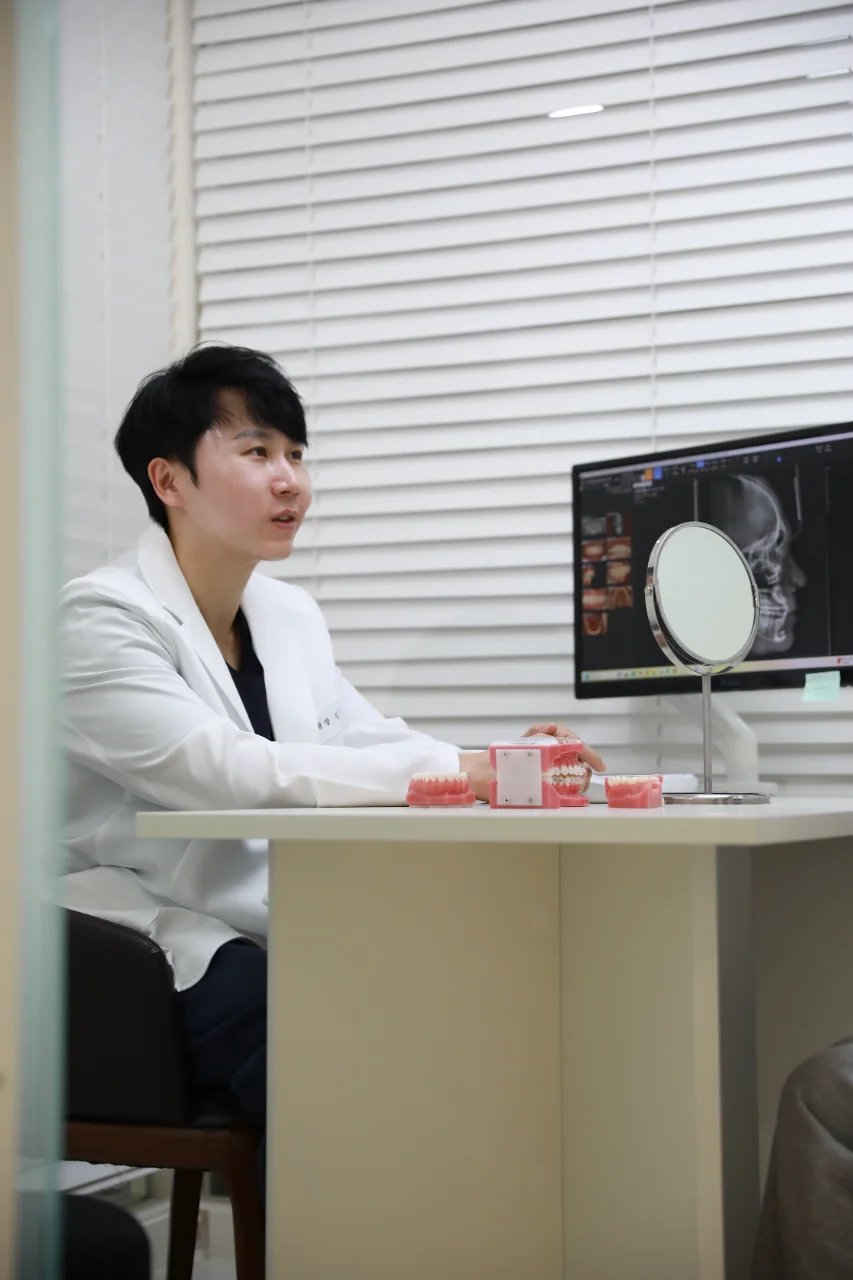
You do not need to decide on anything today.
However, it is better to have the situation checked sooner rather than later.
A single panoramic X-ray can show where and how many permanent tooth buds are missing, as well as how much time there may be.
Once you know the condition accurately, vague concerns can become a specific plan: “what to look at and when.”
There is no need to rush into treatment, but this is also not something to forget about.
For now, the best choice may be simply to have the situation properly evaluated once.
This was Ceramic Dental Clinic.