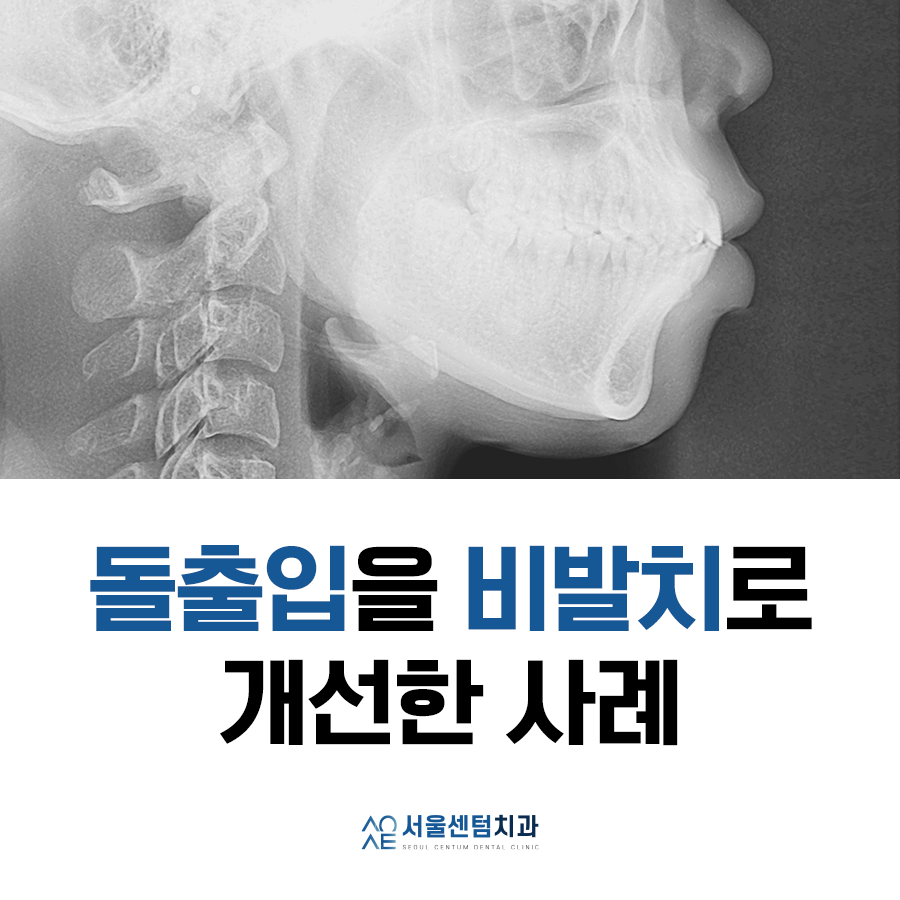
Due to congenital or acquired issues,
orthodontic treatment may become necessary.
So today, I’d like to introduce
a case of protruding mouth improvement without tooth extraction.
If this had been done with extraction orthodontics, the degree of protrusion
could have been corrected a little more ideally,
but because the patient requested a non-extraction approach,
after discussing various options,
we proceeded without extracting any teeth.
Using interproximal reduction and tooth retraction with mini-screws,
we achieved a satisfying result.
The total treatment period was about 1 year and 5 months,
and periodontal treatment was also carried out during the process.
This may be useful information for those who currently have gum issues and dental protrusion.
✔
Before starting orthodontic treatment,
photographs such as panoramic X-rays are essential
to examine the overall anatomical structure
of the oral cavity.
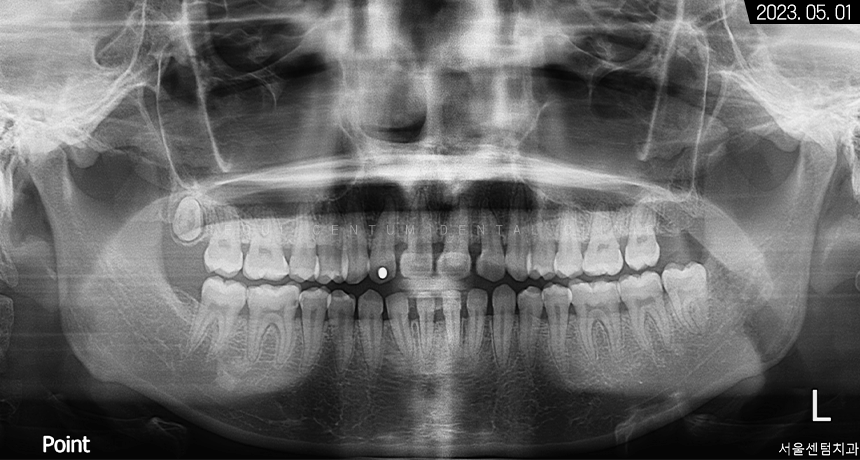
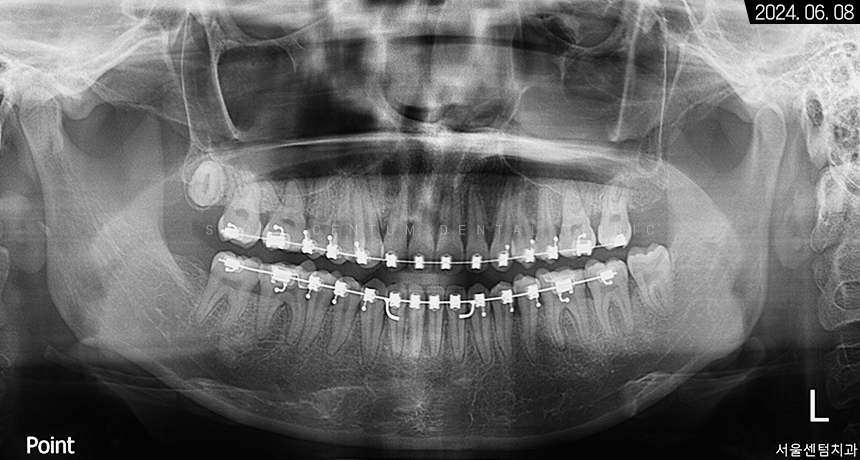
Looking at the patient’s panoramic image,
we can see that the teeth are very crowded
and that this is a typical case of dental protrusion
caused by a narrow space in the oral cavity.
The lower left wisdom tooth was visible,
and the upper right wisdom tooth had also erupted.
It was confirmed that the front teeth overlapped due to insufficient space,
and since there was partial spacing between the teeth,
it was expected that the degree of protrusion could be reduced to some extent
by closing those spaces while performing interproximal reduction at the same time.
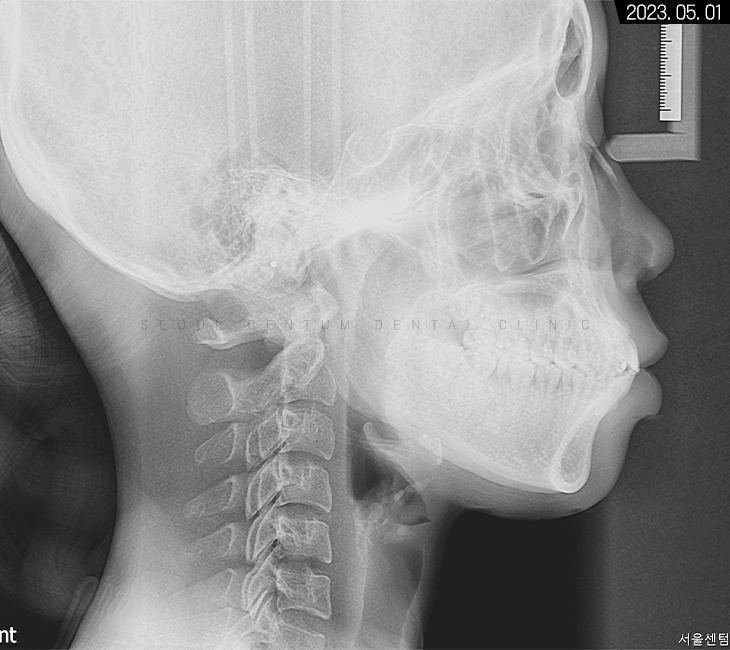
Looking at the lateral cephalometric image,
an overjet condition is clearly noticeable,
and when an aesthetic line is drawn from the tip of the nose to the chin,
it can be seen that the lips protrude excessively.
Although the mouth appears protruded
and the lower jaw seems recessed,
if the dental protrusion is resolved,
the lower jaw naturally moves forward and upward,
returning to a structurally normal range.
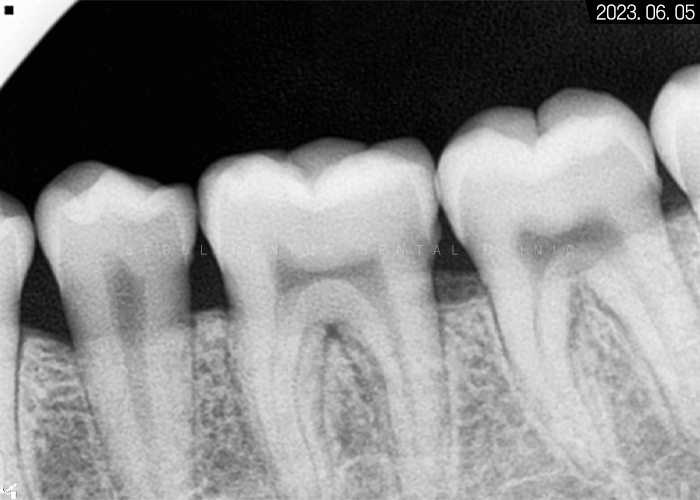
The alveolar bone condition was favorable,
so it was expected that root movement would not be difficult.
First, because overall tooth movement was required,
brackets were attached to each tooth one by one,
the lower wire was connected first to adjust the pressure,
and then the wire was also connected straight across the upper teeth
to apply force.
Since there were no particularly extruded areas,
the X-ray image shows the wire extending in a straight line.
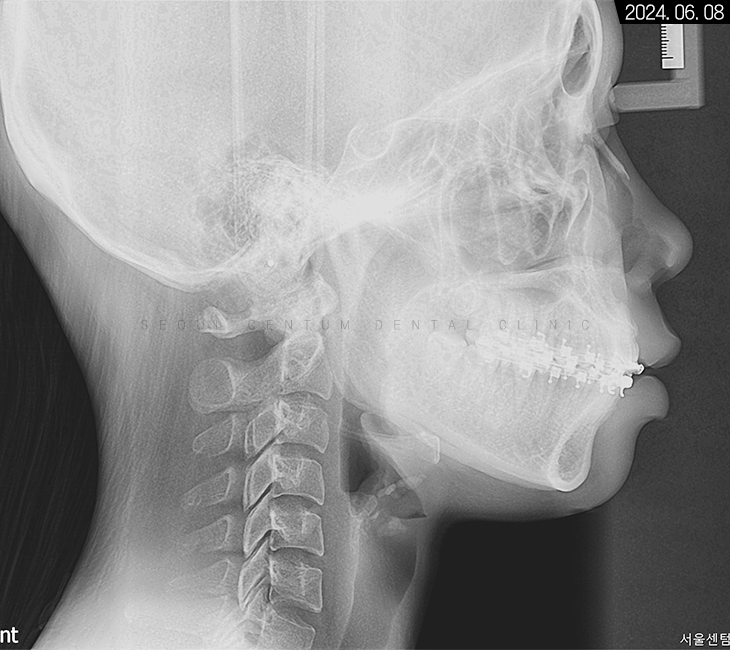
From the side, you can see that the brackets were evenly attached
from the posterior teeth to the anterior teeth,
and the thick lips and blunt chin were still visible.
The aesthetic line had not yet been formed,
so we decided to monitor the progress.
After a total period of about 1 year and 5 months,
after removing all the existing appliances,
we placed a retainer.
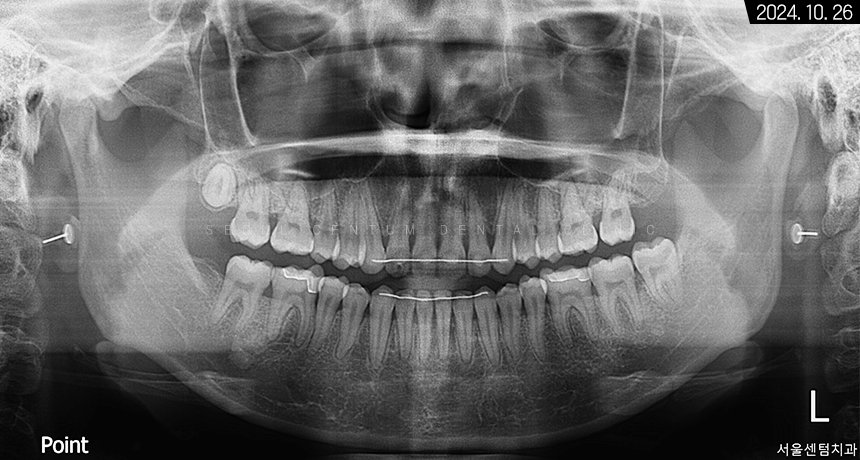
In the panoramic image,
you can see the retainer neatly attached to the anterior teeth.
In addition, the spacing seen at the beginning had been resolved,
and it can be seen that the vertical position of the root of the lower front tooth,
which had been bent, had returned to normal.
Since the patient was reluctant to have teeth extracted,
the wisdom teeth were left in place.
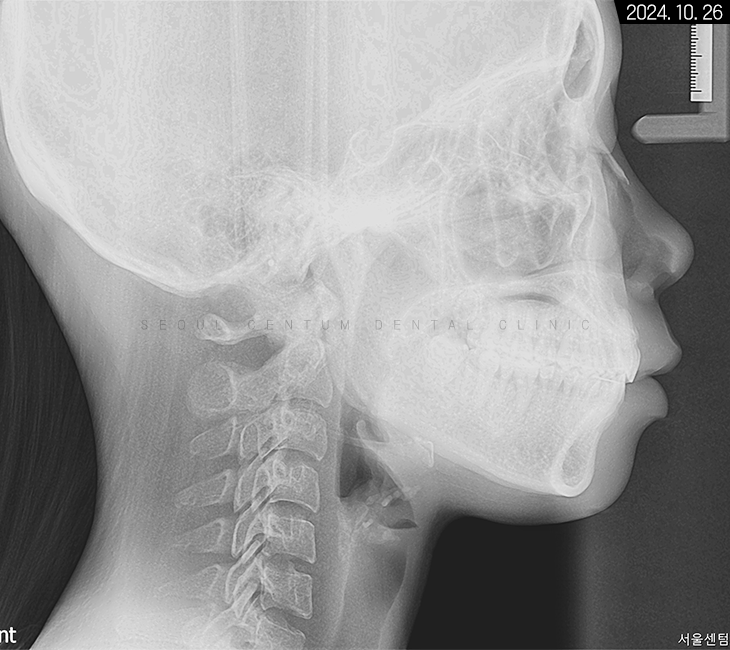
Even in the cephalometric image,
the overjet had clearly improved,
to the point that it was immediately noticeable,
and the fullness of the upper lip had also been reduced.
The lower jaw, which had been positioned backward and downward,
also returned to a well-balanced position forward and upward
through correction of the protruding mouth.
It still slightly touches the aesthetic line,
but considering that the patient is a foreigner,
it is a natural degree of protrusion.
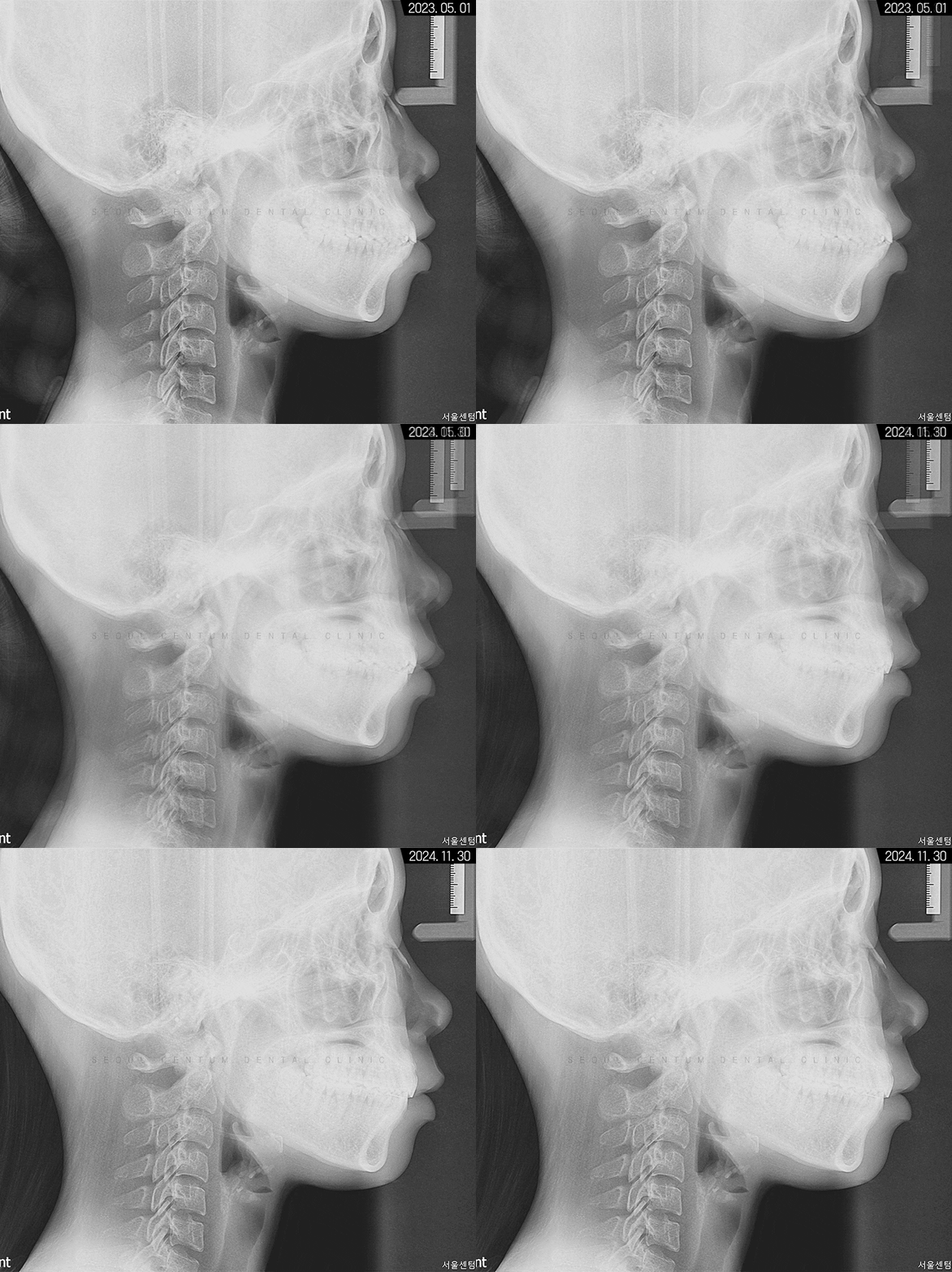 Comparison with the initial state
After orthodontic treatment, the oral structure is clearly more aligned,
and even the areas that were outside the normal range,
such as the angle and protrusion,
have been corrected, making the appearance much better.
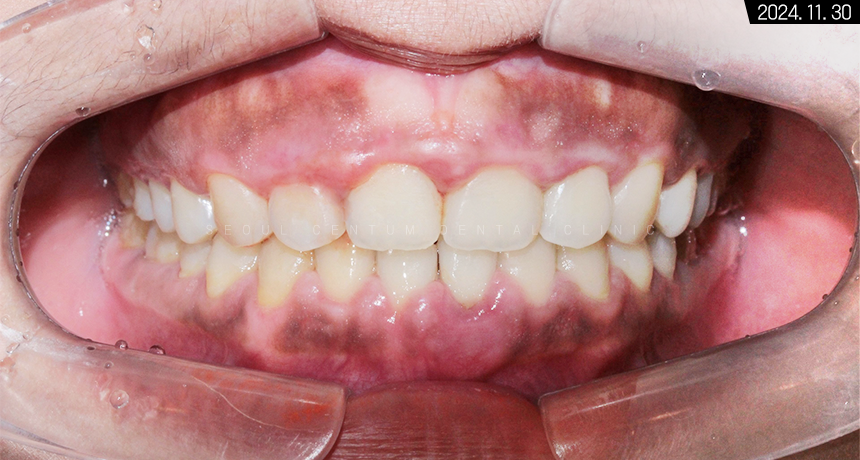
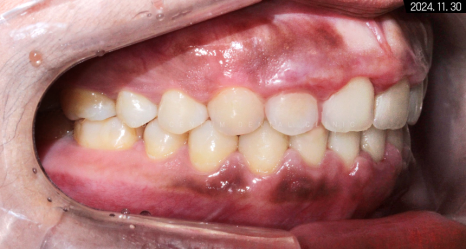
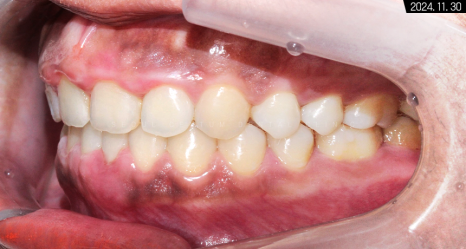
In the intraoral photos, you can see bleeding from the gingiva of the lateral incisor.
This occurred during the process involving root planing
because the periodontal pockets were deep.
Although there is a little bleeding,
there is no need to worry,
because it is part of the process of improving the gums.
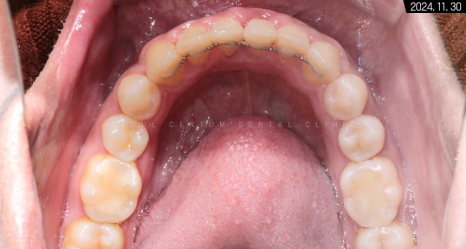
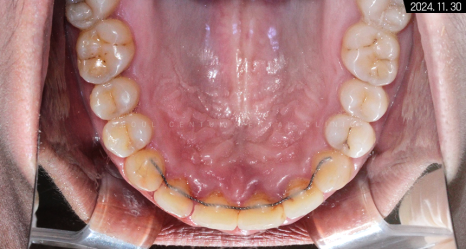
Because the orthodontic treatment was completed properly,
when the oral cavity is viewed from above and below,
you can see a more aligned dental arch than before.
The midline of the central incisors also matches,
and the front teeth fit together firmly like interlocking gears.
In this way, from the posterior teeth to the anterior teeth,
everything came together correctly without any twisted areas.
The dental arch and U-shape also have smooth curves.
The appropriately rounded shape looks very nice.
The molar relationship is also good,
and it can be confirmed that all the teeth have come within the normal line
without any extruded areas.
What did you think of the case of protruding mouth improvement without tooth extraction
that I introduced today?
Depending on the pattern of protrusion,
if there is a desired facial line,
extraction may be necessary,
but in this case, because the patient is a foreigner,
because the aesthetic line 기준 can be considered somewhat more flexible than for Koreans,
and because there was partial spacing between the front teeth,
we were able to proceed without extraction.
We proceeded with a slight amount of interproximal reduction,
and as a method for improving protruding mouth without extraction,
we could also consider opening the midpalatal suture to secure space
or using the wisdom tooth area
to carry out posterior retraction of the molars.
In conclusion, I would like to say that
there are several methods that can be used to improve a protruding mouth,
and that they can be applied according to each person’s oral condition~
If you are currently worried about a protruding mouth like the patient in this post,
or if you need an accurate diagnosis,
please leave a comment to inquire.