What should you do if your implant screw suddenly falls out on a Saturday or Sunday?
Did you know that there is a screw inside a dental implant?
In fact, before becoming interested in dental implants,
many people do not realize that an actual screw exists beneath an implant.
In professional terminology, it is called a screw.
Implant Screws
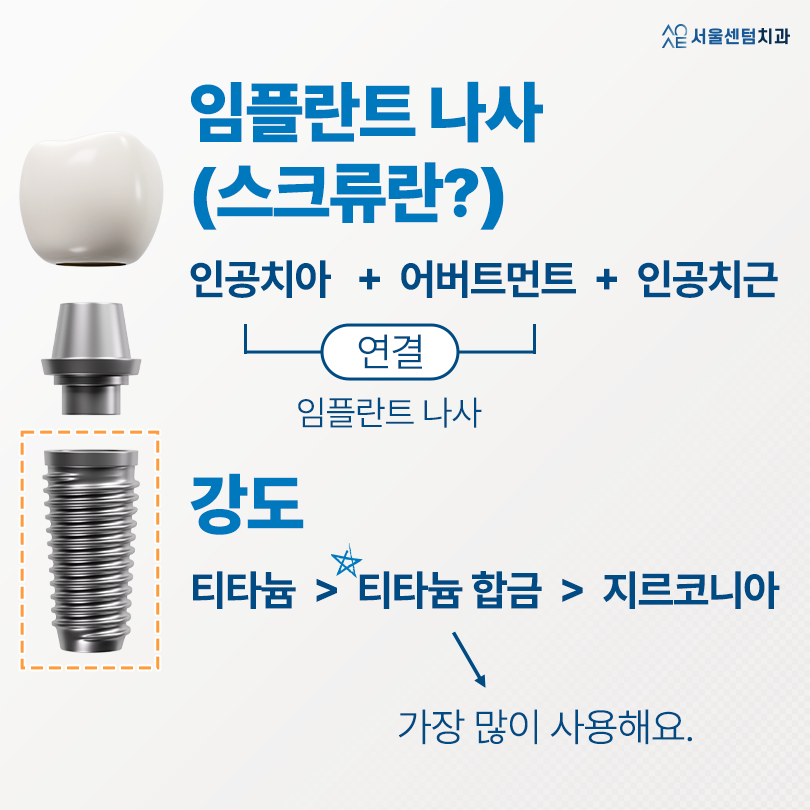
Looking broadly at the components of a dental implant,
it consists of a fixture, abutment, and crown.
The fixture refers to the artificial tooth root placed inside the bone,
while the abutment is the post connecting the artificial tooth and the root,
and the crown refers to the artificial tooth.
The implant screw connects the abutment and the crown.
“If there is an implant screw, are they all the same?”
If you ask this question, the conclusion is that
all implant components come in different types.
Screw materials are broadly divided into
pure titanium, titanium alloy, and zirconia.
Pure titanium has high biocompatibility as well as
relatively good strength, so it is less likely to deform
and remains stable when considered over the long term.
Titanium alloy has excellent strength,
but because it is hard,
considerable force is generally required when tightening it.
Titanium alloy is the material used most commonly.
Zirconia may also be used, but it is generally limited to cases involving metal allergies.
Although it offers good esthetics,
its strength is relatively lower than that of titanium,
so it is not primarily used.
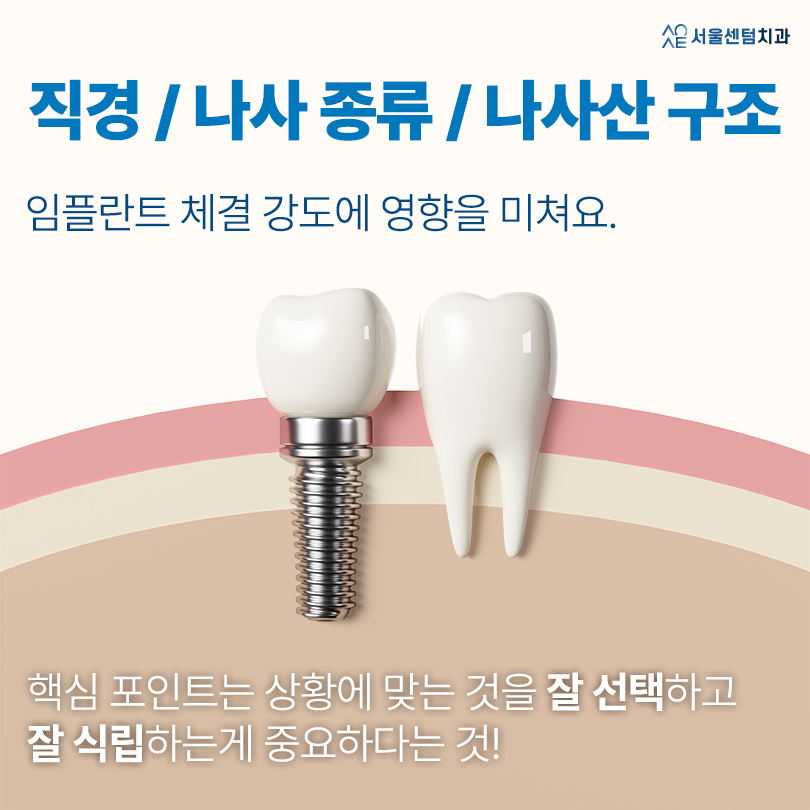
Diameter
These implant screws also come in many different diameters and lengths.
Generally, a larger diameter means greater strength,
while a thinner diameter tends to be used for precise connections.
It is not simply a matter of saying that thicker is always better
or that thinner is always better.
A suitable screw must be selected according to the fixture’s length and diameter
for a stable connection.
The same applies to length.
Long screws have a larger bone-contact area,
which provides greater initial stability,
while short screws are suitable for areas with limited space
or shallow bone quality.
Choosing the length and diameter appropriate for each individual
is always the first priority,
but here is a summary based only on length and diameter.
When a thicker screw is used, the connection area inevitably becomes larger,
so the likelihood of the screw loosening naturally decreases.
The same applies to length: longer screws provide greater stability
and are less likely to loosen,
but it is not possible to use a long, thick screw in every situation.
Screw Types and Thread Structure
Even when looking at screws that are not used for implants,
you can see grooves on their surfaces.
They spiral downward in a rounded, pig-tail-like shape.
This shape allows the screw to connect properly.
As the threads engage with the fixture,
the rotational force is converted into tightening force.
The deeper and more closely spaced the threads are,
the greater the force that secures the implant,
and the surface of the threads is also important.
If the surface is not sufficiently rough or fine,
the screw may loosen.
The more precise the thread structure,
the greater the tightening force and the lower the likelihood of loosening.
There are also different types of screws
that further refine these distinctions.
With a standard screw, the risk of loosening is low
if it is properly tightened.
People often focus only on which implant product is used,
but ultimately, problems may or may not occur
depending on who completes the procedure and how well it is done.
Proper tightening is the most important factor.
Self-tapping thread, which cuts through the bone during insertion,
and locking thread, designed to prevent screw loosening,
provide greater long-term stability.
Micro- and nano-screws strengthen initial fixation,
so they are less likely to loosen during the early stage.
Connection and Tightening Methods
You thought tightening the implant screw
was the end of the process, right?
It is not.
There is also the connection method to consider.
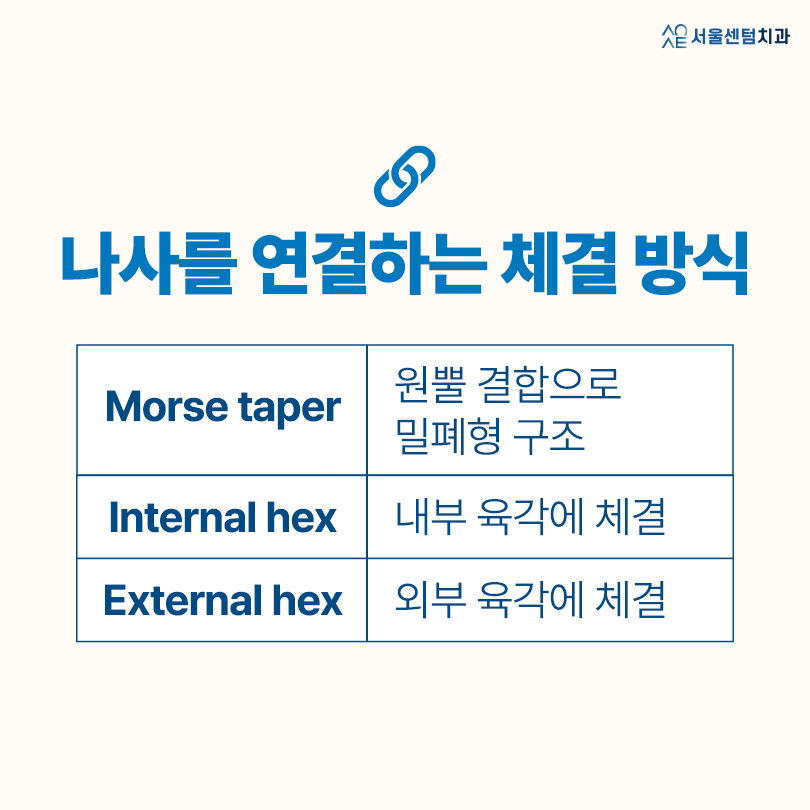
The Morse taper has the lowest tendency to loosen.
Because it uses a conical connection and has a sealed structure,
it can be considered a case in which loosening is almost nonexistent.
The Internal hex method is the next connection method
with a low risk of implant screw loosening.
Because it is tightened into an internal hexagonal groove,
it also distributes chewing loads effectively.
Finally, the External hex method is tightened onto an external hexagon,
so there is a possibility of loosening.
One additional point is that some implant screws have surface treatments.
When a surface treatment is applied,
osseointegration is improved.
As a result, the possibility of loosening is reduced.
The Role of an Implant Screw
Ultimately, the implant screw
keeps the abutment and prosthesis from shaking or moving
while helping distribute the chewing forces
placed on the overall implant structure.
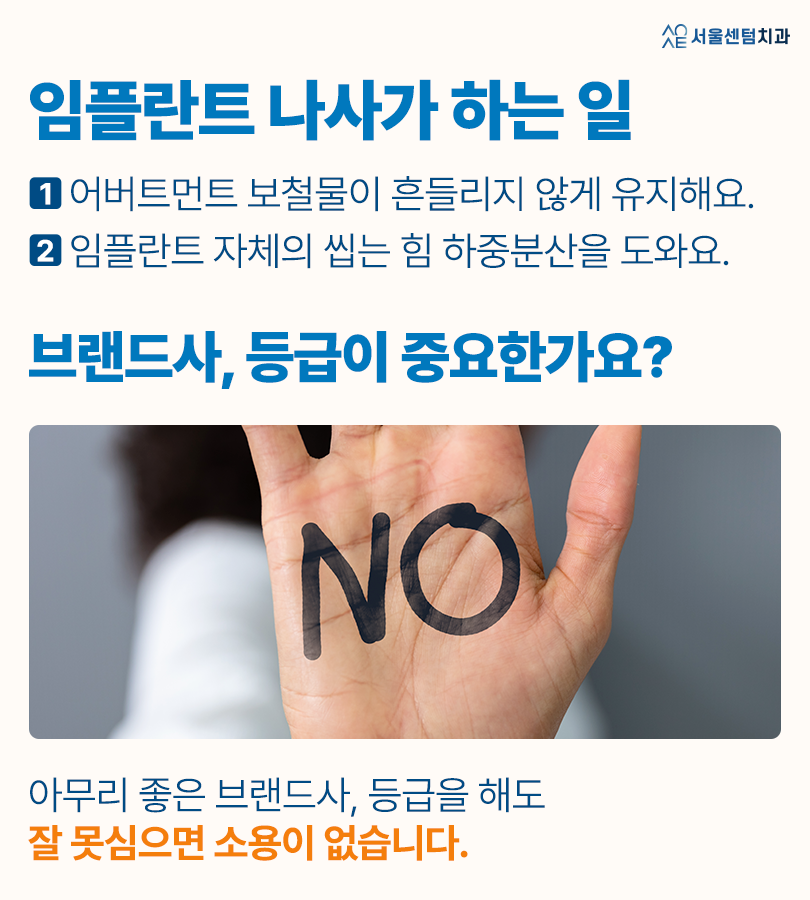
Because different brands and grades are available,
many people consider only the brand and grade of the implant screw important.
However, the most important thing is
“how well it was placed.”
If the screw is placed at the wrong angle
because the procedure was performed without sufficient skill
or rushed through in a factory-like manner,
the positions of the abutment and crown may become distorted.
If that happens, the bite naturally cannot align properly.
Ultimately, bone resorption may occur.
There is also a risk of failed osseointegration
if initial fixation is insufficient.
If the implant is placed close to the bone and nerves,
pain, tingling, or sensory problems may occur.
My Screw Seems to Have Suddenly Loosened! What Should I Do?
There are many causes of an implant screw falling out,
but most cases involve inadequate early osseointegration,
a loosened screw connection,
excessive occlusal loading,
defects in the material itself,
or issues that develop after long-term use.
In conclusion, the implant may not have been placed properly,
but material defects and product aging can also be possible causes.

When this happens, the prosthesis and abutment will naturally become loose.
You may feel pain immediately when chewing food.
The screw may even come out completely.
If you experience these symptoms on a weekday,
you may be able to visit a dental clinic immediately,
but if not, here is what you should do.
First, never tighten it by hand
or try to fasten it with a screwdriver!
There is a reason a dentist is needed for this procedure.
If you damage the screw itself while trying to tighten it,
it may need to be replaced, which could result in additional costs.
Leave it as it is.
If you have these symptoms, refrain from continuing to eat normally this weekend.
Repeated chewing may damage the fixture
and cause it to become even looser.
A diet such as porridge or other foods requiring as little chewing as possible is recommended.
Do Not Use Adhesive for Temporary Fixation
There have actually been cases in which people used instant adhesive
to reattach the implant.
This can make removal at the dental clinic impossible
and may lead to major surgery.
Under no circumstances should you use any adhesive other than dental adhesive yourself.
서울센텀치과 provides regular treatment on both Saturdays and Sundays,
so even if something like this happens, appropriate action can be taken immediately.
We have explained in detail which aspects are important
for those who were unfamiliar with implant screws.

To help prevent an implant screw from coming loose,
it is recommended that you visit the dentist regularly for checkups
and avoid hard foods.
Basic oral care is essential as well.
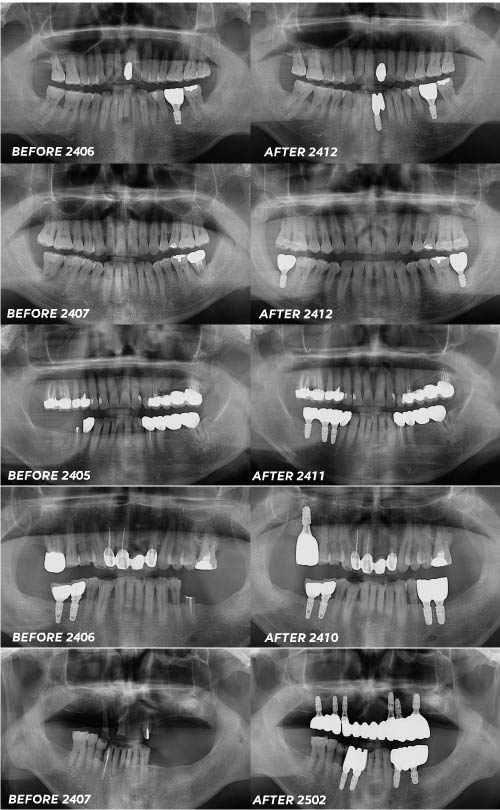
Smoking and drinking alcohol during the early stages of an implant
may interfere with osseointegration, so it is recommended that you refrain from them!
Is the cost of a cracked tooth expensive?
What if you are unsure whether swelling after an implant is normal?