If You Ever Need to Have an Implant Removed
When getting an implant, most people are probably undergoing
an expensive treatment, so they do it with the thought,
“I want to use it for a long time.”
Some people also assume that once an implant is placed,
it will be preserved permanently.

But if everything seemed to have been done properly and then
something suddenly goes wrong, you may have no choice but to think,
“What happened?”
Many people know that implants can be used semi-permanently,
but this may be exactly when the phrase
“the importance of proper care” applies.
What Happened to Me Before the Implant Had to Be Removed?
Before receiving a diagnosis that an implant needs to be removed,
there may clearly have been warning signs,
but people sometimes ignore them or assume they are insignificant.
The first is bleeding or swelling in the gums around the implant.
This may be an early sign of peri-implantitis,
but it is often overlooked.

If treatment is delayed, it can lead to bone loss,
so it can be dangerous.
Second, even minor pain should not be ignored after an implant is placed.
If the implant was initially placed properly but you feel it becoming loose,
you should not put off getting it checked.
You should also be alert if the implant feels looser than it did at first,
or if food frequently gets stuck between the teeth after meals.
Any change from the condition immediately after treatment should be checked.
These symptoms may indicate that the bone supporting the implant
has weakened, so it is important to visit a dental clinic
early after symptoms appear.
Whether you visit the dentist when symptoms first appear
can determine whether you end up needing to have the implant removed.
I Went to the Dentist
Why Did This Worst-Case Scenario—Having the Implant Removed—Happen?
What kinds of cases make removal unavoidable?
The first and most representative case is severe peri-implantitis.
This is a condition in which inflammation develops in the gums and bone
around the implant.
As it progresses deeper, the bone is resorbed,
which can cause the implant to become loose.
This is also called bone resorption.
If it is discovered in the early stages, it may be possible to address it,
but if you visit only after leaving it untreated for a long time,
it may be difficult to manage.
Peri-implantitis can also occur depending on an individual's immune status
or lifestyle habits, so caution is needed.
Bone resorption may also occur when the bone density or volume is too low,
but this does not happen to everyone,
so there is no need to worry excessively.

There are also cases where an implant fails during the initial placement stage,
or where it is removed because of pain or discomfort,
although these issues may not always be significant.
Early failure may be affected by smoking, diabetes,
or an individual's overall health.
It may also occur if you do not take sufficient care with eating
immediately after the procedure.
These problems can often be avoided by carefully understanding
and following the instructions provided by the dental clinic
during the early period,
so be sure to use the implant cautiously at first.
Finally, there are cases in which patients complain of pain and discomfort.
As mentioned above, the pain may be caused by inflammation,
or it may occur because biting force differs from person to person
and the bite is not properly balanced.
If there is discomfort during the early period,
this may be something that can be adjusted,
so it is important to visit the dentist early
and receive appropriate treatment.
Complete Removal vs. Partial Removal
You may be surprised to hear that an implant needs to be removed
and wonder whether you will need another surgery.
Implant removal can generally be classified as simple removal or surgical removal,
as well as complete removal or partial removal.
When complete removal is necessary, the entire implant,
including the fixture body, is removed.
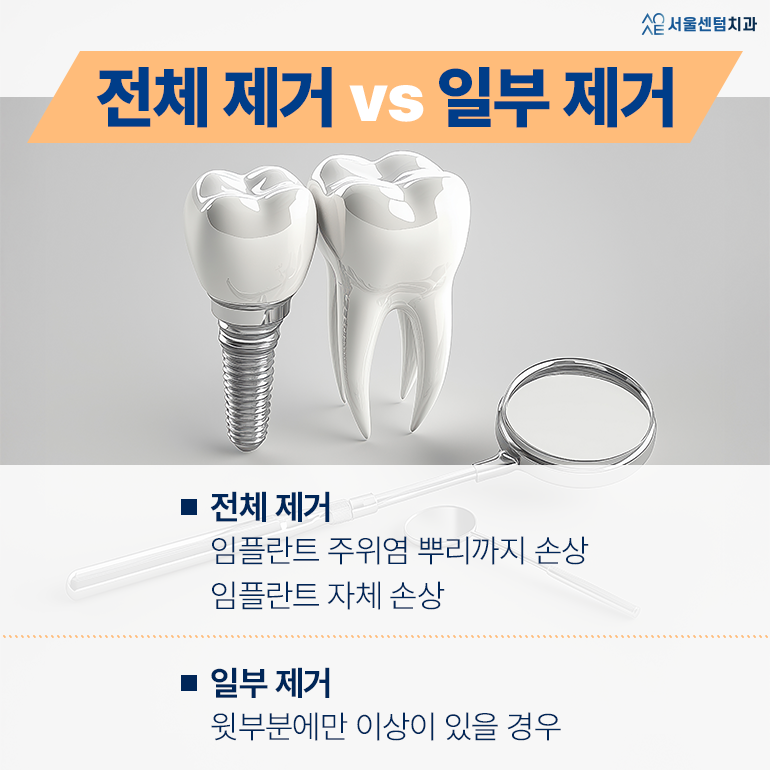
If peri-implantitis has spread uncontrollably rather than remaining in its early stage
and has damaged the area all the way to the root,
complete removal may be unavoidable.
Complete removal may also be the only option when the implant itself is damaged.
If you visit after the condition has been left untreated for a long time
and substantial bone loss has already occurred,
bone grafting may also be necessary.
Fortunately, in some cases, it is possible to remove only part of the implant
and replace it. This is when the problem is limited to the upper portion.
Compared with complete removal, this reduces the overall burden
in terms of both cost and treatment time.
Simple Removal vs. Surgical Removal
Another distinction is whether the implant can be removed simply
or whether surgery is unavoidable.
A simple case may involve mild loosening of the implant
or a loss of fixation.
This may be manageable with a simple procedure
when a problem occurs soon after placement.
Surgical removal is unavoidable when complete removal is required.
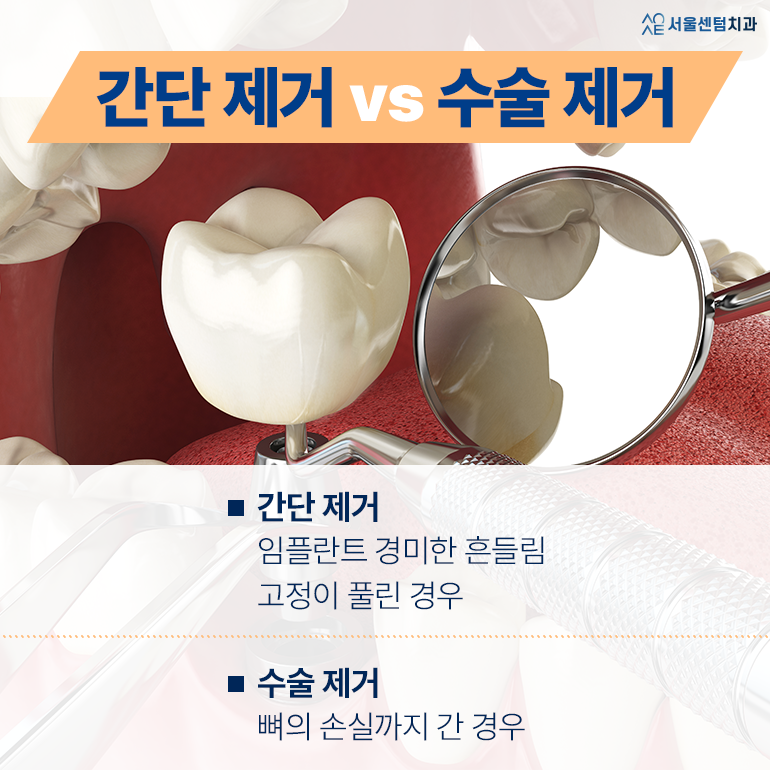
If the implant has already firmly fused with the bone
but inflammation has developed around it and caused bone loss,
it is difficult to avoid surgery.
In conclusion, if complete removal is necessary,
surgical removal may be required.
When bone damage has also occurred,
additional treatment may be necessary.
How Can I Use It for a Really Long Time?
Even if the implant itself is relatively inexpensive,
it is replacing a tooth that you would otherwise use for life,
so considering the price per implant alone,
it is difficult to regard it as inexpensive.
It is also a treatment that can place a considerable financial burden on patients.
If you maintain your oral health and use the implant for a long time,
you may be able to use it comfortably for 10 years or more.
Therefore, rather than focusing only on the price,
you should consider whether the clinic can place the implant properly
so that it can be used for a long time.
What should you do to use an implant for a long time
without needing to have it removed?

Do not assume that everything is fine just because you have had an implant placed.
Be sure to attend regular checkups as recommended.
Oral care is also essential.
The gums around an implant are naturally more vulnerable
than those around natural teeth.
You need to brush more carefully,
and thorough dental care using an oral irrigator or similar tool
is also necessary.
Smoking in particular greatly increases the likelihood of inflammation,
so quitting smoking is recommended.
If you already have diabetes or osteoporosis,
peri-implantitis and bone resorption may progress more quickly,
so careful management is important.
Do not forget that it is also important
not to put excessive force on the implant by eating very hard foods
or exposing it to impact.
Getting an implant is not the end of the process.
Because it is not a natural tooth,
you need to continue taking good care of it
if you want it to last a long time.
Rather than simply looking for the cheapest implant,
be sure to choose a dental clinic
that also provides thorough aftercare.

Foods to Eat After Getting an Implant!
Why Is There an Additional Charge When I Went to Get an Implant?