Why does gum recession happen during orthodontic treatment? Can it be prevented?
Before starting orthodontic treatment, one of the symptoms people vaguely fear is gum recession during orthodontic treatment.
There is the expectation that teeth can be aligned neatly, but at the same time, I think quite a few people feel a vague sense of fear.
If you look through many dental reviews, you can easily find comments like, “The teeth look straighter and I’m happy with that, but the roots seem longer,” or “My teeth seem more sensitive.”
Gum recession during orthodontic treatment does not happen to everyone.
Let’s take a detailed look at why gum recession occurs, what kinds of cases there are, and how to reduce the risk.
The start of gum recession
One thing that people who want orthodontic treatment but are worried about it often misunderstand is gum recession.
Many people think that gums will always recede if they get braces.
The truly important point about gum recession during orthodontic treatment is not the force used for orthodontics itself, but the moment that force exceeds the anatomical limits of each person’s gums and bone.

What are the individual differences?
First, the thickness of the gum bone
The front teeth and canines originally have thin bone.
They are very easy to push outward even with a small amount of force.
If excessive force is applied to this bony area, the thin alveolar bone surrounding the tooth roots can be resorbed, and in such cases the gums may recede.
Second, the direction in which the teeth move
In particular, you should pay attention to forward tipping movement.
If the front teeth spread forward, or if they are pulled back too forcefully in a short period of time to correct protrusion, the likelihood of gum recession increases.
Third, naturally vulnerable cases
The thickness of the gums people are born with differs from person to person, and if the gums are thin or the root shape is pointed or flat, the gums can collapse more easily.
In the end, even if someone else receives the same force in the same area during orthodontic treatment, gum recession may or may not occur.
The intersection with lifestyle habits
Orthodontic force alone cannot be said to be the only cause of gum recession.
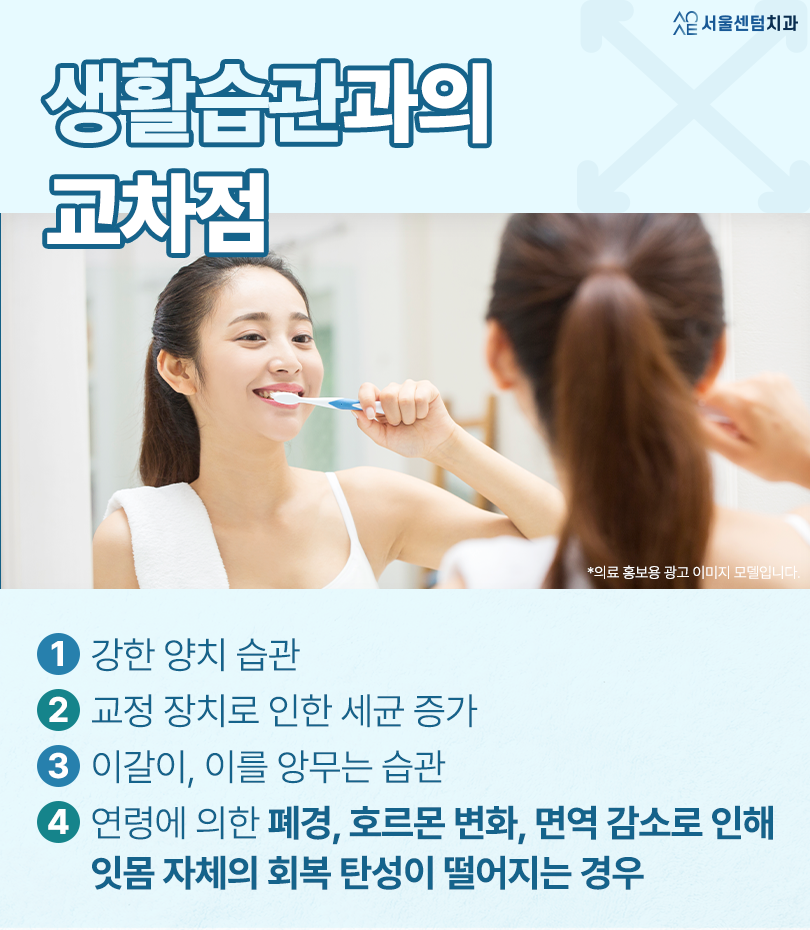
That is because lifestyle habits can act as a variable whether you are in orthodontic treatment or not.
First, a strong brushing habit
If you scrub the root area of the teeth vigorously, it can strongly irritate the gums and make them even thinner.
Second, increased bacteria due to orthodontic appliances
You may have heard that you need to brush even better when you have orthodontic treatment.
Food particles can get trapped between the appliances, which can increase bacteria.
If this is not managed properly, inflammation can develop and can lead to weakening of gum thickness.
Third, teeth grinding and clenching
Teeth grinding can affect dental health even when you are not having orthodontic treatment, and it can have an even greater effect during treatment. It can shake the tooth roots and cause gum recession.
There may also be individual hormonal changes. In patients in their 40s to 60s and older, changes in the gums may be more noticeable.
This can happen because menopause, hormonal changes, and reduced immunity can lower the gums’ ability to recover and their elasticity.
Actual gum recession and response
The symptoms people mention during orthodontic treatment vary in many ways.

Along with that, let’s carefully check how treatment is handled at Seoul Centum Dental Clinic.
Some people say that the tooth roots seem to be exposed, and many say that the teeth seem to have become longer.
Some people also say that their teeth feel sensitive or that they feel pain in the gums.
There are many different symptoms people report.
At such times, there are several possible approaches.
One method is to slowly adjust the orthodontic force over time and move the teeth more gradually.
By reducing the amount of force, you can prevent damage to the tooth roots while also giving the gums time to recover.
Orthodontic treatment is not something that is better just because it is done quickly; ultimately, it is a treatment that must preserve the health of both the teeth and the gums.
If you feel pain in the gums or tooth sensitivity, there is a method of recovery through inflammation management and scaling after orthodontic treatment is completed.
The principles of healthy orthodontic treatment
As we talk about gum recession, some people may already feel frightened.

However, if treatment is done at the right clinic, I can say it is not something you need to worry about.
First core principle: Before orthodontic treatment, an accurate analysis is essential.
Each person’s gum bone thickness is different, and the position of the tooth roots is also different, so if these are carefully checked before starting treatment, it can proceed without problems.
Even during orthodontic treatment, applying too much force does not shorten the treatment period.
Rather, small but strong, continuous force allows the teeth to move more stably.
Movement that continuously considers the bite is also important.
It is important to move the teeth so that the bite can remain as balanced as possible during treatment.
In particular, there are quite a few cases in which people in their 40s and older choose orthodontic treatment, and at that time it is important to carefully check the condition of the gums before proceeding.
It is also very important to have the dentist check things carefully during treatment and to plan the treatment process well, but it is equally important for the patient to return home and take good care of their teeth.
Using dental floss, interdental brushes, and water flossers, and not neglecting oral care, is very important.
In the end, gum recession during orthodontic treatment does not mean that orthodontics is bad or harmful. Rather, it can occur when orthodontic treatment pushes past the limits of an individual’s gums.
If treatment can be carried out at a clinic that avoids crossing that line, orthodontic treatment can be completed without problems.
The single most important criterion
The standard is whether the change is within what my gums can tolerate.
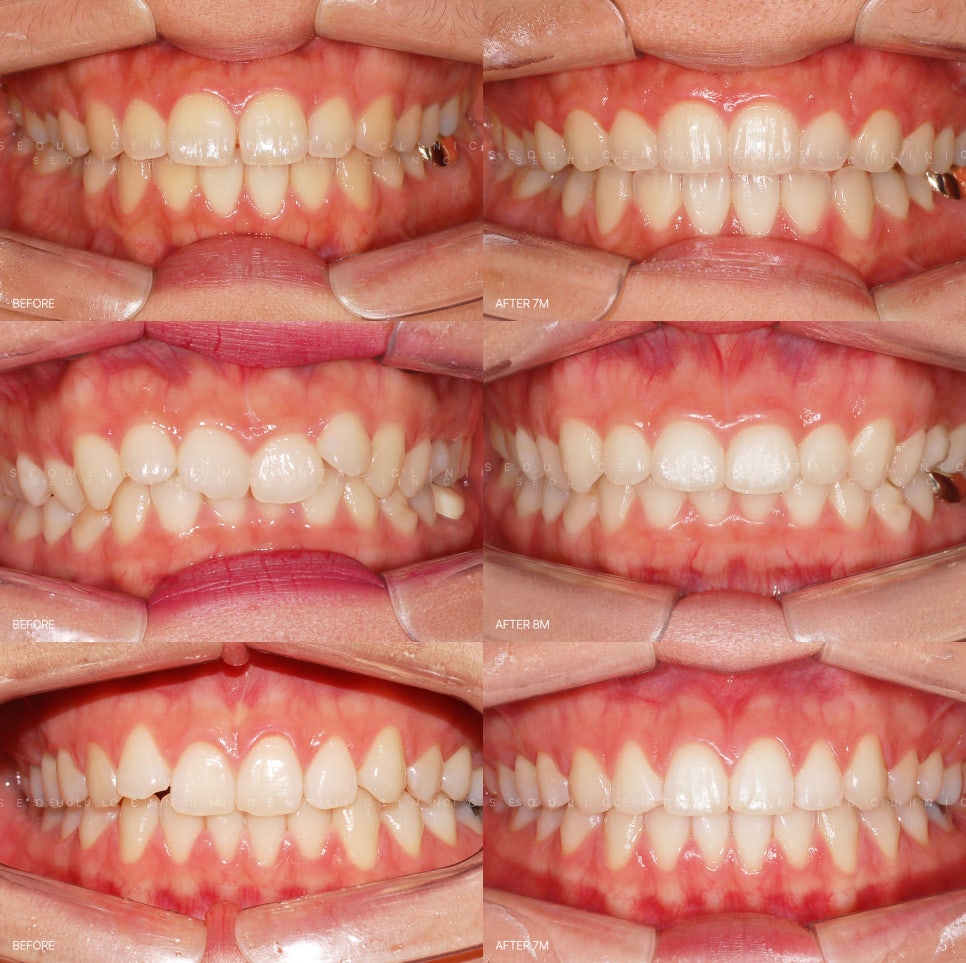
Orthodontics is a treatment that can determine your facial impression and chewing function for life.
That is because it is not acceptable for the teeth to become straight if another problem arises.
If you are considering orthodontic treatment, or if you are already in treatment and worried about your gums, it is important to check your condition in the middle of treatment as well.
Seoul Centum Dental Clinic has orthodontic specialists, and through precise analysis they create orthodontic treatment plans that consider not only each person’s teeth but also the condition of the gums.

If you are worried about gum recession during orthodontic treatment, we hope you will receive a precise, personalized consultation and then decide.
Conditions for same-day wisdom tooth extraction?
Summary based on implant price comparison sites