When a dentist suddenly tells you to get root canal treatment, a crown, or similar procedures, many people feel uncomfortable about it.
Hello,
This is Seoul Centum Dental Clinic.
Since many people already feel some degree of reluctance about dental treatment itself,
there are many cases where they wonder whether the treatment is really necessary.

Today, this is a case where an actual patient came in with an X-ray
and asked a question.
Let’s take a look at today’s story.
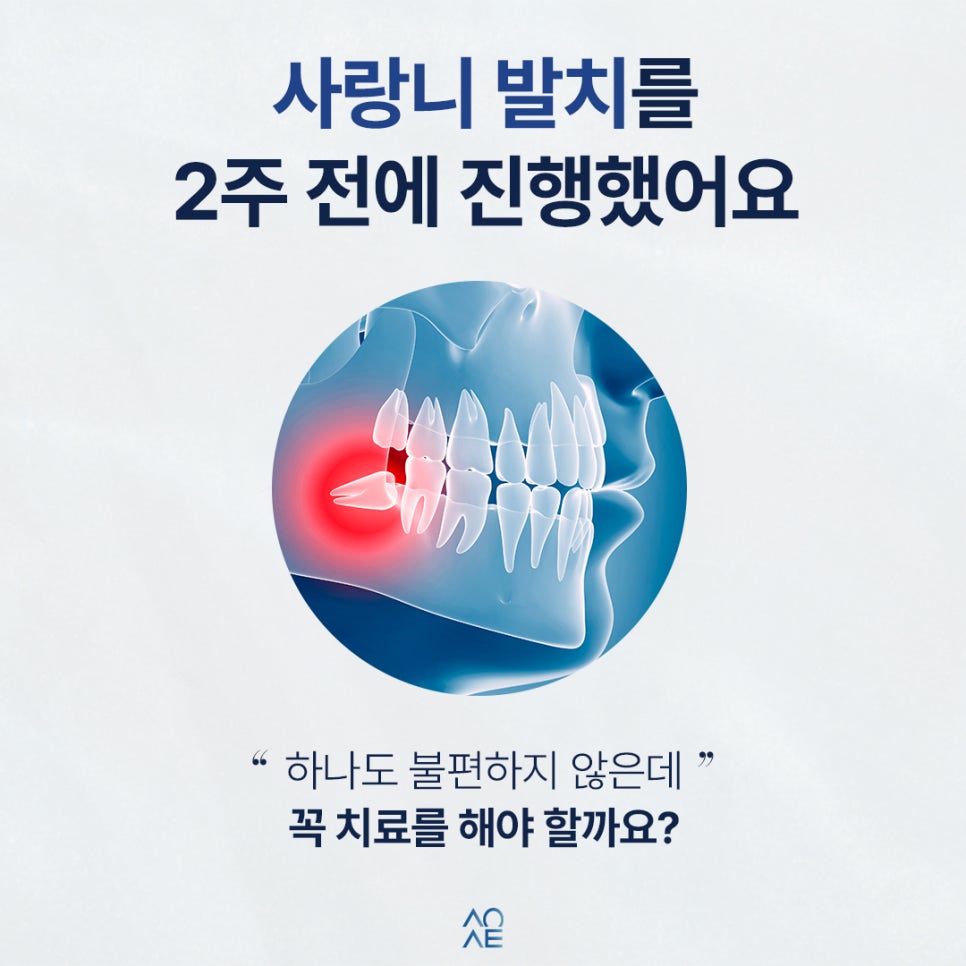
I had my wisdom tooth extracted two weeks ago.
When wisdom teeth are extracted, cases like this
often happen.
In today’s story, the wisdom tooth was lying sideways,
so it commonly caused decay in the adjacent molar.
This time as well, after the extraction, decay was found on the side of the molar.
Looking at the X-ray, the patient showed a picture
where part of the molar had turned gray.
However, the patient was not feeling any pain or discomfort at all.
Even while eating, they did not feel any discomfort,
so they came in worried after hearing from another dental clinic that they might even need an implant.
Honestly, when we look only at the X-ray,
we usually tell patients which teeth definitely need treatment and which ones do not,
but in this X-ray, the affected area was quite large.
So, based on the X-ray alone, it would not have been strange at all
to hear a suggestion to extract the tooth.
Because the wisdom tooth had been lying sideways
and had been pressing on the side of the molar in front of it for a long time,
the location of the decay makes treatment very difficult,
and the root canal treatment itself is also classified as a high-difficulty case.
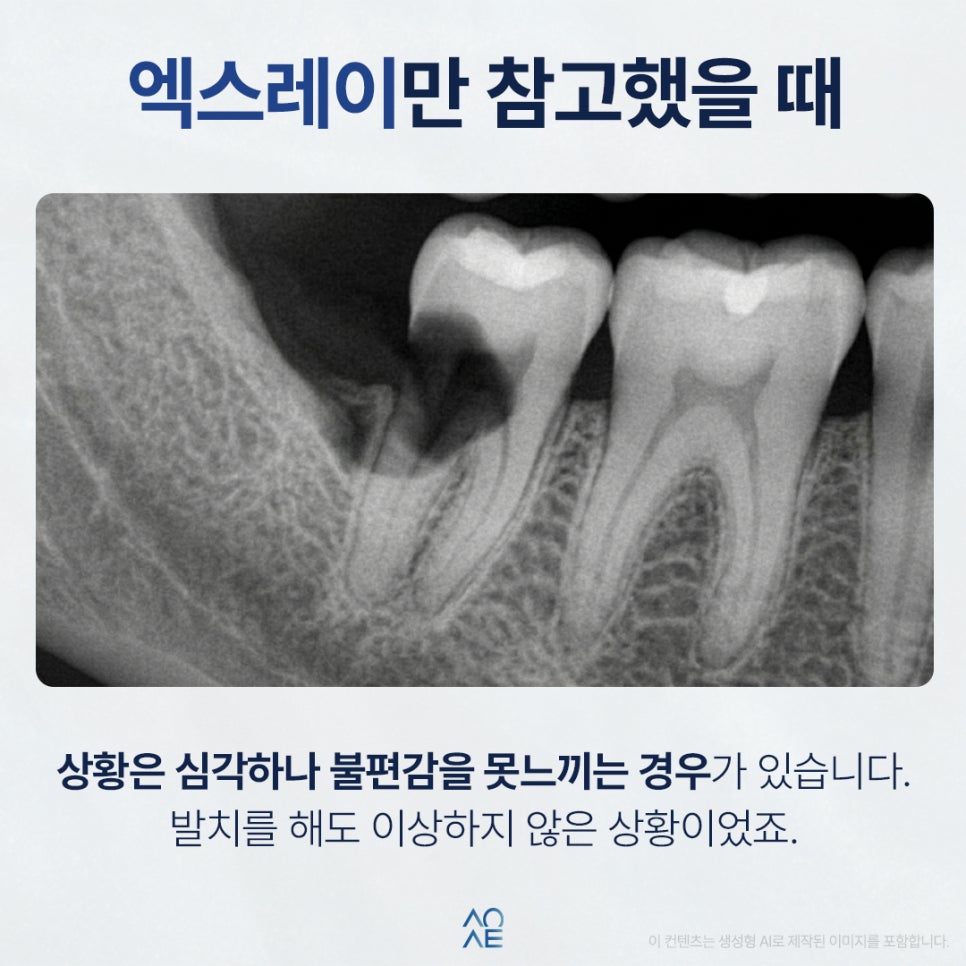
This area is especially difficult because the decay is not easily visible from the outside,
and there are almost no symptoms,
so it is often discovered only after an X-ray is taken by chance.
The root canal process can also be difficult,
and for the patient, the process of eventually moving on to crown restoration can feel quite burdensome.
Even so, if the first clinic that saw the patient suggested root canal treatment,
I think it was because the doctor was trying to save the natural tooth somehow.

These days, if a tooth is treated and only marginally preserved,
but it seems likely to end up needing an implant anyway,
it is not uncommon to simply extract the tooth and place an implant afterward.
Considering that, this can be seen as a case where a conservative approach
was considered in order to preserve the natural tooth.
There are always variables: the patient’s age and how long the tooth will need to be used.
In fact, the factor that makes treatment decisions the most difficult here
can be the patient’s age.
If the patient is still relatively young,
even if root canal treatment is not easy in this situation,
it may still be worth trying to save the tooth.

Implants are very good these days,
and if the clinician is skilled, there is usually not a major problem,
but unlike a natural tooth, the lifespan can vary depending on future care.
Because the time needed for maintenance is longer,
there is more reason to consider treatment that tries to preserve the natural tooth.
On the other hand, if the patient is already older,
there is also the burden of the treatment process itself.
If the chance of saving the natural tooth is low even after treatment because of the prognosis,
then extraction followed by an implant can be the more realistic choice.
Rather than saying one treatment is definitively right or wrong,
this is closer to a matter of situation and priority.
Root canal treatment and a crown,
or extraction and an implant,
is not a situation where it is easy to simply judge one as right and the other as wrong.
In the end, the question is whether you want to make every effort to save the tooth,
or whether you want to reduce the burden of treatment.

The patient’s age group can also be a key point in the decision.
In this case, it is naturally a confusing situation,
so I recommend thinking it through once and choosing the right dental clinic
according to your situation and age.
I imagine many people worry about this kind of decision because of wisdom teeth
and end up visiting several dental clinics, so I brought up a real concern.
I hope today’s story helped you with your decision,
and I will end this post here.
If you were born without a permanent tooth,
what happens if you chew only on one side?