Hello, I’m Kim Min-young, a specialist in conservative dentistry.
TV celebrities or influencers often have neatly aligned teeth.
And they look white and bright.
Some people consider veneers to achieve a similar look,
but if you do not want to modify the alignment or shape of your teeth,
you can apply treatment in a way that improves only yellowed teeth rather than prosthetics.
Even just improving the color can create a much brighter impression,
and today, I’d like to share information about one of the aesthetic treatments,
one-day teeth whitening, at Seonyudo Dental Clinic.
This post is written to provide objective information,
and I would like to note that all images used in the main text were generated by AI.
1. Am I also someone with yellow teeth?
Perhaps many of you already know why teeth become yellow.
Still, let me explain it in a little more detail.
The reasons natural teeth become discolored can be broadly divided into two categories.
One is extrinsic discoloration, which most people are familiar with.
This happens when pigments in foods such as coffee or curry darken only the outer surface.
In such cases, one-day teeth whitening can be used to restore the original color.
The other cause, intrinsic discoloration,
occurs when the color darkens due to factors inside the natural tooth,
so if the cause is properly identified and improvement is possible,
non-vital tooth whitening can help restore the tooth’s natural color.
Today at Seonyudo Dental Clinic, I will focus on treatment methods that can improve extrinsic staining.
First, let me share how to check whether your teeth are actually yellow.
When applying makeup, you choose foundation to match your skin tone.
There are standard shades such as 21 or 23 so you can check your skin color.
The shade of natural teeth also has standards that can be quantified in the same way.
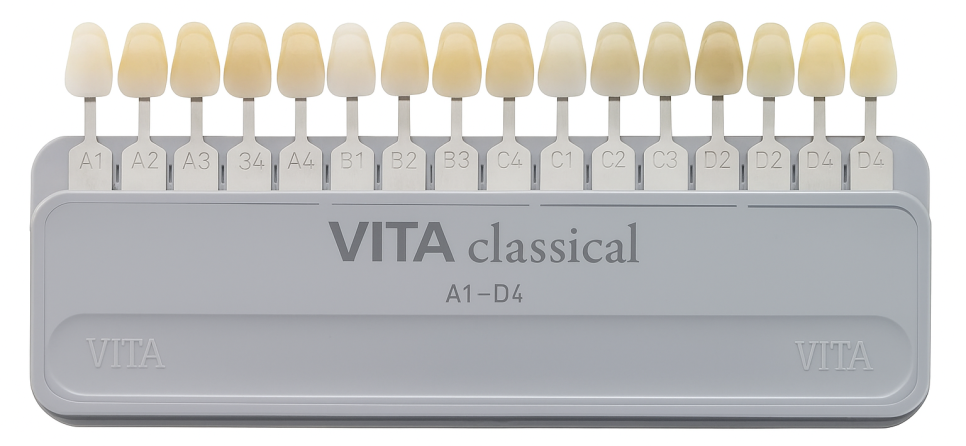
Something like the example photo prepared by Seonyudo Dental Clinic is called a shade guide,
and I will briefly explain how it is classified.
It is based on the internationally used VITA system,
and consists of four hue groups, A to D, and lightness levels from 1 to 4.
A: reddish-brown series
B: yellow series
C: gray series
D: reddish-gray series
In the case of the letters written on the shade guide, they indicate that the shades are divided as above,
and the numbers next to them mean that the smaller the number,
the brighter the lightness.
Thanks to this systematic classification,
both patients and medical staff during treatment can
clearly understand the current condition,
and it can help objectively compare before and after.
Usually, when it is judged as A1, it is considered bright,
and A2 is typically, and A3 somewhat dark.
Please note that this is a general guideline and there may be slight differences depending on skin tone.
If the shade-taking result shows yellowing due to extrinsic staining,
one-day teeth whitening can be tried.
2. What is the treatment process?
Let me explain in detail what the process is at Seonyudo Dental Clinic.
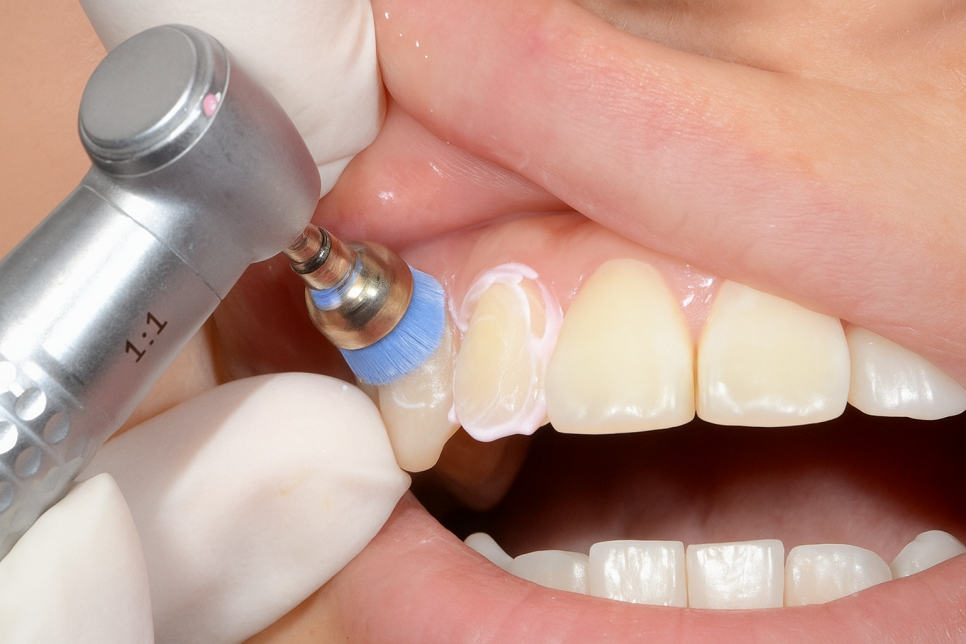
First, to allow the agent to be absorbed evenly,
we remove deposits on the surface.
If there is calculus, scaling is performed,
and if there is only plaque, tooth cleaning is carried out using a brush and abrasive.
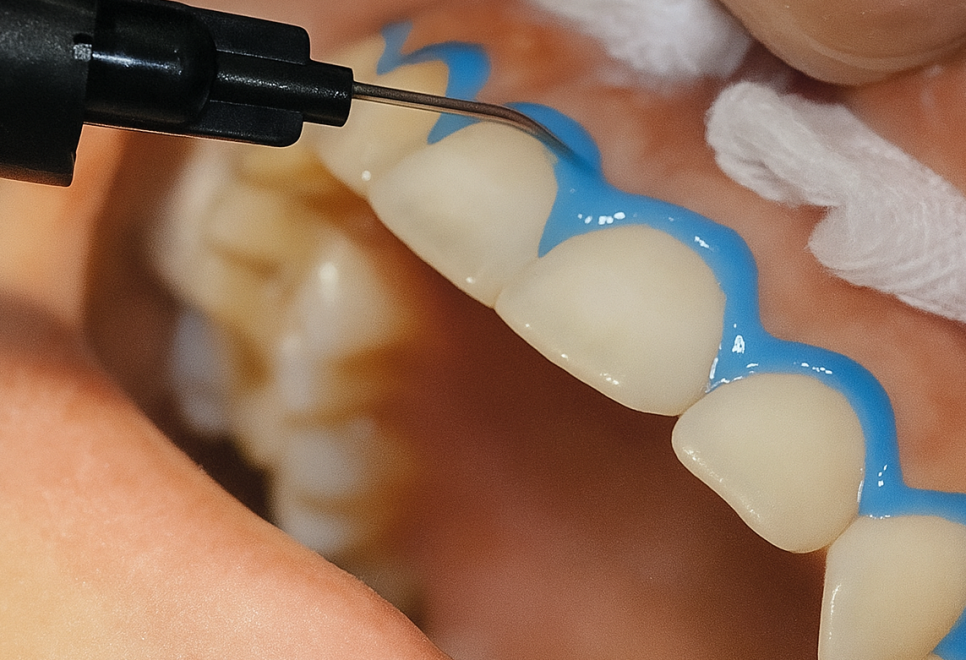
After that, a resin called a dam is built up to protect the gums.
The blue material in the photo is the dam,
and it is a step taken in advance to protect against sensitive reactions
caused by [hydrogen peroxide], the main ingredient of the agent.
A careful cover must be applied so that symptoms such as tooth sensitivity or hypersensitivity do not occur.
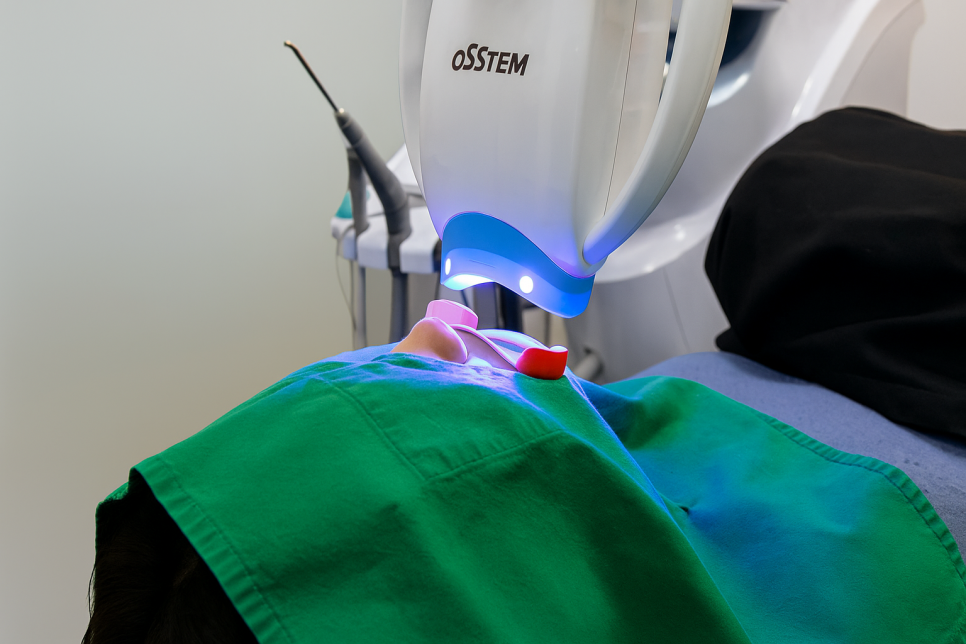
After that, the agent is applied and a light irradiator is used for about 15 minutes.
Usually, when performing one-day teeth whitening,
this process is repeated two or three times.
The number of times varies from person to person,
as it is determined by evaluating how much the tooth has returned to its natural color.
In addition, if it is judged that it is difficult to finish in one day,
additional retouching sessions may be performed several times.
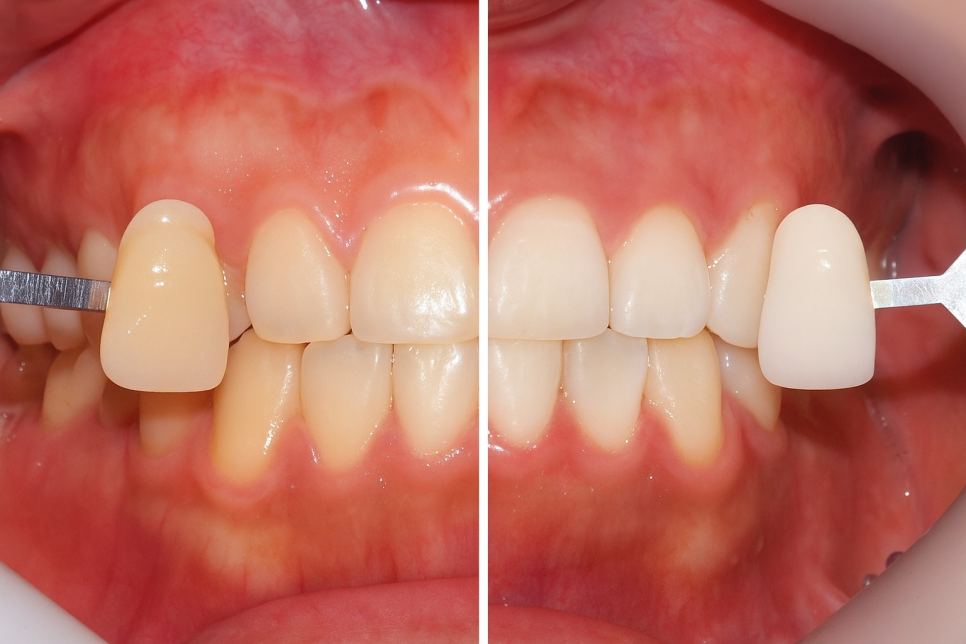
After a series of steps, the parts that looked like yellow teeth become brighter.
The factors that caused staining on the tooth surface are removed,
restoring the original color.
So if you are hoping for an overly bright shade, you should keep in mind that
one-day teeth whitening alone makes it difficult to achieve a very bright tone.
3. What precautions should be kept in mind?
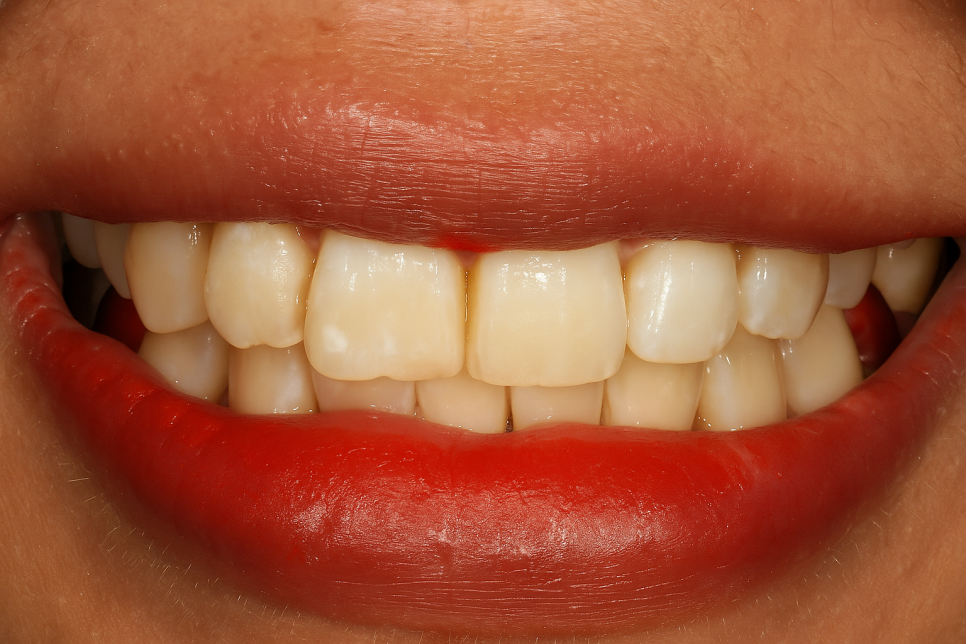
Even if tooth cleaning has been performed so the agent can be absorbed evenly,
white blotches may appear in areas where it is better absorbed and takes effect.
Usually, as you eat or go about daily life, they gradually discolor again and look natural.
In other words, it is a temporary symptom,
so there is no need to worry too much.
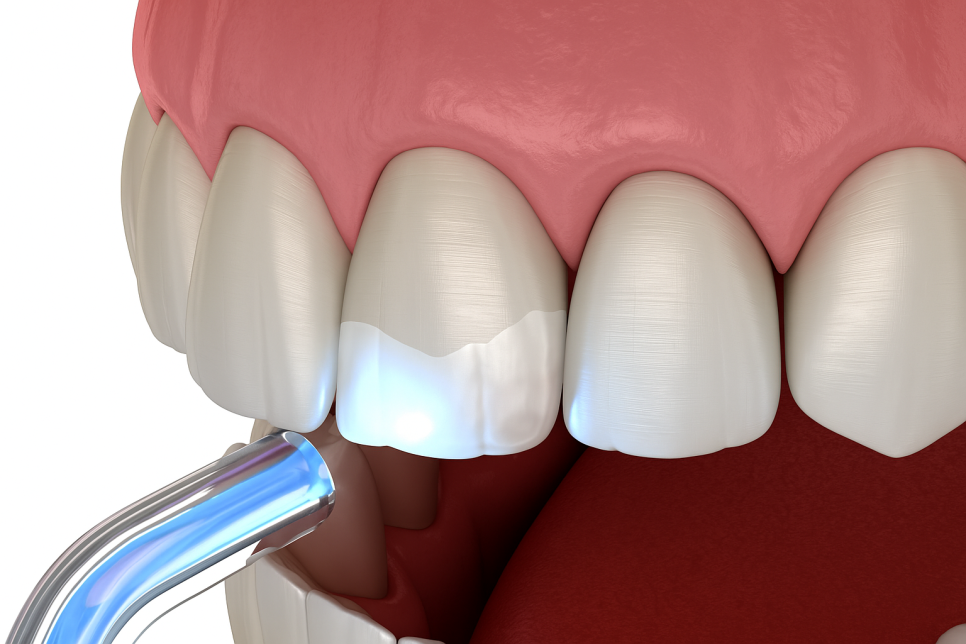
The agent reacts only to natural teeth, so if prosthetics or resin restorations have been done,
those areas will not become brighter,
which may create a slight color difference in those parts.
In addition, sensitive reactions such as tooth sensitivity may appear temporarily,
but in most cases the symptoms improve within a few days,
and if you drink coffee or eat curry right away,
your teeth may become yellow again.
Also, since this is not a permanent treatment, retouching may be necessary.
Typically, retouching is performed every 6 to 12 months.
Today at Seonyudo Dental Clinic, I shared information about ways to improve yellowed teeth.
As interest in aesthetic treatment increases, demand has also risen.
As a result, treatments such as veneers and whitening tend to spread like trends,
but because they are directly related to oral health, the most important thing is to check whether the treatment is suitable for you.
I hope my post was helpful,
and I will end here.
This has been Kim Min-young, a specialist in conservative dentistry at Seonyudo Dental Clinic. Thank you.