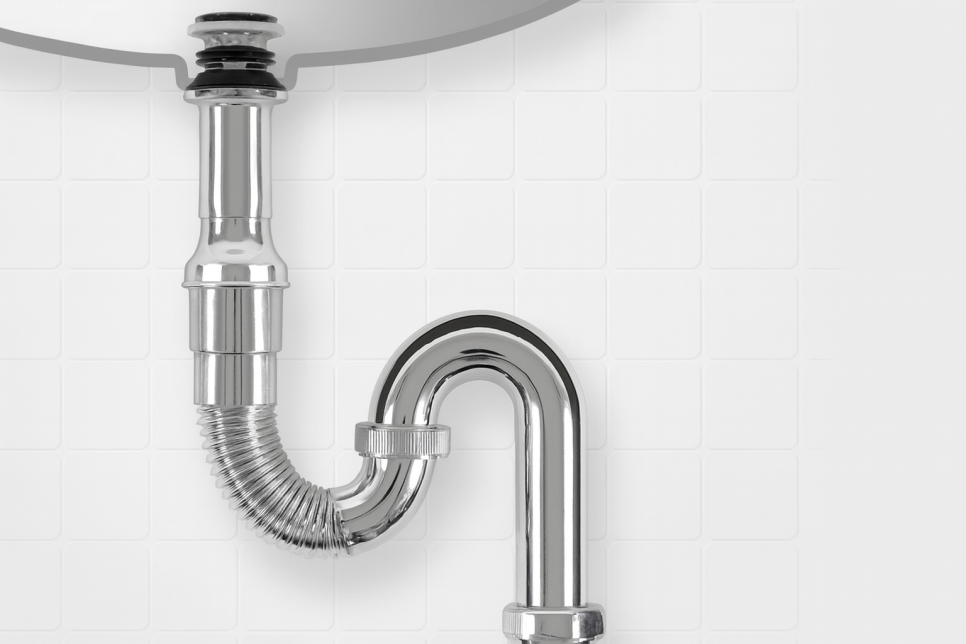
If you take a close look at the pipes under a sink,
there is a curved section.
Hair and many other foreign substances can build up and get stuck there,
making it difficult for water to drain properly.
The reason this kind of inconvenience happens so often is because the pipe
has a curved shape.
Today, I’d like to talk about this characteristic in relation to a worn [C-shaped root canal].
As the name suggests, this refers to a unique form of nerve canal in which the tooth root does not extend straight,
but bends toward the end and looks like a C shape.
Because of this feature, it can interfere with endodontic treatment
and the preservation of the natural tooth.
At Dangsan-dong Dental Clinic, we will take a close look at why a C shape makes root canal treatment more difficult.
- C-shaped root canal system
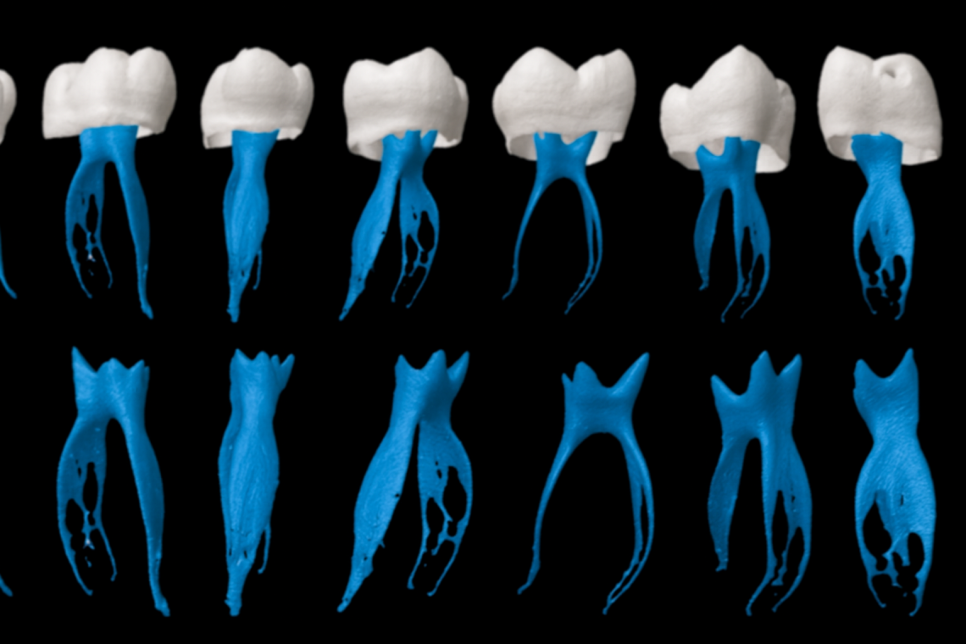
Root canals come in many different forms.
You can see their variety at a glance from the photo prepared by Dangsan-dong Dental Clinic, right?
In most cases, the root extends straight out,
but in cases where it is curved in a C shape,
because the pulp tissues are intertwined, the step of thoroughly disinfecting the infected area becomes difficult.
The roots need to be properly separated on the buccal or lingual side,
and possible causes include fusion so that they appear as one, cementum deposition, or failure of fusion of the epithelial root sheath.
As a result, it takes on a structure connected in a 'C' shape,
and its form changes frequently depending on the location.
So when viewed in cross-section, a variety of shapes can be seen,
such as a C shape, ribbon shape, or tubular shape.
It has been reported to occur especially in 21.5% of Asians and 2.7% of Western populations,
and is known to occur most often in the mandibular second molar.
A C-shaped root canal does not automatically cause problems.
It is simply a structural variation in the tooth,
and does not lead to any particular issues in daily life.
However, because root canal treatment is more difficult and the recurrence rate is high,
it can interfere with preserving the natural tooth,
which is why it often increases the chance of extraction.
- Why does treatment become more difficult?
In general, during root canal treatment,
the success rate depends on how well [infection is eliminated].
Because the anatomy is very complex, there is a high risk that bacteria may re-enter later and cause reinfection,
so the nerve canals must be thoroughly explored from the beginning to avoid missing any parts,
but C-shaped root canals are not easy to explore in the first place.
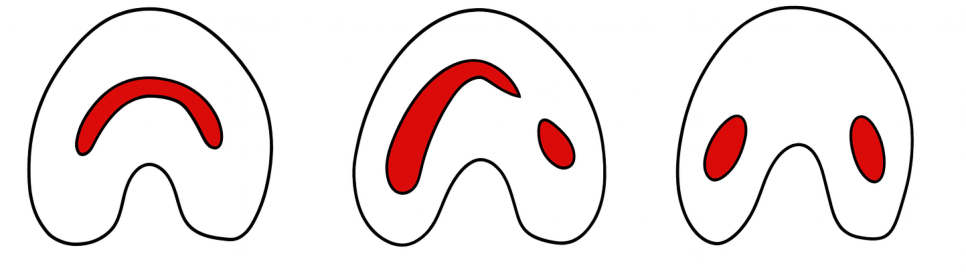
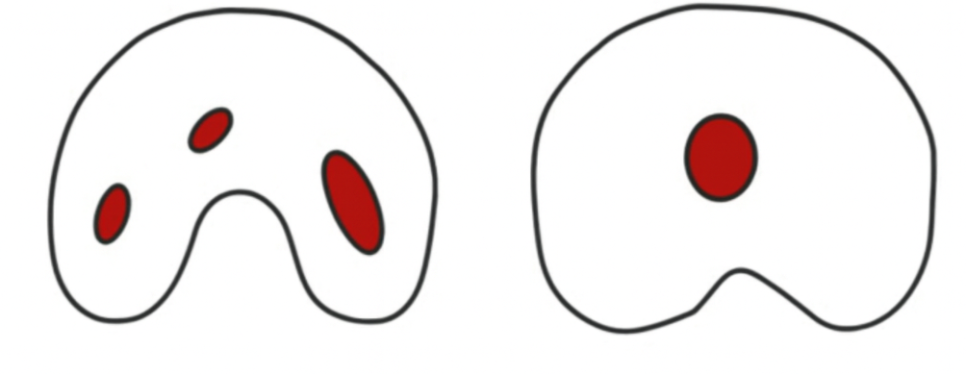
As in the photos prepared by Dangsan-dong Dental Clinic,
because the canals are connected or spread out widely,
it is difficult even to find the opening.
In addition, the dentin inside the root may be thin
or formed in a very flat shape,
which creates areas that instruments cannot reach.
Naturally, this makes the disinfection process difficult.
So what should be done?
Because of the structural characteristics of C-shaped root canals, the treatment success rate is low
and the possibility of recurrence is high, but that does not mean extraction is always necessary.
By understanding the inside through diagnostic data and proceeding carefully,
it is possible to overcome some of the structural limitations.
At this stage, Dangsan-dong Dental Clinic will explain
which points should be noted.
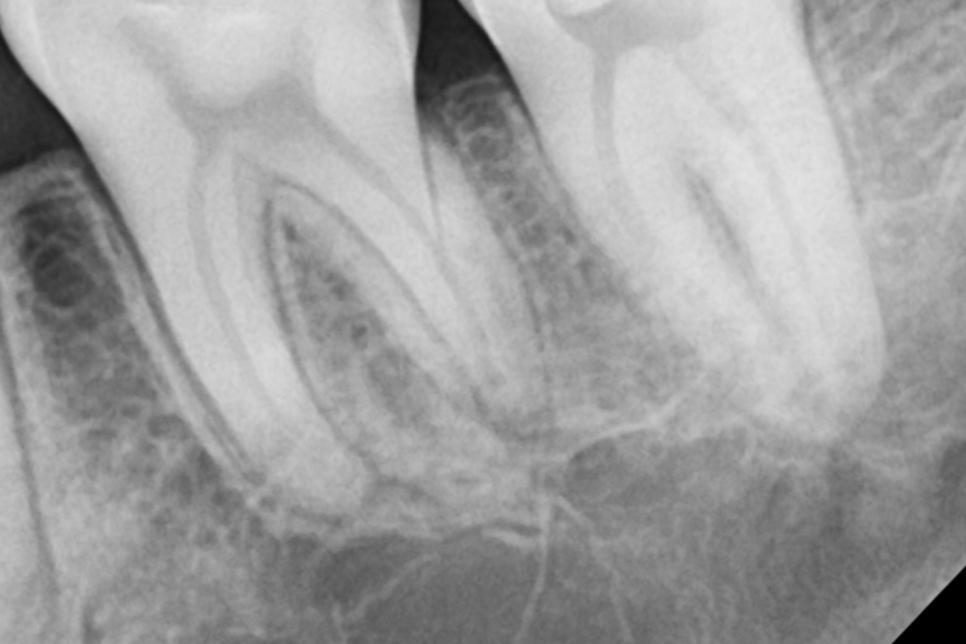
Of the two teeth shown in the photo prepared by Dangsan-dong Dental Clinic,
one has a C-shaped root canal.
From this image alone, it is difficult to determine.
Only by carefully examining the inside with three-dimensional data can we identify
where it curves, whether it is interrupted like a semicolon (;),
what the shape of the pulp chamber floor is, and where the orifice is,
allowing us to understand many factors in advance before beginning treatment.
After carefully identifying the tooth structure,
we focus on finding the nerve using instruments such as explorers or files.
At this time, if the opening is widened too forcefully, perforation may occur.
This is especially risky when the dentin is thin.
Because the internal anatomy is extremely delicate,
using a microscope in this process allows for more detailed and precise work.
After the opening is found, the interior is disinfected.
As mentioned earlier, there may be areas that are difficult for instruments to reach,
so during the filing process, various methods are used to ensure that the disinfecting solution can reach deeply.
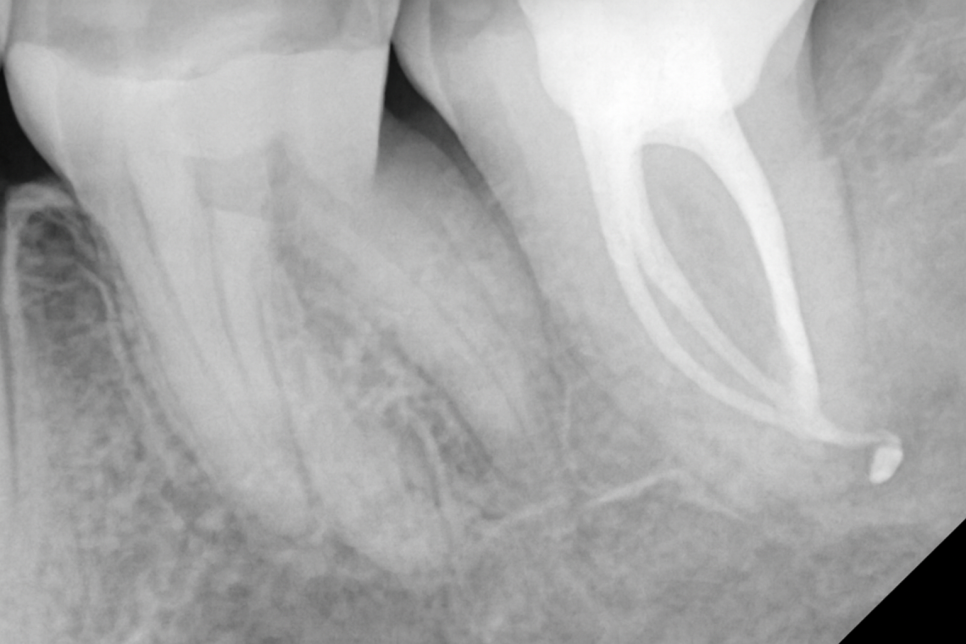
If signs of infection resolution are observed afterward,
as in the example photo prepared by Dangsan-dong Dental Clinic,
the inside is filled with biocompatible material,
and even at this stage, careful attention is needed.
Because a good seal reduces the risk of bacterial reinfection later,
the focus is on achieving an airtight seal using filling material.
It is true that due to anatomical structure,
there are limitations in treating C-shaped root canals,
but that does not mean preserving the natural tooth is always difficult
or that treatment necessarily ends in extraction.
To create a positive prognosis,
if the complex internal anatomy is understood and thoroughly prepared for,
even the limitations of anatomy can be overcome.
For this process to proceed smoothly,
I personally think that 'choosing the medical team' is important.
You should check whether they have previously treated similar cases
and whether they are a specialist in conservative dentistry,
because that is what allows them to provide a more professional treatment process.
That concludes the information prepared today by Dangsan-dong Dental Clinic.
I hope this has been helpful, and I’ll end the post here.
This was Kim Min-young. Thank you.