Hello,
I am Kim Min-young, a restorative dentistry specialist at a dental clinic in Dangsan-dong.
When you choose toothpaste,
what criteria do you use?
I always choose one that contains a large amount of fluoride
for cavity prevention,
and when I go to Olive Young or a supermarket,
a lot of people seem to choose the toothpaste that advertises,
"We brighten yellow teeth."
However, when you actually look up reviews,
there are many comments saying that the effectiveness is not clear
and that it does not brighten as much as hoped.
The reason is not so much the product itself,
but the low concentration of the key ingredient.
Let me explain this in detail
at the Dangsan-dong dental clinic.
Do you know Oxiclean?
It is famous as a laundry detergent that makes stained white clothes white again
with oxygen bubbles.
In a similar principle, the key ingredient, hydrogen peroxide,
removes the staining substances on the surface of the teeth,
allowing them to regain their original color.
That is the principle of whitening.
However, because toothpaste is classified as a quasi-drug,
the concentration of hydrogen peroxide, the key ingredient,
is regulated to a certain extent.
Because it is a product made for hygiene management
or disease prevention,
it is regulated at 3%.
On the other hand, products used for one-day whitening at clinics or hospitals
are medicines, so they are regulated at 15%.
Because the amount containing the key ingredient is different,
the effectiveness is bound to differ as well.
I will explain at the Dangsan-dong dental clinic
how improvement can be achieved through one-day whitening.
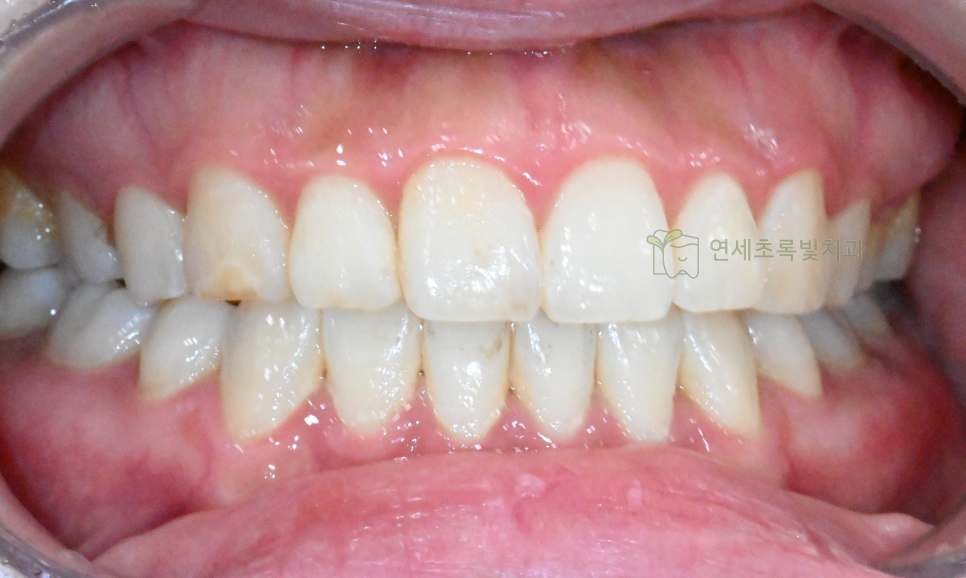
The original tooth color was not particularly yellow,
but blotchy staining could be seen in places.
Because the tooth color was not uniform,
the appearance was being compromised.
The reason for this discoloration is extrinsic staining.
The outermost layer, enamel,
was stained by curry, coffee, and similar substances,
which caused the color to turn yellow like this.
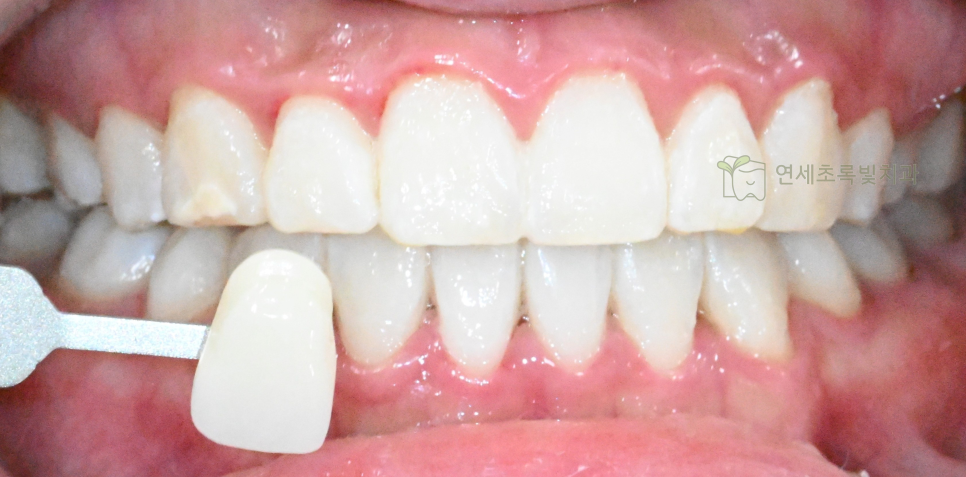
In such cases, going through one-day whitening
restores the original color and brightens the teeth.
The areas that had become yellow in spots brightened,
and after applying the treatment three times,
we were able to restore the A1 shade.
Let me show you another example prepared by the Dangsan-dong dental clinic.
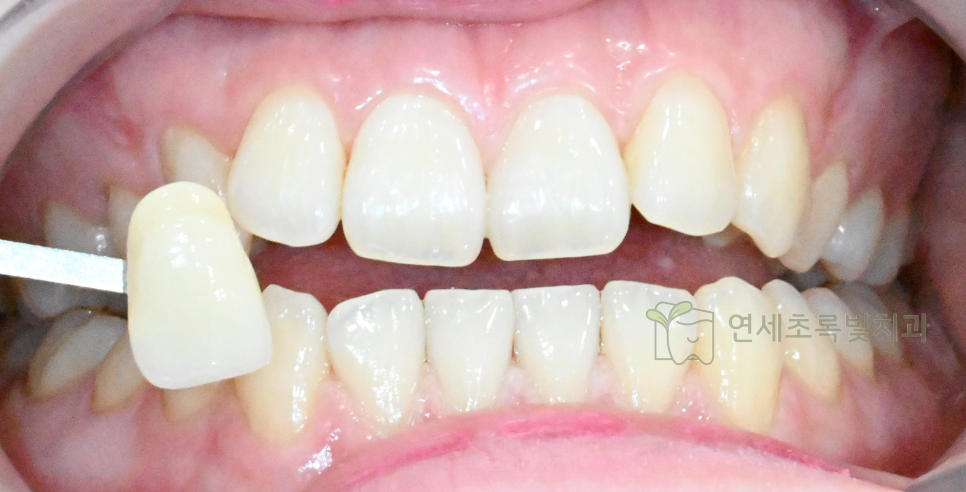
This case also has a slightly yellowish
discolored appearance.
Just as skin tone differs from person to person,
and cosmetics are categorized by numbers such as shade 17 and 21
to help with selection,
tooth color also varies, so saturation and brightness
are categorized using letters and numbers.
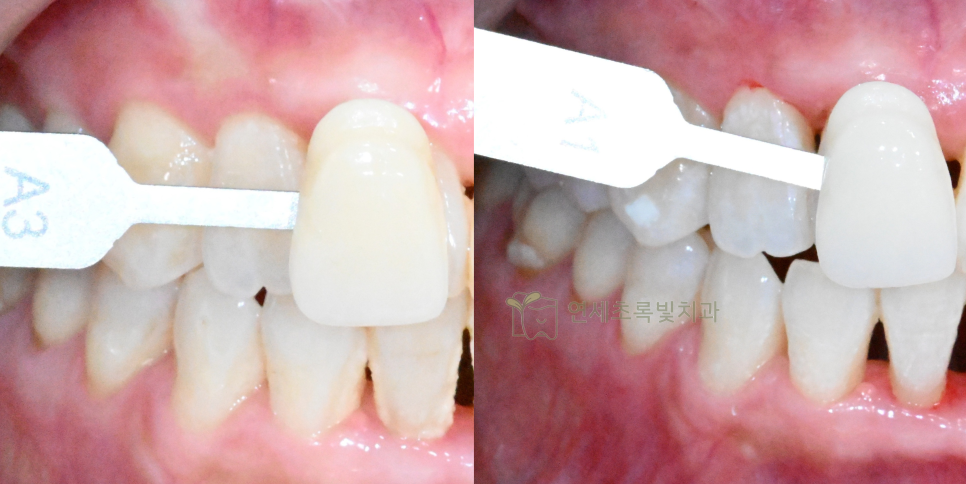
This example case was measured as A2
before one-day whitening.
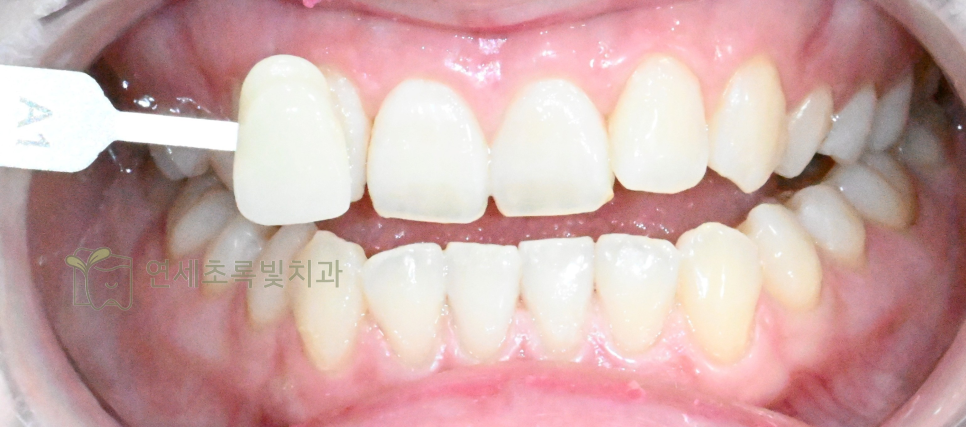
As a result of applying the whitening agent three times,
it brightened to A1.
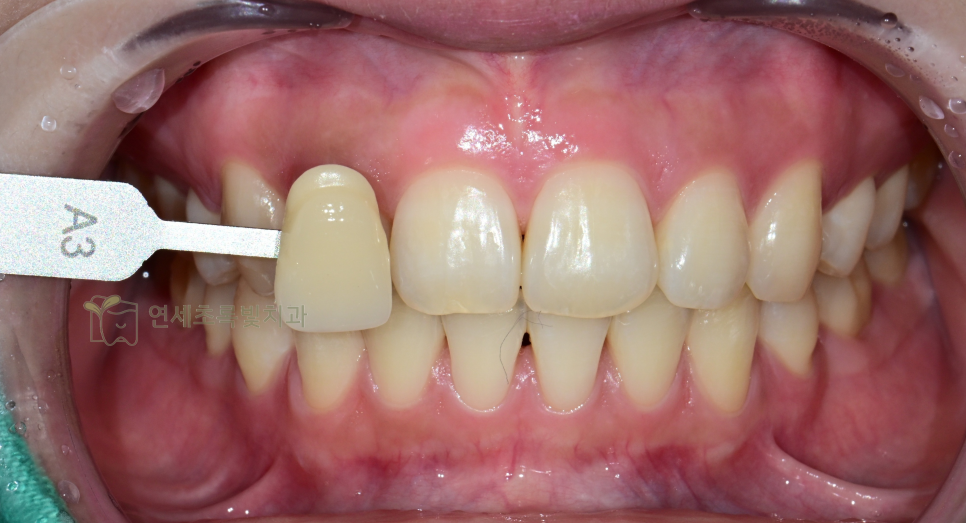
This case also has a somewhat darker tone,
measured as A3.
Through one-day whitening,
it regained a bright, original color as A1.
It is even darker, with an A3 shade,
compared to the example case shown earlier at the Dangsan-dong dental clinic.
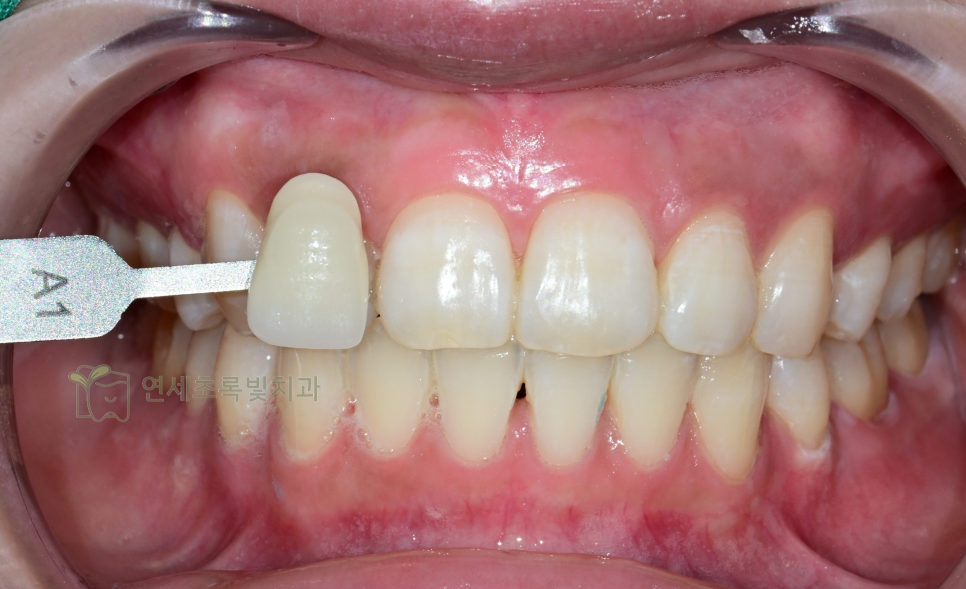
By applying the treatment three times,
we were able to restore the color to the bright A1 shade.
The before-and-after difference is very clear, right?
The hydrogen peroxide, the key ingredient in the treatment,
was sufficiently absorbed,
so the staining substances were removed,
which made such good results possible.
I heard that the sensitivity is severe..
Because hydrogen peroxide has strong oxidizing power,
if it touches the gums or soft tissues,
tooth sensitivity or pain may occur.
So before the procedure, the area is sufficiently isolated
with resin (Dam), and then whitening is performed,
and after it is finished, tooth sensitivity may
feel severe temporarily,
but
within a few days, the sensitivity symptoms
naturally subside.
In addition, after tooth whitening, there is a concern
that the teeth may discolor again when they come into contact
with pigmented substances such as coffee, cigarettes, or curry.
Therefore, it is necessary to check the condition regularly
and continue to receive touch-up treatments.
Today at the Dangsan-dong dental clinic, we explained why whitening toothpaste
is not noticeably effective,
and what changes can be made through a professional procedure.
I hope this was helpful to those who had questions about it,
and I will end the post here.
This has been Kim Min-young, a restorative dentistry specialist.
Thank you.